Why are you settling for a 39-year return on your capital when the tax code allows you to reclaim that value in a single year? Most property owners feel the weight of high tax bills while their cash remains trapped in the rigid, long-term depreciation schedules of their physical assets. You understand that your building is a vehicle for wealth, yet standard accounting methods often treat it like a static liability that drains your current liquidity. Learning how to accelerate depreciation on commercial property is no longer just an accounting preference; it’s a strategic necessity in 2026.
We promise to show you how to unlock significant cash flow by transforming traditional depreciation into immediate tax savings through rigorous, engineering-based cost segregation. With the “One Big Beautiful Bill Act” making 100% bonus depreciation permanent, the opportunity to optimize your portfolio has never been greater. This guide previews the technical reclassification process, the impact of current Section 179 limits, and how to build a defensible tax strategy that survives IRS scrutiny while maximizing your bottom line today.
Key Takeaways
- Move beyond the static 39-year depreciation schedule to unlock capital that is currently trapped in your building’s structure.
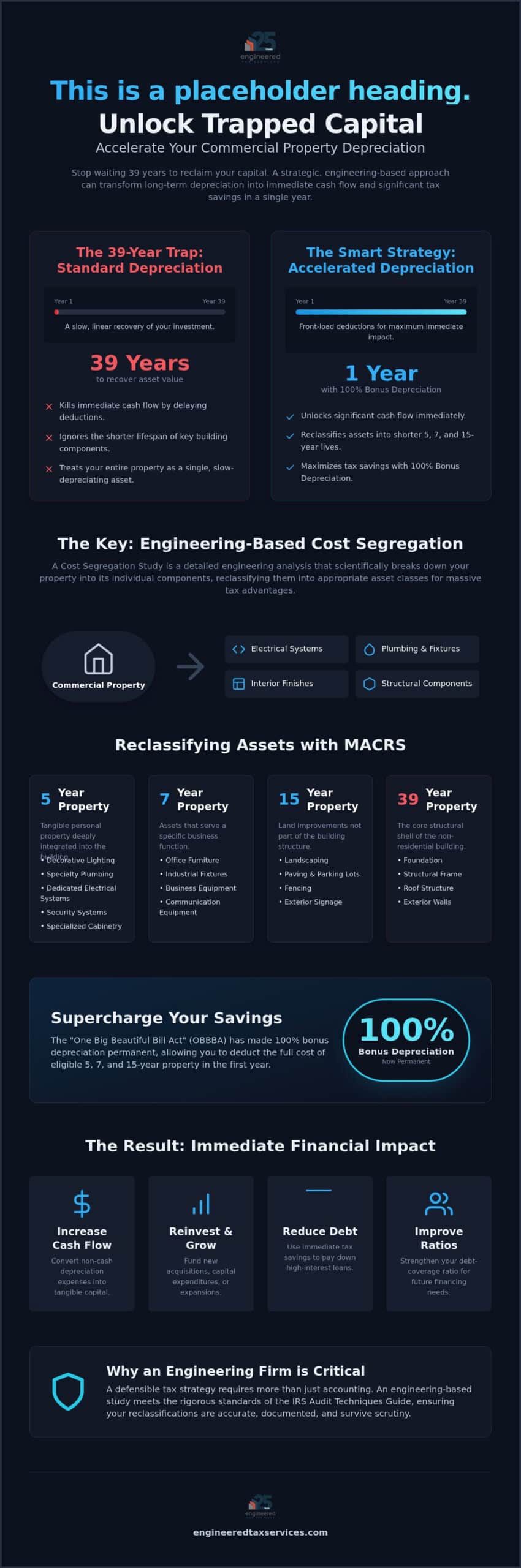
- Learn how to accelerate depreciation on commercial property by utilizing MACRS asset classes to reclassify property into shorter 5, 7, or 15-year recovery periods.
- Leverage the permanent 100% bonus depreciation established by the OBBBA and optimized Section 179 limits to maximize your 2026 tax deductions.
- Ensure your tax strategy is defensible by employing an engineering-based cost segregation study that meets the rigorous standards of the IRS Audit Techniques Guide.
- Realize an immediate increase in cash flow by converting non-cash depreciation expenses into tangible capital for reinvestment or debt reduction.
The Problem with Standard 39-Year Depreciation Schedules
The Modified Accelerated Cost Recovery System (MACRS) dictates that non-residential commercial buildings are typically depreciated over a 39-year period. While this straight-line method is the IRS default, it often acts as a financial anchor for sophisticated investors. This approach assumes your entire asset loses value at a uniform, sluggish rate, which is an engineering fallacy. When you focus on how to accelerate depreciation on commercial property, you’re moving away from this passive accounting model toward a proactive wealth strategy that reflects the physical reality of your building.
The Time Value of Money (TVM) teaches us that capital today is worth significantly more than capital tomorrow. In tax planning, this means a deduction in the current year is far superior to a deduction scheduled for 2060. The 2026 tax landscape makes this distinction even more vital. Following the passage of the “One Big Beautiful Bill Act” (OBBBA) on July 4, 2025, the 100% bonus depreciation rate is now a permanent fixture of the tax code. This creates a massive opportunity for owners to maximize their immediate liquidity rather than waiting decades for a return on their investment.
Why the IRS Default is a Cash Flow Killer
Standard depreciation ignores the technical lifespan of your building’s mechanical, electrical, and plumbing systems. It groups five-year assets like specialized cabinetry or security systems with thirty-nine-year assets like the foundation. This lack of precision kills cash flow by delaying deductions you’re legally entitled to take now. A Cost Segregation Study provides the engineering data needed to separate these components for the IRS. Accelerated depreciation is the strategic reclassification of assets into shorter recovery periods. By ignoring these distinctions, you’re effectively paying taxes on “phantom” income that could have been offset by legitimate, front-loaded expenses.
Opportunity Cost: What Your Trapped Capital Could Be Doing
The Mechanics of Accelerated Depreciation: MACRS and Asset Classes
The Modified Accelerated Cost Recovery System (MACRS) is the engine behind every successful tax optimization strategy. It provides the framework for assigning specific recovery periods to various building components. Understanding the nuances of these asset classes is the first step in learning how to accelerate depreciation on commercial property. While the IRS provides the rules in IRS Publication 946, the challenge lies in the technical identification of these assets within a complex construction project. Precise classification requires moving beyond simple accounting to a detailed engineering analysis of the building’s physical makeup.
Identifying 5-Year and 7-Year Personal Property
Most property owners overlook assets that are deeply integrated into the building’s infrastructure. The 5-year class includes tangible personal property such as decorative lighting, specialty plumbing for medical or industrial use, and dedicated electrical systems that support specific equipment rather than the building’s general operation. These items are frequently hidden within general construction contracts, often buried under broad categories like electrical or interior finishes. Because they don’t look like portable equipment, they’re often misclassified as structural components.
The 7-year class typically captures office furniture, industrial fixtures, and specific communication equipment. Companies upgrading to enterprise-grade communication solutions from Stratelegy can often reclassify those specific hardware costs into this shorter recovery period, significantly improving their immediate ROI. Proper classification requires a deep dive into tangible property regulations to distinguish between a structural component and an asset that serves a specific business function. Without an engineering-based review, these high-value deductions remain misclassified as 39-year property, delaying your tax benefits by decades. It’s not just about what the asset is, but how it functions within your specific business operations.
Understanding 15-Year Land Improvements and QIP
Land improvements constitute the 15-year recovery class. This includes site work such as asphalt paving, decorative fencing, and permanent landscaping. These assets are often the most straightforward to identify but are frequently undervalued in standard accounting summaries. By pulling these costs out of the general building basis, you significantly shorten the time it takes to recover your investment capital.
Qualified Improvement Property (QIP) represents a massive strategic advantage for non-residential property owners in 2026. QIP refers to interior improvements made to a building after it was originally placed in service. Under current regulations, QIP retains its 15-year recovery period and remains eligible for 100% bonus depreciation. This makes interior renovations a powerful tool for immediate tax relief. If you’re planning a significant capital project, consulting with a specialized engineering firm ensures that every dollar spent is allocated to its most tax-efficient class. This technical precision transforms a standard renovation into a high-yield financial maneuver.
Cost Segregation: The Engine of Accelerated Depreciation
A Cost Segregation Study is the formal, technical process used to dissect a property’s purchase or construction price into its constituent components. It’s the primary method for anyone looking at Accelerated Depreciation in Commercial Real Estate. This isn’t a simple paper exercise; it’s a multi-stage engineering project designed to provide rigorous substantiation for the IRS. By identifying assets that can be depreciated over 5, 7, or 15 years instead of the standard 39, you’re essentially front-loading your tax benefits to maximize current liquidity.
The process follows four critical stages to ensure compliance and precision:
- Engineering Review: Experts analyze blueprints, contractor invoices, and ALTA surveys to identify costs that qualify for shorter recovery periods.
- Physical Site Inspection: Engineers conduct a walkthrough to verify that the assets identified in the plans actually exist and are being used in a way that justifies their classification.
- Technical Report Preparation: A comprehensive document is created, detailing the legal and engineering basis for every reclassified asset.
- Tax Integration: The findings are applied to the tax return. For properties acquired in prior years, this often involves filing Form 3115 to catch up on missed deductions without needing to amend past returns.
The Engineering-Based Methodology vs. Modeling
Many tax professionals rely on “modeling” or “rule of thumb” estimates, but these are major red flags for the IRS. Modeling uses statistical averages rather than the actual physical reality of your building. If you want to know how to accelerate depreciation on commercial property with full audit protection, you need a detailed engineering take-off. This involves measuring every linear foot of specialized piping and every dedicated circuit. This level of precision ensures that your deductions are based on verifiable data, not just accounting “best guesses.”
Stacking Incentives: 179D and 45L Integration
The true power of this strategy is realized when you stack incentives. A comprehensive Cost Segregation Study shouldn’t exist in a vacuum. By integrating the analysis with the 179D EPAct Tax Deduction for energy-efficient commercial buildings or the 45L Tax Credit for multifamily units, you create a synergistic effect. This is where we produce an “Engineered Incentives Report.” This single, unified study identifies components that are both eligible for accelerated depreciation and energy-efficiency rewards. For example, high-efficiency lighting systems can be reclassified as 5-year property while simultaneously qualifying for a 179D deduction. This dual-benefit approach ensures you aren’t leaving money on the table while building a more sustainable portfolio.
Bonus Depreciation and Section 179 in 2026
The tax landscape for 2026 provides an unprecedented opportunity for investors who understand how to accelerate depreciation on commercial property. While previous legislation scheduled a gradual phase-out of bonus depreciation, the “One Big Beautiful Bill Act” (OBBBA), signed on July 4, 2025, fundamentally changed the game. This law made 100% bonus depreciation permanent for qualified property. This means you no longer have to worry about a 20% or 0% phase-out. Instead, you can immediately expense the full cost of five, seven, and fifteen-year assets identified through cost segregation in the year they are placed in service. This permanent status provides the long-term certainty needed for multi-year capital planning and aggressive portfolio growth.
The “Mid-Quarter Convention” remains a potential trap for the unwary. If more than 40% of your total depreciable property is placed in service during the fourth quarter, the IRS requires you to use a mid-quarter convention rather than the more favorable mid-month or half-year conventions. This can significantly reduce your first-year deductions. A technical cost segregation study helps you monitor these thresholds with precision. By accurately timing when assets are placed in service and classifying them correctly, you can avoid this trap and keep your tax savings at their maximum potential.
The Strategic Power of Permanent 100% Bonus Depreciation
With 100% bonus depreciation now a permanent fixture, the ROI calculation for new acquisitions has shifted. It’s no longer about racing against a sunset clause. Instead, the focus has moved to maximizing the volume of assets reclassified into shorter MACRS recovery periods. Because Qualified Improvement Property (QIP) is eligible for this 100% rate, interior renovations now offer a dollar-for-dollar reduction in taxable income. This makes the technical identification of assets even more critical. You aren’t just looking for “easy” wins; you’re seeking to uncover every possible five-year component to wipe out your current year tax liability.
Section 179 for Real Estate Improvements
Section 179 offers another layer of immediate expensing, though it comes with specific limits that bonus depreciation does not. For the 2026 tax year, the maximum deduction is $2,560,000. This deduction begins to phase out on a dollar-for-dollar basis once your total qualifying property purchases exceed $4,090,000. Section 179 is particularly useful for specific building improvements that might not qualify for bonus depreciation, such as roofs, HVAC systems, fire protection, and security systems. While bonus depreciation is often the first choice because it has no dollar limit, Section 179 remains a vital tool for smaller portfolios or specific system upgrades. To ensure you’re utilizing the most efficient combination of these codes, consult with our engineering team to analyze your specific asset mix and maximize your 2026 savings.
Why an Engineering Firm is Critical for Defensible Results
Understanding the theory of how to accelerate depreciation on commercial property is only the first step. The real challenge lies in execution and defense. The IRS provides a specific roadmap for this through the Cost Segregation Audit Techniques Guide (ATG). This document serves as the “gold standard” for what the Service considers a high-quality study. It explicitly highlights that a defensible report must be based on actual engineering data and a physical site inspection, rather than simple accounting estimates or “rule of thumb” percentages. If your study lacks this technical depth, you’re essentially inviting an audit adjustment that could claw back your hard-won cash flow.
The distinction between an engineering-based study and a standard accounting estimate is profound. While a CPA is an expert in tax law, they typically don’t have the training to perform detailed construction take-offs from blueprints or assess the specific function of a building’s electrical sub-systems. An engineering firm like ETS employs specialists who can accurately identify and value assets that an accountant might miss. This technical precision is why the IRS prefers studies conducted by professionals with an engineering background. We bridge the gap between the physical reality of your building and the legal requirements of the tax code.
Don’t assume it’s too late if you didn’t perform a study in the year you acquired a property. We frequently conduct “look-back” studies for assets purchased in prior years. These studies allow you to catch up on all the depreciation you should have taken since the date of acquisition, resulting in a significant “catch-up” deduction in the current tax year. This is a powerful tool for immediate liquidity without the need to amend previous tax returns.
IRS Compliance and Audit Protection
A “Quality” study, as defined by the IRS ATG, requires a methodical approach that includes a physical site visit and a detailed cost breakdown. Professional engineering licensure (P.E.) is a critical component of this process. It signals to the IRS that the report was prepared with a high level of technical integrity and professional accountability. At ETS, we leverage our 25-year track record and experience conducting over 10,000 studies annually to ensure every report is bulletproof. If the IRS ever inquires about your strategy, we provide full support, standing behind our engineering data to protect your savings.
Getting Started: The ETS Process
The path to optimization begins with a complimentary benefit analysis. This preliminary review allows our team to estimate your potential savings before you move forward with a full study. To begin, we typically require a few key documents:
- Final closing statements or purchase agreements.
- Detailed construction budgets or contractor invoices (for new builds or renovations).
- Appraisal reports and building blueprints, if available.
This data gives our engineers the foundation they need to build a strategic plan tailored to your specific asset. Maximize your commercial property’s cash flow with an ETS Cost Segregation Study and transform your tax liability into a source of growth capital.
Secure Your Financial Advantage Through Technical Precision
Navigating the complexities of 2026 tax laws requires more than just standard accounting; it demands a technical re-evaluation of your physical assets. By moving beyond the inefficient 39-year depreciation schedule and leveraging the permanent 100% bonus depreciation established by the OBBBA, you can significantly increase your current liquidity. Understanding how to accelerate depreciation on commercial property through cost segregation allows you to reclaim capital that would otherwise remain trapped in your building’s foundation for decades. This isn’t just about deferral; it’s about optimizing your portfolio’s growth potential today.
As an independent, licensed engineering firm and a national authority conducting over 10,000 studies annually, we specialize in bridging the gap between construction data and tax law. Our expertise in stacking 179D and 45L incentives ensures you capture every dollar of value while maintaining full IRS compliance. Don’t leave your cash flow to chance or outdated estimates. Schedule a Complimentary Benefit Analysis with our Engineering Team to uncover the hidden potential within your property. It’s time to transform your tax strategy into a proactive engine for wealth preservation and long-term stability.
Frequently Asked Questions
What is accelerated depreciation on commercial property?
Accelerated depreciation is a strategic tax method that reclassifies building components into shorter recovery periods of 5, 7, or 15 years instead of the standard 39-year straight-line schedule. This process front-loads deductions into the early years of ownership, which significantly increases your immediate cash flow. By identifying personal property and land improvements separately from the building’s structural core, you’re able to reflect the actual engineering lifespan of those specific assets.
Can I use accelerated depreciation for a property I bought years ago?
Yes, you can perform a “look-back” cost segregation study to catch up on missed depreciation from previous years. This process allows you to claim all the deductions you would’ve received had you accelerated depreciation from the date of acquisition. Best of all, you don’t need to amend prior tax returns. You simply file IRS Form 3115 to claim the entire catch-up amount in your current tax year filing.
Is a cost segregation study worth it for a smaller commercial building?
A cost segregation study is often worth the investment for properties with a cost basis as low as $500,000, depending on the asset type. Smaller buildings with high-intensity interior build-outs, such as medical offices or restaurants, yield significant reclassifiable assets. We recommend a complimentary benefit analysis to ensure the projected tax savings substantially outweigh the cost of the engineering study before you commit to the full process.
How does the 2026 bonus depreciation phase-out affect my tax strategy?
The 2026 tax strategy is simplified by the “One Big Beautiful Bill Act,” which made 100% bonus depreciation permanent. You don’t have to worry about a phase-out schedule anymore. This permanent status means you can continue to immediately expense the full cost of 5, 7, and 15-year property. This provides long-term certainty for your capital planning and maximizes the impact of learning how to accelerate depreciation on commercial property.
What is the difference between Section 179 and accelerated depreciation?
Section 179 allows for immediate expensing of specific assets up to a $2,560,000 limit for 2026, while accelerated depreciation via MACRS has no such dollar cap. Section 179 is frequently used for building systems like HVAC or roofs that might not qualify for bonus depreciation. Accelerated depreciation, driven by cost segregation, focuses on reclassifying permanent building components into shorter lifespans to maximize first-year write-offs regardless of your total purchase volume.
Does accelerating depreciation trigger an IRS audit?
Accelerating depreciation doesn’t inherently increase audit risk if the study follows the IRS Cost Segregation Audit Techniques Guide. The IRS actually expects sophisticated investors to use these legal methods to reflect asset lifespans accurately. The key is using an engineering-based report rather than simple accounting estimates. A study backed by a licensed engineering firm provides the technical substantiation required to defend your classifications during any standard inquiry.
Can I accelerate depreciation on a residential rental property?
Residential rental properties can certainly benefit from accelerated depreciation, though they use a 27.5-year baseline instead of the 39-year commercial standard. Cost segregation identifies 5-year assets like appliances and flooring, alongside 15-year land improvements like fencing and landscaping. This strategy is highly effective for multifamily developments and short-term rentals to offset rental income and improve the property’s overall return on investment for the owner. Property investors looking to apply these techniques to their income-generating units can find a detailed breakdown in this cost segregation guide for rental property, which covers the 2026 regulatory standards and engineering-based methodology in depth.
How much cash flow can a cost segregation study typically unlock?
A cost segregation study typically reclassifies 20% to 35% of a property’s cost basis into shorter-lived asset classes. For a building with a $3 million basis, this means moving $600,000 or more into immediate 100% bonus depreciation. While specific results vary by property type, this move often results in hundreds of thousands of dollars in tax savings during the first year, providing a massive boost to your current working capital.