
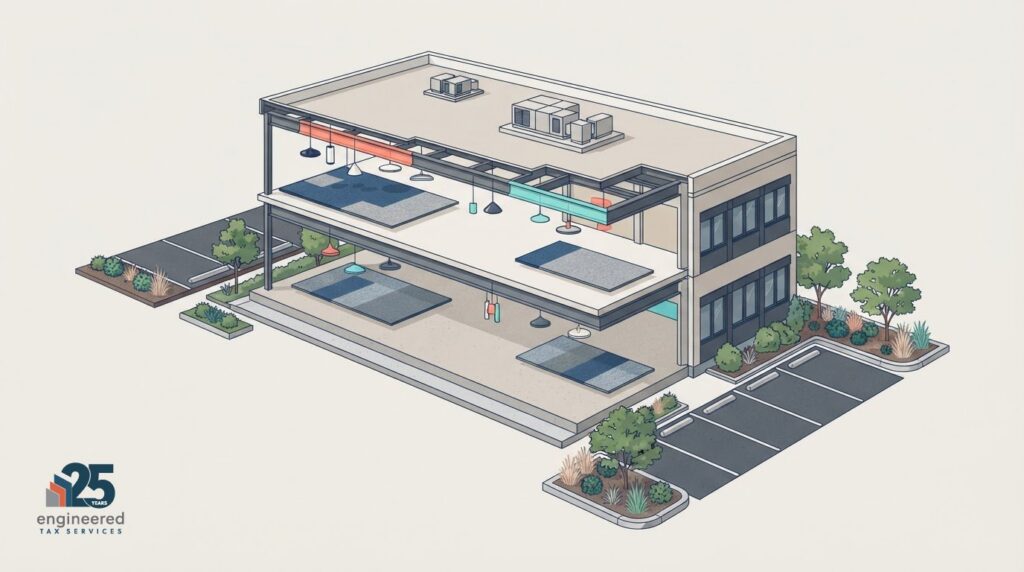
For recent commercial property buyers, tax savings from property componentization may come from identifying eligible parts of a building that can be depreciated faster than its structure, shifting deductions into earlier tax years. The IRS generally sets recovery periods of 39 years for commercial buildings and 27.5 years for residential rental buildings.
It’s reasonable to ask whether property componentization will affect your tax bill now or simply change when you claim deductions. Commonly performed through a cost segregation study, property componentization doesn’t create new basis. It analyzes property costs and classifies eligible components for depreciation under applicable rules.
This article explains how the analysis works, which owners may benefit, and how acquisition timing, records, passive loss limits, and a future sale can affect the outcome. You’ll also find a hypothetical example and practical questions to discuss with your CPA before deciding whether a study fits your property.
Key Takeaways
- See how a property’s components may qualify for different depreciation periods, changing when deductions are claimed.
- Assess whether your property, ownership plans, and ability to use tax losses make a study a practical fit.
- Understand why acquisition and construction timing can affect the depreciation rules that apply.
- Bring your property records and questions about future sale or reuse to your CPA to discuss reporting and potential recapture.
Who This Applies to, and Who It Doesn’t
Recent commercial property buyers are often strong candidates for property componentization, especially when the building has distinct systems, finishes, or site improvements that may qualify for shorter depreciation periods. A cost segregation study analyzes the property’s costs and classifies eligible assets for tax depreciation. The cost segregation analysis is most useful when the timing of deductions could affect the owner’s tax position and the property records support a defensible allocation.
It can also be relevant to owners of rental properties acquired in earlier years. A prior purchase does not, by itself, rule out a study. The decision turns on the property’s remaining depreciable basis, its construction and renovation history, the records available, and how the owner expects to use the resulting deductions. U.S. residential rental buildings are generally depreciated over 27.5 years, while commercial buildings are generally depreciated over 39 years, according to the Internal Revenue Service. Identifying qualifying components with different recovery periods may change the timing of deductions.
Earlier deductions matter only if you can use them. Passive activity loss rules may limit whether a real estate owner can use property losses to offset other income in the current year. Your tax situation, ownership structure, participation in the activity, and other income all affect the practical value of accelerated depreciation. A study can support tax savings from property componentization, but it doesn’t make a deduction immediately usable when tax rules limit its use.
- Potential fit: Owners of commercial or rental property with meaningful depreciable basis, clear property records, and a tax plan that can account for accelerated deductions.
- Worth assessing: Investors who bought in a prior year or completed renovations, since acquisition timing and later work may affect the analysis.
- Often a poor fit: Owners with little depreciable basis, inadequate records, or no practical ability to use the deductions in the relevant period.
Owner-occupied personal residences generally aren’t a fit for a cost segregation study because the strategy concerns depreciable property used in income-producing or business activity. If you’re considering a study, bring your purchase and renovation records to your CPA and discuss how deductions could affect your current tax position and plans for the property. That conversation helps distinguish a technically possible study from one that fits your investment and tax circumstances.
How Property Componentization Works
A cost segregation study analyzes property costs and assigns eligible assets to tax depreciation classes. Acquisition, construction, renovation, and applicable tax rules shape that analysis.
Building Components and Asset Classes
Asset classes group property costs according to the applicable tax recovery period. The Internal Revenue Service says U.S. residential rental buildings are generally depreciated over 27.5 years, while commercial buildings are generally depreciated over 39 years. That classification matters because eligible components may have shorter recovery periods than the building structure. The study’s engineering analysis connects each classification to physical assets and project records.
Qualifying Property and Components
Property components qualify for accelerated depreciation when tax rules treat them as separate eligible assets and the study supports their classification. Owners of income-producing real estate, including rental apartments, hotels, offices, and manufacturing facilities, may consider cost segregation. For example, a limited-service hotel placed in service in August 2025 had a study completed in February 2026. Its analysis examined whether identifiable hotel components belonged in shorter-lived classes.
Reclassifying Components for Shorter Depreciation Lives
Reclassification separates eligible costs from the building structure, assigning each asset to its applicable recovery period. In a hypothetical 2025 example, an engineer analyzes a hotel’s documented construction costs and identifies qualifying components; the CPA then applies the relevant tax treatment to those supported amounts. For eligible property acquired after January 19, 2025, IRC §168(k), under the One Big Beautiful Bill Act, provides 100% bonus depreciation. IRS Notice 2026-11 also addresses component elections and return statements.
Accelerated Depreciation and Early-Year Savings
Shorter recovery periods and applicable bonus depreciation can shift deductions toward earlier years, changing when owners report taxable income. The result depends on eligible assets and the taxpayer’s circumstances. Tax incentives can affect the calculation too: a Section 179D deduction reduces the building’s depreciable basis. State tax treatment follows state law, so ask your CPA to compare the federal and relevant state returns. If a property is sold or repurposed, prior depreciation may affect its remaining basis and later tax treatment.
Common Mistakes and Misconceptions
Accelerated depreciation changes when eligible costs are deducted, but doesn’t automatically create a permanent tax reduction. Claiming deductions earlier can improve cash flow in the near term, while reducing the basis remaining later. You also need enough taxable income under applicable rules to use deductions when expected. A study’s classification is one part of the calculation, not a promise that every identified amount will reduce current tax.
Mistake: Treating the purchase price as depreciable building cost
A property’s purchase price isn’t all depreciable building basis. Land and building costs must be accounted for separately, and a component analysis must reconcile to the property’s overall cost rather than create additional basis. For example, an allocation to equipment or site improvements still needs support from purchase documents, construction records, and the property’s physical features. Don’t simply copy a seller’s accounting labels or rely on an unsupported percentage. If renovation costs are included, distinguish them from acquisition costs and document the work they represent.
Mistake: Assuming depreciation recapture makes a study pointless
Accelerated depreciation can affect the tax calculation when property is sold or converted to personal use. A sale may require you to account for depreciation previously claimed, and the treatment depends on the assets and transaction. That possibility doesn’t make a study pointless; it makes your ownership horizon relevant. Compare the potential timing benefit with your expected holding period, planned sale, and intended use of the property. Ask your CPA how prior deductions could affect the sale-year return.
Mistake: Assuming every deduction is usable now
Passive activity loss rules may restrict the use of rental losses against other income. A larger depreciation deduction, therefore, may not produce an immediate tax reduction for every owner. The result depends on your tax position and applicable limits. Before treating projected deductions as current-year savings, ask your CPA to distinguish amounts you can use now from those that may be limited or carried forward.
These distinctions matter when assessing tax savings from property componentization. Review the study’s allocation, supporting records, current-year tax treatment, and potential sale consequences together. An allocation can be technically supportable yet a poor planning fit if you can’t use the deductions as expected or the sale implications are overlooked.
Questions to Ask Your CPA
Bring your purchase documents, renovation records, and construction files to your CPA. These records help the tax team determine eligible costs, connect engineering findings to deductions, and assess federal and state tax treatment. Ask specific questions before the cost segregation analysis is reflected on a return.
- Which records should I provide? Ask whether the team needs the purchase agreement, closing statement, fixed-asset schedule, plans, contractor invoices, change orders, and renovation scopes. For self-constructed property, ask how project cost records and construction dates will support each component’s classification.
- How will you document construction timing for a component election? Ask how the engineering analysis will identify components that were less than 10% complete before January 19, 2025. Project schedules, invoices, payment records, and dated construction documents can help show the status of specific work at that point.
- Which costs and property components are eligible? Ask how the study separates land, the building structure, and components with shorter depreciation lives. Request an explanation of the evidence supporting each classification, including how renovations or acquired assets affect the allocation.
- How will the deductions appear on my federal and state returns? Ask which tax year receives each deduction, whether passive activity limits affect your ability to use it, and whether state rules follow federal treatment. Ask your CPA to show how the study changes taxable income and any carryforward calculations.
- Does a component election fit this property and return? Ask whether the election applies to all eligible components or only selected ones. Under IRS Notice 2026-11, the election statement must accompany a timely filed return, including extensions. Ask who prepares the statement and how the election affects bonus depreciation and your reported basis.
For a property under construction, include dated plans, schedules, invoices, and payment records in your discussion with your CPA. The analysis should connect those documents to identifiable components rather than treat the project as one undivided cost. Ask how the team will retain that supporting documentation with the study and tax records.
Close the discussion by asking how accelerated deductions could affect a future sale or change in property use. This connects current tax benefits with the remaining basis and potential recapture reported in a later year. A clear answer helps you evaluate tax treatment as part of the property’s full ownership plan.
Your next decision is whether a property-specific analysis belongs in your tax plan, not whether accelerated depreciation sounds attractive in theory. The value of tax savings from property componentization depends on the records supporting the allocation, the deductions you can use, and how long you expect to hold or use the property. Discuss these factors with your CPA before the results are reflected on a return.
If you’d like to discuss whether a study fits your property, contact Engineered Tax Services. A focused conversation can help you decide what to examine next with your tax advisor.
Frequently Asked Questions
How Do I Recognize This Benefit?
Look for differences between the property’s existing depreciation schedule and the schedule used for tax reporting. Compare asset descriptions, assigned costs, and deduction amounts with the records your CPA relied on. If the documents don’t align, ask how the return reflects the study’s findings. This reconciliation helps show whether reported treatment matches the analysis supporting potential tax savings from property componentization.
Is This Just a Timing Difference?
Often, the main effect is that deductions fall in different years, but their practical value depends on your tax position over time. Ask your CPA to compare projected tax payments across the years in your ownership plan, rather than focusing only on the first year. The analysis should also account for deductions you can’t currently use and how they may be treated on later returns.
What Is Property Componentization for Tax Purposes?
For tax purposes, property componentization is a supported allocation of property costs among identifiable assets for depreciation reporting. A useful study record ties each asset description and allocated cost to plans, invoices, or other project evidence. This lets your tax preparer trace reported amounts back to the property and retain the supporting records alongside depreciation schedules.
How Does a Cost Segregation Study Create Tax Savings?
A study gives your tax preparer asset-level information for depreciation schedules. To assess its effect, compare the study’s asset schedule with the records used on the return, then ask how each change affects reported deductions and taxable income. For a property included on prior returns, also ask your CPA how current-year reporting should account for its earlier depreciation history.
What Are the Current Federal Bonus Depreciation Rules and Percentages?
Under IRC §168(k), 100% bonus depreciation applies to eligible property acquired after January 19, 2025, under the One Big Beautiful Bill Act. The percentage alone doesn’t establish eligibility for every building cost. Give your CPA the purchase and construction records, including dates, so they can assess which assets meet the applicable rules and how the deduction belongs on the relevant return.
How Do Section 179 and Bonus Depreciation Compare With Cost Segregation?
IRC §179 and IRC §168(k) provide tax treatment for eligible property, while cost segregation identifies and allocates costs among building assets. They aren’t interchangeable: a study supplies asset-level information, and your CPA determines whether particular assets qualify under either provision. Ask how any proposed treatment affects elections, taxable income, and the depreciation schedules retained for future returns.
Disclaimer
This article is general information, not tax or legal advice. Tax rules change, and how they apply depends on your specific facts. Talk with your CPA or tax advisor before acting on anything here.