Could the technical problem-solving on a construction project support an R&D tax credit, even when the work looks like ordinary project delivery? Complexity alone isn’t enough. An R&D tax credit for construction companies depends on whether the work involved technical uncertainty and a documented process for evaluating alternatives.
It’s reasonable to question whether design changes, field adjustments, or subcontractor work count as research. Routine construction and quality control generally aren’t enough. Work that tests alternatives to resolve engineering or design uncertainty may merit closer review. The challenge is to distinguish qualifying experimentation from work performed to meet standard project requirements, then connect the activity to reliable records and potentially eligible costs.
This 2026 guide explains which construction activities may qualify, how the IRS four-part test applies, and what project evidence and cost details can support a claim. It also explains how to assess whether a study connects engineering analysis to the work performed, rather than relying on broad descriptions. Engineered Tax Services is an independent, licensed engineering firm that conducts R&D tax credit studies nationally, applying technical analysis to construction projects and their supporting documentation.
Key Takeaways
- For the R&D tax credit for construction companies, eligibility depends on the activities performed, not the company’s industry label.
- Use the four-part test to screen projects for technical uncertainty and experimentation, without treating an initial screen as a guarantee of qualification.
- Connect each potential research activity to contemporaneous records and relevant expense categories to build a clear support trail.
- Compare study approaches by whether they assess technical work, costs, records, and applicable tax requirements together.
- Shortlist projects, identify the engineering questions, and organize the evidence before a specialist evaluates the claim.
R&D Tax Credit for Construction Companies: What Work May Qualify?
The federal research and development (R&D) tax credit can provide a tax benefit for certain qualified research activities and related expenses. Construction businesses aren’t automatically eligible or excluded because of their industry. The relevant question is what the company’s people actually did: did they address a technical uncertainty by evaluating alternatives, or complete work using established methods?
That distinction can matter across design, engineering, and project execution. A general contractor, specialty subcontractor, or design-build firm may face technical challenges while developing a building system, selecting materials, or improving a construction process. But a complex project, custom result, or unexpected field condition doesn’t establish qualification on its own. Assess the work against the applicable requirements. The examples below are screening prompts, not determinations of eligibility or credit value.
Which construction activities may involve qualified research?
Look for projects where the team faced a technical question without a known solution at the outset, then evaluated possible approaches. For example, engineers might model alternative structural configurations to address performance constraints, test materials under specified conditions, or compare construction methods to improve a process. Design iterations, prototype development, simulations, and controlled testing can help show how the team investigated alternatives.
The work matters more than the project label. A bespoke building component may involve routine customization if the team applied established methods. Conversely, a phase that looks like ordinary construction may include a distinct experiment if staff systematically tested competing technical approaches. Ask what was uncertain, which alternatives were considered, and what evidence shows how the team evaluated them.
Which common construction tasks generally need closer scrutiny?
Routine design revisions, adapting a standard plan to fit a site, correcting installation issues, and ordinary troubleshooting may not involve qualified research. A change made to satisfy a client preference or contract specification isn’t experimental development simply because it required coordination or specialized skill. Meeting building codes is necessary project work, but code compliance alone doesn’t demonstrate a qualifying research process.
Site conditions provide context, not automatic evidence of research. Unusual soil, limited access, or existing-building constraints might prompt a technical investigation, but the challenge alone doesn’t establish that the company systematically evaluated alternatives. The key is what followed: were different technical solutions analyzed or tested, and were the results used to resolve uncertainty?
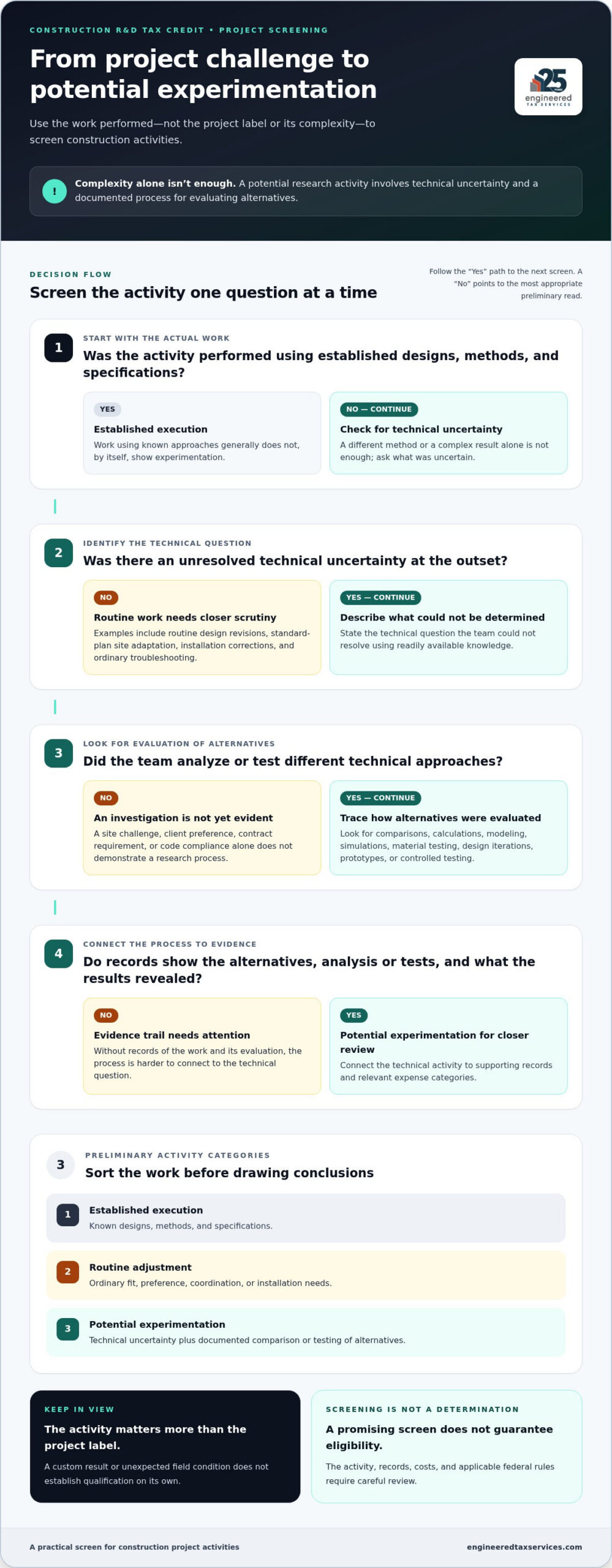
For a practical first screen, sort project activities into three categories:
- Established execution: Work performed using known designs, methods, and specifications.
- Routine adjustment: Changes addressing ordinary fit, preference, coordination, or installation needs.
- Potential experimentation: Technical work involving uncertainty and documented comparison or testing of alternatives.
This framework can help construction companies identify projects for closer review without presuming that every engineering challenge qualifies. The R&D tax credit for construction companies is activity-based: a defensible assessment connects the technical work to evidence of the research process and the costs associated with it.
Apply the Four-Part Test to Construction Projects
The four-part test offers a structured way to screen construction activities for potential federal R&D tax credit eligibility. Consider each requirement in relation to the specific work, not just the project’s overall complexity. Passing an initial screen doesn’t guarantee qualification; the activity, records, costs, and applicable federal rules all require careful review.
Consider an illustrative project involving an energy-efficient building system. The team may face uncertainty about meeting performance goals within design constraints, compare technical configurations, and use calculations or testing to assess alternatives. The Department of Energy Building Technologies Office describes research and development in building technologies, a useful example of the technical fields where construction-related innovation may occur. A connection to such a field alone doesn’t establish tax credit eligibility.
Connect uncertainty and experimentation to project decisions
Start with the unresolved technical question: what couldn’t the team determine using readily available knowledge at the project’s outset? Then trace how it responded. A useful account identifies the alternatives considered, the analyses or tests performed, and what the results revealed. Compare that sequence with routine scheduling, estimating, procurement, or project coordination. Those decisions may be essential to delivery, but they don’t by themselves show technical experimentation.
Assess the remaining requirements without overgeneralizing
Evaluate each element against the activity’s actual purpose and technical basis. These questions can keep the review specific:
- Permitted purpose: Was the work intended to improve a product or process’s function, performance, quality, or reliability? A design effort to improve system performance or a construction-process change intended to improve safety may warrant review.
- Technological in nature: Did the work rely on engineering or physical sciences, rather than aesthetic preference, market research, or business judgment alone?
- Elimination of uncertainty: Was the capability, method, or design uncertain at the outset? Identify what the team needed to resolve, rather than describing only the final result.
- Process of experimentation: Did the team evaluate alternatives through analysis, modeling, simulation, testing, or systematic trial and error? Show how that evaluation informed decisions.
A project can involve engineering without satisfying every requirement. An engineer’s calculations may simply confirm a standard design. By contrast, documented analyses comparing approaches to resolve a technical unknown may warrant a closer eligibility review. The distinction rests on the purpose and process, not on technical terminology in a project file.
Also screen for exclusions and other statutory details. Funded research, work after commercial production, routine quality control, market research, and cosmetic changes require particular attention under the applicable rules. Don’t assume a project qualifies based on a summary or a single test result. A disciplined R&D tax credit for construction companies review connects each requirement to project-specific facts and supporting evidence. An engineering-led R&D tax credit study can assess that technical work alongside its documentation.
Match Construction Records and Costs to the Work Performed
A well-supported analysis connects technical activities to the records and expenses associated with them. Start with the work, then follow its evidence trail into payroll, purchasing, and contract records. A project budget or bookkeeping code can help locate information, but neither proves that an activity was qualified research or that a cost belongs in a claim.
Use a project-level map to organize the initial review. The examples below are prompts for investigation, not conclusions about eligibility or expense treatment.
| Activity to review | Technical question | Potential supporting evidence | Expense categories to assess |
|---|---|---|---|
| Comparing structural design alternatives | Which design could meet the required performance constraints? | Design iterations, calculations, engineering notes, review comments | Employee wages; supplies used in testing, if applicable |
| Testing material or system configurations | How would alternatives perform under the project’s technical conditions? | Test plans, results, photographs, material records, revision history | Wages; potentially relevant supplies |
| Evaluating a construction-process change | Could a different method improve a technical outcome? | Process notes, trial records, meeting minutes, communications about results | Wages; contract research, if applicable |
Create an activity-to-evidence trail
For each task under review, record who performed, supervised, or supported it, when the work occurred, what technical question the team faced, and where the related records are stored. Dated drawings, calculations, test logs, engineering notes, emails, and meeting records can help reconstruct the sequence of decisions. Link each revision to the question it addressed instead of collecting files without context.
Construction records are often spread across project managers, engineers, subcontractors, and accounting systems. A consistent project-level index can connect those sources: identify the project and activity, note relevant dates and people, then reference the technical and financial records. Recognize and document gaps rather than filling them with assumptions.
Review employee, supply, and contractor costs carefully
Expense categories need their own analysis. Connect employee time to the specific qualified services performed, supervised, or supported, rather than including it solely because someone worked on a potentially relevant project. Review supplies based on their actual use in the research activity and the applicable tax rules. Contract research also calls for fact-specific analysis of the work performed, payments, agreements, and rights to the research.
Invoices, payroll details, time records, purchase documentation, and contract terms can help show whether costs align with the technical record. A general ledger label such as “engineering” or a project-wide budget doesn’t establish that every related expense qualifies. For the R&D tax credit for construction companies, a defensible workpaper traces each potentially relevant cost to an activity, evidence, and applicable tax treatment. Current requirements and the facts of each arrangement matter.
Compare R&D Credit Study Approaches Before Choosing a Path
Construction projects bring together technical decisions, cost records, and tax requirements. A study approach should account for all three. General tax preparation, internal screening, and an engineering-based study can play different roles, but a broad eligibility statement or projected result can’t replace documented, project-specific analysis.
- General tax preparation may address how tax information is organized and reported. By itself, it may not examine the engineering decisions, design iterations, and field testing behind a construction project.
- Internal screening can help a company shortlist projects and locate records. Its usefulness depends on whether staff can connect technical activities to uncertainty, experimentation, and relevant costs.
- Specialist engineering-based study brings technical analysis into the review, linking project activities and source records with cost information and applicable tax requirements.
These approaches aren’t necessarily substitutes for one another. The key is whether the work collectively produces a clear, supportable account of the activities and expenses being considered. For an R&D tax credit for construction companies, look beyond the study label and examine what the analysis covers.
What should a construction-focused study examine?
A thorough scope should examine projects and activities in detail, including design, engineering, and any field experimentation. Project-level discussions can clarify who faced a technical question, what alternatives were evaluated, and how the team used the results. The study should connect those technical narratives to calculations and source records, rather than relying on generalized descriptions of innovation.
Useful questions include:
- Does the analysis identify specific projects and technical activities?
- Are design changes, testing, and engineering decisions tied to source documentation?
- Can the cost calculations be traced to the activities and records reviewed?
- Are assumptions, exclusions, and limitations explained clearly?
Written findings should be organized so the company’s tax professionals can review the technical analysis alongside the relevant tax treatment. This supports informed coordination without treating an engineering study as a substitute for tax-return preparation or professional tax review.
How does engineering analysis add practical value?
Technical specialists can interpret drawings, calculations, revisions, test results, and project communications in context. That analysis helps distinguish work involving technical uncertainty and evaluation of alternatives from ordinary project execution. It also makes the reasoning visible: which activity was reviewed, what evidence informed the assessment, and how the technical narrative connects to costs.
Coordination matters. Engineering findings and accounting records should be considered together, while applicable tax requirements are reviewed for the specific claim. No study can promise eligibility, a particular credit, or an examination outcome. A sound process documents both its analysis and its limits.
Engineered Tax Services conducts R&D tax credit studies as an independent, licensed engineering firm. Explore ETS’s R&D tax credit engineering approach to see how technical project work can be evaluated alongside supporting information. The R&D tax credit study page provides more information about ETS’s engineering-led service.
Move from Construction Project Screening to a Defensible Study
Once you’ve identified projects that may merit a closer look, move from a broad shortlist to a fact-based review. A clear sequence keeps technical activity, supporting records, and expenses connected, while giving reviewers a practical way to understand the work performed.
- Shortlist projects: Identify projects with engineering or design work that may have involved unresolved technical questions.
- Define the questions: Note what the team needed to determine, which alternatives it considered, and what prompted analysis or testing.
- Gather records: Assemble project materials that reflect the decisions and work, organizing them by activity and project period.
- Review costs: Connect potentially relevant employee, supply, and contractor costs to specific activities for further analysis.
Prepare project information for an initial review
Start with concise project summaries, then gather design iterations, calculations, testing records, engineering notes, and communications that show how technical decisions developed. Identify the project periods and the employees or contractors involved, along with relevant agreements or cost records. Organize files by activity, not just by project name, so potential experimentation can be distinguished from routine construction, coordination, and installation work.
A useful summary states the technical question, the alternatives considered, and how the team evaluated them. Instead of simply noting that a design changed, identify the constraint that prompted the revision and the analysis that informed the selected approach. Base the details on project records and knowledgeable personnel. Don’t infer experimentation from a final drawing or expense code alone.
Understand the ETS study and next steps
Engineered Tax Services (ETS) is an independent, licensed engineering firm that conducts R&D tax credit studies nationally. Its engineering-led analysis evaluates construction activities alongside supporting information and related costs, helping connect technical project work to the documentation used to assess a claim. ETS reports conducting more than 10,000 tax studies annually. That company-reported figure describes its overall study volume, not a construction-specific result or a prediction of eligibility.
Findings depend on the project facts, available evidence, cost information, and applicable tax rules. An engineering study can inform the technical analysis and provide organized findings for coordination with the company’s tax professionals, but it can’t promise a credit amount, eligibility, or acceptance by the IRS. Keep the review grounded in the records and identify gaps openly.
To move from project screening to a technical review, prepare a focused summary of the construction activities and the records available for assessment.
Make Technical Documentation Part of the Next Project
A potential R&D opportunity can also prompt a stronger project habit: capture the technical question and decision trail as work unfolds. That practice can preserve useful context, distinguish investigative work from routine delivery, and make future project reviews more efficient. It won’t determine tax eligibility on its own, but it can make the facts easier to evaluate when a review is appropriate.
For companies considering the R&D tax credit for construction companies, the next step is to turn promising project leads into a focused technical and cost review. Engineered Tax Services, founded in 2001, evaluates construction activities and supporting information through engineering-led R&D tax credit studies. Results depend on project facts and applicable tax rules, and no credit outcome is guaranteed.
Discuss a construction-focused R&D tax credit study with ETS to identify a practical path for reviewing your projects. A clear, evidence-based assessment can help your team make informed decisions about next steps.
Frequently Asked Questions
Can construction companies qualify for the R&D tax credit?
Yes, potentially, if specific activities and expenses meet the applicable requirements. A company’s construction classification alone doesn’t establish or prevent eligibility. For example, a project team might investigate whether a structural approach can meet a performance objective under unusual design constraints. That work warrants review only if the facts support the required research criteria. For the R&D tax credit for construction companies, assess the actual activities, records, costs, and current rules rather than relying on the project’s label.
What construction activities may qualify for the R&D tax credit?
Some design, engineering, or process-development activities may qualify if they meet the applicable criteria. A team might compare structural configurations, test material combinations, or evaluate a proposed construction method to resolve a technical question. The project’s custom nature or complexity isn’t enough by itself. Document what the team set out to determine, the alternatives it considered, and how it assessed them. Routine installation or a standard design adjustment generally needs closer scrutiny.
Do contractors and subcontractors count toward construction R&D tax credit expenses?
Contractor and subcontractor expenses may warrant review, but an invoice alone doesn’t make a cost eligible. The analysis depends on the technical work performed and relevant contract terms, payment details, rights, and tax requirements. For example, a subcontractor’s engineering analysis may need to be distinguished from ordinary installation work on the same project. Keep agreements, invoices, scopes of work, and project records together so the activity and cost can be evaluated in context.
What records should a construction company keep for an R&D tax credit claim?
Keep records that help establish what the team investigated and how it reached decisions. Useful examples include dated drawing revisions, calculation files, test results, engineering notes, meeting records, and communications explaining why an approach changed. Pair those materials with employee time or cost records and relevant purchase or contractor documentation. Indexing evidence by project activity and date makes it easier to connect technical decisions to the people and expenses involved.
Does a construction project have to be successful to qualify for the R&D tax credit?
No, a successful final result isn’t the sole measure of whether research activities may qualify. A failed test can still provide evidence that a team evaluated an alternative and learned from the outcome. But an unsuccessful result doesn’t automatically establish eligibility, either. The review focuses on the work undertaken, the uncertainty addressed, the evaluation process, supporting records, and applicable tax rules. Preserve results that didn’t lead to the final design, along with the decisions they informed.
Is ordinary construction or code compliance eligible for the R&D tax credit?
Ordinary construction and code compliance alone don’t establish eligibility. A code requirement may define a design constraint, but the company still needs to assess whether separate work involved qualifying research. Routine installation to meet a specification differs from testing multiple technical approaches to solve an unresolved engineering problem. Separate those activities in project records where possible. This makes it easier to assess investigative work without treating all labor or costs on the project as research.
How does an engineering firm evaluate an R&D tax credit for a construction company?
An engineering firm can examine technical work and its records alongside potentially relevant costs, then assess how the facts align with applicable tax requirements. Engineered Tax Services conducts R&D tax credit studies and analyzes project documentation such as design revisions, calculations, and testing materials in context. The review can also help organize findings for coordination with the company’s tax professionals. Conclusions depend on the project evidence and current rules; no study can promise eligibility or a specific credit.