The IRS has officially retired the era of “reasonable estimates” for research claims, replacing it with a rigid, component-level mandate that leaves no room for ambiguity. With the full implementation of the One Big Beautiful Bill Act and the mandatory requirements of Form 6765 Section G, mastering the R&D tax credit documentation requirements is no longer optional for firms seeking to protect their bottom line. Most innovative companies feel the mounting pressure of this shift, struggling to bridge the gap between technical engineering activities and the strict financial substantiation now required by 2026 regulations. It is a daunting transition that transforms the R&D credit from a simple accounting exercise into a complex engineering and legal challenge.
This guide provides the strategic roadmap you need to ensure your claims are not only audit-ready but also fully compliant with the latest standards for domestic research expensing. You’ll learn how to establish a clear technical nexus and implement contemporaneous record-keeping that satisfies the IRS’s demand for granular specificity. We will examine the mandatory qualitative disclosures of Section E and the project-level reporting protocols necessary to maximize your credit while minimizing administrative risk. By aligning your data capture with these stringent standards, you can secure your incentives and focus on long-term growth with total confidence.
Key Takeaways
- Transition from “reasonable estimates” to the 2026 “strict specificity” mandate to ensure your claims withstand modern IRS scrutiny and regulatory changes.
- Master the technical framework of the Four-Part Test by documenting the “Process of Experimentation” with engineering-level precision rather than simple accounting summaries.
- Navigate the mandatory 2026 reporting updates for Form 6765, specifically the detailed business component requirements now required in Section G.
- Identify the essential R&D tax credit documentation requirements needed to create a robust hierarchy of qualitative evidence, ranging from technical blueprints to contemporaneous project notes.
- Learn how a licensed engineering methodology bridges the gap between technical innovation and financial substantiation for a truly audit-ready study.
The Evolution of R&D Tax Credit Substantiation Standards in 2026
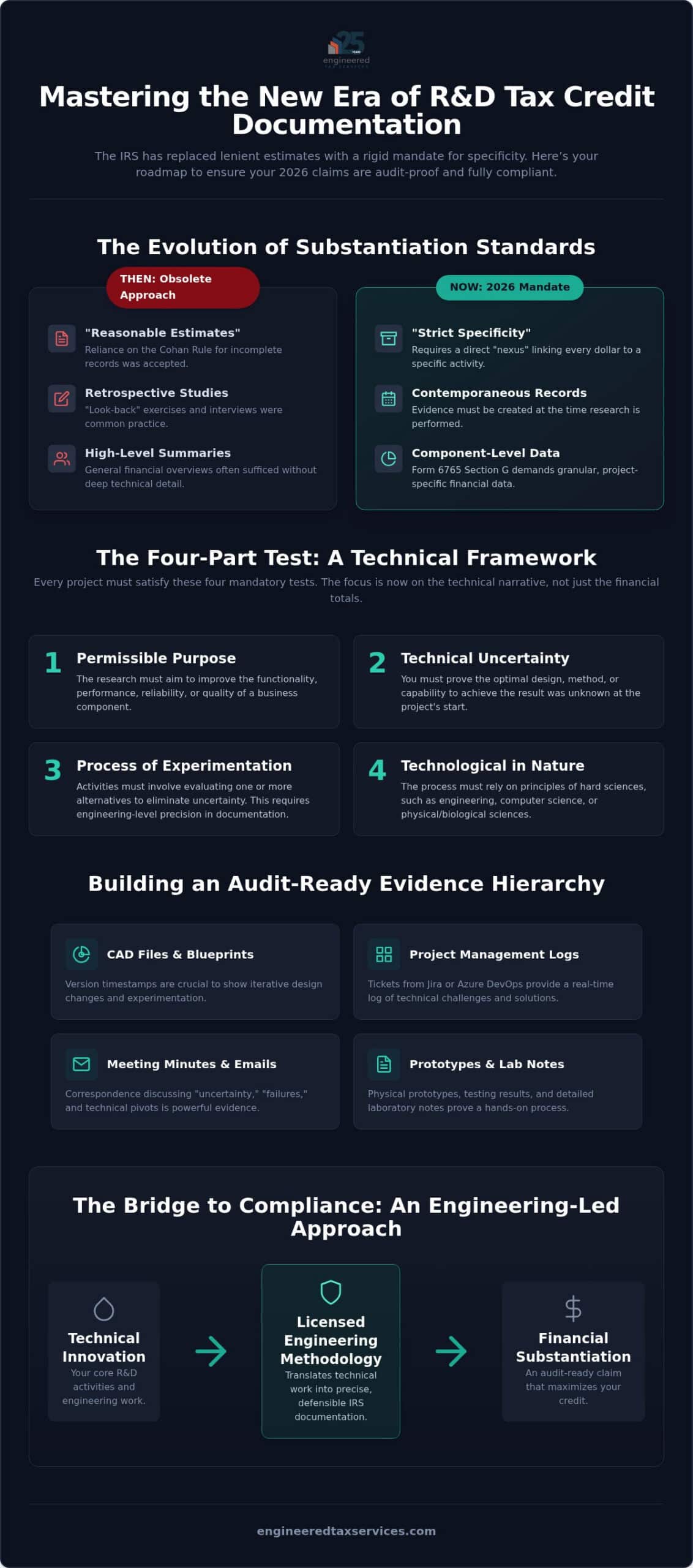
Section 41 of the Internal Revenue Code serves as a vital catalyst for domestic innovation, yet its application has become increasingly complex. In 2026, the landscape has shifted from a lenient interpretation of “reasonable estimates” to a rigid “strict specificity” requirement. This evolution was accelerated by the 2021 Chief Counsel Memorandum (CCM), which set the stage for the mandatory disclosures we see today on Form 6765. The IRS has intensified its focus on high-volume “R&D mills” that prioritize claim quantity over technical accuracy. Consequently, businesses must treat R&D tax credit documentation requirements as a rigorous engineering exercise rather than a mere accounting task. This shift ensures that only those who can prove their technical journey through precise data can unlock the credit’s full potential.
Why ‘Reasonable Estimates’ Are No Longer Sufficient
Recent judicial rulings, specifically Harper and Premier Tech, have dismantled the traditional reliance on the “Cohan Rule,” which once allowed for reasonable estimates when records were incomplete. The courts now demand a direct “nexus.” This means you must link every dollar of qualified research expenses (QREs) to a specific business component or technical activity. If a refund claim lacks this granular detail, the IRS may issue a summary dismissal before an audit even begins. In 2026, the absence of project-specific data isn’t just a weakness; it’s a disqualifier. Relying on high-level financial summaries without technical substantiation creates a significant risk of claim rejection and potential penalties.
The Role of Contemporaneous Record-Keeping
In the 2026 regulatory environment, “contemporaneous” refers to records created at the exact time the research was performed. Waiting until the end of the year to reconstruct activities through “look-back” studies is no longer a viable strategy for high-value claims. The IRS gives the most weight to daily technical records that prove a process of experimentation occurred. Effective R&D tax credit documentation requirements now prioritize the following evidence types:
- CAD files and engineering blueprints with version timestamps that show iterative changes.
- Project management logs, such as Jira or Azure DevOps tickets, that track technical challenges.
- Technical meeting minutes and internal email threads discussing “uncertainty” and “failure.”
- Prototypes, testing results, and laboratory notes.
Adopting a proactive approach ensures your documentation is captured as innovation happens. This method captures the technical nuance that standard accounting firms often miss. By moving away from retrospective interviews and toward real-time data capture, your firm can build a robust, audit-ready defense that reflects the true depth of your technical investment.
Documenting the Four-Part Test: A Technical Framework
To secure a valid claim under 2026 regulations, every project must satisfy the four mandatory tests defined by Section 41. While many firms focus on the financial totals, the IRS now prioritizes the technical narrative behind the numbers. You must demonstrate a “Permissible Purpose” by documenting how the research intended to improve the functionality, performance, reliability, or quality of a product or process. This requires more than a high-level summary; it necessitates a specific technical baseline that identifies the “Technical Uncertainty” present at the project’s inception. You need to prove that your team didn’t know the optimal design or the capability to achieve the result from the outset. Documentation such as initial feasibility reports or project charters that outline these technical hurdles is essential for meeting modern R&D tax credit documentation requirements.
The “Technological Nature” test remains a cornerstone of substantiation. Your records must clearly show that the research relies on the principles of physical or biological sciences, engineering, or computer science. If your documentation doesn’t reflect these hard sciences, the IRS may categorize the activity as non-qualifying market research or aesthetic design. For companies in complex sectors, utilizing a licensed engineering approach ensures that the technical nuances of your work are captured with the precision the IRS demands.
Proving the Process of Experimentation
The IRS defines the process of experimentation as a systematic trial-and-error methodology used to evaluate one or more alternatives to achieve a result where the capability or the method of achieving that result is uncertain at the beginning of the research activities. To document this effectively, you must maintain logs that track iterative testing, modeling, and simulations. Failed attempts and discarded hypotheses are not signs of a weak claim; they are the strongest evidence that a true process of experimentation occurred. Version-controlled CAD files and timestamped testing results provide a concrete audit trail that “look-back” interviews simply cannot replicate.
Defining the Business Component
A common pitfall in 2026 filings is “over-aggregating” activities. The IRS requires you to segment research into discrete business components, which are defined as specific products, processes, software, or techniques. Under the finalized 2026 instructions for Form 6765, taxpayers must report the top 80% of their Qualified Research Expenses (QREs) across no more than 50 business components in Section G. Grouping expenses by department rather than by component is a strategic error that often triggers deeper scrutiny. By documenting at the component level, you create a clear nexus between the technical challenge and the associated labor or supply costs, ensuring each dollar is fully substantiated and protected against summary dismissal.
Modern Disclosure Requirements: Form 6765 and Refund Claims
The 2026 tax year marks a definitive end to high-level reporting. Under the new IRS mandate, Form 6765 Section G is no longer optional for most taxpayers. This section requires a granular breakdown of expenses by business component, specifically targeting the top 80% of your qualified research expenses. You’re now limited to reporting no more than 50 components, forcing a strategic prioritization of your most significant technical projects. This shift means R&D tax credit documentation requirements now demand a precise quantification of wages, supplies, and contract research costs for every individual project you claim. You can’t simply present a total sum; you must prove the allocation of resources to specific technical challenges.
When filing an administrative refund claim, the stakes are even higher. The IRS requires five essential items for a claim to be considered valid. You must identify all business components, list every individual involved in the research, and describe the technical information each person sought to discover. Additionally, you must provide the total qualified costs for wages, supplies, and contract research. Missing even one of these details can result in a summary rejection of your entire claim before it even reaches the audit stage.
The Specificity Requirement for Amended Returns
Many businesses fall into the “perfectly valid but procedurally deficient” trap by submitting claims that lack the required technical nexus. While the IRS has provided a transition period until January 10, 2027, to perfect deficient claims within 45 days of notice, it’s far safer to submit an audit-ready filing from the start. Partnering with a specialized R&D tax credit engineering firm provides the technical oversight needed to navigate these procedural hurdles. This proactive approach ensures your amended returns meet the highest standards of substantiation before they ever reach an agent’s desk.
Employee Narratives and Technical Seekings
Identifying “who” performed the research is now just as critical as identifying “how much” was spent. In 2026, you must document the specific “technical seekings” of each individual, describing exactly what information they attempted to discover through their work. This goes beyond simple job descriptions. It requires defensible narratives that link daily labor to the resolution of technical uncertainty. Conducting structured technical interviews with your subject matter experts is the most effective way to capture these narratives. These interviews transform raw payroll data into a comprehensive story of innovation that justifies every dollar of the credit. It’s about capturing the intellectual effort that drives the financial claim.
Quantitative vs. Qualitative Documentation: Bridging the Gap
The financial totals reported on your tax return are merely the starting point for a successful incentive claim. In 2026, the IRS requires a seamless bridge between your general ledger and your technical activities. This means your R&D tax credit documentation requirements must encompass both quantitative data, the financial “how much,” and qualitative evidence, the technical “how.” Without a clear nexus linking these two, your claim remains vulnerable to summary dismissal during a desk audit. While oral testimony from your lead engineers can provide valuable context, it’s considered the least reliable form of evidence in the absence of contemporaneous records. You must anchor your claim in a hierarchy of evidence that prioritizes objective technical artifacts over subjective recollections. This hierarchy places timestamped CAD files and engineering logs at the pinnacle, while retrospective interviews are relegated to a supporting role.
Quantitative Evidence: The Financial Foundation
Your financial substantiation begins with a precise extraction of W-2 wage data, Form 1099s for external contractors, and general ledger supply costs. In 2026, the IRS has moved beyond simple department-wide allocations; they now expect time-tracking data or highly credible time-allocation percentages that reflect actual hours spent on qualified tasks. This is particularly critical in specialized sectors where labor costs are high and technical challenges are constant throughout the year. For a deeper dive into sector-specific financial strategies, consult our 2026 R&D Tax Credit Guide for Manufacturers. Ensuring these numbers are audit-ready requires a forensic accounting mindset that standard tax preparers often lack. It’s about proving that the dollars spent actually fueled the innovation claimed.
Qualitative Evidence: The Engineering Narrative
Qualitative evidence serves as the technical proof that a rigorous process of experimentation actually occurred. This documentation hierarchy includes project plans, design revisions, and technical meeting minutes that specifically highlight uncertainty and failure. Patent applications and white papers are gold-standard evidence because they inherently prove the technological nature of your research and the novelty of your solution. These documents provide a snapshot of the technical state of the art and the specific hurdles your team overcame during the development cycle. The ideal “Technical Case File” for a 2026 project consists of a timestamped repository containing initial uncertainty definitions, iterative CAD revisions, and final testing logs that validate the technical resolution. By preserving these artifacts, you transform an abstract tax claim into a concrete engineering record. Capturing this level of detail requires a partner who understands engineering as well as tax law. To ensure your technical narrative meets these rigorous standards, you should engage a specialized engineering tax firm to conduct your study.
Building an Audit-Ready R&D Study with Engineering Precision
A successful claim requires more than just balancing a ledger; it demands a deep understanding of the technical challenges your engineers face daily. Traditional accounting firms often lack the technical depth to document the “Process of Experimentation” required by the IRS, frequently overlooking qualified activities that happen on the shop floor or in the software dev environment. By contrast, an engineering-based approach ensures that R&D tax credit documentation requirements are met with the same level of precision used in your own product development. This methodology transforms raw data into a structured narrative that pre-emptively answers an auditor’s questions by clearly defining the technical uncertainty and the iterative steps taken to resolve it. Adopting a proactive audit defense posture from day one ensures that your documentation isn’t just compliant but bulletproof.
The Engineering Advantage in R&D Tax Credits
Engineers speak the language of innovation, allowing them to identify qualified research that accountants might misclassify as routine maintenance or standard design. This expertise is vital for translating “shop floor” breakthroughs into the specific Section 41 terminology required for a valid claim. For example, a minor adjustment in a manufacturing process to overcome a material failure is a technical victory that qualifies for the credit, yet it often goes undocumented without technical oversight. As a national leader in technical tax studies, Engineered Tax Services conducts over 10,000 studies annually, utilizing a licensed engineering approach that provides the technical substantiation necessary to withstand the highest levels of IRS scrutiny. We bridge the gap between your technical team and the tax code, ensuring that no eligible dollar is left on the table while accounting for the complex Section 174 amortization impacts of the 2026 tax year.
Final Checklist for 2026 R&D Compliance
Before submitting your 2026 filing, perform a final “smell test” on your documentation. Is it specific to a business component? Was it created contemporaneously? Does it describe a technical process of experimentation? Your final R&D report should serve as a comprehensive case file that includes the following must-have documents for every business component claimed:
- Initial project charters or technical specifications defining the baseline uncertainty.
- Iterative design records, including CAD revisions or timestamped code commits.
- Testing logs and failure reports that prove a systematic trial-and-error process.
- Detailed wage and supply allocations tied directly to these technical activities.
In the 2026 regulatory environment, the burden of proof rests entirely on the taxpayer. Don’t leave your financial stability to chance with a study that lacks technical depth. Schedule a consultation with our R&D engineers today. to ensure your documentation meets the 2026 standards for engineering precision and forensic accuracy.
Secure Your Innovation Advantage in 2026
The 2026 tax landscape demands a fundamental shift in how your firm approaches innovation incentives. Success no longer rests on year-end financial summaries; it requires a deep integration of technical narratives and engineering-level substantiation. By mastering the R&D tax credit documentation requirements, you move beyond mere compliance and toward a strategy of wealth preservation and growth. You’ve seen how bridging the gap between qualitative evidence and quantitative data creates a robust defense against IRS scrutiny.
As a premier national authority, Engineered Tax Services brings technical precision to every study. We are a licensed engineering firm that performs over 10,000 studies annually, providing the institutional knowledge you need to protect your claims. Our specialized methodology ensures that your technical breakthroughs are documented with the rigor required by today’s standards. Secure your R&D tax credit with an engineering-based study from ETS. Take control of your financial efficiency and ensure your firm’s innovative efforts are fully recognized and rewarded.
Frequently Asked Questions
What are the primary R&D tax credit documentation requirements for 2026?
The primary R&D tax credit documentation requirements for 2026 center on the mandatory completion of Form 6765 Section G. This section requires a granular breakdown of qualified research expenses by business component for your top projects. Additionally, you must provide qualitative disclosures in Section E, which include details on officer wages and the total number of business components claimed. These mandates ensure the IRS can assess the risk of every claim upon filing.
Can I use estimates for employee time in my R&D credit claim?
You cannot use “reasonable estimates” or retrospective guesses for employee time in the 2026 tax year. The IRS now enforces a strict specificity standard, requiring contemporaneous records that link every employee hour to a specific technical activity. While automated time-tracking is the most secure method, you must at least provide credible time-allocation percentages supported by technical logs, project notes, or meeting minutes created at the time the work was performed.
What happens if my R&D tax credit documentation is deemed insufficient by the IRS?
If your documentation is deemed insufficient, the IRS may issue a summary dismissal of your refund claim before it even reaches the audit stage. Under current transition rules, taxpayers have until January 10, 2027, to perfect deficient claims within 45 days of receiving an IRS notice. Failing to meet these standards results in the permanent loss of the credit and may trigger a broader audit of your entire tax return.
How do the new Form 6765 requirements affect small businesses?
Small businesses are exempt from the mandatory Section G filing if their total qualified research expenses are $1.5 million or less and their average annual gross receipts for the prior three years are $50 million or less. However, these businesses must still complete the qualitative disclosures in Section E. Small firms with under $31 million in gross receipts also have until July 6, 2026, to retroactively apply immediate expensing for domestic R&D costs from 2022 through 2024.
Is project-level accounting mandatory for the R&D tax credit?
Project-level accounting is effectively mandatory for 2026 due to the reporting requirements of Form 6765 Section G. You must demonstrate a direct technical nexus between every dollar of qualified research expense and a specific business component. General ledger summaries that aggregate costs by department are no longer sufficient to withstand IRS scrutiny. Success requires a forensic approach that tracks labor, supplies, and contract research at the individual project level.
What is the difference between Section 174 and Section 41 documentation?
Section 174 documentation focuses on identifying all research and experimental expenditures that must be capitalized or immediately expensed under the One Big Beautiful Bill Act. Section 41 documentation is more rigorous, focusing specifically on proving that technical activities meet the Four-Part Test to qualify for the tax credit. While Section 174 covers a broader range of costs, Section 41 requires deeper evidence regarding the process of experimentation and technical uncertainty.
How long should I keep my R&D tax credit records?
You should generally keep your R&D tax credit records for at least three years from the date you filed the return or two years from the date you paid the tax. However, because these credits can be carried forward for up to 20 years, the IRS can audit the base year calculations long after the original filing. Most strategic partners recommend a retention period of seven to ten years to ensure your claims remain audit-ready throughout their entire lifecycle.
Does a patent automatically qualify my activity for the R&D credit?
A patent does not automatically qualify your activity, but it serves as high-quality evidence during an audit. The IRS considers a patent application strong proof that the activity met the “Technological Nature” test and that “Technical Uncertainty” existed at the project’s inception. You must still satisfy the other parts of the Four-Part Test, specifically by documenting the systematic process of experimentation and the iterative testing logs used to achieve the final result.