Could a technical oversight in your building's simulation cost your firm nearly six dollars per square foot in lost tax savings? While the potential for wealth optimization under the Section 179D deduction has never been higher, the margin for error in 179D energy modeling requirements is narrowing as we approach the 2026 legislative deadlines. It's understandable if you feel concerned about the shifting ASHRAE 90.1 standards or the looming June 30, 2026, deadline for construction commencement. You recognize that these incentives represent a significant opportunity for financial efficiency, yet the risk of an IRS audit due to improper modeling remains a valid professional anxiety.
This guide empowers you to navigate these technicalities with the precision of a seasoned engineering partner. You'll gain the expertise needed to master the technical standards required to qualify for these incentives and protect your firm's long-term stability. We will break down the specific IRS-approved software tools, the 25% energy reduction thresholds, and the rigorous documentation needed to secure the 5x bonus rate through Prevailing Wage and Apprenticeship (PWA) compliance. By the end of this analysis, you'll have a clear, strategic path to maximizing your $5.81 per square foot deduction and ensuring your 2026 projects are fully certified and audit-ready.
Key Takeaways
- Identify how to utilize whole-building simulations to prove the mandatory 25% to 50% energy cost reduction compared to specific ASHRAE reference buildings.
- Navigate the complex 179D energy modeling requirements for 2026 by using IRS-approved software that focuses on financial savings rather than just energy consumption.
- Determine the optimal certification route for retrofits by comparing predictive traditional modeling against the alternative performance-based pathway.
- Protect your deduction from audit scrutiny by documenting Prevailing Wage and Apprenticeship (PWA) compliance and collecting precise as-built specifications early in the process.
- Unlock maximum ROI by integrating engineering-led energy studies with Cost Segregation to capture the full spectrum of available tax incentives.
What is 179D Energy Modeling and Why is it Mandatory?
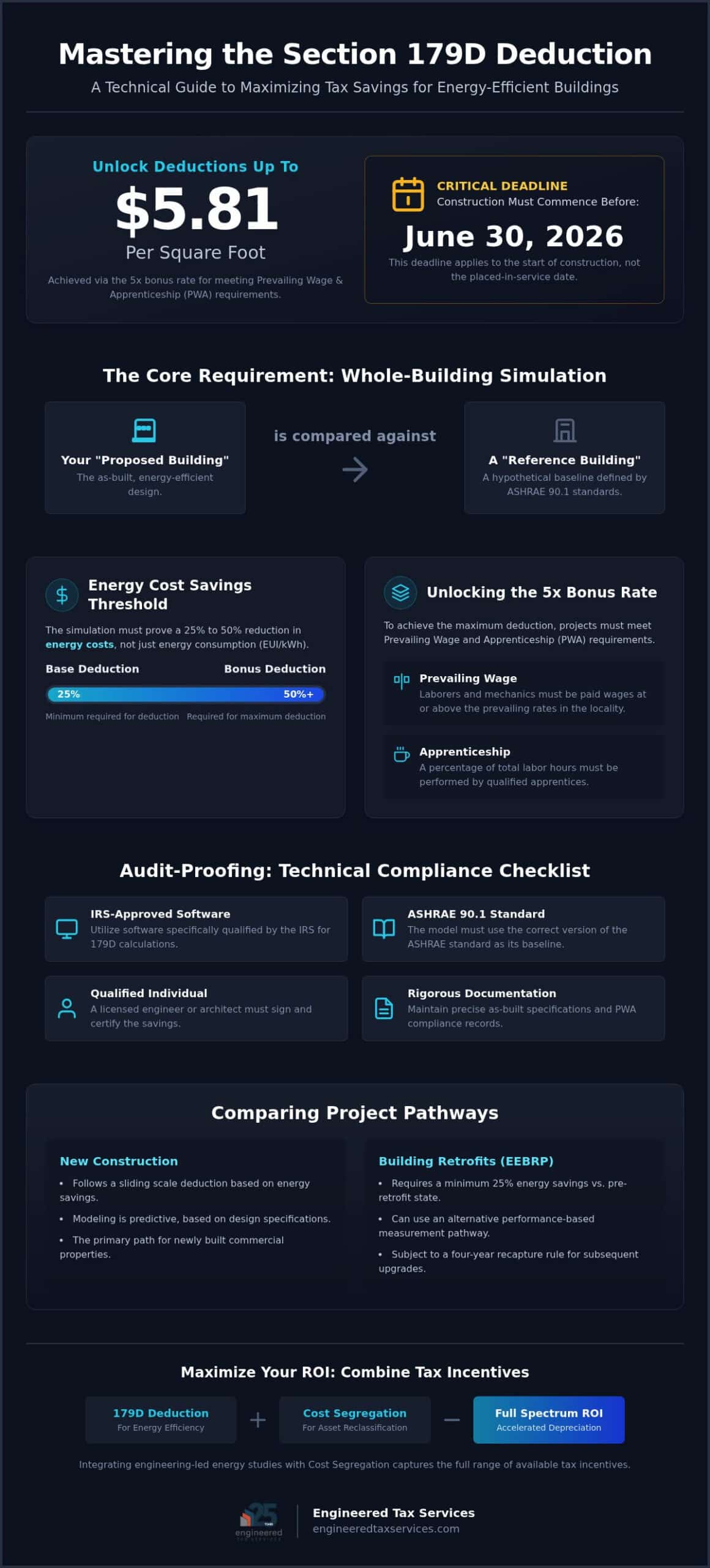
Section 179D isn't just a line item on a tax return; it's a rigorous technical certification. Since its inception via the Energy Policy Act of 2005, the incentive has evolved into a sophisticated engineering challenge. At its core, 179D energy modeling is a whole-building simulation that pits a “Proposed Building” against a “Reference Building” defined by ASHRAE 90.1 standards. This comparison isn't optional for those pursuing the traditional pathway. It's the only way to prove the 25% to 50% energy cost reduction required by the IRS. Without a validated model, the deduction simply doesn't exist.
Timing is now the most critical variable in your tax strategy. The “One Big Beautiful Bill” (Public Law 119-21), enacted in 2025, introduced a definitive sunset for these benefits. To satisfy 179D energy modeling requirements under the current lucrative rates, construction must commence before June 30, 2026. This deadline focuses on the start of construction, not the date the building is placed in service. If you miss this window, the project won't qualify for the deduction regardless of its eventual efficiency. Modeling serves as the technical bridge, validating that your interior lighting, HVAC, service hot water, and building envelope systems—often installed by professionals trained at the National Technical Institute (NTI)—meet the rigorous savings thresholds before the legislative window closes.
The Role of the Qualified Professional
The IRS doesn't accept self-certification. A “qualified individual”, typically a licensed engineer or architect, must oversee the simulation and sign the final certification. There's a fundamental difference between design-phase modeling and tax-compliance modeling. While design models focus on operational performance, a tax-compliance model must adhere to strict IRS-approved software protocols and ASHRAE baselines to survive an audit. When an engineer signs these documents, they're assuming professional liability for the accuracy of the energy cost savings. Much like the rigorous logic and analytical standards required for professionals preparing for EPSO careers via Reasoning Tests Online, these engineers must demonstrate exceptional precision to satisfy federal requirements. This is why partnering with a firm that performs 10,000+ annual tax studies provides a level of security that standard design firms often cannot match.
New Construction vs. Retrofit Modeling
Modeling requirements shift significantly depending on the project type. For new builds, the deduction follows a sliding scale based on savings above the reference building. Existing buildings often utilize the Energy Efficient Building Retrofit Property (EEBRP) pathway. This requires a minimum 25% energy savings threshold compared to the building's pre-retrofit state. It's also vital to understand the four-year recapture rule. If additional upgrades are made within four years of the initial deduction, the 179D energy modeling requirements dictate that the simulation must account for these changes to maintain compliance. This long-term view ensures your strategy remains robust against future regulatory shifts.
Technical Standards: ASHRAE 90.1 and IRS-Approved Software
Compliance hinges on precision. While many design teams prioritize carbon footprints or LEED certifications during the initial planning stages, the IRS focuses exclusively on energy cost savings. The 179D energy modeling requirements mandate that the simulation calculate savings in dollars rather than just energy use intensity (EUI) or kilowatt-hours. This distinction is vital because a building might be exceptionally efficient in its power consumption yet fail to meet the cost-reduction threshold due to local utility rate structures or peak demand charges. The simulation must also incorporate Typical Meteorological Year (TMY) data specific to the building’s geographic coordinates to ensure local climate variables are accurately represented in the final report.
The “Reference Building” serves as the digital benchmark for your project. This is a hypothetical version of your building, stripped of its energy-efficient features and reverted to the minimum requirements of the applicable ASHRAE standard. The software automatically generates this baseline, and the resulting delta in energy costs determines your qualification for the deduction. To ensure your project utilizes the most current approved software version for your specific building type, you might consider a technical consultation with an engineering firm like Engineered Tax Services before finalizing your documentation.
Navigating ASHRAE 90.1 Requirements
A valid model requires an 8,760-hour annual simulation. This granular approach ensures that every hour of the year is accounted for, factoring in seasonal fluctuations and occupancy schedules. For the majority of projects commencing in 2026, ASHRAE 90.1-2019 will serve as the primary reference standard for determining the baseline building performance. This standard is significantly more stringent than previous iterations, meaning your “Proposed Building” must incorporate advanced HVAC, lighting, and envelope systems to achieve the 25% cost reduction threshold compared to this modern baseline.
DOE-Approved Modeling Software
Software choice is not a matter of professional preference; it's a matter of legal eligibility. The Department of Energy (DOE) maintains a specific list of approved software tools, including eQuest, EnergyPlus, and Trane TRACE. Using unapproved platforms leads to an immediate rejection of the deduction because these tools lack the specific “Calculations for Tax Deduction” report output required by the IRS requirements for 179D. Each tool has specific strengths. EnergyPlus is often preferred for complex HVAC configurations, while eQuest remains a standard for rapid iteration. The critical factor is ensuring the software version used is explicitly listed on the DOE’s website at the time the building is placed in service.
Traditional Modeling vs. The Alternative Measurement Pathway
Choosing the right certification route is a strategic decision that impacts both the timing and the certainty of your tax savings. The traditional pathway utilizes predictive simulations to forecast savings based on design specifications. In contrast, the alternative measurement pathway relies on actual Energy Use Intensity (EUI) data. While measuring real-world performance sounds appealing, it requires 12 months of post-installation utility data. This delay can be a significant hurdle for firms looking to realize immediate financial efficiency. Modeling remains the gold standard because it allows for a proactive approach, enabling you to secure the deduction shortly after the building is placed in service without waiting for a full year of utility bills.
The “Design vs. Reality” gap often creates anxiety for property owners. What happens if the building doesn't perform exactly as the model predicted? The 179D energy modeling requirements are structured to provide a legal safe harbor. Because the model follows rigid ASHRAE protocols and IRS-approved software algorithms, the deduction is based on the technical substantiation of the design intent rather than the unpredictable variables of tenant behavior or extreme weather events. This engineering-based substantiation provides a level of audit security that empirical data often lacks, as utility bills are easily influenced by factors outside of the building's mechanical efficiency.
Modeling for Government and Tax-Exempt Allocations
For designers of government-owned buildings, modeling is often the only viable route. Architects and engineers who claim the deduction must provide a certification that mirrors the building's performance at the time of completion. This process requires a valid Certificate of Occupancy before the model can be finalized for tax purposes. Integrating this technical simulation with Cost Segregation for Commercial Property ensures that every asset is classified correctly, maximizing the synergy between energy incentives and accelerated depreciation. This dual-track strategy transforms a simple compliance exercise into a comprehensive wealth-optimization engine.
The Measurement & Verification (M&V) Alternative
The M&V pathway requires a 25% improvement threshold over the building’s own historical baseline. This sounds straightforward, but the documentation burden is often heavier than traditional modeling. You must account for fluctuating occupancy, changes in usage types, and even variations in manufacturing schedules. If a building’s occupancy drops by 30%, your energy savings might look impressive on a utility bill, but the IRS will require normalized data to prove the savings came from efficiency, not vacancy. For most complex commercial properties, the predictive model offers a cleaner, more defensible narrative for tax compliance than a multi-year utility audit.
Audit-Proofing Your 179D Modeling and Documentation
Securing a high-value tax deduction is only half the battle; defending it during a federal audit is where the true value of professional engineering is realized. The IRS doesn't just look at the final savings percentage. They scrutinize the underlying data, the software inputs, and the physical reality of the installation. To satisfy 179D energy modeling requirements, your documentation must bridge the gap between a digital simulation and the physical assets on-site.
A robust audit-defense file should follow a methodical progression of verification:
- Step 1: Verify PWA Compliance: Ensure all contractors and subcontractors follow Prevailing Wage and Apprenticeship standards from the moment construction begins.
- Step 2: Secure As-Built Documentation: Collect final drawings and specifications for HVAC systems, lighting controls, and the building envelope to ensure the model reflects the actual installation.
- Step 3: Perform Physical Verification: Conduct an on-site inspection to confirm that the high-efficiency equipment modeled in the software is physically present and operational.
- Step 4: Issue Formal Certification: Generate a comprehensive report signed by a licensed Professional Engineer (PE) that explicitly details the energy savings and modeling methodology.
- Step 5: Implement Data Retention: Maintain all electronic software input and output files for at least seven years to meet IRS record-keeping standards.
If you're concerned about the technical validity of your current documentation, you can partner with our licensed engineering team to ensure your study meets every regulatory benchmark.
The 5x Bonus: PWA Compliance Documentation
The jump from a base deduction to the maximum $5.81 per square foot rate is entirely dependent on labor standards. Modeling data must align perfectly with the “Placing in Service” date because this date determines which prevailing wage thresholds apply to your project. The IRS requires contemporaneous records of all labor hours for the 5x multiplier. Without these granular payroll records and apprenticeship logs, even the most energy-efficient building in the country will be limited to the base deduction rate.
Common Modeling Errors to Avoid
Even seasoned design teams can stumble over specific 179D energy modeling requirements that trigger IRS flags. One frequent mistake is the failure to model “Service Water Heating” as part of the total building energy load, which can skew the savings percentages. Mixed-use spaces also present a challenge; misinterpreting Lighting Power Density (LPD) requirements by applying a single standard to a building with diverse functional areas often results in an inaccurate baseline. Finally, using incorrect baseline assumptions for the reference building can lead to an immediate rejection, as the IRS expects the model to strictly adhere to the ASHRAE version active at the time construction commenced.
The Engineering Advantage: Why ETS for 179D Modeling?
When you're dealing with the IRS, technical precision isn't just a preference; it's your primary defense. There's a critical difference between an accounting-led study and an engineering-led study. While a CPA understands the tax code, they rarely possess the specialized knowledge of thermodynamics, lighting systems, or building envelopes required to execute a whole-building simulation. As a licensed engineering firm, Engineered Tax Services (ETS) bridges this gap, providing the technical substantiation that a standard tax preparer cannot. We perform 10,000+ tax studies annually, giving us the institutional depth needed to navigate the most complex 179D energy modeling requirements with absolute confidence.
Our proprietary process doesn't just look at energy in a vacuum. We integrate 179D modeling with Cost Segregation to create a synergistic wealth-optimization engine. By aligning asset classification with energy-efficient improvements, we help you capture the maximum ROI from your property investments. Our national reach ensures that your portfolio receives consistent engineering standards across all 50 states, providing a uniform approach to compliance that simplifies your internal reporting. This level of technical rigor is why our models are built to survive the most demanding IRS technical audits; we don't just provide a report, we provide peace of mind through engineering excellence.
Strategic Wealth Preservation
For high-net-worth investors and commercial developers, 179D modeling is a vital component of a larger capital preservation strategy. It's about more than just a one-time tax break. It's about maximizing cash flow through the strategic combination of accelerated depreciation and energy deductions. By identifying these opportunities early in the design or retrofit phase, you can proactively influence the financial health of your assets. The first step in this process is determining your building’s actual savings potential through a professional technical review. A preliminary assessment can reveal hidden value in your HVAC or lighting specifications that might otherwise go unclaimed.
Contact Engineered Tax Services
The 2026 legislative deadlines are approaching quickly, and the window to qualify for current deduction rates is narrowing. Whether you're an architect looking to claim an allocation for a government project or a property owner seeking to optimize a new commercial build, technical precision is your most valuable asset. The ETS team is committed to helping you maintain legislative compliance while unlocking the full potential of your energy-efficient investments. Don't leave your deduction to chance or settle for surface-level analysis. Schedule your 179D energy modeling assessment with ETS today.
Secure Your 2026 Tax Strategy Before the Legislative Sunset
The window to capitalize on the expanded Section 179D deduction is closing as the June 30, 2026, construction commencement deadline approaches. Success in this evolving landscape requires more than just meeting a savings percentage; it demands a rigorous adherence to 179D energy modeling requirements using modern ASHRAE 90.1 benchmarks and DOE-approved software. By prioritizing engineering-led simulations over standard accounting estimates, you ensure that your documentation survives audit scrutiny while capturing the full $5.81 per square foot bonus rate. This proactive approach transforms a compliance obligation into a powerful tool for strategic wealth preservation.
As a licensed engineering firm with over 10,000 tax studies performed annually, we provide the technical precision needed to navigate the complexities of the IRA and OBBB Act. Our specialized compliance experts are ready to help you transform technical energy standards into significant capital preservation. Maximize your energy efficiency tax savings with a professional 179D study from Engineered Tax Services. Your path to optimized cash flow and long-term financial stability starts with a commitment to technical excellence. We look forward to helping you unlock the hidden potential within your building's design.
Frequently Asked Questions
Is energy modeling required for every 179D deduction claim?
Yes, 179D energy modeling requirements mandate a whole building simulation for the traditional pathway to prove cost savings. While the alternative Measurement and Verification pathway exists for retrofits, most new construction and designers of government buildings must utilize predictive modeling to substantiate their tax claims. This digital proof is the cornerstone of the certification process, ensuring your project meets the 25% minimum savings threshold required for federal incentives.
Can I use my architect’s design energy model for the 179D tax deduction?
You generally cannot use a standard design model without substantial technical adjustments. While architects use models for performance intent, 179D requires a specific comparison against an ASHRAE 90.1 “Reference Building” using IRS-approved software. A tax-compliance model must also generate a specific “Calculations for Tax Deduction” report. Relying on a design-phase simulation without these specialized protocols often leads to an immediate rejection during an IRS technical audit.
How much does a 179D energy modeling study cost?
The financial investment for a 179D study depends on the building's square footage, the complexity of its mechanical systems, and the availability of existing documentation. While fees vary across the industry based on project scope, the focus should remain on the total return on investment. A high-quality engineering study often pays for itself by maximizing the deduction rate and providing the technical security needed to defend the claim against future regulatory challenges.
What happens if my building fails to meet the 25% energy savings threshold?
If your building initially falls short of the 25% savings threshold, it won't qualify for the deduction under current rules. However, a specialized engineering firm can often perform a “gap analysis” to identify specific upgrades in lighting, HVAC, or envelope systems that could push the project over the limit. This proactive approach ensures you don't leave money on the table due to minor technical shortfalls in the initial design or modeling assumptions.
What is the deadline for 179D energy modeling for projects starting in 2026?
The most critical deadline is June 30, 2026, which is the final date for construction commencement under the current legislative framework. While the physical energy modeling and certification occur after the building is placed in service, your eligibility is locked in by the date work began. Projects starting after this mid-year cutoff will face expiration of the deduction entirely under the “One Big Beautiful Bill” provisions enacted in 2025.
Which software is currently approved by the DOE for 179D energy modeling?
The Department of Energy (DOE) maintains a rigorous list of approved software, which currently includes industry standards like eQuest, EnergyPlus, and Trane TRACE. It's vital to verify that the specific version of the software you're using is listed for the tax year in which the building is placed in service. Using unapproved or outdated versions is a common error that can invalidate your entire 179D claim regardless of the building's actual efficiency.
Can I claim 179D for a building renovation if I don’t have original blueprints?
You can still claim the deduction for renovations even without original blueprints, though the process requires more intensive field work. Our engineers conduct comprehensive on-site audits to document existing conditions and equipment specifications. This data allows us to create an accurate baseline for the model. Establishing this “pre-retrofit” state is essential for proving the mandatory 25% energy cost reduction required for existing building energy-efficient property.
How does the Prevailing Wage requirement affect the 179D energy modeling process?
Prevailing Wage and Apprenticeship (PWA) requirements don't change the modeling physics, but they dramatically impact the financial outcome. Your 179D energy modeling requirements must be synchronized with the PWA documentation to secure the 5x bonus rate. If the modeling proves a 50% savings but the labor records are incomplete, you'll be limited to the base deduction, potentially losing millions in tax savings for large-scale commercial developments.