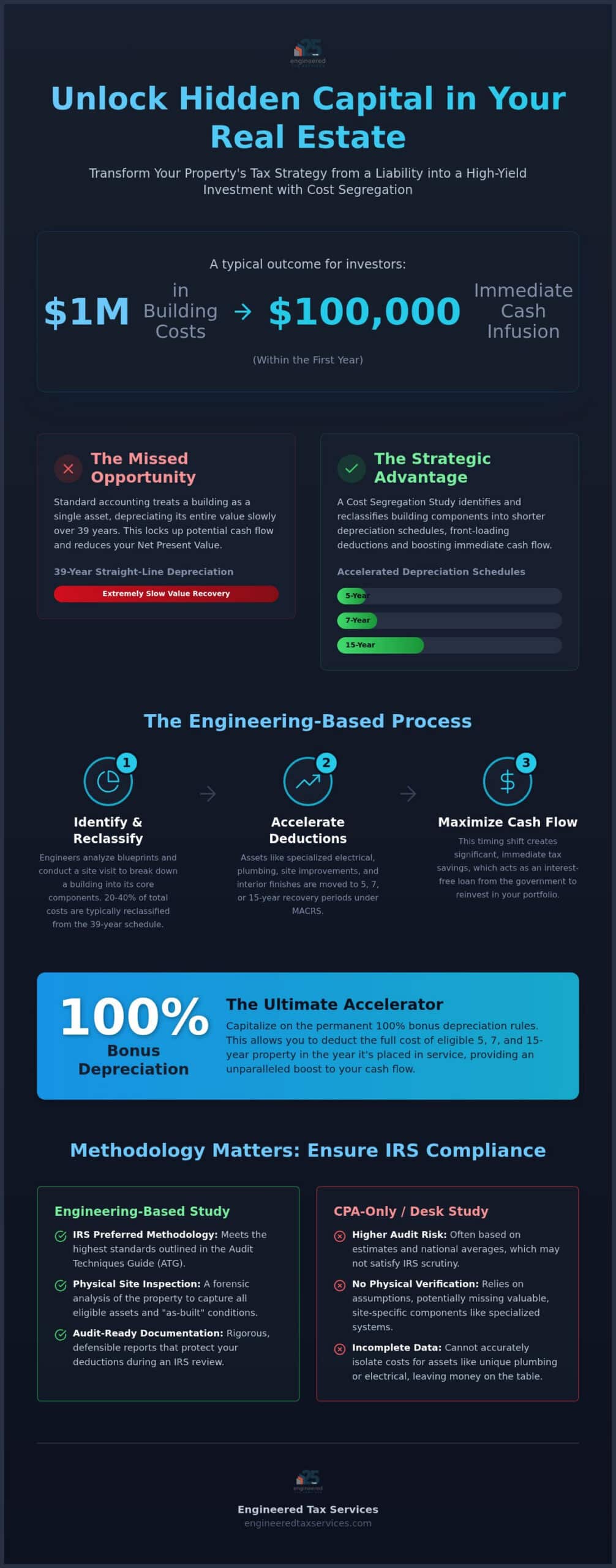
What if your real estate portfolio could generate an immediate cash infusion of $100,000 for every $1 million in building costs within the first year? Many investors feel buried by high tax liabilities on new acquisitions, particularly as they struggle to keep pace with evolving IRS guidance. You likely realize that standard 39-year depreciation schedules are a massive missed opportunity for wealth preservation. By examining a detailed cost segregation study example, you can see how engineering-grade data transforms static assets into liquid capital. It’s frustrating to leave money on the table because of complex tax codes, but the path to optimization is clearer than you think.
We’ll show you exactly how a professional engineering-based study unlocks massive savings by reclassifying assets into 5, 7, and 15-year categories. With 100% bonus depreciation now permanent under the One Big Beautiful Bill Act of 2025, your potential for immediate cash flow is at an all-time high. This article explores real-world property scenarios and explains how to maintain IRS compliance under Notice 2026-11 through rigorous, defensible documentation. You’ll gain a clear understanding of how to maximize your 2026 returns while eliminating the fear of audit risks. It’s time to move beyond simple compliance and start treating your tax strategy as a high-yield investment.
Key Takeaways
- Accelerate your cash flow by shifting property components from 39-year schedules to 5, 7, or 15-year windows.
- Secure your deductions with engineering-based methodologies that meet the highest IRS standards for documentation and audit defense.
- Analyze a practical cost segregation study example to see how specific assets like specialized electrical and site improvements impact your bottom line.
- Capitalize on the permanent 100% bonus depreciation rules by strategically timing when your property is placed in service.
- Leverage an Engineered Incentives Report to integrate multiple tax credits into a single, cohesive wealth preservation strategy.
What is a Cost Segregation Study? The Mechanics of Accelerated Depreciation
Standard accounting often treats a building as a single, massive unit depreciated over 39 years for commercial use or 27.5 years for residential property. This approach is inefficient because it ignores the reality that a building is a collection of distinct components with varying lifespans. A What is a Cost Segregation Study? allows owners to break down these components into shorter recovery periods. By identifying personal property and land improvements, you can reclassify 20% to 40% of a building’s cost into 5, 7, or 15-year schedules.
This shift significantly increases your Net Present Value (NPV) by front-loading tax deductions. It isn’t just about total savings; it’s about the timing of those savings. For instance, a cost segregation study example might involve moving $500,000 of interior finishes from a 39-year schedule to a 5-year schedule. This move generates an immediate increase in after-tax cash flow that can be reinvested into new acquisitions or operational improvements. While some firms offer “desk studies” based on estimates, these often fail to meet the rigorous standards of the IRS Audit Techniques Guide. A full engineering-based analysis involving a site visit is the only way to ensure every eligible asset is captured and documented for audit defense.
MACRS and the Tangible Property Regulations
The Modified Accelerated Cost Recovery System (MACRS) serves as the framework for these reclassifications. Since the 2014 Tangible Property Regulations (TPR) were introduced, the distinction between structural components and “incidental” assets has become even more critical for property owners. These regulations provide a roadmap for identifying which costs are capitalized and which can be expensed. It’s no longer enough to guess. You need a precise engineering analysis to distinguish between the building’s core structure and the specialized systems that support your business operations.
The Concept of ‘Time Value of Money’ in Tax Planning
Tax planning is fundamentally a game of timing. A dollar saved today is worth significantly more than a dollar saved ten years from now because that capital can be put to work immediately. Cost segregation effectively functions as an interest-free loan from the federal government, providing you with liquidity when you need it most. Cost segregation is an engineering-based tool for wealth preservation that optimizes the timing of tax obligations to maximize immediate reinvestment potential. When reviewing a cost segregation study example for a retail center, one might find that specialized lighting and decorative finishes qualify for much faster recovery periods than the roof or walls.
Engineering-Based vs. CPA-Only Studies: Why Methodology Matters
Methodology isn’t just a technical choice; it’s a compliance requirement. The IRS Audit Techniques Guide (ATG) explicitly prefers engineering-based methodologies over “desk studies” or rule-of-thumb estimates. Standard accounting software often relies on national averages that don’t account for specific site conditions or “as-built” construction costs. For instance, a cost segregation study example for a medical facility would require identifying specialized plumbing and electrical systems that generic software simply can’t isolate from structural costs. Without a detailed breakdown of these costs, you risk leaving significant capital on the table.
Professional credibility matters when reclassifying millions in assets. A Journal of Accountancy analysis highlights how these specialized studies provide the necessary bridge between tax law and physical construction reality. It’s about moving beyond simple book entries to technical substantiation. Engineers use blueprints, specialized software, and physical inspections to calculate the exact value of each component. This level of detail is what protects your wealth during an IRS review. If you want to ensure your documentation is audit-ready, you can explore how our Cost Segregation experts provide this technical precision.
The Site Inspection: More Than Just Photos
Engineers don’t just take pictures; they conduct a forensic analysis of the property. During a physical walk-through, they look for specialized wiring, reinforced flooring, and HVAC systems dedicated to specific equipment. These “hidden” assets often make up a significant portion of the accelerated depreciation pool. Verifying the existence and condition of these assets ensures the final report is grounded in physical truth, not just architectural drawings. This step is vital for properties that have undergone renovations or additions since their original construction.
Audit Defensibility and Professional Liability
Using “rule of thumb” percentages is a recipe for IRS scrutiny. An engineering firm provides a higher level of substantiation because their reports are based on detailed cost estimations and specialized software. This precision reduces the risk of audit adjustments that could claw back your tax savings. We serve as your strategic partner, defending our reports through the entire life of the property. This institutional knowledge provides peace of mind, knowing that your tax positions are supported by rigorous standards and technical expertise. Relying on an cost segregation study example that lacks this depth could lead to costly corrections down the line.
Real-World Cost Segregation Study Examples by Property Type
Applying a strategic lens to different asset classes reveals how physical characteristics dictate tax savings. A multifamily complex offers vastly different reclassification opportunities than a cold-storage warehouse. While the core objective remains the same, the specific assets identified vary based on the property’s use and construction. We see this play out in every cost segregation study example we conduct, where engineering precision uncovers value that standard accounting misses. By isolating components that support specific business functions, such as the specialized infrastructure in a distribution center served by drivers from Lone Star Truck Driving Academy, we move beyond the building shell to find hidden capital.
Medical office buildings and retail strip centers offer unique special purpose assets. In medical facilities, we isolate specialized plumbing for exam rooms and decorative finishes that create a premium patient experience. Retail centers benefit from a deep dive into tenant improvements and expansive parking lot structures. Each cost segregation study example demonstrates that the more specialized the property, the greater the opportunity for engineering-based wealth optimization. This granular analysis is what separates a standard tax filing from a comprehensive wealth preservation strategy.
Example: $5M Multifamily Property Analysis
In a $5M multifamily property analysis, we typically see 20% to 30% of the basis reclassified into accelerated categories. This includes 5-year personal property like luxury vinyl plank flooring, kitchen cabinetry, and high-end appliances. We also identify 15-year land improvements such as asphalt paving, site lighting, and perimeter fencing. By moving $1.25 million from a 27.5-year schedule to these shorter windows, the owner realizes a massive jump in first-year depreciation. This front-loaded deduction provides immediate liquidity to fund further renovations or acquire additional units, effectively using tax savings as a low-cost capital source.
Example: $10M Industrial Facility Analysis
Industrial facilities often present the highest potential for specialized reclassification due to process-related infrastructure. In a $10M industrial facility analysis, engineers look beyond the shell to identify dock levelers, reinforced flooring for heavy machinery, and specialized power drops. These components aren’t just part of the building; they are essential to the operations and qualify for 5 or 7-year depreciation. Implementing cost segregation commercial property strategies on these facilities can significantly boost ROI. Security systems and specialized HVAC for temperature-controlled zones also fall into these accelerated pools, transforming a static warehouse into a high-yield tax shield.
Maximizing Cash Flow: The Impact of 2026 Bonus Depreciation Rules
The landscape for real estate investment shifted dramatically with the passage of the One Big Beautiful Bill Act in July 2025. While previous years followed a strict phase-out schedule, 2026 now offers a permanent 100% bonus depreciation rate for qualified property. This creates an unprecedented opportunity for investors to write off the entire cost of short-life assets in a single year. When you review a cost segregation study example for a new acquisition, you’ll see how this rule transforms a standard deduction into a powerful cash flow engine. It’s no longer about waiting decades to recoup your investment; it’s about immediate capital recovery.
Strategic timing remains essential for maximizing these benefits. Assets must be “placed in service” to qualify, meaning they are ready and available for their intended use. This distinction is critical for developers and those undergoing major renovations. For small to mid-sized investors, the interplay between Section 179 expensing and cost segregation provides multiple paths to zero out tax liability. By aligning these tools, you can ensure your property works as hard for your bottom line as it does for your tenants. If you’re ready to see how these rules apply to your portfolio, contact our team for a Cost Segregation analysis today.
The 2026 Landscape: Permanent 100% Bonus Depreciation
The expected step-down in bonus depreciation percentages has been reversed, providing long-term certainty for the first time in years. Under IRS Notice 2026-11, taxpayers are directed to apply existing regulations with these updated, permanent 100% rates. This change makes engineering precision even more valuable. Because every dollar reclassified now qualifies for a full deduction, the accuracy of your cost segregation study example directly determines the size of your tax shield. High-quality documentation is the only way to secure these massive deductions against future IRS scrutiny.
Catch-Up Depreciation: No Amended Returns Needed
Many owners don’t realize they can claim missed depreciation from properties acquired years ago without filing amended tax returns. By using Form 3115 and a Section 481(a) adjustment, you can “catch up” on all the accelerated depreciation you should have taken since the day you bought the building. Catch-up depreciation allows property owners to consolidate years of missed deductions into a single, massive one-year tax windfall that immediately offsets current income. This strategy is particularly effective in 2026, as it provides a significant liquidity boost without the administrative burden of reopening past tax years.
The ETS Difference: Implementing Your Strategic Tax Plan
Choosing the right partner is the final step in securing your financial legacy. At Engineered Tax Services (ETS), we don’t just provide reports; we act as a specialized bridge between engineering precision and complex tax law. Our licensed engineers perform over 10,000 studies annually, ensuring that every cost segregation study example we produce is rooted in technical accuracy and audit-defensibility. This institutional knowledge is vital for protecting your wealth as you navigate the permanent 100% bonus depreciation rules. We prioritize your long-term stability by delivering documentation that stands up to the highest levels of IRS scrutiny.
Technical precision is our hallmark. While a CPA might understand the tax code, they often lack the engineering background required to identify specialized structural components. We combine these disciplines to offer a level of detail that generic accounting firms simply cannot match. This proactive approach turns your tax liabilities into growth opportunities. By analyzing the physical reality of your property, we ensure you claim every dollar you’re legally entitled to keep.
A Holistic Approach to Property Tax Incentives
Cost segregation is often the primary driver of immediate cash flow, but it’s just one piece of a comprehensive tax planning for property investors strategy. During our engineering site visits, we look for every possible way to maximize your return. This includes identifying energy-efficient assets that qualify for 179D EPAct tax deductions or 45L tax credits. By integrating these incentives into a single Engineered Incentives Report, we help you preserve capital for future acquisitions or strategic 1031 exchanges. Our goal is to unlock the hidden potential within your property while simplifying the path to optimization.
Getting Started with a Preliminary Analysis
Transforming your property into a tax-efficient asset begins with a clear, data-driven assessment. We start with a preliminary benefit analysis to determine the potential return on investment for your specific property type. To begin this process, you’ll need to provide a few key documents:
- A final closing statement or cost basis documentation.
- A recent appraisal of the property.
- Architectural drawings or blueprints, if available.
- A detailed depreciation schedule for existing assets.
Once we have this information, our engineers perform a deep dive into the “as-built” construction costs. The timeline from engagement to the final delivery of your engineering report typically spans several weeks, depending on the complexity of the site. We handle the heavy lifting of data collection and technical analysis so you can focus on growing your portfolio. Every cost segregation study example in our portfolio represents a commitment to precision and client advocacy. Don’t leave your wealth preservation to chance. Schedule your professional consultation with Engineered Tax Services today.
Secure Your Financial Future Through Strategic Asset Reclassification
Engineering precision is the foundation of defensible tax planning. By moving beyond generic accounting estimates, you ensure that every eligible asset is accurately classified to maximize your immediate liquidity. The permanent 100% bonus depreciation rules for 2026 provide a rare window to transform static property into a high-yield cash flow engine. Whether you’re acquiring new assets or reviewing a cost segregation study example for an existing portfolio, the quality of your documentation determines the strength of your wealth preservation strategy.
As an independent, licensed engineering firm and national authority on incentives, we perform over 10,000 studies annually to help investors bridge the gap between technical construction and tax law. Our expertise ensures your deductions are both maximized and protected against IRS scrutiny. It’s time to take control of your tax liability and reinvest that capital into your next growth opportunity. We’re ready to serve as your strategic partner in optimizing every square foot of your investment, and for those interested in the future of asset management, you can read more about tokenizing real-world assets.
Request Your Complimentary Cost Segregation Benefit Analysis
Your path to optimized cash flow starts with a single strategic decision. We look forward to helping your portfolio reach its full financial potential through technical excellence and rigorous standards.
Frequently Asked Questions
What is a typical cost segregation study example for a residential rental?
A typical example for a residential rental involves reclassifying 15% to 25% of the building’s purchase price into shorter depreciation cycles. This process identifies assets like carpeting, cabinetry, and appliances as 5-year personal property. It also moves land improvements like fencing and driveways into 15-year schedules, significantly accelerating deductions compared to the standard 27.5-year timeline.
Can I perform a cost segregation study on a property I bought several years ago?
Yes, you can perform a look-back study on properties acquired in previous tax years. The IRS allows you to claim all missed depreciation in the current year through a Section 481(a) adjustment. This strategy provides an immediate cash infusion without the need to file amended tax returns for the years you missed those deductions.
Does a cost segregation study increase my risk of an IRS audit?
No, a professional engineering-based study actually provides a layer of protection by meeting the rigorous standards of the IRS Audit Techniques Guide. These reports use technical data and physical inspections to substantiate every claim. By providing a clear and defensible audit trail, you reduce the likelihood of adjustments during an IRS review.
How much does a cost segregation study typically cost for a commercial building?
The investment for a study is based on the size, location, and mechanical complexity of the property. Large commercial facilities requiring detailed on-site forensic analysis involve more resources than smaller residential units. Most investors find the resulting tax savings provide a return that is several times the cost of the professional engineering services.
What is the difference between a desk study and an engineering-based study?
A desk study relies on remote estimates and generic cost data, while an engineering-based study involves a physical site inspection and forensic cost modeling. The IRS explicitly prefers the engineering approach because it identifies “as-built” costs rather than rough averages. This technical precision is essential for capturing every eligible asset and ensuring long-term audit defensibility.
Is bonus depreciation still available in 2026 for cost segregation?
Yes, 100% bonus depreciation is available for qualified property placed in service during 2026. This was made permanent by the One Big Beautiful Bill Act of 2025, reversing previous phase-out schedules. In this environment, a cost segregation study example for a new acquisition can lead to a full first-year deduction for all reclassified short-life assets.
Do I need to amend my previous tax returns to claim accelerated depreciation?
No, you don’t need to amend your prior returns to catch up on missed depreciation. You simply file IRS Form 3115, which is an Application for Change in Accounting Method. This allows you to consolidate all previous years of missed accelerated depreciation into a single, massive deduction on your current year’s return.
What types of assets are most commonly reclassified in a study?
Personal property and land improvements are the most frequent targets for reclassification. This includes interior finishes like specialized lighting and cabinetry, along with external features like asphalt paving and perimeter fencing. Every cost segregation study example highlights how these specific items move from 39-year structures to 5 or 15-year recovery periods to maximize cash flow.