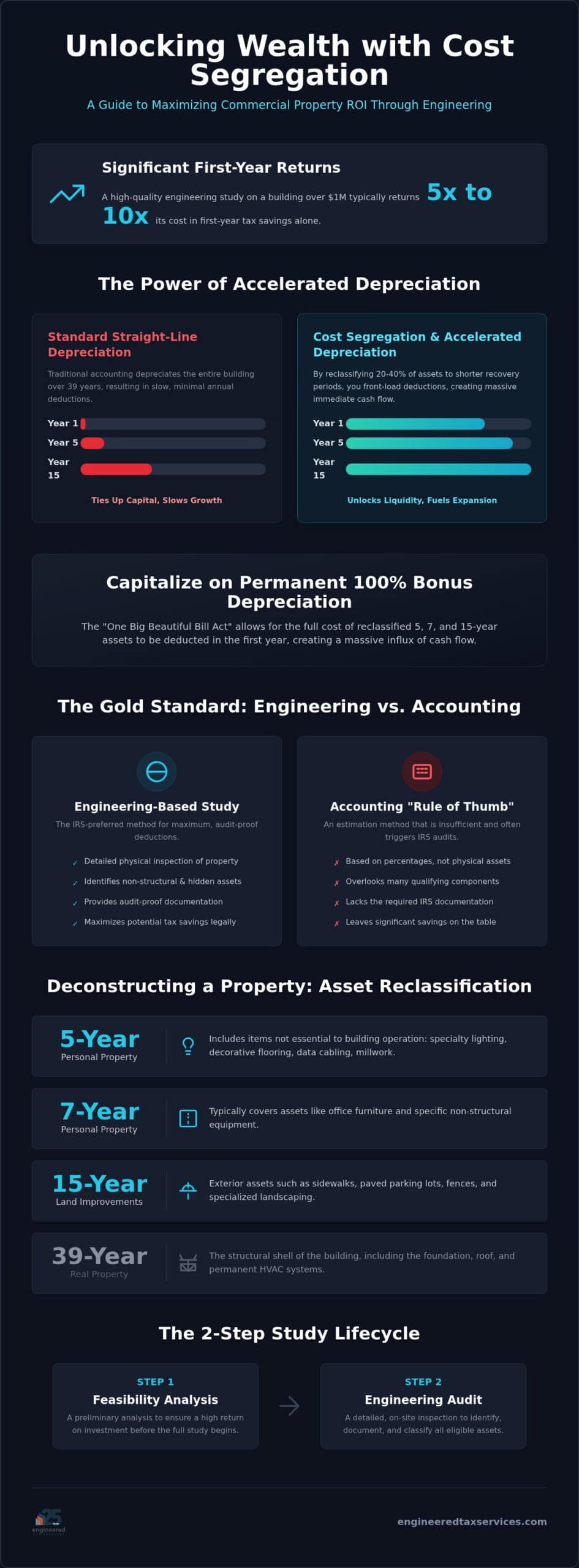
Did you know that a high-quality engineering study on a building valued over $1 million typically returns five to ten times its cost in first-year tax savings? Most investors feel the weight of heavy tax liabilities on new acquisitions, often looking for a more efficient cost segregation commercial property strategy to mitigate these costs. You've likely felt the sting of capital being tied up in federal taxes when it could be fueling your next portfolio expansion.
It's a common challenge, but it is also a massive opportunity for growth. This guide reveals how to unlock immediate cash flow and maximize your ROI through engineering-based methodologies, specifically leveraging the permanent 100% bonus depreciation restored by the One Big Beautiful Bill Act. We'll examine the technical precision required to provide audit-proof documentation while transforming your tax strategy into a high-performance wealth optimization engine. By moving beyond simple accounting and into specialized engineering analysis, you can secure the liquidity needed to scale your holdings with confidence.
Key Takeaways
- Learn how to transition from 39-year straight-line depreciation to accelerated 5, 7, and 15-year schedules to significantly increase your current year cash flow.
- Understand why an engineering-based approach to cost segregation commercial property is essential for reclassifying building components legally and withstanding IRS scrutiny.
- Capitalize on the permanent 100% bonus depreciation rules established by the One Big Beautiful Bill Act to realize substantial first-year tax deductions.
- Explore the two-step lifecycle of a professional study, beginning with a feasibility analysis to ensure a high return on investment before the engineering audit begins.
- Discover how to compound your wealth by integrating accelerated depreciation with energy-efficient incentives like the 179D deduction for a holistic tax strategy.
The Strategic Impact of Cost Segregation on Commercial Property Portfolios
Cost segregation is far more than a simple line item on a tax return; it's a strategic, engineering-based analysis designed to dissect building components and reassign them to their proper recovery periods. For owners of a cost segregation commercial property, the traditional 39-year straight-line depreciation is often a missed opportunity for liquidity. By conducting a formal cost segregation study, you can reclassify between 20% and 40% of your building's basis into 5, 7, and 15-year recovery schedules. This shift capitalizes on the principle of the Time Value of Money. A dollar saved in taxes today is significantly more valuable than a dollar saved decades from now, as that capital can be immediately reinvested into your portfolio to generate compound growth.
In 2026, this strategy has become even more potent. The passage of the “One Big Beautiful Bill Act” in July 2025 made 100% bonus depreciation permanent for qualified property acquired after January 19, 2025. This means that assets reclassified through cost segregation can often be fully deducted in the first year. This creates a massive influx of cash flow that can transform the financial trajectory of a commercial investment, providing the immediate capital needed to stay competitive.
Why Real Estate Investors Prioritize Cost Segregation
Savvy investors view accelerated depreciation as a primary tool for wealth preservation. Unlocking this hidden capital provides the liquidity needed for immediate property improvements or new acquisitions without seeking external financing. By reducing your immediate federal tax liability, you effectively lower the “net” purchase price of the asset. This strategy also strengthens your financial position with lenders. Increased cash flow improves your debt-coverage ratios, providing a more robust balance sheet that supports future growth and portfolio expansion.
The Difference Between Accounting Estimates and Engineering Studies
Don't confuse a technical engineering study with a basic accounting estimate. The IRS is clear: “rule of thumb” percentages based on property types are insufficient and often trigger audits. True optimization requires a licensed engineering firm to perform a detailed physical inspection and document non-structural elements. Engineers identify components like specialized electrical systems, millwork, and site improvements that an accountant might overlook. An engineering-based study is the recognized gold standard for IRS compliance, providing the technical documentation required to defend your deductions. This level of precision ensures that your wealth optimization strategy is both maximized and secure.
Engineering vs. Accounting: How Asset Classification Drives Accelerated Depreciation
While many investors view depreciation as a static accounting entry, true wealth optimization relies on an engineering perspective. Standard accounting practices often default to a 39-year straight-line schedule for the entire building. However, a detailed analysis of a cost segregation commercial property reveals that a building is actually a collection of individual assets, each with its own recovery period. By following standards set by the American Society of Cost Segregation Professionals, engineers can deconstruct a property into four primary categories. This technical breakdown is what allows you to move capital from long-term depreciation into immediate cash flow.
The classification process identifies assets in the following recovery buckets:
- 5-Year Personal Property: This includes items that aren't essential to the building's operation. Examples include specialty lighting, decorative flooring, and data cabling.
- 7-Year Personal Property: This category typically covers office furniture and specific pieces of equipment.
- 15-Year Land Improvements: These are exterior assets such as sidewalks, paved parking lots, fences, and specialized landscaping.
- 39-Year Real Property: This is the structural shell, including the foundation, roof, and permanent HVAC systems that serve the entire building.
Identifying Personal Property and Land Improvements
Precision is vital when distinguishing between structural elements and personal property. For instance, a standard wall is real property, but a decorative partition designed for a specific tenant use can often be reclassified as a 5-year asset. Engineers also look for “dedicated” mechanical systems. If an electrical circuit or plumbing line exists solely to support a piece of production equipment, it's categorized as personal property rather than part of the building's permanent systems. Site preparation also holds hidden value; drainage systems and grading specifically for parking areas fall into the 15-year land improvement category. If you want to see how these classifications apply to your specific portfolio, you can consult with a licensed engineering specialist to identify these hidden assets.
The Role of Tangible Property Regulations (TPR)
Tangible Property Regulations provide a framework for immediately expensing certain repairs rather than capitalizing them over decades. A cost segregation study is a prerequisite for maximizing these benefits, particularly through Partial Asset Disposition (PAD). If you renovate a building and replace the roof or windows, a study allows you to identify the remaining tax basis of the old components. You can then write off that value immediately rather than continuing to depreciate an asset that no longer exists. This strategy is especially powerful during major remodels, where demolishing building components can lead to significant, immediate write-offs that a standard tax filing would miss.
Navigating Bonus Depreciation and Tax Reform in 2026
The tax landscape for 2026 has been fundamentally reshaped by the “One Big Beautiful Bill Act” (OBBBA) passed in July 2025. This legislation provided essential certainty to real estate investors by making 100% bonus depreciation permanent for qualified property acquired and placed in service after January 19, 2025. For owners of a cost segregation commercial property, the ability to write off the full cost of reclassified assets in the first year is now a core pillar of long term wealth strategy. Utilizing a professional study ensures you capture every cost segregation tax benefits available, turning technical asset classification into immediate, usable capital for reinvestment.
Even with the return of permanent 100% bonus depreciation, the complexity of IRS Notice 2026-11 requires a higher level of technical documentation. The sunsetting provisions of the original Tax Cuts and Jobs Act (TCJA) still influence other areas of the tax code, making the optimization of depreciation even more vital for portfolio health. By maximizing first year write offs, you create a strategic buffer against rising interest rates and shifting corporate tax brackets. A study acts as a defensive shield. It ensures that your aggressive depreciation claims are backed by rigorous engineering standards that withstand IRS scrutiny. Timing is everything in 2026.
The 2026 Bonus Depreciation Landscape
The transition in early 2025 created a unique window of complexity that investors must navigate today. Assets placed in service between January 1 and January 19, 2025, were limited to a 40% bonus rate, while those following the January 19 cutoff jumped to the permanent 100% level. This discrepancy makes Section 481(a) “catch up” adjustments a vital tool for 2026 tax planning. Property acquired in prior years when rates were lower can still benefit from 100% bonus depreciation if a retroactive study is performed now. This allows you to claim missed deductions without the need for amended returns, providing a sudden influx of liquidity.
Strategic Timing for Property Acquisitions and Improvements
While performing a study in the year of acquisition is optimal for immediate cash flow, it's not the only path to value. Retroactive studies can be conducted for properties purchased up to 15 years ago, capturing historical depreciation that was never utilized. In 2026, as high net worth individuals and corporations face potential shifts in tax brackets, the decision to accelerate depreciation becomes a tactical move to offset higher liabilities. Timing your study to coincide with significant capital improvements or acquisitions ensures that your wealth preservation strategy remains proactive rather than reactive. This precision allows you to maintain a competitive edge in a shifting market.
The Lifecycle of a Cost Segregation Study: From Engineering Audit to IRS Compliance
A high-fidelity study for a cost segregation commercial property follows a rigorous four-stage lifecycle. This methodical approach ensures that every component is accounted for, valued accurately, and documented to withstand the highest levels of scrutiny. It's a technical journey that transforms a physical asset into a strategic tax instrument. To begin this process with a preliminary ROI estimate, you can request a feasibility analysis from our engineering team.
- Step 1: Feasibility Analysis. We perform a preliminary evaluation to estimate potential tax savings. This ensures the study provides a significant return on investment before you commit to the full process.
- Step 2: Engineering Site Visit. A licensed engineer conducts a physical inspection of the property. We document as-built conditions, take detailed photographs, and identify non-structural components that qualify for accelerated depreciation.
- Step 3: Cost Modeling. Using the data gathered, we apply engineering-based cost estimation. We use records, blueprints, and industry-standard unit costs to assign a precise value to every individual asset.
- Step 4: Final Report Delivery. You receive a comprehensive technical document. Your CPA uses this report to adjust your depreciation schedules and claim the identified tax benefits on your federal filing.
Why a Site Visit is Non-Negotiable
Precision requires presence. Many firms attempt “desk audits” that rely solely on original blueprints, but these documents rarely reflect the “as-built” reality of the property. Renovations, tenant improvements, and contractor deviations can significantly change the asset mix. By documenting these changes in person, our engineers often identify additional five-year assets that would otherwise remain hidden in the building's structural basis. These field notes and photographs serve as the primary evidence in the event of an IRS inquiry, providing a factual foundation that paper-only estimates simply cannot match.
Ensuring IRS Audit Protection
The IRS Cost Segregation Audit Techniques Guide (ATG) sets the standard for what constitutes a quality study. Adhering to these requirements is essential for security. Because ETS is a licensed engineering firm, our reports carry the weight of professional indemnity. An engineer's signature on the final document signals to the IRS that the study was conducted using recognized engineering methodologies rather than arbitrary accounting estimates. With a track record of performing over 10,000 studies annually, our work is designed to be audit-resistant. This technical rigor ensures that every cost segregation commercial property we analyze receives the maximum legal benefit while maintaining full regulatory compliance.
Optimizing Wealth Preservation with Engineered Tax Services
A siloed approach to tax planning often leaves significant capital on the table. For owners of a cost segregation commercial property, the real value lies in the integration of multiple engineered incentives. Our Engineered Incentives Report serves as a comprehensive roadmap for wealth optimization, combining traditional cost segregation with energy deductions and specialized credits. This holistic strategy ensures that every technical aspect of your building's design and operation is leveraged for maximum financial benefit. We don't just look at what you own; we analyze how it functions to preserve your capital.
By conducting a single engineering audit, we identify overlapping opportunities that standard accounting firms often miss. For developers and owners undergoing major renovations, R&D tax credits can often be captured alongside depreciation benefits if the project involves technical innovation or improved building systems. We also facilitate 1031 Exchange services to address the complexities of depreciation recapture. This proactive planning prevents the tax benefits you've realized from being eroded when you eventually transition out of an asset. It's about securing the entire lifecycle of your investment, which can also include specialized sustainability initiatives like those managed by WTEEC Engineering & Consulting for waste management and circular economy projects.
Beyond Depreciation: The Total Tax Optimization Strategy
The synergy between accelerated depreciation and the 179D energy efficient commercial building deduction is a powerful catalyst for cash flow. In 2026, eligible projects can still realize deductions of $5.00 or more per square foot, provided construction begins before the June 30, 2026, phase-out deadline. We also specialize in identifying Qualified Improvement Property (QIP). These interior improvements qualify for a 15-year recovery period and are eligible for the permanent 100% bonus depreciation established by the OBBBA. To further protect this optimized wealth, our specialized commercial insurance services ensure your portfolio is resilient against unforeseen risks while maintaining high-level liquidity.
Partnering with a National Leader
ETS operates as a national authority, bringing specialized expertise to all commercial building types, from high-rise office towers and retail centers to industrial facilities and multifamily complexes. We don't replace your tax professional; we empower them. By collaborating directly with your existing CPA firm, we provide the rigorous technical data and engineering reports they need to file with total confidence. Our institutional knowledge and national reach make us the expert's expert in high-level tax strategy. You can schedule a free feasibility analysis with Engineered Tax Services to discover the hidden potential within your cost segregation commercial property and start your journey toward optimized wealth preservation.
Secure Your Competitive Edge with Technical Precision
Optimizing a cost segregation commercial property is no longer a matter of simple accounting; it's a strategic engineering imperative. By leveraging the permanent 100% bonus depreciation and rigorous asset reclassification, you can transform tax liabilities into immediate reinvestment capital. This approach doesn't just increase cash flow today. It builds a foundation of long term financial stability and audit protection that generic estimates cannot provide.
As a licensed engineering firm performing over 10,000 studies annually, we provide the technical depth required to withstand IRS scrutiny. Our IRS-compliant, engineering-based methodology ensures that your wealth preservation strategy is both aggressive and secure. Don't leave your portfolio's growth to chance when precise data is available to fuel your next acquisition. You can take the first step toward maximizing your ROI today. Request Your Free Cost Segregation Feasibility Analysis and unlock the full potential of your commercial assets. Your path to optimized wealth is just one technical audit away.
Frequently Asked Questions
What is a cost segregation study for commercial property?
A cost segregation commercial property study is a strategic engineering-based analysis that identifies and reclassifies building components into shorter depreciation categories. By separating personal property and land improvements from the structural shell, you move assets from a 39-year recovery period to 5, 7, or 15 years. This process accelerates tax deductions and dramatically improves immediate cash flow for the property owner.
How much does a cost segregation study cost?
The cost of a professional study varies depending on the property's size, type, and complexity. Fees are typically structured based on the amount of engineering labor and technical analysis required to produce a report that meets IRS standards. While a detailed study requires an upfront investment, the resulting tax savings and increased liquidity usually provide a return on investment that far exceeds the service fee.
Is cost segregation worth it if bonus depreciation is phasing out in 2026?
Cost segregation remains highly effective because the One Big Beautiful Bill Act of 2025 made 100% bonus depreciation permanent for most qualified property acquired after January 19, 2025. Even if legislative changes were to alter these rates in the future, the ability to front-load depreciation through shorter recovery periods still provides a significant Time Value of Money advantage. Accelerating deductions is always more beneficial than waiting decades to recover your capital.
Can I perform a cost segregation study on a property I bought several years ago?
You can conduct a retroactive study on properties acquired up to 15 years ago through a look-back study. This allows you to claim missed depreciation from prior years in a single catch-up adjustment using IRS Form 3115. You don't need to amend previous tax returns to realize these benefits, making it an efficient way to inject sudden capital into your current fiscal year.
What is the IRS ‘Audit Techniques Guide' for cost segregation?
The IRS Cost Segregation Audit Techniques Guide (ATG) is the official document that outlines the standards and methodologies the IRS expects for a valid study. It emphasizes the importance of engineering-based reports over simple accounting estimates. Following this guide ensures your documentation is robust enough to withstand technical scrutiny during an examination, providing the security needed for aggressive tax planning.
Do I need a new study if I renovate my commercial building?
A new analysis is highly recommended following significant renovations or tenant improvements to capture additional accelerated depreciation opportunities. These updates allow you to identify new 5-year assets and utilize Partial Asset Disposition (PAD) rules. PAD allows you to immediately write off the remaining tax basis of old components, such as HVAC units or lighting systems, that were removed during the renovation process.
What is the minimum building value for a cost segregation study to be profitable?
A cost segregation commercial property typically sees a positive return on investment when the depreciable basis is $500,000 or higher. For properties valued over $1 million, the first-year tax savings often return five to ten times the cost of the engineering study according to industry data. A feasibility analysis is the best way to determine if the projected cash flow benefits justify the technical audit.
How does cost segregation affect my 1031 exchange?
Cost segregation can trigger depreciation recapture taxes upon the sale of a property, but a 1031 exchange allows you to defer these liabilities. When you transition into a replacement property, the exchange preserves your capital gains and allows you to continue your wealth optimization strategy. It's important to coordinate with a specialized partner to ensure your new asset's basis is properly structured for continued accelerated depreciation.