Most rental property owners are unknowingly overpaying the IRS by tens of thousands of dollars every year because they rely on static, 27.5-year depreciation schedules. It is frustrating to watch your hard-earned rental profits vanish into tax liabilities, especially when the maze of IRS regulations feels designed to keep you in the dark. You likely want to scale your portfolio, yet the constant drain on your cash flow and the lingering fear of an audit can make aggressive tax planning feel risky.
This guide will show you how to leverage engineering-based cost segregation for rental property to unlock immediate liquidity and significantly reduce your tax burden under the restored 100% bonus depreciation rules. By applying a specialized, technical methodology to your assets, you can transform paper losses into a powerful engine for reinvestment. We will explore the latest 2026 regulatory standards, explain why an engineering-led approach provides the ultimate security against IRS scrutiny, and provide a clear roadmap for maximizing your portfolio's financial performance.
Key Takeaways
- Learn how cost segregation for rental property transforms long-term depreciation into immediate tax savings by reclassifying assets into shorter 5, 7, and 15-year recovery periods.
- Secure your investments with an engineering-based study, the IRS-preferred methodology that provides rigorous documentation to withstand audit scrutiny.
- Maximize your upfront cash flow by leveraging the 100% bonus depreciation restored for the 2026 tax year to generate significant first-year deductions.
- Discover how to integrate specialized engineering reports with 1031 exchanges to defer tax liabilities indefinitely and accelerate your portfolio's growth.
What is Cost Segregation for Rental Property?
Cost segregation is a strategic tax planning tool used by real estate investors to accelerate depreciation deductions on their assets. Instead of treating a building as a single unit depreciated over decades, this method identifies specific components that can be written off much faster. For most investors, a cost segregation study is the catalyst for unlocking significant capital that would otherwise be trapped in the property's structure for nearly thirty years.
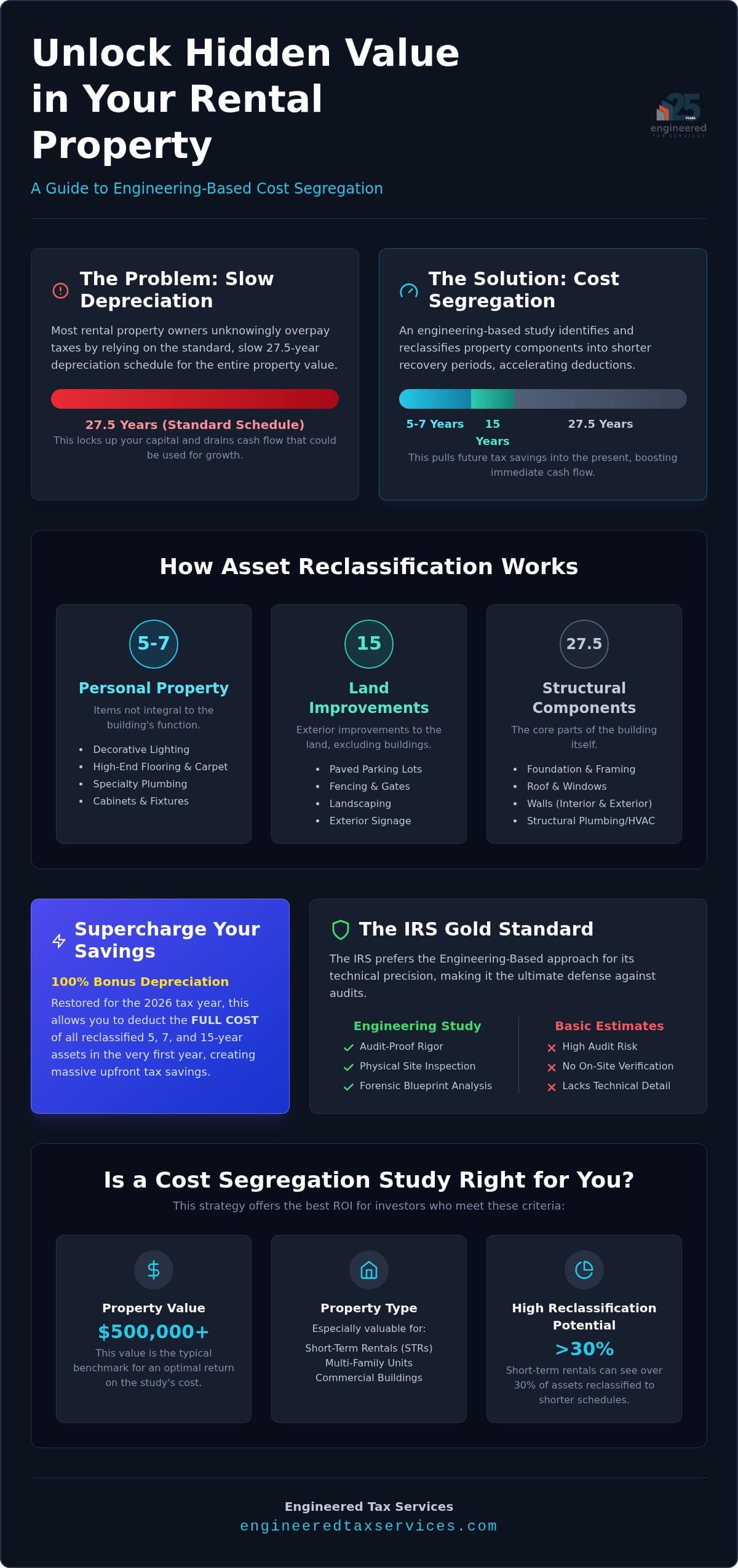
Standard IRS rules require residential rental property to be depreciated over 27.5 years, while commercial assets sit on a 39-year schedule. This slow burn often fails to reflect the actual economic life of various building parts. By reclassifying components into 5, 7, or 15-year recovery periods, you pull future tax savings into the present. This shift dramatically improves the Net Present Value (NPV) of your investment, providing immediate cash flow for reinvestment or debt reduction. The IRS prefers engineering-based studies because they rely on technical precision rather than simple accounting estimates. A licensed engineering firm conducts a detailed analysis of blueprints and physical site conditions to substantiate every deduction. This level of rigor is vital for audit protection; it ensures that your tax positions are defensible and compliant with the IRS Cost Segregation Audit Techniques Guide.
The Core Concept: MACRS and Asset Classification
Within the context of rental real estate, the Modified Accelerated Cost Recovery System (MACRS) is the standardized federal tax method for recovering the cost of capitalized assets through annual depreciation deductions. A building isn't just a shell. It contains personal property (5 or 7-year assets) like decorative lighting, specialty plumbing for appliances, and high-end flooring. It also includes land improvements (15-year assets) such as paved parking lots, fencing, and landscaping. Separating these from the 27.5-year structural core is the essence of cost segregation for rental property.
Who Should Consider a Cost Segregation Study?
While most investors can benefit, a $500,000 property value is often cited as the benchmark for achieving an optimal return on investment. Below this threshold, the fees for a high-quality study might diminish the immediate tax advantage. However, the property type also plays a significant role. Short-term rentals (STRs) often see higher reclassification percentages, sometimes exceeding 30%, because they are frequently sold furnished and require more intensive interior finishes. Multi-family units and single-family rentals also offer substantial opportunities to recapture capital through accelerated schedules. Whether you own a single complex or a national portfolio, the goal remains the same: maximizing the velocity of your money through precise asset classification. Investors who also hold mixed-use or cost segregation commercial property assets can apply the same engineering-based principles to unlock even greater first-year tax savings across their entire holdings.
The Engineering-Based Study: The IRS Gold Standard
While many accounting firms offer depreciation estimates, the IRS explicitly identifies the engineering-based approach as the premier method for substantiating claims. A high-quality cost segregation for rental property is not merely an accounting exercise; it is a forensic engineering project. The distinction lies in the depth of documentation. An engineering-based study involves a comprehensive physical inspection and a forensic analysis of architectural blueprints to identify every non-structural component. This technical rigor ensures that every dollar reclassified is backed by empirical data, creating a defensible shield against potential scrutiny.
The process begins with a detailed site visit where engineers document the specific use and placement of assets. We analyze blueprints and contractor invoices to establish a “nexus” between an asset and its shorter recovery period. For instance, if a property has reinforced flooring or specialized electrical systems to support specific equipment, our engineers document how these components serve a business function rather than a structural one. This level of detail is exactly what the IRS Cost Segregation Audit Techniques Guide (ATG) requires. It moves beyond “desk studies” or “rule of thumb” estimates that often fail to hold up during a formal review.
Why Technical Precision Matters in 2026
IRS scrutiny on real estate tax strategies has intensified, making the methodology of your study more important than ever. We utilize the “unit-in-place” engineering method, which builds the valuation of each component from the ground up based on actual construction costs and labor. This is significantly more accurate than “residual” costing, which simply subtracts known structural costs from the total purchase price. By calculating the exact value of every sink, light fixture, and square foot of paving, we prevent “double-dipping” on deductions and ensure your tax positions are conservative yet fully optimized. Engaging a licensed engineering firm ensures your documentation meets these rigorous professional standards while maximizing your first-year cash flow.
The ETS Specialized Methodology
As a licensed engineering firm performing over 10,000 tax studies annually, we've developed a methodology that bridges the gap between complex construction data and tax law. Our team of licensed engineers and tax specialists works in tandem to identify hidden opportunities in your portfolio that a standard CPA might overlook. We don't just provide a report; we act as a strategic partner in your wealth preservation journey. Our reports are designed to be “audit-ready” from day one, providing the peace of mind that comes from institutional-grade technical precision. This proactive stance allows you to focus on growing your portfolio, knowing your tax strategy is grounded in rigorous, engineering-based evidence.
Identifying Reclassifiable Assets in Rental Properties
A building is not a single, static asset. From a technical perspective, it is a complex assembly of systems, finishes, and infrastructure that serve distinct purposes. Identifying these components is the central task of cost segregation for rental property. We categorize items based on their recovery periods, moving beyond the structure itself to find value in shorter-lived assets that provide immediate tax relief.
The IRS uses the “Functional Link” test to determine if a component qualifies for accelerated depreciation. This test asks whether an asset serves the building's core structural integrity or the specific business of renting. If a component is non-structural and removable, or if it supports a specific tenant activity, it likely qualifies for a shorter life. For example, while standard plumbing is structural, the dedicated piping for a kitchen island or a specialized laundry facility is a 5-year asset because it supports a specific business function. Distinguishing between these requires a forensic eye and a deep understanding of construction engineering.
- 5-Year Assets: Personal property such as decorative lighting, carpeting, and specialty plumbing.
- 7-Year Assets: Office furniture or specific equipment used in property management.
- 15-Year Assets: Land improvements including paving, fencing, and exterior lighting.
Residential Rental Components (MACRS 5-Year)
Interior finishes offer some of the most significant opportunities for reclassification. Kitchen cabinetry and high-end millwork are often overlooked, yet they are frequently classified as 5-year assets because they are not essential to the building's structural shell. Similarly, removable wall coverings and specialized window treatments qualify for accelerated schedules. Appliances and furniture provided within the units are also prime candidates. By documenting these items through a technical lens, we ensure they are depreciated over sixty months rather than nearly three decades.
Land Improvements and Site Utilities (MACRS 15-Year)
The area surrounding your building contains substantial value that typically qualifies for a 15-year recovery period. Site drainage and stormwater management systems are critical infrastructure components that are often misclassified as part of the land or the building. Asphalt paving, parking lot lighting, and perimeter fencing also fall into this bucket. Irrigation systems and professional landscaping are not just aesthetic additions; they are depreciable land improvements. Identifying these site-specific utilities requires an engineering perspective to separate them from the non-depreciable land itself, ensuring every possible dollar is captured for your cash flow.
Strategic Implementation: Timing and Bonus Depreciation
The timing of your study is just as critical as the technical methodology used to produce it. As we reach 2026, the tax environment for real estate investors is shifting due to the scheduled phase-out of bonus depreciation under the Tax Cuts and Jobs Act (TCJA). Understanding how to time your cost segregation for rental property ensures you don't leave capital on the table as these incentives evolve. While the percentages are changing, the core strategy of accelerating depreciation remains one of the most effective ways to preserve wealth and fund future acquisitions.
Even as bonus depreciation levels fluctuate, cost segregation remains a vital tool because it reclassifies assets into shorter recovery periods. This provides a permanent tax deferral by allowing you to deduct the cost of your assets much faster than the standard 27.5-year schedule. This increased velocity of cash flow is often more valuable than the total nominal deduction over time because of the time value of money. By pulling those deductions forward, you gain immediate liquidity to reinvest into new properties or capital improvements.
The 2026 Bonus Depreciation Landscape
The transition from 100% bonus depreciation to the current 20% level has been a steady step-down over the last five years. In 2022, investors enjoyed full immediate expensing; however, that rate dropped by 20% annually, landing at the 20% mark for assets placed in service during the 2026 tax year. This doesn't mean the benefit has disappeared. It simply means that the “leftover” 80% of the reclassified asset's value is depreciated over its 5, 7, or 15-year life rather than all at once. Because of this phase-out, 2026 represents a critical “last call” for investors to maximize their remaining TCJA benefits before potential legislative changes in the coming years. To ensure you are capturing every available cent, you can request a preliminary analysis to see how the 20% rate impacts your specific portfolio.
The Power of Catch-Up Depreciation
Many investors mistakenly believe they've missed the opportunity to benefit from cost segregation if they didn't perform a study in the year they purchased a property. This is a costly misconception. Through a “look-back” study, you can analyze properties acquired as far back as 15 years ago. This process allows you to claim all the depreciation you “missed” in previous years and take it as a single, massive deduction in the current tax year.
The IRS allows this through Form 3115, the Application for Change in Accounting Method. Filing this form provides an automatic consent to change how you depreciate your assets without the need to amend previous years' tax returns. This results in an immediate cash flow injection that can offset current income, providing a significant boost to your net operating income. It's a strategic way to “unlock” equity that has been sitting idle in your building's structure for years.
Maximizing Wealth with Engineered Tax Services
Engineered Tax Services operates at the vital intersection of high-level engineering and sophisticated tax law. We don't view a cost segregation study as a standalone compliance task. Instead, we treat it as a cornerstone of your broader wealth-preservation strategy. By combining technical precision with deep regulatory knowledge, we help investors maximize the velocity of their capital. While software tools might provide rough estimates, they lack the defensibility of a report signed by a licensed engineering firm. This distinction is critical for high-net-worth individuals and complex portfolios that require institutional-grade documentation.
Our expertise extends beyond the initial study. We specialize in integrating cost segregation for rental property with other powerful incentives, such as 1031 exchanges. This allows you to defer taxes indefinitely while simultaneously accelerating depreciation on the replacement property. We also identify overlooked opportunities like the 179D EPAct Tax Deduction for energy-efficient commercial buildings or 45L Tax Credits for energy-efficient residential units. This holistic approach ensures that no incentive is left unclaimed, turning your tax strategy into a proactive driver of growth.
Strategic Wealth Preservation
The difference between a standard filing and proactive optimization is measured in the growth of your portfolio. When you partner with us, we act as the “expert's expert” for your CPA, providing the technical substantiation they need to confidently apply aggressive tax positions. The capital saved through these engineering-based studies can be immediately compounded into new property acquisitions; for those exploring the Philadelphia market, Tom Englett at agent215.com can help identify neighborhoods with strong investment potential. Over a decade, the cumulative effect of reinvesting these tax savings can result in a significantly larger portfolio than if you had followed a traditional, static depreciation schedule. It is about preservation as much as it is about expansion.
Get Started with a Preliminary Analysis
Initiating a study is a straightforward process designed to respect your time and professional focus. To provide an accurate benefit analysis, we typically require a few key documents, including your closing statement and a recent appraisal. Our team then performs a high-level review to estimate your potential tax savings before you commit to a full study. A typical engineering-based engagement takes several weeks to complete, as it involves a thorough technical review and physical site analysis. This meticulous approach ensures the final report is robust enough to withstand any level of scrutiny while providing a clear path for your financial advancement.
Request your specialized tax engineering analysis today to discover how much liquidity is currently trapped within your rental assets.
Optimize Your Portfolio's Financial Future
You've seen how accelerating depreciation can fundamentally alter the trajectory of your real estate investments. By reclassifying building components into shorter recovery periods, you move from passive compliance to active wealth optimization. This strategic shift provides the immediate liquidity needed to reinvest in new acquisitions or improve existing assets. The security of an engineering-based study is paramount in this process. As a Licensed Engineering Firm performing over 10,000 studies annually, we provide the IRS-defensible methodology required to protect your deductions against scrutiny.
Implementing cost segregation for rental property is not just about immediate tax relief; it's about generating the cash flow necessary to scale your portfolio in an evolving market. Don't leave your capital trapped in long-term depreciation schedules when it could be working for you today. Schedule a complimentary cost segregation benefit analysis with our engineers to see how much liquidity you can reclaim. Your path to a more efficient, growth-oriented portfolio starts with technical precision and a commitment to long-term stability.
Frequently Asked Questions
Is cost segregation worth it for a single-family rental property?
Yes, cost segregation often provides a substantial return on investment for single-family homes if you plan to hold the asset for several years or own multiple properties. The decision typically hinges on the net present value of the accelerated tax savings compared to the cost of the study. For many investors, the immediate cash flow generated from these deductions provides the necessary liquidity to fund their next down payment or major renovation.
What is the minimum property value required for a cost segregation study?
While there is no legal minimum, most professionals suggest a $500,000 property value as the benchmark for achieving an optimal return. Properties valued below this threshold may still benefit, particularly if they are part of a larger portfolio or are high-end short-term rentals. In these cases, the cumulative tax savings often outweigh the professional fees associated with a forensic engineering analysis.
Can I perform a cost segregation study on a property I've owned for years?
You can absolutely perform a study on properties acquired in previous years through what is known as a look-back study. The IRS allows you to claim all missed depreciation in the current tax year by filing Form 3115. This process doesn't require you to amend past tax returns, making it an efficient way to inject sudden capital into your rental business without administrative headaches.
How does the 2026 bonus depreciation phase-out affect my savings?
For assets placed in service during 2026, bonus depreciation is scheduled at 20% under current TCJA guidelines. While this is lower than previous years, cost segregation for rental property remains a powerful tool because the remaining 80% of the asset's value is still depreciated over 5, 7, or 15 years. This is significantly faster than the standard 27.5-year schedule, ensuring you still capture the majority of the tax benefit early in the property's life.
What is the difference between an engineering-based study and a software estimate?
An engineering-based study is the IRS gold standard because it involves a physical site inspection and a detailed review of architectural blueprints by licensed professionals. Software estimates rely on generalized algorithms and “rule of thumb” percentages that lack technical substantiation. If your return is reviewed, the IRS explicitly prefers the forensic documentation provided by an engineering firm over a simplified software output.
Does a cost segregation study increase my risk of an IRS audit?
Performing a study doesn't inherently increase your audit risk; in fact, a high-quality report often provides a layer of security. By following the IRS Cost Segregation Audit Techniques Guide, a licensed engineering firm creates a defensible trail of evidence for every deduction. Having this level of technical precision ready from day one demonstrates a commitment to compliance and professional integrity.
Can I use cost segregation for a short-term rental or Airbnb?
Short-term rentals are often the best candidates for cost segregation for rental property because they generally contain a higher percentage of personal property and land improvements. Since these properties are frequently sold fully furnished, the amount of 5-year assets is typically higher than in long-term rentals. Additionally, if you materially participate in the business, these depreciation losses might offset your other active income.
How does cost segregation interact with a 1031 exchange?
Cost segregation and 1031 exchanges work together as a powerful wealth-preservation duo. While you must be careful about “recapture” taxes when selling, a strategic study on the replacement property can often offset those liabilities. Our engineers work with your tax team to ensure that the asset classifications align across both properties, allowing you to defer taxes indefinitely while maximizing your current cash flow. Investors expanding into larger holdings should also explore how cost segregation for commercial property can further amplify these tax deferral strategies on replacement assets.