
What Real Estate Investors are Learning the Hard Way
If you are a real estate investor who has ever looked into cost segregation, you have probably noticed something confusing. There are multiple firms, very different prices, and very different projected tax savings. And yet they are all selling something called a cost segregation study.
Here is the problem. Cost segregation is not a standardized product. It is a concept.
The cost segregation provider you choose can significantly impact how much depreciation you actually receive, whether your position holds up under IRS scrutiny, and how much additional tax benefit you unlock in the future. Most real estate investors do not realize this until it is too late.
Let’s break it down.
The Misconception: A Cost Seg Study is a Cost Seg Study
It is easy to assume that all cost segregation studies are essentially the same. They all reclassify assets, accelerate depreciation, and provide a report. So, the natural instinct is to compare price, reclassification percentages, and estimated tax savings. But that is like comparing two appraisals or two engineering reports based only on the final number. You are skipping the most important part, which is how that number was created.
What the IRS Actually Cares About
The IRS does not evaluate your study based on how many pages it has, how high your five-year property percentage is, or how attractive the projected savings looked upfront. They care about methodology, documentation, engineering support, asset-level detail, and how well the study ties back to actual costs.
In other words, your cost segregation study is a tax position, and it must be defensible.
A high-quality study does not just produce a number. It shows exactly how that number was derived.
Not All Cost Segregation Studies Look the Same
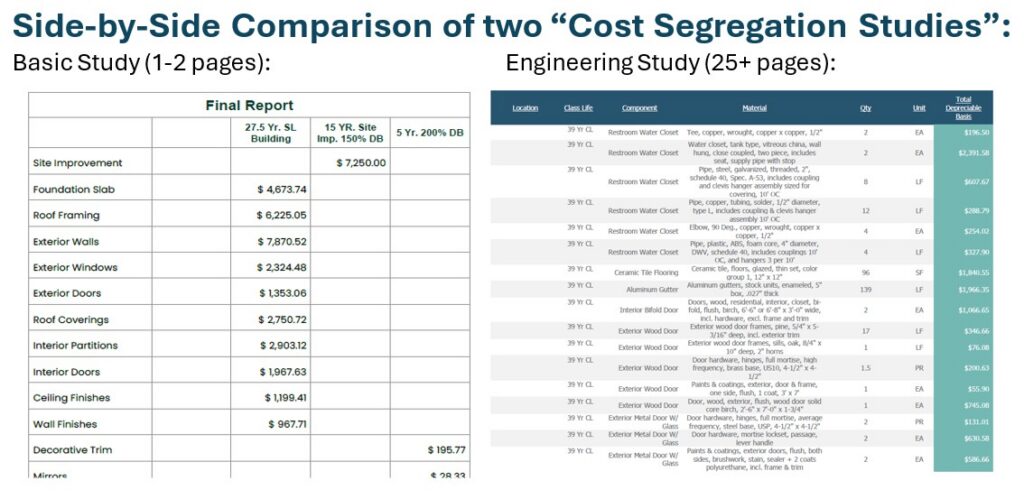
When you compare studies side by side, the difference becomes obvious.
Some studies are primarily summary-based. These include high-level allocations, limited line-item detail, minimal supporting schedules, and are focused on delivering a result.
Others are engineering-based. These include site inspections and fieldwork, detailed asset-by-asset breakdowns, indirect cost allocations, unit-of-property analysis, and full reconciliation to project costs.
These are not small differences. They directly impact accuracy, defensibility, and long-term tax value.
The Benefit Analysis Trap
Before you even get a study, most cost segregation firms provide a cost benefit analysis. This is where many investors get misled.
A cost benefit analysis is an estimate. It is based on assumptions and created before detailed engineering work is performed.
Those assumptions include land value allocation, asset classification percentages, bonus depreciation treatment, and tax rate and holding period.
Here is the issue. Some cost segregation providers inflate estimates to win the project and then deliver a lighter study behind it.
So, while it may look like higher projected savings at a lower fee, in reality you may be receiving less detailed work, leaving deductions on the table, and taking on more audit risk.
A bigger estimate does not mean a better study.
The Hidden Value of Cost Segregation that Most Investors Miss
Most conversations about cost segregation focus on first-year tax savings. But that is only part of the story.
A high-quality study also sets you up for partial asset disposition (PAD).
This allows you to write off components of a property when they are replaced or removed.
Examples include replacing a roof, renovating interiors, upgrading HVAC systems, or removing flooring, cabinetry, or electrical components.
If your original cost segregation study properly identified and valued those components, you may be able to deduct the remaining basis of those assets when they are retired.
This can create significant additional tax savings down the road.
A great cost segregation study does not just pay you once. It pays you again.
How to Evaluate a Cost Segregation Provider
If you are considering a study, here are the questions that actually matter.
- Do they perform a site inspection, or is the study done remotely using assumptions?
- Is the study engineering-based, or primarily based on estimates and templates?
- Do they provide detailed asset-level breakdowns, or just summary allocations?
- Are indirect costs properly allocated, as this can materially impact depreciation?
- Do they support unit of property analysis, which is critical for repair versus improvement treatment?
- Is the study truly audit-ready, not just a promise of support but actual documentation?
- Does the study support future partial asset disposition, or is it only focused on year-one benefits?
“YOU ARE NOT BUYING A REPORT. YOU ARE BUYING A DEFENSIBLE TAX POSITION.”
Why a Cost Segregation Study Price Alone is Misleading
It is tempting to compare cost segregation and fixed asset review providers based on cost. But you are not buying a report. You are buying a defensible tax position.
A cheap cost segregation study may take less time, include less detail, provide less support, and limit future tax opportunities.
The cheapest study can become the most expensive.
Final Thought
Cost segregation can be one of the most powerful tax strategies available to real estate investors, but only if it is done right.
The difference between cost segregation study providers is not just about service, turnaround time, or price. It is about methodology, detail, and long-term value.
Before you choose a provider, ask yourself whether you are comparing numbers or comparing the work behind the numbers. That is where the real value lives.
If you would like a second opinion on a benefit analysis or want to better understand what a high-quality study should look like, we are happy to walk you through it. No pressure, just clarity.
Request a Meeting with a Cost Segregation Consultant Today
Engineered Tax Services | ETS is one of the best cost segregation companies in Florida and throughout the United States. We have been serving companies of all types of industries for over 25 years with engineering-based studies and strategic tax planning services. Call 800-236-6519 or contact us online today.