A project can involve sophisticated engineering and still fall short of the R&D tax credit requirements. Use the four-part test for R&D tax credit eligibility to screen specific activities, not as a shortcut from “innovative work” to a qualified claim.
A project label alone can’t show whether routine product development or engineering work meets the legal criteria. Translating technical decisions into a clear, supportable analysis means looking at what the team did, what it didn’t yet know, and how it evaluated possible solutions. Even when an activity meets all four tests, that doesn’t automatically make every related expense eligible.
This guide explains each IRS test and how to apply it to business activities. You’ll learn what evidence can help demonstrate a permitted purpose, a technological basis, technical uncertainty, and a process of experimentation. You’ll also see how to distinguish activity eligibility from the separate review of related costs. A structured technical analysis can connect project facts to each criterion and identify where documentation needs closer attention.
Key Takeaways
- Use the four-part test for R&D tax credit eligibility to assess activities, not simply whether a project seems novel.
- Translate each statutory criterion into a practical question about the work, its technical uncertainty, and how the team explored solutions.
- Distinguish technical development from routine adaptation, duplication, cosmetic changes, and ordinary quality control.
- Break projects into business components and activities before evaluating whether the work meets the criteria.
- Organize project records to show uncertainties, alternatives considered, tests performed, and decisions made.
What the Four-Part Test for the R&D Tax Credit Actually Determines
The four-part test for R&D tax credit eligibility is a framework under Internal Revenue Code Section 41 for identifying qualified research activities. It asks whether the work has a permitted purpose, is technological in nature, seeks to eliminate technical uncertainty, and follows a process of experimentation. An activity must satisfy all four criteria. Being new to the market, technically complex, or valuable to the business isn’t enough on its own.
The distinction matters because tax analysis starts with what people actually did, not the project’s name or outcome. A project can produce a useful innovation without every task involved meeting the research criteria. For general background on the credit and its history, the Research & Experimentation Tax Credit overview discusses the four-part test. A claim analysis, however, must be grounded in applicable law and the facts of the work.
Which business activities and components are evaluated?
Section 41 focuses on research activities connected to a business component. Statutory examples include products, processes, computer software, techniques, formulas, and inventions. The component frames what the business sought to develop or improve. The activity-level review then examines the specific work performed toward that goal.
Consider a manufacturer redesigning a component to improve performance. Engineering work comparing alternative designs may merit review, while routine production scheduling or standard sales preparation may have a different result. Even within the engineering effort, some tasks may address technical questions while others simply implement a settled design. Assessing activities separately avoids treating the entire project as uniformly qualifying or nonqualifying.
Why the four tests are only one part of a claim
Passing the four tests supports the qualification of research activities. It doesn’t establish that every project expense qualifies or determine the credit amount. Those are separate steps. After evaluating activities, a claim analysis must identify potentially eligible expenses, connect them to the qualified work, substantiate the amounts, and apply the relevant calculation rules.
For example, a project may include activities that meet the research criteria, but that doesn’t automatically make all employee time, materials, or outside services associated with the project eligible expenses. Records must support both the nature of the work and the costs attributed to it. An initial screen can identify projects for closer analysis, but it isn’t a final tax position or a credit calculation.
Apply Each of the Four R&D Tax Credit Tests to Project Work
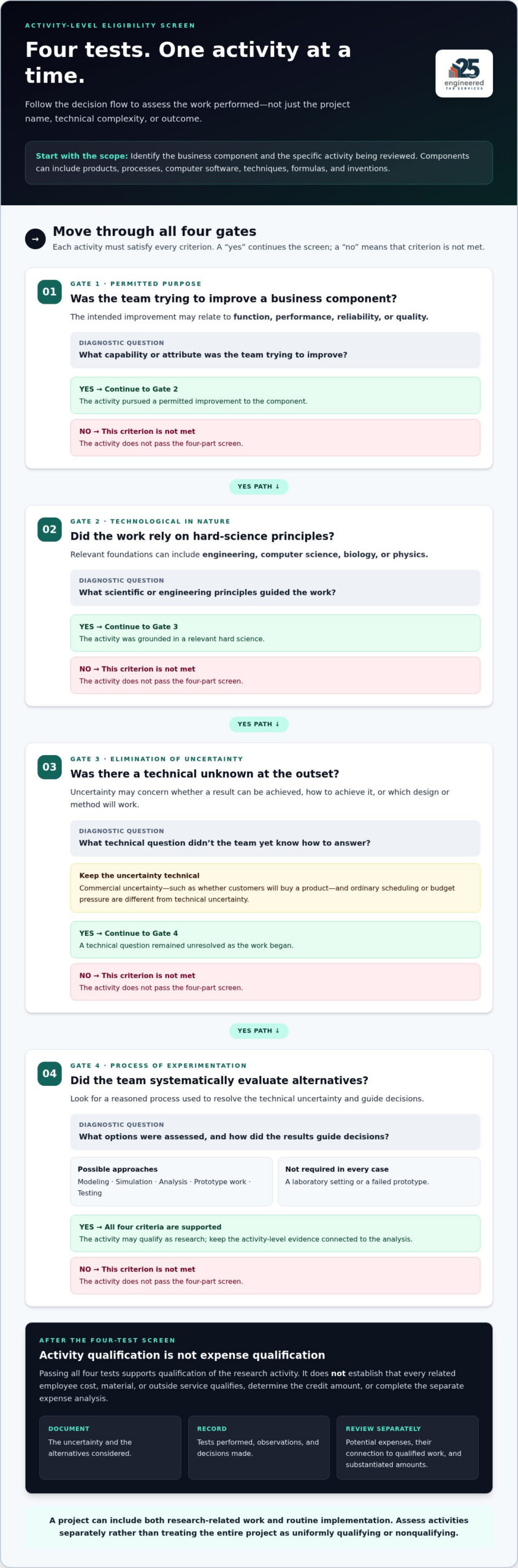
Apply the four-part test for R&D tax credit eligibility to the specific work performed, not just the project’s overall goal. For each activity, ask what improvement the team pursued, what technical question it faced, what scientific or engineering principles informed the work, and how the team evaluated possible solutions. The tests work together. Strength on one criterion can’t make up for failure to meet another.
| Criterion | Plain-English meaning | Diagnostic question |
|---|---|---|
| Permitted purpose | The work aims to develop or improve a business component’s function, performance, reliability, or quality. | What capability or attribute was the team trying to improve? |
| Technological in nature | The work relies on principles of a hard science, such as engineering, computer science, biology, or physics. | What scientific or engineering principles guided the work? |
| Elimination of uncertainty | At the outset, the team faced uncertainty about capability, method, or appropriate design. | What technical question didn’t the team yet know how to answer? |
| Process of experimentation | The team systematically evaluated alternatives to resolve technical uncertainty. | What options were assessed, and how did the results guide decisions? |
For example, a team developing a more reliable product component might test whether a revised material can meet performance requirements under operating conditions. The goal may support a permitted purpose, but the other criteria need their own analysis: Was there a technical unknown? Did the work draw on relevant scientific principles? Did the team evaluate alternatives systematically? The IRS Form 6765, Credit for Increasing Research Activities offers an official reference for information reported in connection with the credit.
What does the uncertainty test look for?
Technical uncertainty concerns whether or how a desired result can be achieved, or which design or method will work. It differs from commercial uncertainty, such as whether customers will buy a product, and from ordinary scheduling or budget pressure. To assess it, identify the question the team faced at the outset. Then connect that question to records showing the choices made as the work progressed.
What counts as a process of experimentation?
Look for a reasoned evaluation of alternatives. It may include modeling, simulation, analysis, prototype work, or testing. A qualifying process doesn’t require a laboratory or a failed prototype in every case. Documentation should reflect what the team actually did, including the options it considered, what it observed, and how it made decisions. A polished explanation assembled after the project ends is not a substitute for evidence of the work.
A practical review connects each criterion to project facts. Engineering analysis can help translate technical decisions into evidence relevant to the tests, while tax expertise can address how those findings fit the claim requirements. An R&D tax credit study from Engineered Tax Services can help organize that assessment and its supporting documentation.
Where R&D Tax Credit Eligibility Gets Difficult: Borderline Work and Exclusions
Borderline projects often combine technical development with routine execution. A team may resolve a genuine design uncertainty early, then spend later stages implementing a settled solution. Reviewing the entire project as one block can blur that distinction. Apply the four-part test for R&D tax credit eligibility to specific activities and facts. Don’t infer eligibility from a project title, an “innovation” label, or the industry in which the work occurs.
Use these comparisons as screening prompts, not final tax conclusions:
- Technical development: Evaluating alternative designs because the team doesn’t yet know which can meet performance requirements may indicate research activity for closer review.
- Routine adaptation: Adjusting an established process to accommodate a standard customer preference, without resolving a technical unknown, may point away from qualified research.
- Duplication or cosmetic change: Reproducing a known product or changing its appearance alone doesn’t establish that the work addresses technical uncertainty.
- Ordinary quality control: Inspecting finished units against established specifications differs from testing alternatives to determine how an uncertain technical requirement can be achieved.
The distinction depends on what the team knew, what it investigated, and how its decisions changed over time. Design revisions, test results, technical notes, and change records can help show whether the work involved experimentation or routine implementation.
How do routine improvements differ from qualified research?
Ask whether the method was already established when the activity began. If staff followed a known procedure to implement a settled design, that work may differ from earlier efforts to determine whether or how the design could work. The distinction isn’t automatic. Examine the actual technical challenge, alternatives considered, and records created during the work before drawing a conclusion.
When can funding, software, or other exclusions matter?
Some activities may face separate statutory limitations or exclusions, even if they involve technical work. Funded research can require examination of contracts, payment terms, who bears the financial risk, and who retains rights to the results. Software developed for internal use can also be subject to additional rules. The application of these rules depends on the facts and should be checked against current authority. This overview isn’t a complete catalog of exclusions.
The IRS shrink-back concept can also matter when a broad business component doesn’t satisfy the requirements as a whole. In appropriate cases, the analysis may need to focus on a narrower component or subset of activities, rather than treating the entire project as qualifying or nonqualifying. Defining that boundary calls for careful technical and tax analysis.
For complex projects, an engineering-led review can connect technical records to the activity-level analysis and flag issues that need closer attention. Request an R&D tax credit study from Engineered Tax Services to assess project activities and supporting documentation.
Build a Defensible Activity-by-Activity R&D Qualification Review
A repeatable review separates three questions: which activities may qualify, which expenses may be associated with those activities, and what records support the analysis. Use the four-part test for R&D tax credit as a screening framework, then follow these steps:
- Define the business components. Identify the product, process, software, or other component involved, and describe the technical objective.
- Break out the activities. Separate research and testing from routine implementation, production, or other project work.
- Assess each criterion. Record how the activity relates to the objective, technical uncertainty, scientific principles, and evaluation of alternatives.
- Review exclusions and limitations. Flag issues such as funded research or software rules for current, fact-specific tax analysis.
- Assess evidence and potential expenses. Match records to activities, then evaluate potentially eligible costs separately. Don’t treat the project budget as a qualified expense total.
The substantially-all standard can be relevant to particular statutory tests, but its application and measurement should be verified against current authority before relying on it. It doesn’t replace an activity-level review.
What records help explain the technical work?
Useful records may include design files, test results, engineering notes, version histories, and project communications. Link each item to the activity it documents. A design revision may show alternatives considered, while a test result may show what the team learned and how that affected the next decision. The most relevant evidence varies by project. Contemporaneous technical records strengthen a fact-based review by showing how uncertainties and decisions unfolded during the work.
How should technical analysis and tax review work together?
Engineers can interpret technical processes, identify relevant activities, and explain how project facts relate to uncertainty and experimentation. Tax professionals can assess applicable tax treatment, expense rules, and claim requirements. That collaboration helps keep the technical narrative aligned with the tax analysis. For a related overview, the R&D tax credit documentation requirements and audit risk guide discusses the role of technical support in substantiating a claim.
What can an engineering-based study contribute?
An engineering-based R&D tax credit study can organize activities by business component and evaluate technical uncertainty, alternatives, and experimentation. Technical documentation and reporting can connect the underlying work to the analysis. For example, a design history may show why a team changed its approach after test results revealed a limitation. That evidence informs the assessment. It doesn’t, by itself, make an activity qualify or guarantee an IRS outcome or credit amount.
Move from initial screening to informed next steps
Before a detailed review, assemble a concise project summary covering components, activities, technical objectives, uncertainties, and available records. Engineered Tax Services is a national engineering firm that conducts more than 10,000 tax studies annually across its services and provides R&D tax credit studies with technical documentation and reporting. Explore its R&D tax credit engineering firm services for a structured technical assessment, or discuss an R&D tax credit study.
Turn Your Project Review Into a Clear Next Step
The most useful outcome of an initial review isn’t a quick yes or no. It’s a clearer picture of which activities merit deeper analysis, what technical evidence supports them, and where uncertainty remains. That distinction helps your team move from the four-part test for R&D tax credit screen to expense analysis and claim preparation with a clearer understanding of the work.
For complex projects, an independent engineering perspective can help translate design choices, test results, and development records into a structured technical assessment. Engineered Tax Services is an independent, licensed engineering firm founded in 2001. Its R&D tax credit studies apply engineering analysis without treating a preliminary screen as a guarantee of eligibility or outcome.
If your projects involve unresolved technical questions or a mix of development and routine work, discuss an R&D tax credit study with Engineered Tax Services to get a structured assessment of the activities and supporting evidence.
Frequently Asked Questions
What is the four-part test for the R&D tax credit?
The four-part test for R&D tax credit eligibility is a framework for evaluating whether research activities meet federal criteria. It examines the activity’s purpose, scientific or engineering basis, technical uncertainty, and evaluation of alternatives. For a product redesign, the review looks beyond the finished product to the specific technical challenge the team addressed. The project’s label or successful outcome alone can’t establish that the work qualifies.
Do all four parts of the R&D tax credit test have to be met?
Yes. An activity must satisfy all four criteria to meet the test. They aren’t separate routes to eligibility, and a strong showing on one point can’t compensate for a missing criterion. Apply them to the relevant activity rather than assuming every task in a project has the same result. If the facts support some development work but not later implementation, the review should preserve that distinction.
What is the process of experimentation test?
The process of experimentation test looks for a systematic way to evaluate alternatives and resolve technical uncertainty. A team might compare two design approaches using calculations, simulations, or structured performance tests, then use the results to choose its next step. The method depends on the work; a formal laboratory trial isn’t required in every case. A useful record shows the alternatives considered, the evaluation performed, and how the findings informed decisions.
Does routine product development qualify for the R&D tax credit?
Sometimes, but routine development doesn’t qualify simply because it creates a new product or feature. Configuring a product using an established method may be routine, while investigating whether an unfamiliar design can meet a technical requirement may warrant closer review. The distinction depends on what was uncertain and what the team actually did. Development records can help separate technical investigation from ordinary updates or implementation.
Can software development qualify under the four-part test?
Yes. Software development may qualify if the specific activities meet all applicable research criteria. Building a feature with familiar tools and established methods may differ from resolving a technical question about how to achieve a required capability. Software developed for internal use can face additional requirements, so its purpose and use matter. Review the applicable rules for the relevant tax year and analyze development activities separately from routine coding, maintenance, or deployment.
Does passing the four-part test mean all project costs qualify?
No. Passing the activity test doesn’t automatically make every project expense eligible. A separate cost review must identify potentially qualified expenses, establish their connection to qualifying activities, and apply relevant tax rules. A project budget, for instance, may include research work alongside sales, administration, or routine production. The four-part test informs the activity analysis; it doesn’t substantiate expense amounts or calculate the credit on its own.
What documentation supports the four-part test?
Useful documentation depends on the project, but it should show what the team was trying to achieve and how its work developed. Relevant materials may include dated design revisions, test data, technical discussions, engineering calculations, and records of decisions. Organize them by business component or activity, then note what each item helps establish. Clear links between records and project work make the basis for the analysis easier to explain.