For multifamily developers in 2026, leaving $5,000 per unit on the table isn't just a missed opportunity; it's a strategic failure in a high-stakes capital market. You've likely realized that the Inflation Reduction Act’s enhancements offer unprecedented potential, yet the shift to Zero Energy Ready Home (ZERH) standards and strict prevailing wage requirements has made the path to compliance feel like a technical minefield. This 45L tax credit case study illustrates how a specialized, engineering-based approach transforms these intricate building science requirements into a predictable, high-yield financial outcome.
You shouldn't have to choose between aggressive tax savings and audit security. We understand the anxiety surrounding labor compliance and the uncertainty of stacking specialized incentives with cost segregation. This article provides a blueprint for securing the maximum credit while maintaining 100% IRS compliance through precise technical documentation. We'll preview the exact methodologies used to unlock $5,000 per unit for 2026 projects, ensuring your developments achieve peak cash flow before the critical June 30 acquisition deadline. By bridging the gap between energy performance and fiscal optimization, you can turn regulatory hurdles into a significant competitive advantage for your future developments.
Key Takeaways
- Discover how to capture the maximum $5,000 per unit credit by aligning your multifamily projects with the latest Zero Energy Ready Home (ZERH) standards before the 2026 expiration.
- Analyze a real-world 45L tax credit case study involving a 120-unit development to see how engineering-based modeling overcomes construction-phase compliance hurdles.
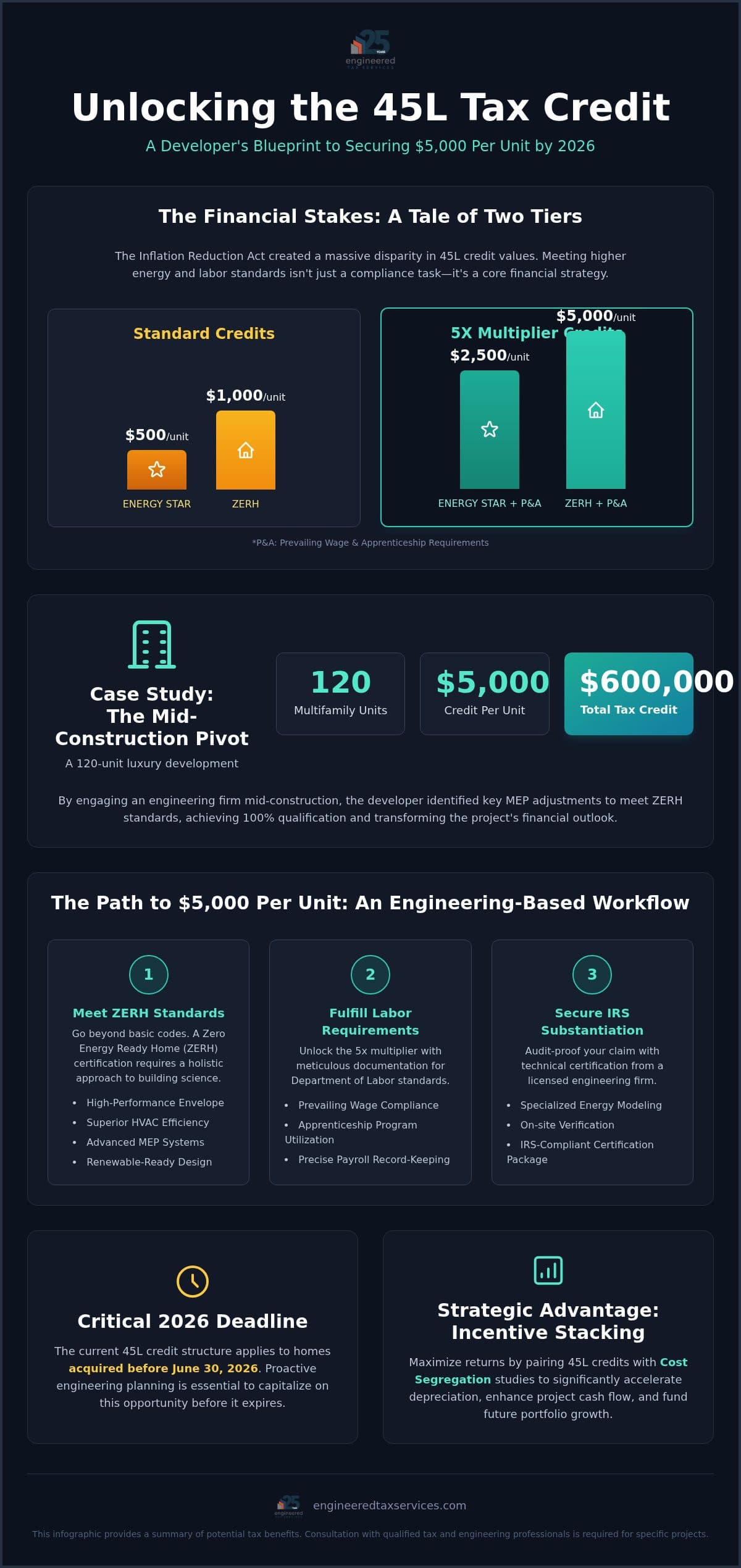
- Master the 5x credit multiplier by implementing precise workflows for prevailing wage and apprenticeship requirements, transforming a standard $1,000 credit into a $5,000 windfall.
- Learn why IRS-compliant substantiation requires a licensed engineering firm to bridge the gap between basic energy ratings and specialized tax certification.
- Explore the strategic advantages of stacking 45L credits with cost segregation to significantly accelerate project cash flow and long-term portfolio expansion.
The 2026 45L Landscape: Why Multifamily Developers Need Engineering Precision
Current federal tax policy has transformed the 45L Energy Efficient Home Credit from a temporary tax extender into a permanent, high-stakes pillar of project finance. For multifamily developers, 2026 represents a pivotal year where the credit is no longer a peripheral incentive but a core driver of project ROI. This shift requires a move away from simple accounting estimates toward rigorous, engineering-based substantiation. A detailed 45L tax credit case study often highlights that without technical precision, developers risk leaving millions in capital on the table or failing an IRS audit due to insufficient documentation of energy performance standards.
Evolution of 45L: Post-Inflation Reduction Act Reality
Legislative changes via the Inflation Reduction Act of 2022 fundamentally altered the landscape by removing the “three-story” height restriction. This change opened the door for high-rise multifamily developments to access the same lucrative credits previously reserved for low-rise residential builds. Many industry insiders refer to this stabilization of 2026 incentives as the “One Big Beautiful Bill Act,” reflecting the long-term certainty it provides to the construction sector. However, this expanded access comes with heightened complexity. Developers must now bridge the gap between older energy codes and the more stringent ENERGY STAR Multifamily New Construction National v3.2 and the Department of Energy’s Zero Energy Ready Home (ZERH) standards.
The Financial Stakes: $500 vs. $5,000 per Unit
Financial outcomes in 2026 are defined by a massive disparity in credit tiers based on labor and energy performance. While a base ENERGY STAR certification offers $500 per unit, meeting the Department of Labor’s prevailing wage and apprenticeship requirements triggers a 5x multiplier. This elevates the credit to $2,500 for ENERGY STAR or a substantial $1,000 to $5,000 for ZERH-certified units. On a typical 100-unit development, the difference between a base credit and the maximum tier is $450,000 in direct tax savings. This isn't just a minor variance; it's a transformative amount of capital that can fund future acquisitions or offset rising interest rates.
Because the stakes are so high, successful 45L tax credit multifamily strategies require early-stage engineering planning. In any comprehensive 45L tax credit case study, you'll find that the most successful developers don't treat these credits as an afterthought. Instead, they utilize specialized energy modeling to ensure every building component meets the rigorous ZERH criteria. This proactive approach doesn't just secure the $5,000 per unit; it provides the robust technical substantiation necessary to withstand IRS scrutiny in an era of increased enforcement. With the current credit set to expire for homes acquired after June 30, 2026, the window for this level of financial optimization is narrowing.
Case Study Anatomy: Unlocking the $5,000 ZERH Credit Tier
This 45L tax credit case study examines a 120-unit luxury multifamily development that successfully pivoted its strategy during the construction phase to capture the highest possible federal incentives. Initially designed to meet standard local building codes, the project team realized that a modest shift in engineering specifications could unlock the $5,000 per unit Zero Energy Ready Home (ZERH) credit. By engaging a licensed engineering firm to perform a mid-construction audit, the developer identified critical Mechanical, Electrical, and Plumbing (MEP) adjustments that bridged the gap between basic compliance and elite energy performance. The result was a 100% qualification rate and a total credit of $600,000, significantly improving the project's overall capitalization.
Achieving Zero Energy Ready Home (ZERH) Status
Meeting the ZERH Multifamily Version 2 standard in 2026 requires a holistic approach to building science that goes beyond simple insulation upgrades. Key performance indicators focus on a high-performance building envelope, superior HVAC efficiency, and rigorous indoor air quality protocols. A unique requirement for this tier is the “Solar Ready” provision. This mandate ensures that the roof structure and electrical panels are pre-configured for future photovoltaic integration. These technical benchmarks are more demanding than standard Energy Star requirements, but they represent the gold standard for modern residential development and long-term asset value.
The ROI of Engineering Intervention
The financial logic behind engineering intervention is undeniable. The cost of technical modeling and certification is a minor investment when compared to the $600,000 in total credits secured for this 120-unit project. By adhering to official IRS guidance on 45L, the development team ensured that every adjustment, from enhanced thermal breaks to high-efficiency water heaters, was documented to withstand future scrutiny. Technical precision doesn't just unlock capital; it provides the robust substantiation required for IRS defense, protecting the developer's ROI from future clawbacks.
Identifying these cost-effective design tweaks early allowed the developer to move from a standard Energy Star rating to the ZERH tier without a massive overhaul of the project budget. This strategic implementation demonstrates that the right engineering partner can find hidden value in existing designs. If you want to ensure your next project hits these high-performance benchmarks, you should consult with a licensed engineering firm to perform a preliminary assessment of your plans. This proactive step is the difference between a modest tax break and a transformative financial outcome.
Navigating the 2026 Prevailing Wage and Apprenticeship Multipliers
The 2026 fiscal environment dictates that labor compliance is no longer a secondary concern for multifamily developers. The difference between a $1,000 base ZERH credit and the $5,000 enhanced incentive hinges entirely on the 5x multiplier triggered by Prevailing Wage and Apprenticeship (PWA) standards. For a typical 100-unit project, this represents a $400,000 swing in tax liability. Any successful 45L tax credit case study underscores that while energy efficiency is the foundation, labor documentation is the vault that secures the cash. Developers must take a proactive role in monitoring subcontractor practices, as the IRS places the ultimate burden of proof on the taxpayer claiming the credit. If you don't have a system for real-time labor tracking, you're effectively gambling with your project's ROI.
IRS substantiation requirements for the 5x multiplier are rigorous and demand more than just a signed affidavit from a general contractor. Your project file must contain granular data, including payroll records, labor classifications, and proof of apprenticeship participation. This documentation must be maintained for at least three years after the credit is claimed. Failure to produce these records during an inquiry can lead to the immediate clawback of the credit plus substantial penalties. This makes labor compliance a critical component of any professional 45L tax credit case study and a priority for developers seeking to maximize their 2026 tax benefits.
Documenting Prevailing Wage Compliance
Securing the multiplier requires that all laborers and mechanics on the project are paid wages at rates no less than the prevailing rates determined by the Department of Labor. You must identify the correct wage determinations for your project’s specific labor categories and geographic location at the start of construction. Real-time payroll auditing is the only way to ensure 100% compliance across all tiers of subcontractors. If underpayments are discovered, the IRS allows for correction payments to laborers plus interest and penalties to the Treasury to maintain eligibility. Without these meticulous records, the higher credit tier is indefensible during a professional audit.
Meeting the Apprenticeship Hour Requirements
For projects starting in 2026, the apprenticeship labor hour requirement is set at 15% of the total labor hours. This means a significant portion of the work must be performed by qualified apprentices from registered programs. If your subcontractors cannot find enough apprentices, you must document “Good Faith Efforts” by keeping records of formal requests sent to local apprenticeship programs and their subsequent denials. This level of detail is a core component of a professional engineered tax incentives report, which serves as your primary defense in labor validation. Precision in these labor files is just as critical as the energy modeling itself, ensuring your 2026 project achieves its full financial potential.
The Technical Certification Workflow: From Energy Modeling to IRS Substantiation
IRS regulations mandate that 45L certifications be performed by an independent third party, specifically a licensed professional engineer or a qualified individual under their supervision. This isn't a mere accounting exercise; it's a rigorous building science evaluation. While many developers are familiar with a standard HERS rating for building code compliance, a 45L tax certification requires a deeper level of technical substantiation. This 45L tax credit case study demonstrates that engineering firms must utilize IRS-approved software to simulate energy performance against a specific reference home. This simulation accounts for the building's thermal envelope, mechanical systems, and lighting efficiency to prove a measurable reduction in energy consumption compared to 2021 IECC standards.
Physical verification is a non-negotiable component of the workflow. Engineers must conduct site visits to perform blower-door testing and duct-leakage assessments. These tests provide empirical data on the building’s airtightness and HVAC efficiency, moving the project beyond theoretical models into verified reality. Without this level of physical testing and a final report signed by a licensed professional, the credit remains vulnerable to IRS challenges. Technical precision during this workflow is what transforms a high-performance building into a high-yield tax asset.
Step 1: Preliminary Modeling and Gap Analysis
Successful developers integrate energy modeling into the earliest stages of the design process. By reviewing architectural plans before the first shovel hits the ground, engineers can identify performance gaps that might disqualify units from the higher credit tiers. Early modeling prevents the loss of $2,500 per unit in potential credits by identifying performance shortfalls before construction is finalized. This proactive analysis allows for strategic adjustments to insulation types or window specifications while the cost of change is still low. It also provides an opportunity to align project specs with depreciation strategies for commercial real estate, ensuring that energy-efficient components are properly categorized for maximum cash flow.
Step 2: Field Verification and Final Certification
The final phase of the workflow involves on-site verification of all energy-related components, including insulation R-values, window U-factors, and HVAC SEER ratings. This verification ensures that the as-built conditions match the preliminary energy models. Once the units are completed and physical testing is successful, the engineering firm issues the final certification report. This document must be finalized before the unit is acquired or leased by a tenant, as the credit is claimed in the year the unit is first occupied. To ensure your documentation meets these strict timing and technical requirements, you should request a preliminary 45L assessment during your next project's pre-construction phase.
Beyond 45L: Stacking Engineered Incentives for Maximum Portfolio Growth
The true power of a 45L tax credit case study isn't found in a single incentive but in the strategic stacking of multiple federal provisions. At Engineered Tax Services (ETS), we advocate for an “Engineered Incentives” philosophy. This approach views a building not just as a structure, but as a complex assembly of tax-advantaged components. By looking at a project through the lens of engineering and tax law simultaneously, developers can unlock exponential cash flow that far exceeds the benefit of any standalone credit. This holistic strategy is essential for 2026 developments where high interest rates and construction costs demand maximum fiscal efficiency.
Stacking 45L and 179D in Mixed-Use Developments
Mixed-use developments present a unique opportunity to leverage the 179D energy efficient commercial building deduction alongside 45L credits. While the 45L credit targets the residential units, 179D provides a significant deduction for the energy-efficient systems within the commercial and common areas. A sophisticated 45L tax credit case study for a mixed-use tower might show how a single, high-performance building envelope can satisfy the requirements for both programs simultaneously. Our methodology allows these studies to be performed concurrently, reducing administrative overhead and ensuring that the energy modeling data for 45L seamlessly supports the 179D certification. This dual compliance ensures that every square foot of the asset is optimized for tax savings.
The Synergy of Accelerated Depreciation
The most potent pairing for 45L is the strategic application of cost segregation commercial property studies. While 45L provides a direct dollar-for-dollar reduction in tax liability, cost segregation allows developers to front-load depreciation on non-structural assets like specialized lighting, flooring, and landscaping. This combination creates a massive influx of capital in the early years of a project's lifecycle. Successful developers use the immediate tax savings from these stacked incentives to fund the equity requirements for their next development phase, effectively creating a self-funding growth engine.
By partnering with a firm that understands the intersection of building science and tax code, you ensure that no incentive is left unclaimed. We act as a proactive advocate for your financial health, providing the technical precision needed for both optimization and IRS compliance. If you're ready to move beyond basic compliance and start building long-term wealth through technical excellence, you should Contact Engineered Tax Services to maximize your 2026 tax strategy.
Secure Your 2026 Development Pipeline with Technical Precision
The transition to higher energy standards and rigorous labor requirements has fundamentally changed the risk and reward profile of multifamily development. As this 45L tax credit case study illustrates, securing the maximum $5,000 per unit credit requires a proactive integration of building science and tax law. By focusing on engineering led design and meticulous labor documentation, you don't just capture immediate tax savings; you build a more resilient, high performing asset class. Stacking these credits with cost segregation and 179D deductions further accelerates your capital recycling for future acquisitions.
As an independent licensed engineering firm performing over 10,000 tax studies annually, we serve as the expert's expert in IRS substantiation. We provide the technical certainty needed to navigate complex ZERH versions and prevailing wage audits with total confidence. It's time to transform your tax strategy into a competitive advantage. Schedule a complimentary 45L feasibility analysis with our engineering team to ensure your 2026 projects achieve their full financial potential. We look forward to helping you optimize your portfolio and preserve your wealth.
Frequently Asked Questions
What is the 45L tax credit for multifamily developers in 2026?
The 45L tax credit provides federal incentives for constructing energy efficient multifamily units. For 2026 developments, the credit amounts vary significantly based on certification levels. ENERGY STAR certified units qualify for $500 per unit, while DOE Zero Energy Ready Home (ZERH) units reach $1,000 per unit. These amounts increase to $2,500 and $5,000 respectively when developers meet prevailing wage and apprenticeship requirements. It's a direct dollar for dollar reduction in tax liability for eligible builders.
Can I claim 45L for a project that didn't meet ZERH standards?
Yes, you can still claim the credit at the ENERGY STAR Multifamily New Construction National v3.2 level. While this tier offers a lower incentive than ZERH, it still provides $500 per unit or $2,500 per unit with labor multipliers. Many developers use a 45L tax credit case study to determine if the incremental cost of reaching ZERH status is outweighed by the $2,500 to $4,000 per unit increase in federal tax savings.
What are the documentation requirements for the $5,000 45L credit?
Securing the maximum $5,000 credit requires two distinct layers of documentation. First, you need an engineering report from a licensed third party verifying the units meet ZERH Multifamily Version 2 standards. Second, you must maintain exhaustive payroll records proving all laborers were paid prevailing wages and that 15% of total labor hours were performed by qualified apprentices. This technical substantiation is vital for defending the credit during a potential IRS inquiry or professional audit.
Is a third-party engineering study mandatory for 45L certification?
Yes, IRS guidance specifically requires that an independent third party certify the energy performance of the units. This individual must be a licensed professional engineer or a qualified certifier under their direct supervision. They use IRS approved software to model energy consumption against a reference home. Standard accounting firms don't provide this certification because it requires specialized building science knowledge and physical site testing like blower door and duct leakage assessments to verify airtightness.
Can the 45L tax credit be combined with the 179D deduction?
You can absolutely combine these incentives, particularly in mixed use developments. The 45L credit applies to the residential portions of the building, while the 179D deduction targets energy efficient systems in the commercial spaces and common areas. Stacking these incentives allows developers to maximize the ROI of their high performance building envelope. Using a single 45L tax credit case study approach for both studies ensures technical consistency and administrative efficiency across the entire asset portfolio.
How do prevailing wage rules affect my 45L credit amount?
Prevailing wage and apprenticeship rules act as a 5x multiplier for the credit amount. Without meeting these labor standards, a ZERH certified unit doesn't qualify for the full amount. Once you substantiate that all mechanics and laborers received the correct Department of Labor wage rates, the credit jumps to $5,000 per unit. This massive increase makes labor compliance a central pillar of project finance for any multifamily development seeking to optimize its 2026 tax position.
Does the 45L credit apply to substantial renovations or only new construction?
The credit primarily targets new construction, but it also applies to substantial reconstruction projects. This generally refers to gut renovations where the building's systems and envelope are significantly altered to meet modern energy performance benchmarks. To qualify, the renovated units must still achieve ENERGY STAR or ZERH certification levels. Developers should perform a feasibility study during the design phase to ensure the planned upgrades will meet the rigorous 2026 federal requirements for these high value certifications.
What happens if my project fails an IRS audit on 45L grounds?
If a project fails an audit, the IRS will claw back the claimed credits plus interest and potential penalties. This usually happens when a developer lacks a signed certification from a licensed engineer or fails to provide granular payroll data for the labor multipliers. Working with an experienced engineering firm ensures your technical documentation is robust and audit ready. This protection is why most institutional investors require an Engineered Incentives Report before claiming these high value credits.