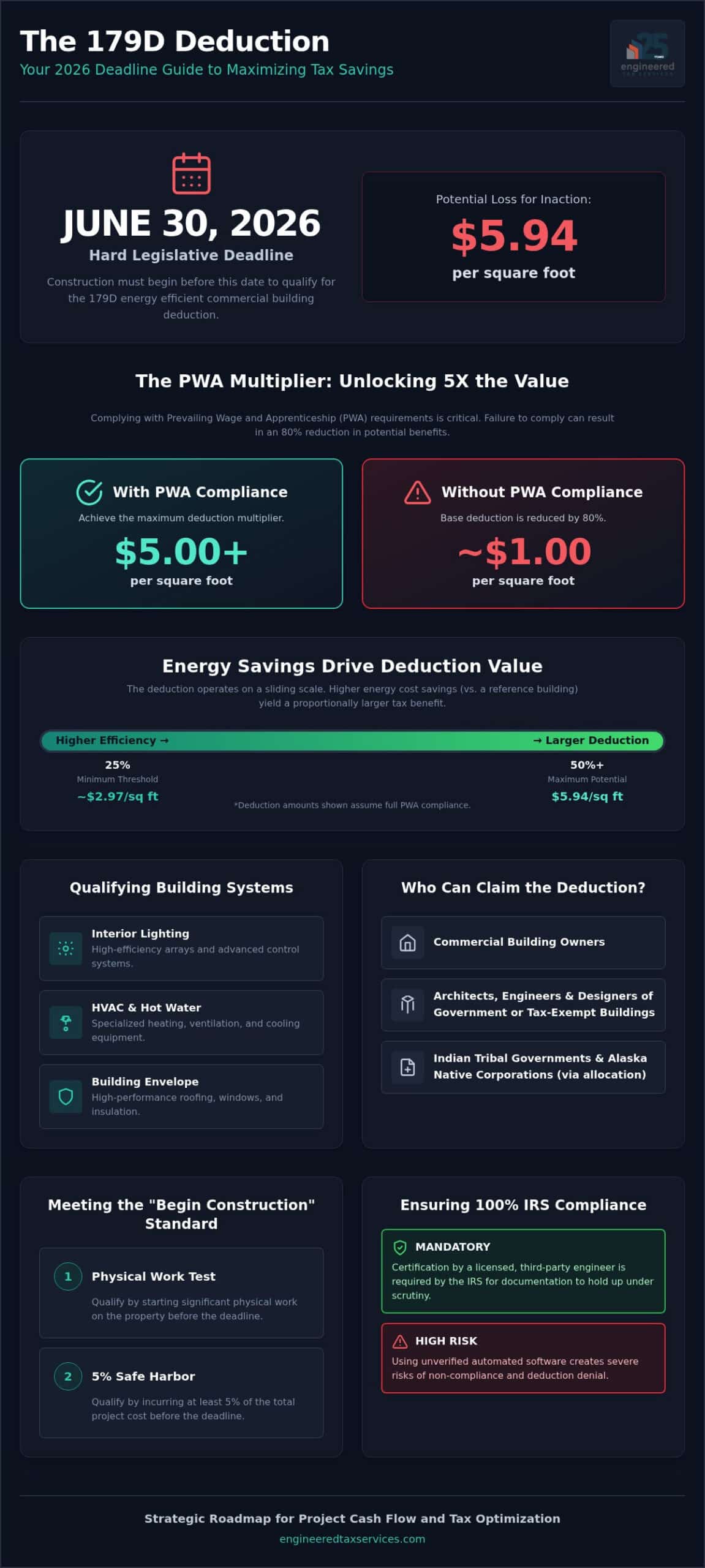
If you don't start construction by June 30, 2026, you're essentially leaving up to $5.94 per square foot on the table. The legislative shift under the “One Big Beautiful Bill Act” has transformed the 179D energy efficient commercial building deduction into a high-stakes engineering race with a hard expiration date. You've likely felt the mounting pressure of balancing intricate energy modeling requirements with the looming risk of missing the mid-year deadline. It's a complex landscape where a single misstep in Prevailing Wage and Apprenticeship (PWA) compliance can slash your potential benefits by eighty percent.
We'll help you navigate these hurdles to lock in maximum value before the upcoming repeal. This guide explains how to utilize the 5% safe harbor rule and secure the rigorous engineering certifications necessary for 100% IRS compliance. You'll discover a strategic framework to optimize cash flow for your current projects while ensuring your designs meet the 25% energy reduction threshold. We're moving beyond simple compliance to show you how technical precision creates long-term financial stability and immediate tax savings.
Key Takeaways
- Secure your eligibility by understanding why construction must commence before the June 30, 2026, legislative deadline.
- Discover how to maximize your 179D energy efficient commercial building deduction by targeting energy savings well beyond the 25% minimum threshold.
- Master the complex Prevailing Wage and Apprenticeship (PWA) requirements to unlock the lucrative $5.00+ per square foot bonus multiplier.
- Learn why the IRS mandates certification from a licensed third-party engineer and the risks associated with using unverified automated software.
- Gain a strategic roadmap for optimizing project cash flow through precise technical documentation and institutional expertise.
The 2026 Countdown: Understanding the 179D Deduction and the OBBB Repeal
The 179D energy efficient commercial building deduction isn't just a line item in the tax code; it's a sophisticated tool for wealth preservation and capital optimization. Originally established by the Energy Policy Act of 2005, this provision remains the premier federal incentive for high-performance commercial builds. It allows taxpayers to accelerate the recovery of costs associated with energy-saving installations, providing an immediate boost to project liquidity and long-term financial stability.
Eligibility for the deduction is categorized into two distinct pathways. Energy Efficient Commercial Building Property (EECBP) covers new construction projects, while Energy Efficient Building Retrofit Property (EEBRP) applies to existing structures undergoing modernization. To qualify, a project must demonstrate significant energy cost savings across one or more of these core building systems:
- Interior Lighting: Implementation of high-efficiency arrays and advanced control systems.
- HVAC and Hot Water: Installation of specialized heating, cooling, and ventilation equipment.
- Building Envelope: Integration of high-performance roofing, windows, and insulation.
The OBBB Sunset and Commencement Standards
The legislative landscape has shifted dramatically with the “One Big Beautiful Bill” (OBBB) Act of 2025. This legislation introduces a hard sunset provision, mandating that construction must begin before June 30, 2026, to secure these benefits. Proving you've “begun construction” requires meeting specific IRS standards. You can satisfy this via the Physical Work Test, which involves starting significant physical work on the property. Alternatively, the Five Percent Safe Harbor allows you to qualify if you've incurred at least 5% of the total project cost before the deadline. Understanding the full scope of 179D EPAct deduction eligibility under the current legislative framework is essential to ensuring your project meets these commencement standards before the mid-year cutoff. Waiting until the second quarter of 2026 to initiate these studies creates severe certification bottleneck risks. Early engagement is the only way to avoid the rush and ensure your documentation holds up under scrutiny.
Who Can Claim the 179D Deduction in 2026?
This incentive serves a diverse range of stakeholders beyond traditional real estate developers. While commercial building owners use the 179D energy efficient commercial building deduction to reduce federal income tax liability, the program also rewards the “Expert's Expert.” Architects, engineers, and designers of government-owned or tax-exempt buildings can claim the deduction through an allocation letter from the building owner. This eligibility now extends to Indian tribal governments and Alaska Native Corporations, offering a powerful avenue for tax-exempt entities to pass financial value to their design partners while promoting sustainable infrastructure.
Evaluating Your Potential: Savings Requirements and Deduction Pathways
Maximizing the 179D energy efficient commercial building deduction requires a nuanced understanding of how performance translates into capital. The incentive operates on a sliding scale that begins at a 25% reduction in energy and power costs compared to a reference building. For every percentage point of efficiency achieved above this 25% floor, the deduction amount increases linearly, capping at a 50% reduction. This structure rewards the most ambitious designs, offering a significant jump in value for projects that push beyond the minimum requirements.
You have two primary routes to certify these savings. The Traditional Modeling Pathway relies on sophisticated software to compare your building's design against a theoretical baseline. Conversely, the Alternative Measurement Pathway allows for a deduction based on measured energy use intensity (EUI) savings, which is often more practical for complex retrofits. To truly optimize your return, you should consider the strategic value of integrating cost segregation commercial property studies with your energy analysis. Combining these methodologies allows you to capture accelerated depreciation on short-life assets while simultaneously securing energy incentives. Savvy investors who are also repositioning real estate assets should explore how 1031 exchange services can be paired with engineering-based tax strategies to preserve capital and create a powerful basis boost on replacement properties. Consulting with a specialist to evaluate your project's eligibility ensures you capture every available dollar from these overlapping tax strategies.
The ASHRAE 90.1 Reference Standard
The American Society of Heating, Refrigerating, and Air-Conditioning Engineers (ASHRAE) provides the technical bedrock for 179D compliance. Under IRS guidelines on 179D, your building's performance is measured against the ASHRAE 90.1 standard in effect four years prior to the date the property is placed in service. For projects coming online in 2026, this typically means exceeding the rigorous benchmarks set by the 90.1-2019 or 2022 versions. The IRS strictly mandates the use of Department of Energy-approved, licensed engineering software to perform these complex comparative simulations.
Retrofit Projects and the Energy Use Intensity (EUI) Path
Existing buildings undergoing modernization often find the Energy Use Intensity (EUI) path more accessible than theoretical modeling. This pathway requires a rigorous Measurement & Verification (M&V) process to document actual performance improvements. You must establish a baseline of energy consumption before the retrofit and then provide a full year of utility data post-installation to verify the savings. To qualify for the deduction through this route, your documentation must prove a sustained 25% reduction in EUI compared to the building's pre-retrofit state. This data-driven approach provides a clear, verifiable trail for IRS auditors while reflecting the real-world efficiency of your mechanical and envelope upgrades. Property owners planning energy efficient commercial renovations in 2026 should understand how this EUI pathway can transform retrofit projects into powerful tax liquidity instruments before the legislative deadline.
The PWA Multiplier: Navigating Prevailing Wage and Apprenticeship Compliance
The financial impact of the 179D energy efficient commercial building deduction changes dramatically when you account for the Prevailing Wage and Apprenticeship (PWA) requirements. Under the current framework, meeting these labor standards triggers a “5x Multiplier,” elevating the potential benefit from a base rate of roughly $1.19 per square foot to a maximum of $5.94 per square foot in 2026. This isn't a mere suggestion; it's a rigorous statutory mandate. As outlined in the Full text of 26 U.S. Code § 179D, the bonus deduction is strictly reserved for projects that prioritize standardized labor practices from day one.
Compliance hinges on two primary pillars. First, every laborer and mechanic employed on the project must be paid at least the prevailing wage as determined by the Department of Labor for that specific locality and craft. Second, the project must satisfy apprenticeship quotas. For construction beginning in 2026, 15% of the total labor hours must be performed by qualified apprentices from a registered program. Failing to meet these quotas or neglecting to document wage payments can lead to extreme financial penalties. If an audit reveals non-compliance after you've claimed the deduction, you'll be forced to pay back wages with interest plus significant IRS penalties to maintain the bonus rate. Multifamily developers navigating these same PWA standards should also explore how the 45L tax credit multifamily projects can qualify for offers up to $5,000 per unit in federal credits before the June 30, 2026, termination deadline.
Documentation and Good Faith Efforts
Maintaining granular payroll records for every subcontractor is the only way to survive an IRS inquiry. You must track hours, wages, and apprenticeship participation with absolute precision. If apprentices are unavailable in your region, you must document a “Good Faith Effort” by submitting formal requests to registered apprenticeship programs and keeping a log of their responses. An engineering firm acts as your technical advocate here, providing the oversight necessary to ensure your labor documentation aligns perfectly with the engineering study's timeline. This proactive verification prevents the “compliance gap” that often leads to disqualified deductions.
The $5.00+ Per Square Foot Opportunity in 2026
The ROI for a 100,000 square foot facility illustrates why PWA compliance is a strategic necessity rather than a bureaucratic hurdle. In 2026, the difference in realized tax savings is staggering. You must establish PWA compliance at the exact moment construction starts to secure these enhanced rates.
- Standard Deduction (Max $1.19/sq. ft.): $119,000 total benefit.
- PWA-Enhanced Deduction (Max $5.94/sq. ft.): $594,000 total benefit.
- Net Financial Gain: $475,000 for a single 100k sq. ft. build.
This massive spread highlights why the 179D energy efficient commercial building deduction is the most powerful tool in your 2026 tax strategy. By integrating labor standards into your project planning, you turn a standard tax break into a significant capital infusion that can fund future builds or offset immediate construction costs.
Selecting a Specialized Engineering Firm for 179D Certification
The IRS is explicit: a 179D energy efficient commercial building deduction must be certified by a third-party, licensed professional engineer or contractor. This isn't a clerical task or a standard accounting entry. It's a technical validation of building thermodynamics and mechanical performance. While many firms claim to offer these services, the IRS requires a level of independent technical precision that most standard tax preparers simply can't provide. Choosing the right partner means selecting a firm that bridges the gap between complex engineering modeling and sophisticated tax law.
Beware of “automated” software solutions that promise quick results without professional oversight. These tools often miss nuanced on-site variables or fail to account for the rigorous PWA documentation required to survive a federal inquiry. A specialized firm doesn't just run a report; they provide a comprehensive engineering study that withstands scrutiny. This level of detail is particularly vital when you're looking to capture multiple incentives. For instance, a firm with deep institutional knowledge can handle 179D studies and R&D tax credit engineering simultaneously. This integrated approach ensures that no “missed” energy-saving opportunities or technical research activities are left on the table during the design or retrofit phase.
Questions to Ask Your 179D Provider
Before committing to a provider, you must vet their technical credentials and their history with the IRS. Don't settle for vague promises of compliance. Ask these direct questions to ensure your deduction is secure:
- Do you have licensed P.E.s (Professional Engineers) on staff who will sign the final certification?
- What specific energy modeling software do you use, and is it on the Department of Energy's list of IRS-approved programs?
- Can you provide a sample certificate of compliance and a detailed technical report that meets current IRS standards?
The CPA vs. Engineering Firm Distinction
Your standard CPA is a vital asset for your business, but they likely cannot sign your 179D certification. The tax code mandates that the person certifying the 179D energy efficient commercial building deduction must have a professional engineering license in the state where the building is located. A specialized engineering firm understands the nuances of building envelopes and HVAC efficiency in a way that a financial generalist cannot. We conduct over 10,000 tax studies annually, providing the “Expert's Expert” perspective that CPAs rely on to complete their clients' filings. This specialized oversight identifies hidden value in your design that standard software might overlook. To protect your investment and maximize your return, you should schedule an engineering-based feasibility study with a national authority before your 2026 construction deadline arrives.
Executing Your 179D Strategy with Engineered Tax Services
Engineered Tax Services (ETS) stands as the premier national authority for engineering-based tax incentives. We aren't just a service provider; we're a strategic partner that provides peace of mind through technical precision. With a track record of conducting over 10,000 tax studies annually, our firm bridges the gap between complex building thermodynamics and the federal tax code. We specialize in the technical documentation that standard accounting firms cannot provide alone, ensuring your 179D energy efficient commercial building deduction is accurate, compliant, and defensible.
Our methodology is designed to alleviate the burden of the June 30, 2026, construction start deadline. We manage the OBBB timeline by helping you satisfy the “Physical Work Test” or the “Five Percent Safe Harbor” requirements well before the sunset provision takes effect. By choosing the “ETS Family” of services, you gain the advantage of an integrated wealth-optimization approach. We don't just look at energy; we evaluate your entire property for Cost Segregation and R&D tax credits simultaneously. This holistic strategy unlocks hidden potential and ensures you aren't leaving money on the table during this critical legislative transition. Investors who are also repositioning commercial assets should consider how 1031 exchange services can complement this integrated approach by deferring capital gains taxes on sold properties while engineering a stronger tax position on newly acquired replacement assets.
The ETS 179D Process: Precision and Peace of Mind
Our engagement begins with a complimentary feasibility analysis. This initial step provides a clear estimate of your potential deduction before you commit significant resources. Once the project moves forward, our engineering team performs detailed site visits and technical data collection to verify every energy-saving component within your HVAC, lighting, and envelope systems. The culmination of this work is a comprehensive, IRS-ready report that stands up to the most rigorous scrutiny. We provide the licensed engineering analysis required for certification, giving you the confidence that your filing is grounded in rigorous professional standards.
Secure Your 2026 Deduction Before the Repeal
The window for strategic planning is closing quickly. Q1 2026 represents the final opportunity to initiate the technical assessments needed to meet the commencement of construction standards. Waiting until the final weeks risks certification bottlenecks and potential disqualification due to the sudden surge in national demand. You can start today by letting our team perform a technical assessment of your portfolio to identify the highest-value opportunities. Don't let the OBBB repeal erase your hard-earned benefits. Schedule a consultation with our 179D specialists today to protect your financial health and optimize your future builds.
Capitalize on Energy Incentives Before the 2026 Legislative Sunset
The window to lock in the 179D energy efficient commercial building deduction is closing rapidly as the June 30, 2026, construction deadline approaches. Success in this high-stakes environment requires more than just energy-efficient design; it demands a rigorous adherence to Prevailing Wage and Apprenticeship standards to secure the five-fold deduction multiplier. By integrating engineering precision with strategic tax planning now, you ensure your project remains eligible for maximum benefits before the upcoming repeal. Proactive documentation isn't just about compliance; it's a fundamental strategy for capital preservation.
As a licensed engineering firm with over 20 years of IRS compliance expertise, Engineered Tax Services is the national authority on OBBB and Inflation Reduction Act incentives. We perform over 10,000 engineering-based tax studies annually, providing the institutional knowledge necessary to protect your investment from audit risk. Don't let technical complexities or legislative shifts compromise your project's ROI. Our team is ready to guide you through the final certification window with the technical depth your portfolio deserves.
Maximize your 2026 tax savings with a professional 179D study from Engineered Tax Services. It's time to transform your building's efficiency into a powerful engine for long-term growth and financial stability.
Frequently Asked Questions
What is the 179D energy efficient commercial building deduction?
The 179D energy efficient commercial building deduction is a federal tax incentive designed to reward owners and designers who prioritize high-performance building systems. It allows for a significant immediate deduction of costs related to the installation of energy-efficient lighting, HVAC, and building envelopes. To qualify, a project must demonstrate a minimum 25% reduction in total annual energy and power costs compared to a standardized reference building.
How much is the 179D deduction per square foot in 2026?
For 2026, the standard deduction ranges from $0.59 to $1.19 per square foot depending on the percentage of energy savings achieved. However, projects that satisfy Prevailing Wage and Apprenticeship (PWA) requirements qualify for an enhanced bonus deduction. This bonus rate starts at $2.97 per square foot for a 25% savings and scales up to a maximum of $5.94 per square foot for buildings reaching a 50% energy reduction.
Does the 179D deduction expire in 2026?
Yes, the current availability for new projects is set to sunset on June 30, 2026, under the provisions of the One Big Beautiful Bill Act. To secure eligibility, you must prove that construction has officially commenced before this mid-year deadline. While the deduction remains available for projects already underway, those failing to meet the “Physical Work Test” or the “Five Percent Safe Harbor” by this date will miss the current incentive window.
Can architects and engineers claim the 179D deduction for government buildings?
Architects, engineers, and designers of record can claim the deduction for work performed on government-owned or tax-exempt properties. Since these entities don't pay federal income tax, they can legally allocate the deduction to the primary designer responsible for the energy-efficient systems. This is finalized through a formal allocation letter signed by the building owner, providing a powerful financial reward for specialized design firms.
What are the PWA requirements for the 179D bonus deduction?
To unlock the five-fold bonus multiplier, you must pay all laborers and mechanics the local prevailing wage as determined by the Department of Labor. Additionally, 15% of the total labor hours for projects starting in 2026 must be performed by qualified apprentices from registered programs. Maintaining precise, granular payroll records for every subcontractor is essential for surviving an IRS audit and preserving your enhanced deduction rate.
What is the difference between EECBP and EEBRP?
EECBP refers to Energy Efficient Commercial Building Property, which typically covers new construction projects verified through energy modeling. EEBRP stands for Energy Efficient Building Retrofit Property, a pathway specifically designed for existing structures undergoing modernization. Retrofit projects often utilize the Energy Use Intensity (EUI) pathway, which compares 12 months of post-installation utility data against the building's pre-retrofit energy consumption baseline. For property owners managing utility portfolios, resources like Pagos Energía EMSA offer specialized guidance on energy payments and procedures; similarly, maintaining organized records of energy consumption is essential for satisfying these IRS requirements.
How do I transfer a 179D deduction from a tax-exempt entity?
The transfer is executed through a written allocation letter that must be signed by an authorized representative of the tax-exempt building owner. This provision applies to buildings owned by federal, state, and local governments, as well as Indian tribal governments and Alaska Native Corporations. The letter must specify the square footage, the systems installed, and the exact amount of the 179D energy efficient commercial building deduction being allocated to the designer.
Is a 179D study worth it for a smaller commercial building?
A 179D study is often highly lucrative for smaller facilities, particularly when the PWA bonus deduction is applied. For example, a 25,000 square foot building achieving maximum efficiency could yield nearly $150,000 in immediate tax deductions. We recommend an initial feasibility analysis for any commercial structure over 20,000 square feet to determine if the technical certification costs are outweighed by the potential for significant capital recovery. Property owners and designers who want a comprehensive overview of 179D EPAct deduction eligibility requirements and the June 30 deadline can use that resource to confirm whether their project qualifies before committing to a full engineering study.