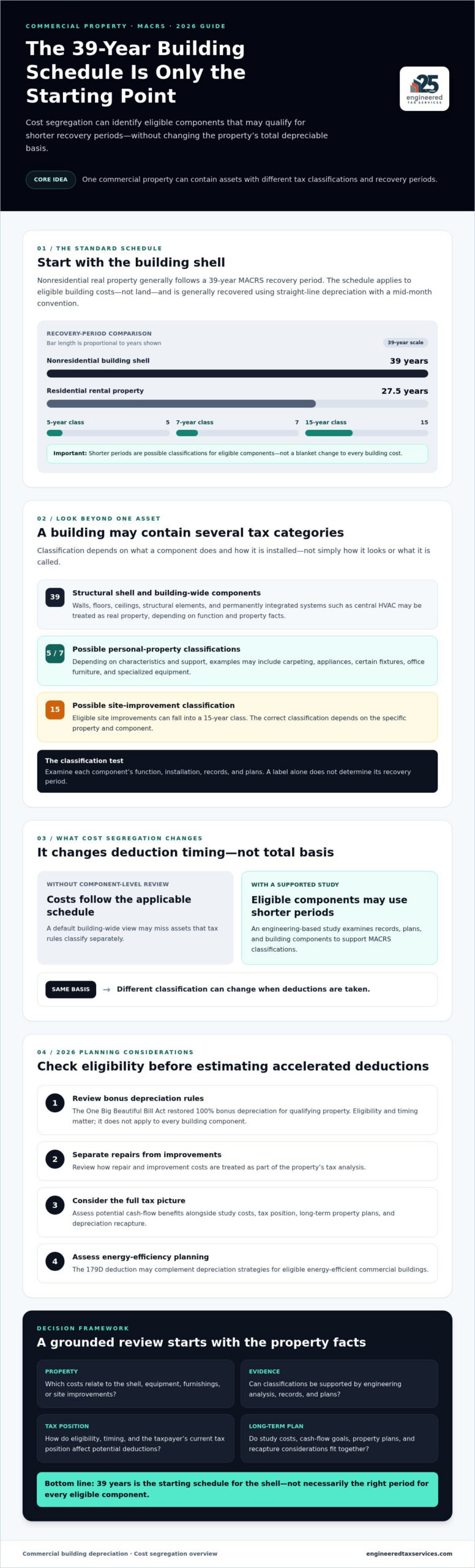
What if a commercial building’s 39-year depreciation schedule is only the starting point, not the whole strategy? The commercial building depreciation life for a nonresidential building’s structural shell remains 39 years under MACRS, but qualifying components may be classified into shorter recovery periods through an engineering-based cost segregation study.
If slow capital recovery and a high tax burden are limiting your property’s cash flow, it’s worth checking whether the default schedule tells the full story. The opportunity lies in identifying assets that tax rules treat differently, then applying the appropriate MACRS class with documented support.
In this 2026 guide, you’ll learn how cost segregation can reclassify eligible components, which assets may fall into 5-, 7-, or 15-year periods, and how the One Big Beautiful Bill Act restored 100% bonus depreciation for qualifying property. Eligibility and timing matter, so accelerated deductions won’t apply to every building component.
We’ll also clarify how repairs differ from improvements, explain depreciation recapture, and discuss how the 179D deduction may complement planning for energy-efficient commercial buildings. Use this framework to evaluate potential cash-flow benefits and make informed, technically grounded decisions.
Key Takeaways
- Learn why the commercial building depreciation life is a starting point for the structural shell, not necessarily the right recovery period for every component.
- See how an engineering-based cost segregation study can identify building components for separate MACRS classification and support informed depreciation planning.
- Understand how 2026 bonus depreciation rules may affect qualifying short-life assets, and what eligibility details to review before estimating deductions.
- Use a practical framework to assess potential cash-flow benefits alongside study costs, tax position, and long-term property plans.
- Explore how the 179D deduction may complement depreciation strategies for eligible energy-efficient commercial buildings.
Understanding the Standard Commercial Building Depreciation Life (39 Years)
For tax purposes, the commercial building depreciation life is generally 39 years for nonresidential real property under the Modified Accelerated Cost Recovery System (MACRS). This category typically covers property used in a trade or business, such as an office or retail building, rather than a residential rental building. Land itself isn’t depreciated; the recovery period applies to eligible building costs.
The 39-year period is a statutory recovery schedule, not an estimate of how long a building will remain useful. Under the Modified Accelerated Cost Recovery System (MACRS), a building’s eligible basis is generally recovered using straight-line depreciation and a mid-month convention. By comparison, residential rental property generally has a 27.5-year recovery period.
The Straight-Line Method vs. Accelerated Recovery
Straight-line depreciation allocates the depreciable basis across the recovery period, subject to timing conventions in the first and final years. This creates a steady stream of deductions, but much of the tax benefit arrives over decades rather than near the initial investment.
Inflation can reduce the purchasing power of deductions received far into the future. For a profitable investor, that delay may make the default schedule feel restrictive: deductions are available, but their timing may not align with current tax exposure or reinvestment goals. In 2026, investors are examining whether eligible building components can be assigned shorter MACRS lives through cost segregation, rather than assuming every cost must follow the building’s 39-year schedule.
Identifying the Building Shell and Structural Components
Nonresidential real property generally includes inherently permanent structures and components that serve the building as a whole. Walls, floors, ceilings, and structural elements are typical examples. Permanently integrated building systems, including central HVAC, may also be treated as part of the real property, depending on their function and the facts of the property.
A common challenge is treating a building as one monolithic asset. A commercial property can contain components with different functions and tax classifications, even when they’re physically connected to the structure. Supportable classification requires examining what each component does and how it’s installed, rather than assigning every cost to the shell. That distinction is the starting point for deciding whether the standard recovery period tells the full story.
The MACRS Framework: Categorizing Assets Beyond the Building Shell
The Modified Accelerated Cost Recovery System (MACRS) assigns depreciable property to recovery periods based on its classification. A commercial property isn’t necessarily one tax asset: its structural shell may follow a 39-year schedule, while eligible equipment, furnishings, and site improvements can fall into shorter classes. The challenge is distinguishing personal property from structural components based on function and installation, not simply appearance.
IRS Publication 946 explains depreciation rules and property classifications. A cost segregation study applies those rules to a specific property by examining records, plans, and building components. Correct classification matters because it determines the recovery period and, for qualifying property, whether accelerated deductions may be available. Reclassification doesn’t change the building’s total depreciable basis; it changes the timing of deductions.
5-Year and 7-Year Personal Property
Some assets serve a particular business function rather than the building as a whole. Depending on their characteristics, examples may include carpeting, appliances, certain fixtures, office furniture, and specialized equipment. A component’s label alone doesn’t determine its class. Specialty lighting or decorative finishes, for instance, require analysis of their purpose and relationship to the building before assigning a recovery period.
Where supported, 5- and 7-year classifications move deductions forward compared with the 39-year building schedule. That timing can improve near-term cash flow, particularly when the taxpayer can use the deductions. Under 2026 rules, qualifying MACRS property with a recovery period of 20 years or less may be eligible for 100% bonus depreciation. Eligibility depends on the applicable requirements and the taxpayer’s circumstances, so a shorter recovery period doesn’t automatically guarantee a particular tax outcome.
15-Year Land Improvements
Land improvements are distinct from both the building shell and movable business property. Paving, sidewalks, fencing, and landscaping may qualify for a 15-year recovery period when the facts and applicable rules support that classification. Engineering review helps document what was installed, where it sits, and how it functions as part of the site.
Because 15-year property is within the 20-years-or-less threshold, qualifying assets may also be eligible for 100% bonus depreciation in 2026. The potential advantage is earlier cost recovery, not a promise of tax savings. Results depend on eligibility, taxable income, and the taxpayer’s broader position. For investors assessing whether a property’s classifications warrant closer review, engineering-based cost segregation can help connect component-level evidence with MACRS treatment.
Cost Segregation: Reducing Asset Life from 39 Years to 5, 7, or 15 Years
Cost segregation examines a commercial property component by component to determine whether certain costs assigned to the building can be properly classified as shorter-lived assets. Rather than treating the entire structure as one asset, an engineering-based study connects physical evidence to tax classifications. The goal isn’t to change the building’s total depreciable basis, but to identify eligible costs whose recovery period may differ from the shell’s 39-year schedule.
The analysis typically draws on construction documents, asset details, and property observations. Engineers assess how components are installed and what they do, distinguishing items that serve the building generally from assets serving a specific business function or improving the site. The findings are documented for tax reporting and reviewed with the taxpayer’s tax professional. For an overview of depreciation basics, the IRS explains that business property with a useful life extending beyond one year is generally depreciated, while land itself isn’t depreciable.
A study can also be considered for property acquired or placed in service in an earlier year. This look-back approach evaluates whether past depreciation classifications may be adjusted under applicable accounting and tax procedures. The potential benefit depends on the property, prior filings, current eligibility, and coordination with a qualified tax professional. It isn’t simply a matter of claiming all missed deductions in the current year.
Engineering vs. Accounting Approaches
A percentage-based rule of thumb may overlook how assets are actually constructed and used. Classification needs evidence. Engineered Tax Services uses a licensed engineering-based approach to cost segregation, bringing technical analysis to the allocation process. Plans, component descriptions, and supporting calculations can explain why an asset was assigned a particular recovery period. This documentation can support a taxpayer’s position, though no study can guarantee an audit outcome.
For a deeper look at the methodology and strategic role of this work, explore Cost Segregation for Commercial Property: Engineering-Based Wealth Optimization in 2026.
Tangible Property Rules and Partial Asset Dispositions
Renovations can raise another depreciation question: what happens to the original component that’s removed? When a building component with remaining tax basis is retired, partial asset disposition rules may allow the remaining basis to be recognized, subject to applicable requirements and adequate records. For example, replacing an existing building system may involve both capitalizing the new improvement and evaluating the tax treatment of the retired component.
Coordinate that analysis with tangible property rules, which distinguish deductible repairs from capital improvements. A documented cost segregation study can help establish component-level detail, while the taxpayer’s tax professional determines the appropriate treatment and reporting. To assess how engineering-based cost segregation may apply to your property, review Engineered Tax Services’ cost segregation approach.
Navigating Bonus Depreciation and Tax Law Changes in 2026
For 2026, the prior bonus depreciation phase-down is no longer the governing rule for qualifying property. The One Big Beautiful Bill Act (OBBBA), signed July 4, 2025, restored 100% first-year bonus depreciation permanently for qualified property acquired and placed in service after January 19, 2025. Under the earlier Tax Cuts and Jobs Act (TCJA) schedule, the 2026 rate would have been 20%. The change makes it important to check the current rules rather than plan around the former phase-out.
The 39-year commercial building shell doesn’t become eligible for 100% bonus depreciation simply because it’s placed in service in 2026. The key is identifying assets that qualify under MACRS. Property with a recovery period of 20 years or less may qualify, including eligible 5-, 7-, and 15-year components identified through cost segregation. For investors evaluating the commercial building depreciation life, the distinction between the shell and qualifying shorter-life assets can shape the timing of deductions.
Plan Around Acquisition and Placed-in-Service Timing
Bonus depreciation eligibility depends on the property and applicable acquisition and placed-in-service requirements, not just the year a return is filed. A practical review should confirm when qualifying assets were acquired, when they were ready and available for business use, and which MACRS class applies. Cost segregation can help identify and document eligible components, but it doesn’t make every building cost bonus-eligible. For additional planning context, see the 2026 Guide to Commercial Real Estate Depreciation.
Pair Depreciation Planning With 179D
Bonus depreciation and the 179D deduction are separate tax provisions, not interchangeable benefits. A qualifying energy-efficient commercial building may warrant a distinct 179D evaluation alongside cost segregation. Energy-focused engineering and component-level depreciation analysis can inform a coordinated strategy, but eligibility for one doesn’t establish eligibility for the other, and the deductions shouldn’t be treated as automatic offsets.
For details on evaluating the energy-related opportunity, review the 179D Energy Efficient Commercial Building Deduction: The 2026 Strategic Guide. To assess whether cost segregation or a 179D study fits your property, explore engineering-based tax studies and discuss the facts with your tax professional.
Implementing an Engineering-Based Tax Strategy for Maximum ROI
A cost segregation strategy is most useful when engineering findings translate into clear, supportable tax classifications. For the commercial building depreciation life, that means examining how components are built and used, then coordinating the analysis with applicable tax rules and the owner’s broader plans. Property management records, construction documents, and tax reporting should tell a consistent story.
A typical study begins with collecting available information, such as purchase and construction records, plans, and prior depreciation schedules. A property site visit can help engineers observe components and compare physical conditions with the documentation. The final report identifies assets, explains their classifications, and provides schedules for review with the taxpayer’s CPA or tax professional.
To evaluate potential return on investment, compare the estimated tax impact and timing of supported accelerated deductions with the study’s cost. The analysis should account for whether deductions can be used, the owner’s tax circumstances, future plans for the property, and possible depreciation recapture upon sale. Earlier deductions may improve near-term cash flow, but they don’t automatically represent permanent tax savings.
Choose a Specialized Engineering Partner
Look for a firm with licensed engineering expertise, a documented methodology, and reports that connect physical evidence to tax classifications. Ask how the team supports its findings and coordinates with the taxpayer’s tax professional. Technical experience can matter for complex portfolios. Engineered Tax Services conducts over 10,000 tax studies annually and specializes in engineering-based tax studies, including cost segregation and R&D tax credits.
Move From Preliminary Review to Implementation
Before commissioning a study, assemble basic property and tax information for a preliminary benefit analysis. Then review the assumptions and potential results with your CPA and engineering partner. This helps connect engineering details with filing decisions and property-specific considerations.
- Gather records: Collect acquisition, construction, renovation, and depreciation information.
- Assess the property: Identify components and site improvements that may warrant separate classification.
- Review the findings: Coordinate the report, tax treatment, and implementation timing with your professional team.
Property owners can connect operations and tax planning by sharing renovation plans and asset records with their tax and engineering teams. Consider whether an engineering-based cost segregation study could support your 2026 tax strategy, then review the findings with your CPA before acting.
Turn Depreciation Planning Into a 2026 Strategy
The 39-year schedule remains the baseline for a nonresidential building’s structural shell, but it doesn’t necessarily determine the recovery period for every asset. MACRS classifications and an engineering-based cost segregation study can help identify components that may qualify for shorter lives, while 2026 bonus depreciation rules make eligibility and timing especially important.
Evaluate more than the commercial building depreciation life alone. Consider how component classifications, your ability to use deductions, and your long-term property plans work together. A well-supported study can bring engineering evidence and tax planning into alignment, with your CPA guiding how findings apply to your tax position.
Engineered Tax Services is an independent, licensed engineering firm specializing in cost segregation, R&D tax credits, and other tax incentive studies. To discuss whether a specialized engineering-based tax study may fit your property, contact Engineered Tax Services.
Frequently Asked Questions
What is the recovery period for commercial real property?
Nonresidential real property generally has a 39-year recovery period under MACRS, using straight-line depreciation and the mid-month convention. This period typically applies to the building structure, not the land, which isn’t depreciable. Residential rental property generally has a 27.5-year recovery period. A commercial property may also contain eligible assets with shorter recovery periods, so the building’s classification doesn’t necessarily determine the schedule for every component.
Can I change the depreciation life of a commercial building after I buy it?
You can’t simply choose a shorter recovery period for the building shell after purchase. However, a cost segregation study may identify components included in the building basis that qualify for separate MACRS classifications. For property owned for several years, a look-back analysis may identify potential adjustments under applicable tax accounting procedures. Have your CPA review the study and determine the proper method for correcting or changing prior depreciation treatment.
Does bonus depreciation apply to 39-year commercial property?
Generally, 100% bonus depreciation in 2026 doesn’t apply to the 39-year structural shell because qualified property must generally have a MACRS recovery period of 20 years or less. Certain components classified through cost segregation may qualify if they meet the applicable requirements. Under the One Big Beautiful Bill Act, 100% bonus depreciation was restored for qualifying property acquired and placed in service after January 19, 2025. Confirm eligibility and timing with your tax professional.
What is the difference between MACRS and straight-line depreciation?
MACRS is the federal tax depreciation system that assigns property to recovery periods and provides rules for calculating deductions. Straight-line is a depreciation method that allocates an asset’s depreciable basis evenly over its recovery period, subject to applicable conventions. For example, nonresidential real property generally uses a 39-year straight-line schedule. MACRS also includes other methods for certain asset classes, so the applicable method depends on the property classification.
How does a cost segregation study affect the depreciation life of a building?
A cost segregation study analyzes building components and supporting records to determine whether certain costs qualify for recovery periods shorter than the building shell’s 39 years. For example, eligible assets may be classified as 5-, 7-, or 15-year property. The study doesn’t change the building’s total depreciable basis or arbitrarily shorten the shell’s recovery period. It provides technical support for component-level classifications that your tax professional can evaluate.
Is a cost segregation study worth it if bonus depreciation is phasing out in 2026?
The premise needs updating: under 2026 rules, 100% bonus depreciation was restored for qualifying property, replacing the former phase-down schedule. A study may still be useful because it identifies eligible asset classes and clarifies depreciation timing, but bonus eligibility and the ability to use deductions depend on the facts. Evaluate the potential tax impact, property records, and ownership plans with an engineering team and your CPA before deciding.
What building components qualify for a 5-year or 15-year life?
Classification depends on an asset’s function, construction, and relationship to the building, so examples aren’t automatic determinations. Potential 5-year property may include appliances, carpeting, and certain fixtures. Potential 15-year property includes land improvements such as paving, sidewalks, and landscaping. An engineering-based cost segregation study examines the property and documents the rationale for assigning eligible components to a shorter MACRS recovery period.
How do the Tangible Property Regulations impact commercial building life?
The Tangible Property Regulations help determine whether costs for work on a building are currently deductible repairs or capital improvements that must be depreciated. They don’t automatically change the building’s recovery period. If a renovation removes an existing component, partial asset disposition rules may also be relevant to its remaining tax basis. Keep project and asset records, then coordinate the treatment of repairs, improvements, and retired components with your CPA.