What if an IRS examiner asks why a building component received a particular depreciation treatment? Strong cost segregation audit defense starts before that question arises. It depends on a clear trail from property and project records to cost allocations, asset classifications, and the depreciation reported on the tax return. A study is harder to explain when technical support is thin or acquisition, construction, and tax records are scattered.
A well-documented study makes the analysis easier to follow. This article explains what an IRS examination of a cost segregation study may involve, which records can support the analysis, and how engineering documentation connects property details and costs to reported classifications. It also shows how to organize a file before an inquiry, rather than reconstructing the analysis under pressure.
We’ll cover the IRS Cost Segregation Audit Techniques Guide, the role of engineering analysis, and the distinct responsibilities of engineering, tax, and legal professionals. Engineered Tax Services is an independent, licensed engineering firm specializing in cost segregation. Engineering documentation supports the technical analysis, while tax-return decisions and legal judgments belong with the taxpayer’s tax adviser and legal counsel. The goal is a clear, evidence-based position, not a promised examination outcome.
Key Takeaways
- Understand how cost segregation audit defense differs from preventing an examination or guaranteeing its outcome.
- Connect asset classifications to property-specific facts and acquisition, construction, or renovation records.
- Use the examination notice and its deadlines to organize a response when the IRS raises questions.
- Identify documentation gaps that could make it harder to explain a study’s analysis and reported positions.
- Coordinate engineering documentation, tax advice, and legal judgment while keeping each role distinct.
What Does Cost Segregation Audit Defense Actually Mean?
Cost segregation audit defense is the organized technical and tax support used to explain and substantiate cost segregation positions reported on a tax return. It connects a property’s physical features and costs to the study’s asset classifications and depreciation analysis, so a reviewer can follow how the conclusions were reached. It does not guarantee acceptance or prevent an examination.
A cost segregation study allocates portions of a property’s cost basis among assets that may receive different depreciation treatment. For background on the study’s purpose and asset reclassification, see What is a Cost Segregation Study? Because classifications affect depreciation reported on a return, questions may focus on whether an asset’s category and basis are supported by the property facts and the study’s analysis.
What an IRS examination can ask about a cost segregation study
An examiner may ask how the study identified particular assets, which property or project records informed the analysis, and how the reported classifications relate to depreciation claimed on the return. For example, a reviewer may need to understand what a schedule description refers to, how an amount was derived, or what evidence supports an allocation. Questions and requested information depend on the taxpayer, return, and examination scope. A cost segregation study alone does not establish that an examination will occur, and no property type or deduction should be treated as a certain trigger.
Audit readiness versus audit-proof claims
Good documentation can make a tax position clearer to explain, but it cannot eliminate examination risk or determine the IRS’s conclusions. Claims that a study is “audit-proof,” guarantees tax savings, or ensures IRS acceptance overstate what documentation can do. Readiness means keeping evidence organized, preserving a traceable link between source records and study conclusions, and coordinating a professional response if questions arise.
Keep engineering support distinct from tax and legal advice
Engineering documentation explains the property-based analysis: what was observed or reviewed, how costs were allocated, and why assets were classified as shown in the study. Tax advisers address how study results are reflected on the return and advise on tax positions. Legal counsel provides legal advice when needed. Engineering support substantiates the study’s technical analysis; it does not replace tax-return advice or legal representation.
Establishing these roles before an inquiry helps keep the explanation consistent. An engineering-led cost segregation study provides technical documentation for its classifications and allocations. The taxpayer’s tax adviser considers return treatment and tax-related decisions, while legal questions belong with counsel. The aim is a coherent, evidence-based explanation, not a predetermined examination outcome.
Build the Engineering Record Behind Every Cost Segregation Position
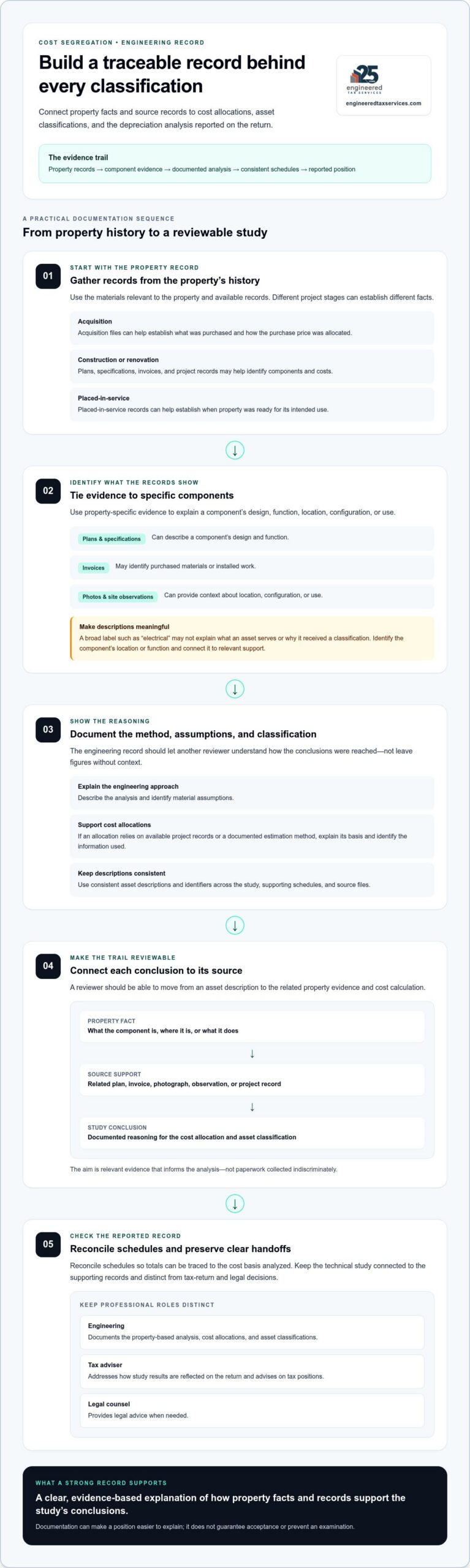
A useful engineering record lets a reviewer trace each reported asset classification back to the property and the analysis behind it. A traceable cost segregation evidence trail connects each classification to relevant property facts, source records, and the study’s documented reasoning. This connection is central to cost segregation audit defense. It makes the basis for a position understandable instead of leaving a list of figures without context.
The record may draw on different stages of a property’s history. Acquisition files can help establish what was purchased and how the purchase price was allocated. For construction or renovation, plans, specifications, invoices, and project records may help identify components and costs. Placed-in-service records can help establish when property was ready for its intended use. The relevant materials depend on the property and the records available.
Connect property records to asset classifications
Plans and specifications can describe a component’s design and function. Invoices may identify purchased materials or installed work. Photographs and site observations can provide context about a component’s location, configuration, or use. A strong study uses evidence that fits the property instead of implying that every project has the same documentation.
Descriptions matter. A broad label such as “electrical” may not tell a reviewer what an asset serves or why it received a particular classification. A more useful description identifies the component’s location or function and ties it to relevant records. For example, the supporting file should help a reviewer move from an asset description to the related plan, invoice, photograph, or cost calculation. The goal is not to collect paperwork indiscriminately, but to show how the evidence informs the analysis.
Document assumptions, methodology, and reviewability
A well-organized report explains the engineering approach and identifies material assumptions, so another reviewer can understand how the conclusions were reached. If a cost allocation relies on available project records or a documented estimation method, explain the basis and identify the information used. Keep asset descriptions and identifiers consistent across the study, supporting schedules, and source files.
Reconcile the schedules so totals can be traced to the cost basis analyzed. Make supporting records findable from the corresponding asset or cost category. There is no single document set that fits every property. The practical test is whether the work can be followed from source information through calculations to the reported result. The American Society of Cost Segregation Professionals provides an industry resource for readers seeking additional context on the profession.
As a practical step, organize acquisition, construction, renovation, and placed-in-service records alongside the study and its schedules. An engineering-led cost segregation analysis connects property evidence with asset classifications and technical conclusions.
How to Respond When the IRS Questions a Cost Segregation Study
An examination request can feel demanding, but a structured response keeps the work focused. Start with the notice rather than assumptions about what the IRS wants. The notice identifies the issues and materials requested; the examination’s scope and applicable procedures can vary. Follow the specific instructions and deadlines in the notice, and verify current IRS procedures with your tax adviser.
Organize the request before assembling records
Before gathering documents, identify what the request covers. Note the tax year, issues raised, records requested, response method, and stated deadline. Then create an index that maps each request to the relevant study section and source records. This makes it easier to see what has been collected, what remains outstanding, and where a technical explanation may be needed.
Preserve original records and keep working copies and communications organized. Do not alter source documents to make them fit the response. Flag questions or inconsistencies for review instead. A practical initial workflow is:
- 1. Review the notice. Record the tax year, contact details, requested information, response method, and deadline.
- 2. Define the scope. Separate questions about property facts, asset classifications, costs, and reported depreciation.
- 3. Preserve and index records. Gather the study, schedules, and relevant acquisition, construction, renovation, and placed-in-service files. Link each item to the request it addresses.
- 4. Coordinate the response. Share the notice and indexed records with the taxpayer’s tax adviser and the professionals responsible for the study’s technical analysis.
- 5. Review before submission. Check that materials answer the request, calculations reconcile, and the response follows the notice’s instructions.
Coordinate the engineering, tax, and legal roles
Each professional brings a distinct perspective. The engineer can explain the study’s methodology, property-level evidence, and basis for technical classifications. The taxpayer’s tax adviser addresses how the study was reflected on the return and evaluates tax questions. If the examination raises legal issues or formal representation is needed, qualified legal counsel should handle that role.
Keep factual document gathering separate from decisions about tax positions or legal arguments. An engineer may clarify what a component is and how its cost was analyzed; that technical explanation does not, by itself, determine the appropriate tax treatment or resolve a legal dispute. Coordinated cost segregation audit defense brings these roles together without blurring their responsibilities.
Initial response checklist: notice reviewed, scope identified, deadline calendared, records preserved, request-to-document index prepared, and adviser roles assigned. Use the notice as the controlling guide, and confirm current procedures before sending materials.
Assess Documentation Gaps Before They Become Response Challenges
A complete-looking file is not necessarily a clear one. For cost segregation audit defense, the key question is whether a reviewer can follow each relevant asset classification from the study’s analysis to property-specific evidence and supporting schedules. A missing document does not automatically mean a reported position is incorrect, but it can make the reasoning harder to demonstrate. Review gaps early, while there is time to identify what the available records do and do not establish.
Spot weak links in the evidence trail
Compare the study’s descriptions and calculations with its supporting records and the related tax-return schedules. Do totals reconcile? Can an asset label be connected to a recognizable property feature, location, or function? Are material assumptions explained, or do conclusions rely on vague descriptions without property-level context?
Use a gap review to prioritize follow-up:
| Potential gap | Why it matters | Practical recordkeeping response |
|---|---|---|
| Broad asset description with no location or function | A reviewer may not understand what property component the classification refers to. | Check available plans, specifications, photographs, invoices, or site records for relevant detail; document the evidence used. |
| Study schedule doesn’t reconcile clearly to supporting cost records | The path from source costs to analyzed amounts may be difficult to follow. | Prepare a reconciliation that identifies source records, calculations, and any explained differences. |
| Historical project records are incomplete | The study may need to rely on limited available information, which should be understood and disclosed. | Inventory what exists, record source limitations, and seek qualified technical review of the available evidence. |
| Assumption is stated without its basis | A reviewer can’t readily distinguish a supported estimate from an unsupported conclusion. | Document the assumption, the information informing it, and any follow-up analysis. |
Prioritize remediation without overstating certainty
Rank gaps by how directly they affect the study’s methodology, an asset classification, a cost allocation, or a question raised in an examination. Then document follow-up work accurately. If historical records are missing, do not invent details or present a reconstruction as an original fact. State what was reviewed, what remains unavailable, and how those limitations inform the analysis.
An incomplete file and an incorrect tax position are not the same thing. If a gap affects how depreciation was reported or how a response should be framed, involve the taxpayer’s tax adviser; refer legal questions to qualified counsel. For broader context on engineering-based studies, read the commercial property cost segregation guide.
Learn more about engineering-based cost segregation support and how it can strengthen the technical record.
Use Engineering-Led Study Support as Part of a Coordinated Defense
A coordinated response depends on having the right expertise explain the right part of the study. An engineering firm can clarify how property components were analyzed, what methodology informed the classifications, and how supporting records relate to the technical conclusions. Precise reporting makes the analysis easier to follow, but it does not control the IRS examination or determine its outcome.
What an engineering firm contributes to audit readiness
Engineered Tax Services is an independent, licensed engineering firm specializing in cost segregation and other engineering-based tax studies nationwide. The company conducts over 10,000 tax studies annually. Its engineering perspective helps explain the property-level basis for a classification, how the study’s analysis was developed, and how technical conclusions connect with supporting documentation.
That contribution is specific and important. It is not the same as deciding how a deduction should be reported or advancing a legal argument. Engineering documentation supports the study’s technical foundation; tax and legal questions remain with the professionals responsible for those areas.
Prepare for the next step with the right professional team
Effective coordination starts with a shared understanding of the question being addressed. The property owner can locate project and ownership records. The engineering team can explain the study and its technical support. The taxpayer’s tax adviser can address return treatment and tax questions, while qualified legal counsel handles legal issues and representation needs. Clear roles help the team respond consistently without confusing technical analysis with tax or legal judgment.
For related background on depreciation in commercial real estate, explore the commercial real estate depreciation guide. It provides broader context for considering how depreciation fits into property tax planning, while a cost segregation study focuses on analyzing property components and their associated costs.
Strong cost segregation audit defense rests on a study whose technical reasoning can be explained and a professional team that knows who should address each question. If you’re reviewing an existing study or planning documentation for a property, Engineered Tax Services provides engineering-led cost segregation study support. Engineering support strengthens the technical record while working alongside your tax adviser and legal counsel.
Strengthen Your Study Before Questions Arise
Audit readiness begins with a clear record, not a last-minute scramble. A strong cost segregation audit defense connects property facts and source documents to asset classifications and depreciation positions, while keeping the study’s assumptions and calculations reviewable. If questions arise, an organized response starts with the examination notice and brings the right professionals together.
Engineering analysis explains the technical basis of a study; the taxpayer’s tax adviser addresses return treatment, and legal counsel handles legal questions. Each role matters. Documentation supports a position, but it cannot prevent an examination or guarantee the IRS’s decision.
Engineered Tax Services is an independent, licensed engineering firm specializing in cost segregation. Founded in 2001, ETS conducts over 10,000 tax studies annually and works nationwide. To discuss engineering-led cost segregation support for your property, connect with Engineered Tax Services.
With a traceable study record and coordinated professional guidance, you can approach the next step with greater clarity and confidence.
Frequently Asked Questions
What does cost segregation audit defense mean?
Cost segregation audit defense means organizing technical and tax support to explain positions reported on a tax return. Engineering documentation connects property facts, cost allocations, and asset classifications to the study’s analysis. It supports reviewability, but does not prevent an examination or guarantee IRS acceptance. An engineer explains the technical work, the taxpayer’s tax adviser addresses return treatment and tax questions, and legal counsel handles legal advice or representation needs.
Does a cost segregation study increase the chance of an IRS audit?
A cost segregation study does not make an IRS examination inevitable, and no specific audit probability should be assumed based on the study alone. Examination decisions depend on circumstances beyond this article’s scope. Focus on accurate reporting and records that explain the property, study methodology, classifications, and depreciation claimed. Keep source documents and calculations organized so you and your advisers can respond clearly if the IRS asks questions.
What documents should I keep for a cost segregation audit?
Keep the cost segregation study and schedules alongside relevant acquisition, construction, renovation, and placed-in-service records. Depending on the property, useful supporting materials may include purchase documents, plans, specifications, invoices, photographs, and records showing project costs. Retain tax returns and depreciation schedules that reflect the study’s results. The appropriate records vary with the property, project history, and study methodology, so organize documents to make each classification and cost allocation traceable.
What happens if the IRS questions my cost segregation study?
Start by reviewing the IRS notice to identify the tax year, issues, requested materials, response method, and stated deadline. Follow the notice and verify current IRS procedures with your tax adviser. Organize the requested records, preserve original documents, and index materials to the relevant study sections. Coordinate technical questions with the engineering team and tax-return questions with your adviser. Legal issues or representation needs should be addressed by qualified legal counsel.
Can an engineering firm represent me in an IRS audit?
An engineering firm can explain the study’s technical analysis, property facts, methodology, and supporting records, but engineering support is distinct from tax or legal representation. The taxpayer’s tax adviser addresses return treatment and tax questions. Qualified legal counsel should handle legal advice and representation needs. Engineered Tax Services provides engineering-based tax studies and technical documentation, not legal representation or representation in Tax Court.
How long should I keep cost segregation study records?
There isn’t one retention period that fits every taxpayer and record. The appropriate period can depend on the tax return, the property, and circumstances affecting the records. Consult current federal record-retention guidance from the IRS and ask your tax adviser how it applies to your situation. Keep the study, supporting property and cost records, related tax returns, and depreciation schedules organized for the applicable period rather than relying on a general rule of thumb.
Can a cost segregation study be updated if property records are incomplete?
A study may be reviewed or updated based on the project’s available evidence, but the appropriate analysis depends on the property and the records that remain. Plans, invoices, photographs, site information, or other project materials may help clarify asset details. State assumptions and source limitations transparently, rather than presenting them as verified historical facts. An engineering review can assess the technical evidence; consult your tax adviser about any effect on a filed return.