Did you know there are more than 12,000 active grant opportunities available right now, yet the vast majority of companies fail to secure a single dollar because they rely on generic databases? It's exhausting to spend hours scrolling through portal listings only to realize you've missed a deadline or simply can't meet the rigorous technical documentation requirements. You likely recognize that capital is available, but the bridge between your operations and federal funding often feels impassable.
We understand that your time is better spent on growth than on administrative dead ends. This article will show you how to transform your approach to grant identification for businesses by moving beyond simple search tools and utilizing technical, engineering-based identification. You'll discover a clear roadmap for securing high-value federal and state grants while integrating these incentives into a broader tax and wealth strategy. We'll explore how specialized technical expertise and Engineered Incentives Reports can handle the complex documentation needed to unlock millions in available capital for 2026, ensuring your firm doesn't just find opportunities but actually wins them.
Key Takeaways
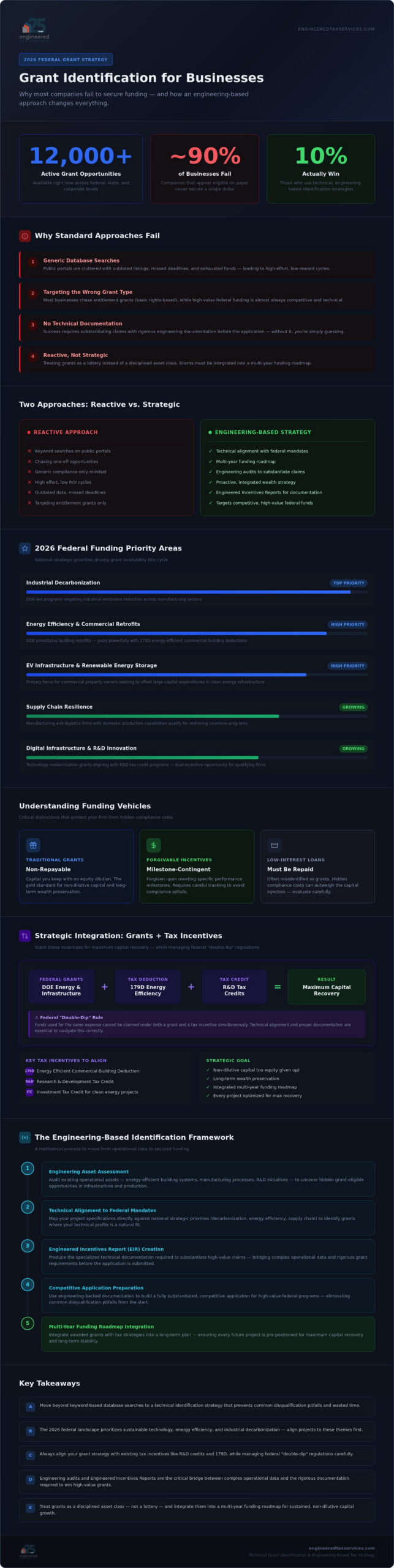
- Move beyond keyword-based database searches to a technical identification strategy that prevents common disqualification pitfalls.
- Identify the primary 2026 federal funding streams focused on sustainable technology and energy efficiency infrastructure.
- Align your funding strategy with existing tax incentives like R&D credits while managing federal “double-dip” regulations.
- Implement a methodical process for grant identification for businesses that utilizes engineering audits to substantiate high-value claims.
- Leverage technical documentation through specialized reports to bridge the gap between complex operational data and rigorous grant requirements.
Beyond the Database: The Reality of Grant Identification for Businesses
For many executives, the search for capital begins and ends with a search bar. They assume that what are business grants? is a question answered by a simple keyword query on a government portal. This perception is a fundamental mistake. True grant identification for businesses isn't a clerical task; it's a strategic financial process that bridges the gap between engineering specifications and federal funding priorities. When you treat grants as a lottery rather than a disciplined asset class, you leave significant capital on the table.
While thousands of companies appear eligible on paper based on their industry codes or employee counts, roughly 90% fail to secure funding. The disconnect usually lies in the identification phase. Most businesses target entitlement grants, which are structured as basic rights, while high-value federal funding is almost always competitive and technical. Success requires substantiating your claims with rigorous technical documentation before you even begin the application. Without this foundation, your business is simply guessing at its qualifications.
The Problem with Standard Grant Portals
Generic databases are often cluttered with noise. While a $10,000 corporate grant might help a local shop, established firms and developers need high-value federal incentives that move the needle on large-scale projects. Relying on public portals often leads to high-effort, low-reward cycles. Information in these databases is frequently outdated, causing teams to chase funds that have already been exhausted or deadlines that passed weeks ago. This inefficiency costs your firm time and internal resources that could be better spent on core operations. It's a reactive approach that rarely yields a high return on investment.
The Strategic Advantage of Technical Identification
A more sophisticated approach involves using engineering-based data to align your specific projects with federal mandates. By assessing your existing assets, such as energy-efficient building systems or R&D initiatives, you can uncover hidden opportunities in infrastructure and manufacturing. This technical identification allows you to build a multi-year funding roadmap. Instead of reacting to one-off opportunities, you integrate grants into your long-term wealth strategy. This ensures that every project is optimized for maximum capital recovery and long-term stability. It's about being proactive rather than just compliant, turning your operational data into a powerful tool for securing non-dilutive capital.
Navigating the Federal and State Grant Landscape in 2026
The current federal grant landscape is undergoing a transformative shift toward industrial decarbonization, supply chain resilience, and digital infrastructure. With over 12,000 active grants currently available across federal, state, and corporate levels, the scale of available capital is unprecedented. However, the complexity of these programs has increased proportionally. Successful grant identification for businesses in 2026 requires understanding that funding is no longer just about generic support; it's about technical alignment with national strategic priorities.
You must also distinguish between various funding vehicles to maintain financial health. While traditional grants are non-repayable, many programs now offer low-interest loans or forgivable incentives that are contingent on meeting specific performance milestones. Differentiating between these vehicles is a critical step in grant identification for businesses. It ensures that your firm doesn't take on hidden compliance costs that outweigh the initial capital injection. For many developers, the goal is to secure non-dilutive capital that supports long-term wealth preservation.
Energy and Infrastructure Grants
The Department of Energy (DOE) is currently prioritizing commercial building retrofits and energy efficiency. Identifying grants for EV infrastructure and renewable energy storage has become a primary focus for commercial property owners looking to offset high capital expenditures. These opportunities are most effective when paired with technical tax strategies. For instance, the 179D energy efficient commercial building deduction rewards the same technical improvements funded by these grants. By documenting these improvements through an Engineered Incentives Report, you create a robust audit trail that satisfies both grant administrators and tax authorities.
Innovation and Manufacturing Incentives
For high-tech firms and manufacturers, the Small Business Innovation Research (SBIR) program remains a cornerstone of federal funding, with Phase I awards reaching up to $323,090 for research and development. There is also a significant push for domestic manufacturing and supply chain resilience grants to reduce reliance on foreign components. Leveraging R&D tax credits alongside these innovation grants allows your business to fund technical activities twice: once through direct capital and again through tax liability reduction. This dual approach maximizes the “value-add” of your technical operations while ensuring your firm remains competitive on a national stage.
Strategic Alignment: Integrating Grants with Tax Incentives
Effective grant identification for businesses requires a holistic view of the balance sheet rather than a siloed search for capital. When you secure a federal or state grant, it doesn't exist in a vacuum; it directly impacts your tax liability and long-term depreciation schedules. Failing to align these financial streams can lead to missed opportunities or, worse, compliance failures that trigger federal audits. A strategic partner ensures that every dollar of grant funding is optimized alongside your broader wealth preservation goals.
One of the most critical hurdles in this process is the “Double-Dip” Rule. Federal regulations generally prohibit taxpayers from claiming a tax credit on the same expenses covered by a grant. For instance, if a business receives funding for a specific research project, those grant-funded expenditures cannot typically be used to calculate R&D tax credits. Navigating federal grant eligibility requires technical precision to separate grant-funded costs from qualified research expenses. This ensures you maximize your incentives without violating IRS or agency-specific guidelines.
Grant funding also influences your depreciation strategies for commercial real estate. Because grants often reduce the depreciable basis of an asset, they must be factored into your capital stack early. By layering these funds with cost segregation commercial property studies, you can still accelerate depreciation on the non-grant-funded portions of your building. This engineering-based approach allows you to recover capital faster while maintaining the integrity of your technical documentation.
Energy Efficiency Synergy
Developers often find significant synergy when combining federal grants with the 45L tax credit multifamily program. Grants can offset the initial costs of high-efficiency HVAC systems or insulation, while the tax credit provides a per-unit incentive for meeting specific energy benchmarks. Using grants to fund the initial engineering studies ensures that your project is “shovel-ready” for both the funding agency and the tax authorities. Precise strategic reporting is essential here to satisfy the distinct requirements of grant providers and the IRS simultaneously.
Capital Preservation Through 1031 Exchanges
In a property transition, grants can serve as a powerful tool for improving a replacement property. Identifying grants that specifically target property redevelopment is a key component of sophisticated grant identification for businesses. When utilizing 1031 exchange services, you can use grant capital to fund energy-efficient upgrades or infrastructure improvements on the new asset. This preserves your exchange capital for the purchase price while enhancing the property's value through non-dilutive funding. Ensuring grant compliance during these transitions requires a deep understanding of both real estate law and technical engineering standards.
The Engineering-Based Identification and Qualification Framework
Most organizations treat grant identification for businesses as a search problem, but in a competitive environment, it's actually a technical qualification problem. Finding a listing is easy; proving your project meets the rigorous engineering standards of a federal agency is where most firms fail. To move beyond the limitations of standard portals, you need a methodical framework that prioritizes technical precision from the outset.
- Technical Project Audit: We analyze your physical assets and operational workflows to pinpoint exact alignment with federal strategic goals.
- Feasibility Analysis: We calculate the true ROI by weighing the grant's value against the long-term costs of technical compliance.
- Engineering Documentation: Our team develops the rigorous technical narratives and data sets required for a high-value submission.
- Compliance Mapping: We ensure project execution remains strictly aligned with the funding agency’s specific milestones to avoid funding delays.
- Ongoing Reporting: We substantiate the use of funds through recurring technical audits, protecting your business from future recapture risks.
Why Engineering Expertise is the Deciding Factor
A standard grant writer focuses on the narrative, but a technical engineering firm focuses on the data. Federal reviewers for high-value incentives are often engineers or PhDs who prioritize technical viability over creative storytelling. Engineering-based identification serves as the primary catalyst for increasing success rates in the 2026 competitive funding environment. By utilizing a licensed firm, you reduce the risk of grant clawbacks and audits that often plague less rigorous applications. Protect your capital by partnering with a licensed engineering firm for your technical grant identification.
Substantiating Technical Claims
Reviewers look for the technical “Why” behind every claim. Whether you're measuring energy savings, carbon reduction, or R&D technical uncertainty, your data must be unimpeachable. For instance, when documenting complex human-machine interactions, researchers often rely on precision tools from Ergoneers to capture the objective behavioral data required by federal reviewers. We provide Engineered Incentives Reports that serve as the technical foundation of your application package. These reports translate complex operational data into the specific metrics federal agencies require. This level of detail addresses the technical uncertainties that often lead to application rejection, ensuring your project stands out as a low-risk, high-impact investment for the government.
Engineered Tax Services (ETS) serves as the essential technical bridge between your operational reality and the complex financial requirements of federal and state funding agencies. While many consultants focus solely on administrative filing, we approach grant identification for businesses through the lens of a licensed engineering firm. This perspective allows us to translate intricate project specifications into the high-precision data that grant reviewers demand. By managing the intersection of engineering and finance, we provide a level of security that standard accounting firms cannot match.
Our national reach is a critical asset for developers and business owners managing multi-state portfolios. Federal priorities often vary in their regional application; our institutional knowledge ensures that your strategy remains consistent across all jurisdictions. We don't just find a single opportunity. Instead, we identify a sequence of incentives that support your long-term growth and capital preservation goals. This transitions the process from simple identification to a comprehensive strategy for wealth optimization and long-term financial stability.
Comprehensive Incentive Management
For firms looking to extend these wealth optimization strategies to their international operations, particularly when hiring technical talent in the Netherlands, icspayroll.com provides specialized Employer of Record services and guidance on local tax advantages like the 30% ruling.
We manage the entire lifecycle of an incentive, from the initial technical audit to the final submission of reporting documentation. Our services go beyond grant identification for businesses to include rigorous technical compliance and ongoing substantiation. This ensures every dollar received is backed by an Engineered Incentives Report, which serves as your primary defense during future agency reviews. By integrating grant success into your broader corporate tax strategy, we help you leverage credits like 179D and R&D alongside your grant funding. This holistic approach maximizes your total capital recovery while maintaining the highest professional standards of accuracy and integrity.
Take the Next Step in Strategic Funding
The most common mistake in the funding landscape is waiting for a deadline to appear before beginning the identification process. High-value grants require a proactive approach that starts months before a funding cycle opens. A technical project review allows you to adjust your engineering plans to better align with federal priorities, significantly increasing your chances of success. Waiting for the announcement often means you're already behind the competition. Don't let your project miss out on millions in non-dilutive capital due to a lack of preparation. Contact an expert today for a comprehensive incentive analysis and discover the hidden potential within your business operations.
Secure Your Strategic Funding Advantage
Securing high-value capital in 2026 demands a shift from passive searching to proactive, technical qualification. Effective grant identification for businesses is no longer a clerical task; it's a strategic engineering discipline. By aligning your operational assets with federal priorities and integrating those funds into a broader tax strategy, you unlock a powerful engine for growth and wealth preservation. We've explored how technical documentation and engineering audits serve as the foundation for successful applications and long-term compliance.
As a licensed engineering firm that conducts over 10,000 tax studies annually, Engineered Tax Services is a national authority on technical tax incentives. We provide the precision needed to bridge the gap between complex engineering data and federal funding requirements. Don't leave your capital recovery to chance or generic databases. Contact Engineered Tax Services for a Technical Incentive Analysis to ensure your firm is positioned for maximum financial efficiency. Your path to optimized growth begins with a technical roadmap designed for precision and results. We look forward to helping you unlock your business's full potential.
Frequently Asked Questions
What is the difference between a business grant and a tax credit?
Grants are front-end capital, usually non-repayable, whereas tax credits are back-end reductions in tax liability. Grants are often competitive and awarded before or during a project. Credits are based on qualified expenditures after they occur. Strategic grant identification for businesses helps you determine which vehicle provides the best immediate cash flow versus long-term tax savings for your specific operational needs.
How do I know if my business project is eligible for federal grants?
Eligibility is primarily determined by aligning your project's technical specifications with the strategic goals of agencies like the DOE or EPA. In 2026, projects focusing on domestic manufacturing, energy efficiency, or supply chain resilience have the highest success rates. A technical project audit is necessary to map your assets against current federal priorities and ensure you meet the rigorous criteria beyond simple organization type.
Can I use a grant and a tax credit for the same energy-efficient building project?
Yes, you can often layer these incentives, but you must navigate the “double-dip” rule carefully. Generally, you cannot claim a tax credit on the portion of project costs covered by a federal grant. For example, if you receive a grant for 30% of a retrofit, only the remaining 70% of expenses qualify for tax credits. Professional oversight ensures you maximize both streams without violating compliance regulations.
What technical documentation is required for most business grants?
Most high-value grants require comprehensive narratives substantiated by engineering data. This includes energy modeling, carbon reduction calculations, or detailed R&D technical uncertainty reports. You must provide an Engineered Incentives Report that translates operational data into the specific metrics required by federal reviewers. Without this technical proof, applications are often rejected for failing to meet the technical “Why” behind the requested funding.
How long does the grant identification and application process take?
The timeline varies but typically spans six to twelve months from the initial identification phase to the final award. This includes several weeks for the technical project audit and feasibility analysis, followed by the agency's review cycle, which can last several months. Proactive grant identification for businesses is essential because waiting for a deadline to be announced often leaves insufficient time for the required engineering documentation.
Are there grants available for commercial property developers in 2026?
Yes, 2026 features significant funding for developers focused on sustainable infrastructure and energy-efficient commercial retrofits. Many programs, such as those from the Department of Energy, offer incentives for EV charging stations and renewable energy storage. These grants are designed to offset the high capital expenditures associated with modernizing commercial assets while improving long-term property value and operational efficiency for the owner.
What happens if my business fails to meet the grant compliance requirements?
Failure to meet compliance can result in grant clawbacks, where the funding agency demands the return of awarded capital. Additionally, your business may face audits or be barred from future federal funding opportunities. Maintaining a robust audit trail through technical reporting is the only way to safeguard your capital. Ongoing compliance mapping ensures your project execution matches the specific milestones agreed upon during the application phase.
Why do I need an engineering firm for grant identification?
An engineering firm provides the technical precision that standard grant writers lack. High-value grants are evaluated by technical experts who prioritize data over narrative. A licensed firm can substantiate energy savings or technical uncertainties using industry-standard methodologies. This expertise reduces the risk of rejection and ensures your project is qualified based on its actual operational data rather than generic eligibility claims found in basic databases.