What if the 1031 exchange you're planning for 2026 isn't just a way to defer taxes, but a mechanism to fundamentally re-engineer your portfolio's financial trajectory? Most high-net-worth investors view the 45-day identification window with a sense of legitimate dread. You've likely felt that familiar anxiety over strict IRS deadlines or the security of your held funds, knowing that a single procedural error could trigger massive tax leakage and stall your growth. It's a high-stakes environment where simply “getting it done” isn't enough to protect your hard-earned equity.
This strategic guide reveals how specialized 1031 exchange services provide the technical precision needed to safeguard your capital while maximizing the value of your next acquisition. You'll discover how engineering-based tax strategies, particularly when paired with the permanent 100% bonus depreciation established by the One Big Beautiful Bill Act, can create a powerful basis boost for your replacement property. We'll examine the critical path toward full tax deferral; moving from institutional-grade fund security to the sophisticated methodologies that unlock hidden potential in your real estate investments. By the end, you'll have a clear roadmap for navigating property transitions with absolute confidence and professional integrity.
Key Takeaways
- Learn how professional 1031 exchange services act as a regulatory safe harbor, ensuring your capital remains protected within IRS-compliant “like-kind” structures.
- Discover the “basis boost” strategy that integrates cost segregation with your exchange to maximize first-year deductions on your replacement property.
- Understand the impact of the One Big Beautiful Bill Act, which made 100% bonus depreciation permanent, fundamentally changing the financial math for property transitions in 2026.
- Master the critical 45-day identification and 180-day exchange windows to avoid tax leakage and ensure the full deferral of capital gains.
- Identify the specific criteria for choosing an institutional-grade partner that offers engineering-based precision rather than just basic administrative facilitation.
What Are 1031 Exchange Services and Why Do Investors Need Them?
Professional 1031 exchange services act as the structural framework for one of the most potent wealth-building tools in the American tax code. At its core, this service facilitates the tax-deferred exchange of “like-kind” investment properties, allowing you to reinvest the entirety of your sale proceeds into new assets. Without this mechanism, a typical commercial sale could trigger a tax liability of 20% to 30%. This immediate tax hit effectively erodes your capital before you can even identify a replacement property, stalling the momentum of your portfolio growth.
2026 marks a pivotal era for real estate portfolios. With the “One Big Beautiful Bill Act” (OBBBA) making 100% bonus depreciation permanent for qualified property acquired after January 19, 2025, the synergy between property transitions and engineering-based tax strategies has reached a new level of efficiency. It's no longer just about avoiding a tax bill; it's about optimizing your property basis to drive long-term stability and cash flow. In an environment where the federal funds rate sits between 3.50% and 3.75%, preserving every dollar of equity is essential for maintaining leverage and purchasing power.
The Core Benefits of Tax Deferral
Tax deferral under Internal Revenue Code section 1031 provides an immediate boost to your investment capacity. Instead of handing over a significant portion of your gain to the IRS, you keep 100% of that equity working in the market. This allows you to acquire larger, higher-yield replacement properties that would otherwise be financially out of reach. Many sophisticated investors use this strategy to diversify their holdings across different real estate sectors nationally or to consolidate multiple smaller properties into a single, high-performing institutional asset. It's a proactive approach to portfolio scaling that prioritizes long-term wealth over immediate liquidity.
The Mandatory Role of the Qualified Intermediary
To maintain the validity of your exchange, the IRS requires a Qualified Intermediary (QI) to serve as a safe harbor for your funds. This independent third party is essential for avoiding “constructive receipt,” a legal trap where the IRS determines you've taken control of the sale proceeds, thereby triggering immediate tax liability. Specialized 1031 exchange services provide this mandatory layer of security. They hold the proceeds from your “relinquished” property in secure accounts while you navigate the 45-day identification period. This ensures that every step of the transition remains compliant, your funds remain secure, and your equity remains shielded from unnecessary taxation during the property transition.
Types of 1031 Exchanges Facilitated by Professional Services
Investors often assume there's only one way to execute a swap. In reality, modern 1031 exchange services offer several specialized structures to fit specific portfolio needs. Whether you're reacting to a sudden market opportunity or planning a long-term development project, the right structure is the difference between a successful transition and a taxable event. Choosing the wrong path can lead to immediate capital gains exposure, erasing the benefits of your property's appreciation.
Delayed vs. Reverse Exchanges
The delayed exchange remains the industry standard for most commercial transitions. In this “forward” structure, you sell your current asset first and have exactly 45 days to identify a replacement. Completion of the purchase must occur within 180 days. However, in competitive 2026 markets where inventory remains tight, a reverse exchange allows you to acquire the “perfect” property before closing on your current one. This requires a sophisticated “Exchange Accommodation Titleholder” (EAT) to hold the title on your behalf.
While the reverse structure offers a strategic advantage, it introduces financing complexities. With the federal funds rate currently at 3.50% to 3.75%, the cost of carrying two properties simultaneously requires precise cash flow modeling. As noted by Forbes on 1031 exchanges, these strategies are essential for investors looking to scale effectively without losing momentum to market volatility. Missing the 45-day identification deadline is the most common cause of exchange failure, making professional oversight a non-negotiable requirement for high-stakes transactions.
Improvement and Build-to-Suit Exchanges
Improvement or build-to-suit exchanges represent the highest level of strategic optimization. These allow you to use tax-deferred dollars not just to buy land, but to fund renovations or ground-up construction on the replacement property. To remain compliant, the improvements must be completed and the property transferred back to you within the 180-day window. Because these projects involve complex cost calculations, they benefit significantly from an engineering-based approach.
This technical oversight ensures that the value added during construction is correctly categorized for maximum tax efficiency. You aren't just buying a building; you're managing a construction timeline within a rigid regulatory window. An engineering-based facilitator can help you bridge the gap between your general contractor's schedule and the IRS's 180-day hard stop. If you're planning a value-add acquisition, it's wise to consult with a strategic partner who understands the intersection of construction and tax law. This level of precision is what separates a basic administrative service from a true wealth-preservation strategy.
The Engineering Advantage: Beyond Standard 1031 Facilitation
While many firms lead with fidelity bonds and escrow security, they frequently ignore the asset's performance after the title transfers. A strategic partner bridges the gap between the legal requirements of 26 U.S. Code § 1031 and the actual profitability of the replacement property. Standard 1031 exchange services often treat the transaction as a paperwork exercise; engineering-based facilitators view it as a wealth optimization event. This holistic approach ensures you aren't just complying with the law but are actively increasing your property's net present value from the moment of acquisition.
The primary limitation of a traditional Qualified Intermediary is their lack of technical insight into the physical building. They can't tell you how to maximize your basis step-up or how to identify hidden tax credits within the building's infrastructure. By choosing a partner with an engineering background, you gain a mentor that understands the technical precision required for high-level professional consultancy. We look at the asset's entire lifecycle to ensure that your capital preservation strategy doesn't end when the exchange closes.
Cost Segregation and 1031 Synergy
When you acquire a replacement property, your tax basis is typically a carryover from the relinquished asset, which can sometimes result in lower annual depreciation. Integrating Cost Segregation into the exchange process allows you to front-load these deductions and unlock immediate cash flow. Cost segregation identifies and reclassifies specific building components, such as specialized electrical systems or site improvements, into 5, 7, or 15-year depreciation schedules rather than the standard 27.5 or 39-year periods. This engineering study provides the technical documentation needed to defend these accelerated schedules during an audit. It also serves as a critical tool for offsetting “boot,” which is any cash or non-like-kind property received that would normally trigger a recognized gain. For investors divesting commercial assets specifically, understanding how a 1031 exchange commercial real estate strategy integrates with cost segregation is essential to maximizing your replacement property's performance from day one.
Energy Incentives in the Replacement Property
The acquisition phase is the most efficient time to identify and claim energy-related tax incentives. For commercial assets, leveraging the 179D Deduction can provide a massive deduction based on the building's energy-efficient systems. Specialized 1031 exchange services with engineering expertise analyze the lighting, HVAC, and building envelope during the due diligence period to ensure these credits are captured immediately. For multifamily developers, the 45L tax credit offers a per-unit benefit that, when combined with a 1031 exchange, significantly lowers the total cost of capital. This level of integrated planning ensures that your replacement property isn't just a tax shelter, but a high-efficiency engine for portfolio growth.
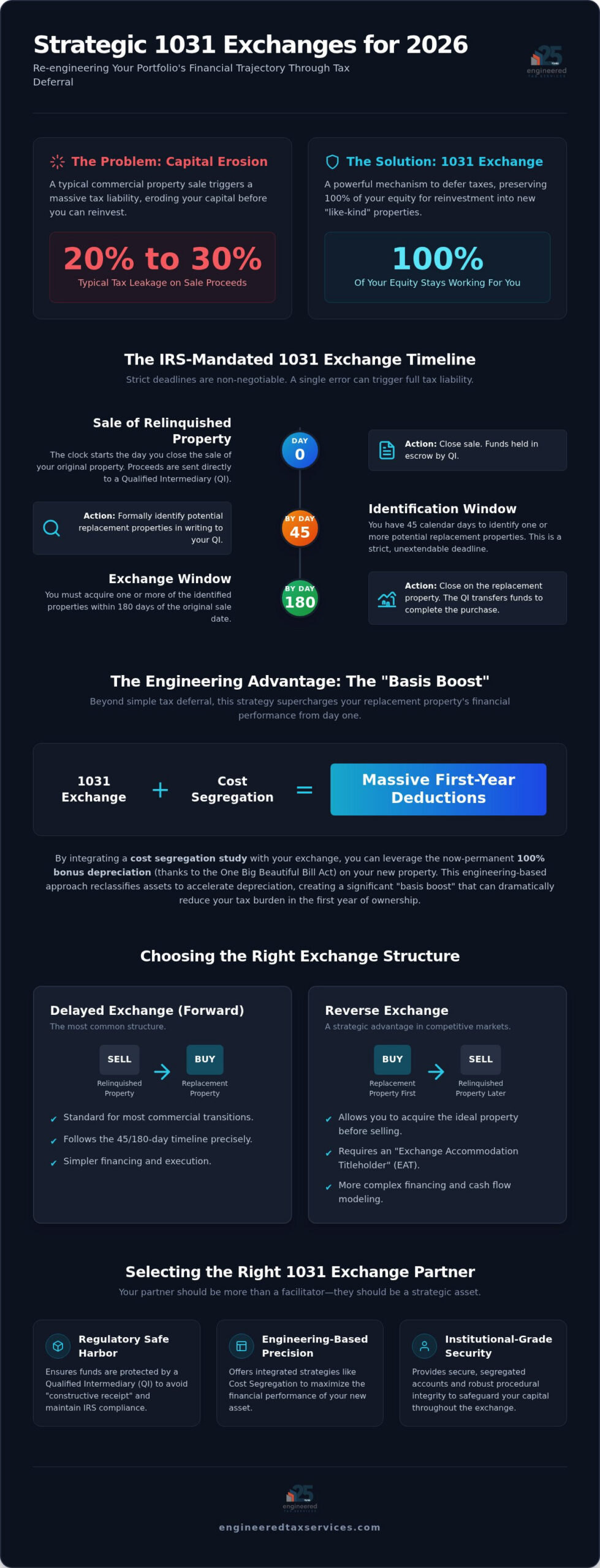
1031 Exchange Rules and Timeline Checklist for 2026
Precision in timing is the hallmark of a successful property transition. The IRS maintains an uncompromising stance on deadlines; missing a single date by even a few minutes can disqualify the entire transaction and trigger immediate capital gains. To navigate this, you need a structured framework that begins well before your first closing. In a market where transaction volume is expected to increase by 20% year-over-year in 2026, having a disciplined schedule is your best defense against tax leakage.
Day 0 marks the official start of your timeline. This is the date you close on the sale of your relinquished property. Crucially, you must engage your 1031 exchange services provider before this moment. If you close the sale and take “constructive receipt” of the funds, the exchange is void. Your Qualified Intermediary (QI) must be in place to receive the proceeds directly from the closing agent to maintain the safe harbor status of your capital.
Property Identification Strategies
The 45-day identification period is often the most stressful phase for investors. By midnight on Day 45, you must provide a written, signed document to your facilitator identifying your potential replacement properties. You generally follow one of two paths:
- The 3-Property Rule: You can identify up to three properties of any value. This is the most straightforward approach for single-asset replacements where you have a clear target.
- The 200% Rule: You can identify any number of properties, provided their combined fair market value doesn't exceed 200% of the property you sold. This is ideal for investors diversifying one large asset into several smaller holdings.
Best practices involve submitting your identification letters early to allow your service provider to verify the legal descriptions. Ambiguity in these documents is a frequent reason for IRS challenges. For a comprehensive breakdown of how to apply these rules without error, review the 1031 exchange timeline rules that govern every milestone from Day 0 through Day 180. Precision matters here.
Common 1031 Pitfalls to Avoid
Even with a clear timeline, technical errors can lead to “Boot,” which is any portion of the exchange that becomes taxable. Cash boot occurs when you don't reinvest all the proceeds. Mortgage boot happens when your debt on the replacement property is lower than the debt on the sold property. Both result in immediate tax liability that erodes your equity.
Another critical risk is inadequate fund security. In 2026, with the federal funds rate at 3.50% to 3.75%, the interest earned on held funds is significant, but the security of the principal is paramount. Choosing a QI without institutional backing or rigorous audit standards exposes your capital to unnecessary risk. If you're ready to secure your portfolio's future with a partner that prioritizes technical precision, reach out to our strategic team to ensure every regulatory hurdle is cleared.
Day 180 is your hard stop. You must close on the replacement property by this date or the date your tax return is due, whichever is earlier. There are no extensions for market volatility or financing delays. This rigid schedule is why professional oversight is the only way to guarantee a full tax deferral.
Selecting the Right 1031 Exchange Partner for Your Portfolio
Choosing the right provider for 1031 exchange services is often the difference between a simple transaction and a strategic wealth event. Many investors make the mistake of selecting a partner based solely on the lowest fee structure. While cost is a factor, the real value lies in the firm's ability to navigate technical complexities and provide institutional-grade security. A transactional provider might process your paperwork, but a strategic partner ensures that your exchange is part of a larger, engineered plan for capital preservation. You need a partner that acts as an advocate for your financial health, not just a passive holder of funds.
Security and Compliance Standards
Security remains the most critical metric when evaluating a facilitator. You're entrusting your entire property equity to a third party; you must verify their financial strength and insurance coverage. Look for providers that offer substantial fidelity bonds, Errors and Omissions (E&O) insurance, and corporate guarantees. At ETS, we leverage our position as a licensed engineering firm to bring a level of technical precision to reporting that standard title companies simply can't match. This expertise is vital for multi-state portfolio exchanges where varying state regulations and complex property types require a national reach and deep institutional knowledge. We conduct over 10,000 studies annually, providing a foundation of reliability that protects your assets from procedural errors.
Integrating Your Tax Strategy
True optimization requires moving from a “one-off transaction” mindset to a long-term growth approach. Your exchange shouldn't happen in a silo. It requires active coordination between your Qualified Intermediary, your CPA, and your engineering tax specialist. This collaborative approach ensures that every decision made during the 180-day window supports your broader financial goals. By integrating 1031 exchange services with specialized studies like cost segregation or energy incentive analysis, you transform a tax-deferral requirement into a performance-enhancing strategy. It's about more than just compliance; it's about unlocking the hidden potential of your next acquisition through technical precision. Understanding the full range of depreciation strategies for commercial real estate available under current law ensures that your replacement property delivers maximum first-year deductions and long-term cash flow.
If you're ready to move beyond basic facilitation and embrace a more sophisticated approach to wealth preservation, schedule a consultation with Engineered Tax Services to optimize your next exchange. Our team provides the precision and advocacy you need to grow your commercial portfolio with confidence and professional integrity.
Secure Your Legacy with Engineered Precision
Navigating the real estate landscape in 2026 requires more than just adherence to timelines. It demands a proactive strategy that integrates tax deferral with asset optimization. By utilizing specialized 1031 exchange services, you don't just protect your equity; you position your next acquisition for maximum cash flow from day one. The permanent 100% bonus depreciation established by the One Big Beautiful Bill Act makes this the ideal time to pair your property transition with a detailed cost segregation study to maximize your first-year deductions.
Don't settle for a transactional facilitator when you can have a strategic partner. As an independent licensed engineering firm, ETS provides the technical precision and institutional-grade security needed to manage complex commercial portfolios. Our approach ensures a seamless integration with cost segregation studies to unlock the full potential of your replacement property's basis. You've worked hard to build your real estate wealth; now it's time to ensure it's fully optimized for the future.
Maximize your property reinvestment with ETS 1031 Exchange Services and take the first step toward a more resilient financial legacy. Your portfolio deserves the peace of mind that comes from professional excellence and rigorous technical standards.
Frequently Asked Questions
What is a Qualified Intermediary in a 1031 exchange?
A Qualified Intermediary (QI) is an independent third party required by the IRS to facilitate the exchange by holding the proceeds from your relinquished property. Their primary role is to prevent you from taking “constructive receipt” of the funds, which would trigger an immediate tax liability. Professional 1031 exchange services provide this mandatory safe harbor, ensuring that every step of the transaction remains compliant with the Internal Revenue Code while your capital stays protected.
Can I do a 1031 exchange on my primary residence?
You cannot perform a 1031 exchange on your primary residence. Section 1031 is exclusively reserved for real property held for productive use in a trade or business or for investment purposes. If you're selling the home you live in, you should instead explore the Section 121 exclusion. This allows individuals to exclude up to $250,000 of gain from their income if specific residency and ownership requirements are met over a five-year period.
What happens if I miss the 45-day identification deadline?
If you miss the 45-day identification deadline, your exchange fails immediately and the sale becomes a fully taxable event. The IRS provides no extensions for this deadline, even in cases of market volatility or financing delays. Once the window closes without a valid identification letter, your facilitator must release the funds to you. This triggers capital gains taxes and depreciation recapture, which is why early due diligence on replacement properties is vital. Understanding the full scope of 1031 exchange timeline rules before you begin is the most effective way to prevent this outcome.
Is a 1031 exchange worth it for a smaller rental property?
A 1031 exchange is often worth it for smaller rentals if the deferred tax liability exceeds the administrative costs. Even on a single-family rental, capital gains and depreciation recapture can quickly total tens of thousands of dollars. By deferring these costs, you keep your full equity working in the market. This allows you to trade up to a higher-performing asset and accelerate your portfolio growth regardless of the initial property's size.
What is ‘like-kind' property according to the IRS in 2026?
In 2026, “like-kind” property refers exclusively to real property held for investment or business use within the United States. This definition is broad; you can exchange an apartment complex for a warehouse or raw land for a retail center. However, personal property like equipment or vehicles no longer qualifies under current tax law. It's also important to note that real property located outside the U.S. isn't considered like-kind to domestic property.
How much do 1031 exchange services typically cost?
The cost of 1031 exchange services varies based on the complexity of the transaction and the specific structure required. Standard delayed exchanges typically involve a setup fee and a per-property identification fee. More complex structures, such as reverse or improvement exchanges, carry higher costs due to the additional legal and administrative oversight involved. You should evaluate providers based on their security standards and technical expertise rather than seeking the lowest possible administrative fee.
Can I use 1031 exchange funds to renovate the new property?
You can use exchange funds to renovate a new property through a specific structure called an Improvement or Construction Exchange. In this scenario, your facilitator holds the title while renovations are completed using the tax-deferred proceeds. To remain compliant, the value of the improvements must be added to the property and the title must transfer back to you within the 180-day exchange period. This is an excellent strategy for value-add commercial investors.
How does cost segregation work with a 1031 exchange?
Cost segregation works with a 1031 exchange by reclassifying components of your new property into shorter depreciation schedules to unlock immediate cash flow. While the exchange defers your gains, an engineering-based study identifies assets for 5, 7, or 15-year depreciation. This strategy can often create enough first-year deductions to offset any “boot” or recognized gain that occurred during the transition, ensuring your new acquisition remains as tax-efficient as possible for your portfolio. To fully leverage these benefits, exploring the latest depreciation strategies for commercial real estate under the One Big Beautiful Bill Act can help you quantify the maximum first-year deduction potential for your replacement property.