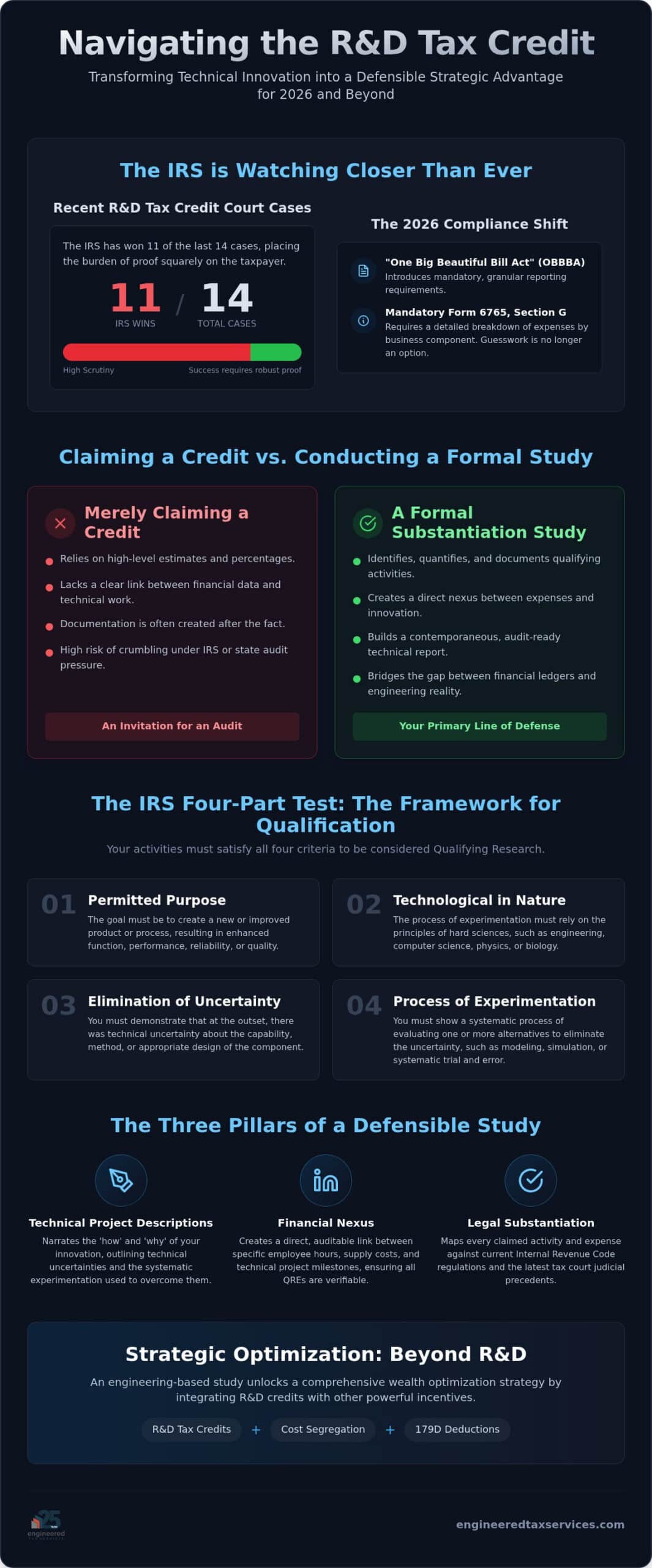
The IRS has won 11 of the last 14 R&D tax credit court cases, a sobering statistic that highlights the growing gap between claiming a credit and actually defending it. For many business owners, the fear of an audit is a constant weight, especially as the “One Big Beautiful Bill Act” (OBBBA) reshapes the landscape for 2026. A formal research and development tax credit study is no longer just a financial exercise; it's a technical necessity. You likely recognize that while the restoration of immediate domestic expensing is a massive win for cash flow, the mandatory reporting requirements of Section G on Form 6765 mean the IRS is watching closer than ever before.
We understand that navigating Section 174 amortization and identifying qualifying technical activities can feel like a distraction from your core engineering goals. This guide will show you how a specialized, engineering-based study transforms these complexities into a defensible strategic advantage. You'll discover how to maximize your federal tax savings while building a robust documentation trail that stands up to the most rigorous scrutiny. We will walk through the specific methodologies required to streamline your compliance process; ensuring your team stays focused on innovation while we secure the capital you've earned.
Key Takeaways
- Learn why a formal research and development tax credit study is essential for transforming technical innovation into defensible tax savings under 2026 IRS regulations.
- Master the IRS Four-Part Test to ensure your activities meet the strict criteria for permitted purpose and technological experimentation.
- Understand why engineering-based documentation is the gold standard for bridging the gap between financial ledgers and technical reality.
- Discover how to integrate R&D credits with Cost Segregation and 179D deductions to create a comprehensive wealth optimization strategy.
- Explore a phased study approach that captures your full innovation story while minimizing distractions for your engineering team.
What is a Research and Development Tax Credit Study?
A research and development tax credit study is a specialized technical and financial audit designed to identify, quantify, and document activities that qualify for federal and state tax incentives. Many companies make the mistake of viewing the Research & Experimentation Tax Credit as a simple line item on a tax return. In reality, there's a vast distinction between merely claiming a credit and conducting a formal substantiation study. The former often relies on high level estimates that crumble under pressure, while the latter creates a comprehensive technical report that serves as your primary line of defense during an IRS or state level tax audit.
The primary objective of a study is to identify Qualified Research Expenses (QREs) as defined under Section 41. This process requires a deep dive into your company’s operations to isolate wages, supply costs, and contract research expenses directly tied to innovation. Because the IRS has won 11 of the last 14 court cases related to these credits, the burden of proof rests entirely on the taxpayer. A professional study ensures that every dollar claimed is backed by contemporaneous documentation, effectively bridging the gap between your financial ledger and the engineering reality of your projects.
The Core Components of a Professional Study
A defensible study is built on three essential pillars that align your business activities with complex tax law:
- Technical Project Descriptions: These documents narrate the “how” and “why” of your innovation. They outline the technical uncertainties faced and the systematic process of experimentation used to overcome them.
- Financial Nexus: This component creates a direct link between specific employee hours and technical milestones. It ensures that qualifying wages aren't just broad percentages but are tied to verifiable work.
- Legal Substantiation: Every activity must be mapped against current Internal Revenue Code regulations and judicial precedents. This ensures your claims remain compliant with the latest tax court rulings.
Why a Study is Mandatory in 2026
The landscape of R&D tax incentives has shifted significantly with the passage of the “One Big Beautiful Bill Act” (OBBBA). While this legislation restored immediate expensing for domestic research costs, it also ushered in a new era of transparency. For the 2026 tax year, Section G of Form 6765 is mandatory, requiring a granular breakdown of expenses by business component. You can't afford to guess on these forms.
The IRS is currently prioritizing documentation quality over the sheer volume of claims. Without a structured study, businesses often struggle to navigate the complexities of Section 174 amortization rules, which still apply to foreign research expenses. As our technical team often reminds clients, “A study without engineering substance is merely an invitation for an audit.” Precision is the only way to protect your cash flow and ensure long term financial stability.
The IRS Four-Part Test: Qualifying Your Activities
To secure the benefits identified in your research and development tax credit study, your activities must satisfy a rigorous four-part test. This isn't a subjective assessment; it's a precise legal framework. The IRS uses these criteria to distinguish between genuine innovation and routine business operations. Understanding these IRS guidelines on the research credit is the first step toward building a defensible claim that can withstand scrutiny.
The first requirement is Permitted Purpose. Your project must aim to develop a new or improved business component's functionality, performance, reliability, or quality. It isn't enough to just change a product; you must be aiming for a technical advancement. Second, the work must be Technological in Nature. This means the process must rely on the principles of physical science, biological science, engineering, or computer science. If your innovation is purely aesthetic or rooted in consumer psychology, it won't pass this stage of the test.
The third pillar is the Elimination of Uncertainty. You must prove that at the project's outset, your team didn't know the optimal design or the specific method for achieving the desired result. Routine problems with routine solutions don't qualify. Finally, you must demonstrate a Process of Experimentation. This is often where claims fail under audit. You must show a systematic trial and error approach where you evaluated alternatives through modeling, simulation, or systematic testing. In fact, following recent court rulings, there's a stricter requirement to prove that at least 80% of research efforts followed this structured process to qualify the entire business component.
Common Qualifying Activities in Technical Industries
Many companies overlook qualifying work because it feels like a standard part of their operation. In manufacturing, developing a new process to increase assembly line efficiency often qualifies. In the tech sector, creating specialized software architectures to solve latency issues or integrating disparate legacy systems involves significant technical uncertainty. If your team is prototyping new product designs to test durability under extreme stress, you're likely sitting on unclaimed credits. You can review your technical activities with an expert to identify these hidden opportunities before your next filing.
What Does Not Qualify as R&D
Maintaining a clean claim requires knowing what to exclude. Routine data collection, standard quality control testing, and basic market research are strictly off-limits. Additionally, under the 2026 rules, any research conducted outside the United States is considered a foreign expenditure and must be amortized over 15 years rather than being immediately expensed. Social science research and cosmetic changes also fail the test. Precision in these exclusions is what makes your research and development tax credit study resilient against IRS challenges.
Why Engineering-Based Analysis is the Gold Standard
The “Engineering Gap” represents one of the most significant risks in contemporary tax planning. While traditional CPAs are experts in financial ledgers, they often lack the technical background to identify the nuances of qualifying activities on a factory floor or in a software lab. A research and development tax credit study is fundamentally a technical document, not just an accounting one. Without an engineering perspective, businesses frequently leave money on the table or, worse, submit claims that lack the technical depth to survive an audit. This gap exists because the IRS requirements focus on the “how” and “why” of the technical process, which often gets lost when translated through a purely financial lens.
Our methodology at ETS focuses on bridging the gap between the shop floor and the tax return. We don't just look at payroll data; we analyze the physical and computer sciences behind your projects. When a licensed engineering firm signs off on a technical report, it carries a level of authority that a standard accounting summary cannot match. This signature signals to the IRS that the technical uncertainties and processes of experimentation have been vetted by professionals who understand the discipline. It's a proactive and empowering stance that focuses on maximizing your potential for improvement while ensuring rigorous compliance standards are met.
The Advantage of a Specialized R&D Tax Credit Engineering Firm
Working with a specialized R&D Tax Credit Engineering Firm: Navigating Technical Tax Incentives in 2026 provides a level of precision that generalists simply can't provide. Our engineers speak the same language as your technical staff. This allows us to extract “hidden” QREs that might otherwise be overlooked, such as time spent by senior engineers in a supervisory or supportive role during the experimentation phase. We excel at drafting technical project narratives that translate complex innovation into the specific language used by IRS engineers, ensuring that the “how” and “why” of your research are crystal clear and perfectly aligned with current judicial precedents.
Documentation Quality: Surviving the IRS Engineering Audit
It's vital to recognize that the IRS employs its own engineering specialists to review high value claims. These experts aren't looking for balance sheets; they're looking for proof of technical uncertainty and systematic testing. Contemporaneous documentation is the most critical factor in audit success. If you don't have records created at the time the work was performed, the IRS is much more likely to disallow the credit. The ETS approach focuses on building a “bulletproof” technical file by capturing the innovation story as it happens. We ensure that every claim in your research and development tax credit study is supported by design documents, test results, and project tracking data that meet the highest standards of professional integrity, providing you with long term financial stability.
The Lifecycle of a Professional R&D Tax Credit Study
A professional research and development tax credit study follows a methodical, four-phase lifecycle designed to build a wall of evidence around your claim. This isn't a simple accounting exercise. It's a strategic progression that moves from high level opportunity identification to granular technical substantiation. By following a structured framework, you ensure that every dollar claimed is backed by a narrative of innovation that satisfies the rigorous standards of the IRS.
The lifecycle begins with Phase 1: Initial Feasibility and Scoping. During this stage, we estimate your potential tax savings before you commit significant time or resources. Phase 2 involves Data Collection and Technical Interviews, where we capture the technical story directly from your innovators. In Phase 3, we perform the Quantitative Analysis, calculating the specific wages, supplies, and contract research costs tied to qualifying projects. Finally, Phase 4 is Deliverable Preparation. This is where we finalize the technical report and prepare the mandatory Section G of Form 6765 for the 2026 tax year, ensuring your filing is complete and accurate.
What to Expect During the Interview Process
Our engineers lead the interview process to minimize the time burden on your internal engineering and IT teams. We don't need your team to learn tax law; we just need them to talk about their work. We review project blueprints, CAD drawings, and testing logs to find evidence of the process of experimentation. This technical deep dive allows us to identify “Support” and “Direct Supervision” roles that non-technical staff often overlook. By speaking the language of your developers and designers, we extract the necessary details quickly and efficiently, ensuring your team stays focused on their core objectives.
The Final Study Deliverable
The result of this comprehensive process is a technical report that serves as your primary line of defense. This deliverable isn't just a summary; it's a project by project breakdown of your qualified research activities. It includes detailed calculation workpapers for both federal and state credits, providing total transparency for your financial records. Every report concludes with a signed technical certification from an engineering specialist, which signals to the IRS that your claim is rooted in professional integrity and technical precision. If you're ready to secure your 2026 incentives, you can start your technical scoping session with our team today.
Strategic Optimization: Integrating R&D with Other Incentives
Maximizing financial efficiency requires looking beyond isolated tax breaks to embrace a holistic “Engineered Incentive” ecosystem. While a research and development tax credit study provides significant value on its own, its true power is unlocked when integrated with other technical tax strategies. By aligning R&D credits with Cost Segregation and the 179D deduction, businesses can create a compounding effect that drastically improves cash flow. This integrated approach ensures that every aspect of your technical and physical infrastructure is working to preserve capital and fuel future growth.
One of the most effective strategies involves leveraging R&D credits to offset the tax impact of accelerated depreciation. For instance, we've seen manufacturers achieve a 30% boost in annual cash flow by stacking these incentives. When you identify qualifying research activities alongside property improvements, you're not just saving money; you're optimizing the entire lifecycle of your investments. This isn't a one-time event. Treating your technical analysis as an annual strategic exercise allows you to capture contemporaneous data as it happens, ensuring your documentation remains bulletproof against future scrutiny.
R&D and 179D: The Energy-Innovation Synergy
The intersection of energy efficiency and technical innovation is a fertile ground for tax savings. Designing specialized, energy-efficient systems for a facility often requires a systematic process of experimentation that meets the four-part test for R&D. This means the same project might qualify for both the federal R&D credit and the 179D Energy Efficient Commercial Building Deduction: The 2026 Strategic Guide. Our engineers specialize in identifying these overlapping opportunities, ensuring that your commitment to sustainability also serves your bottom line.
R&D and Cost Segregation: Maximizing Real Estate Investments
Facility improvements identified in a Cost Segregation for Commercial Property: Engineering-Based Wealth Optimization in 2026 study often involve technical challenges that qualify as research. Whether you're developing custom HVAC solutions or specialized manufacturing cleanrooms, the technical uncertainty involved can be documented within your research and development tax credit study. This synergy allows you to use tax credits to effectively fund the very improvements that drive your operational excellence. It's a proactive way to turn compliance requirements into a strategic advantage for your real estate portfolio.
Next Steps: Securing Your 2026 Tax Strategy
Securing these benefits starts with early planning. Waiting until the end of the tax year to document your innovation story often leads to missed expenses and weaker technical narratives. You need a partner that understands the intersection of engineering and tax law. Choosing a firm that offers a comprehensive “Engineered Tax” approach ensures that no incentive is left on the table and every claim is backed by rigorous technical standards. Don't leave your 2026 savings to chance. You can schedule a complimentary R&D feasibility assessment with our engineering team to begin building your defensible path to wealth optimization.
Secure Your Strategic Advantage for 2026
The 2026 tax landscape demands more than simple compliance; it requires a strategic commitment to technical precision. By prioritizing a formal research and development tax credit study, you're doing more than just identifying costs. You're building a defensible narrative of innovation that integrates with your broader wealth optimization goals, such as cost segregation and energy incentives. This holistic approach ensures that your engineering efforts translate directly into maximized cash flow and long term financial stability.
As a licensed engineering firm with over 20 years of expertise, Engineered Tax Services conducts more than 10,000 engineering-based tax studies annually. Our specialized focus on manufacturer and developer wealth optimization provides the peace of mind you need to focus on your core business. We bridge the gap between technical reality and tax law, providing the robust documentation necessary to withstand any level of scrutiny. We understand the nuances of your industry and provide the precision required to protect your bottom line.
Maximize your innovation incentives with a professional R&D tax credit study. Your commitment to innovation is your greatest asset; it's time to ensure it's fully rewarded and protected for the years ahead.
Frequently Asked Questions
Is a formal R&D tax credit study required by the IRS?
While the tax code doesn't explicitly mandate the term “study,” it strictly requires contemporaneous documentation to substantiate any credit claim. For the 2026 tax year, the mandatory nature of Section G on Form 6765 effectively necessitates a formal research and development tax credit study. Without the granular project by project breakdown such a study provides, you cannot fulfill the new reporting requirements or defend against the increased scrutiny following the “One Big Beautiful Bill Act.”
How much does a research and development tax credit study typically cost?
The cost of a study is typically structured based on the complexity of your operations and the volume of technical projects being evaluated. Most professional firms utilize a fee structure that reflects the engineering expertise required to build a defensible technical report. Rather than viewing this as a flat expense, strategic partners see it as a value add investment that unlocks significant cash flow through tax reduction while providing essential audit protection for your business.
Can my regular CPA perform an R&D tax credit study?
Most traditional CPAs excel at financial reporting but lack the specialized engineering background required to identify technical uncertainty and processes of experimentation. A research and development tax credit study requires a deep dive into physical, biological, or computer sciences that often falls outside the scope of standard accounting. Partnering with a licensed engineering firm ensures that your technical narratives speak the language of IRS engineering specialists, bridging the gap between your shop floor and your tax return.
What is the difference between Section 41 and Section 174 in 2026?
Section 41 governs the actual tax credit calculation, while Section 174 dictates how you must treat the underlying research and experimental expenditures. In 2026, the “One Big Beautiful Bill Act” (OBBBA) has restored the ability to immediately expense domestic R&D costs under Section 174. However, foreign research expenses remain subject to a 15 year amortization period. Navigating this distinction is critical for maintaining long term financial stability and maximizing current year cash flow through precise technical classification.
How far back can a study look for unclaimed R&D credits?
You can generally look back three years to claim credits from open tax years by filing amended returns. For the 2026 cycle, small businesses with average annual gross receipts under $31 million have a unique opportunity to amend 2022 through 2024 returns to retroactively apply for immediate expensing. This specific window closes on July 6, 2026; making a retroactive technical analysis a high priority for companies seeking to recover previously amortized capital and optimize their historical filings.
What happens if our R&D credit claim is audited by the IRS?
If the IRS selects your claim for review, their own specialized engineering teams will scrutinize your technical documentation and process of experimentation. Having a comprehensive technical report from a licensed engineering firm serves as your primary line of defense. The IRS has won 11 of the last 14 court cases in this area, which proves that having contemporaneously prepared, engineering based evidence is the only reliable way to withstand an audit and preserve your savings.
Does our industry qualify if we are not a high-tech software company?
Qualification is based on technical activity rather than industry labels. Manufacturers, food processors, and construction firms frequently qualify through the development of new processes, improved assembly line efficiencies, or specialized system integrations. If your team faces technical uncertainty and uses a systematic process to evaluate alternatives, your activities likely meet the IRS Four Part Test. We focus on uncovering these credits in technical industries that generalists often overlook during routine tax preparation.
How much time will the study require from my engineering team?
A streamlined process is designed to minimize distractions for your internal technical staff. While technical interviews are necessary to capture the innovation story, an expert firm handles the heavy lifting of drafting narratives and calculating the financial nexus. Typically, your engineers will only need to spend a few hours reviewing project logs and participating in focused interviews. This proactive approach ensures you secure maximum incentives without compromising your team's production schedules or core project timelines.