A retroactive R&D tax credit study can help determine whether earlier projects may meet federal research requirements and connect qualifying activities with expenses recorded for each tax year. But identifying a potential credit is only part of the process. The relevant filing window must still be open, and the technical and financial records must support the claim.
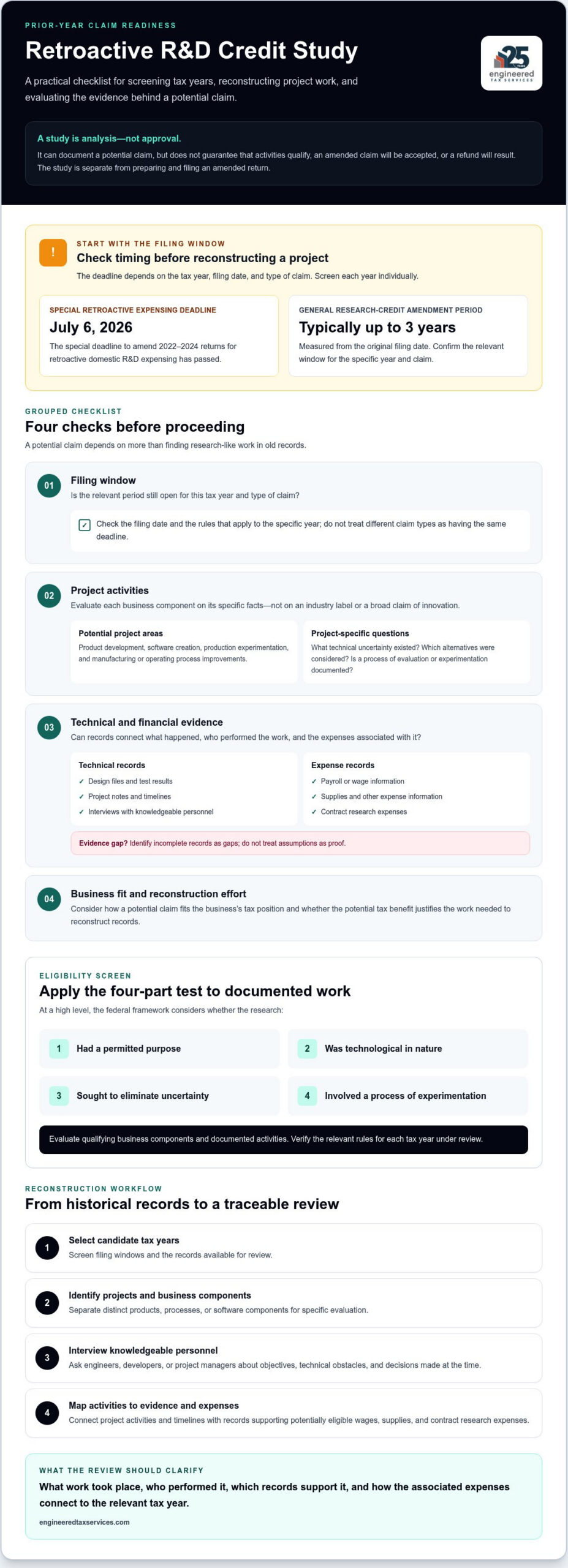
Older project files may be incomplete, and amended-return deadlines can make the timing difficult to assess. The rules depend on the tax year, filing date, and type of claim: the special deadline to amend 2022-2024 returns for retroactive domestic R&D expensing passed on July 6, 2026, while the general period for amending a return to claim a research credit is typically up to three years from the original filing date. This article explains how an engineering-based review assesses project eligibility, which technical and financial records to assemble, and how to evaluate whether to proceed toward an amended claim. Engineered Tax Services’ R&D tax credit study connects engineering analysis with year-specific expense records, while keeping the study distinct from the decision to file a tax return.
Key Takeaways
- A retroactive R&D tax credit study can connect prior-year projects with supporting expense records, but it doesn’t guarantee a credit or refund.
- Screen candidate tax years first. Then assess project activities against the four-part test and identify the evidence available for each business component.
- Compare each year’s filing window, technical records, and expense documentation before deciding whether an amended claim may be viable.
- Follow a practical workflow from year screening and project review to expense mapping, technical reporting, and coordinated filing.
- Engineering analysis and organized documentation can clarify whether a potential claim is ready for further tax review.
Could a Retroactive R&D Tax Credit Study Still Benefit Your Business?
Work that seemed like routine product development, software work, or process improvement may warrant a closer technical review. A retroactive R&D tax credit study examines activities and related expenses from prior tax years to determine whether there is a documented basis for a federal research credit claim. It can bring to light work that wasn’t identified as research during the original tax preparation, particularly when technical decisions were recorded separately from accounting descriptions.
A study is an analysis, not an approval. It documents a potential claim but can’t guarantee that activities qualify, that an amended claim will be accepted, or that a refund will result. Before beginning a retrospective review, weigh four factors: whether the filing window remains open, whether available evidence can support the work, how a claim fits the business’s tax position, and the effort required to reconstruct records.
What does a retrospective R&D tax credit study examine?
Engineers review historical projects, the technical activities performed, and records that explain how the work progressed. Records may include design files, test results, project notes, and payroll or expense information. The engineering study connects documented technical work to expenses for the relevant tax year. It is separate from preparing or filing an amended income tax return. Each year needs its own eligibility and substantiation analysis because projects, costs, and available evidence may differ.
This distinction matters. A technical analysis can inform a potential claim, but deciding whether to file and preparing any required forms are separate steps. The analysis should clarify what work took place, who performed it, and which records support the associated expenses. If records are incomplete, the review should identify the gaps rather than treat assumptions as proof.
Which businesses may have overlooked qualifying research?
Potentially relevant work can arise in product development, software creation, production experimentation, or efforts to improve a manufacturing or operating process. An industry label alone doesn’t establish eligibility. The federal research credit under Internal Revenue Code Section 41 focuses on the activities and their supporting evidence, not simply on whether a company describes itself as innovative. The broad Research and Development Tax Credit overview provides background on the credit’s history and general framework.
For example, a manufacturer might have tested alternative tooling to address a performance uncertainty, while a software team may have evaluated different technical approaches before settling on a system design. Neither example is automatically eligible. A disciplined review asks what technical uncertainty existed, what alternatives the team considered, and whether records show a process of evaluation or experimentation. Apply those questions to each project, even when the work appears in the records under a familiar operational label.
Start with a practical screen, not the assumption that every development expense qualifies. Identify candidate years, check filing windows, assess project and expense records, and consider whether the potential tax benefit justifies the reconstruction effort. This sequence helps determine whether a deeper engineering analysis makes sense.
How an Engineering Study Reconstructs Prior-Year R&D Activities
Historical records are rarely organized by tax-credit category. A retroactive R&D tax credit study brings technical and financial information together so each potential project can be evaluated on its own facts, rather than inferred from a general description of the company’s work.
A disciplined reconstruction typically follows this sequence:
- Select candidate tax years. Screen years based on potential filing windows and the records available for review.
- Identify projects and business components. Separate distinct products, processes, or software components so the technical work can be evaluated specifically.
- Interview knowledgeable personnel. Speak with engineers, developers, or project managers who can explain the objectives, technical obstacles, and decisions made at the time.
- Map the evidence. Connect project activities and timelines with records that support potentially eligible wages, supplies, and contract research expenses.
An engineering study links documented technical activity to the people, materials, and contract research expenses associated with that work, creating a traceable basis for evaluating a potential claim.
How does the four-part test apply to historical projects?
At a high level, the federal framework considers whether research had a permitted purpose, was technological in nature, sought to eliminate uncertainty, and involved a process of experimentation. The analysis focuses on qualifying business components and documented activities, not a broad assertion that the company conducts research. Because statutory interpretation and application can vary by tax year, verify the relevant rules for each year under review.
For instance, testing design alternatives may help show how a team addressed uncertainty, but the activity must be supported by project-specific facts. A project label or successful outcome alone doesn’t establish that the test is met.
What evidence helps rebuild the project record?
Useful records may include project plans, design iterations, test results, technical correspondence, meeting notes, and other contemporaneous documentation. Interviews can clarify what the records mean and help establish a project timeline, but recollections should supplement, not replace, supporting evidence. Personnel records and time information can then help connect individuals’ work to the projects and periods under review.
The expense analysis completes the connection. For each project, reviewers can compare technical timelines with payroll and other expense records to identify potentially qualified wages for eligible services, supplies used in the research, and applicable contract research costs. The goal is traceability: each expense category should relate to documented work, rather than being included solely because it appears in a general ledger account.
Technical findings also need to align with the tax-credit reporting process. The IRS provides information about IRS Form 6765, Credit for Increasing Research Activities, the form used to claim the credit. An engineering study supports the technical analysis; it remains separate from preparing or filing a tax return. Businesses reviewing historical projects can use Engineered Tax Services’ R&D tax credit studies to organize engineering analysis and technical documentation.
Compare Filing Windows, Documentation, and Potential Credit Use
A project may be technically supportable, but the time to make a claim may have expired. Review each candidate year separately, considering filing dates, project evidence, expense records, and tax-return context together. The table below is a screening tool, not a determination of eligibility or a substitute for year-specific tax review.
How do amended-return deadlines affect a retroactive claim?
Internal Revenue Code Section 6511 generally sets a claim deadline tied to the return filing date or tax payment date, and separately limits which prior payments may be refunded. The rules depend on the facts, including when a return was filed and when tax was paid. Verify current IRS guidance and the taxpayer’s dates before concluding that a year is open. An amended return may be one route, subject to applicable filing requirements and the taxpayer’s circumstances.
How should a business compare candidate tax years?
Compare original filing status, project-level evidence, expense records, and relevant return information side by side. Credit use may differ based on the entity and its tax position, so don’t estimate a credit or refund from incomplete records or from one year’s results. A retroactive R&D tax credit study can organize technical findings, but it can’t reopen an expired filing window or make unsupported documentation sufficient. If timing or evidence fails the initial screen, confirm those limits before expanding the analysis.
Prepare a Prior-Year R&D Credit Claim with a Practical Workflow
A retrospective claim is easier to evaluate when technical and financial records follow the same structure. Organize materials by tax year, business component, project, and expense category so reviewers can trace the path from a documented activity to a potentially qualified cost. Keep the engineering study and tax-return documents distinct, then coordinate them before preparing any amended filing.
Use this five-step workflow to move from initial screening to filing coordination:
- Screen candidate years. Record each return’s filing date and relevant payment information, then identify years that may still have an open claim window. Flag uncertain dates for tax review before expanding the study.
- Build a project inventory. List potentially relevant products, processes, software, or other business components by year. Note project owners, start and end dates, and the technical work performed.
- Collect records and clarify the history. Assemble filed returns, project lists, payroll data, general ledgers, contracts, and available technical files. Identify employees who can explain design, testing, and development decisions. Use interviews to clarify records, not replace them.
- Map activities to expenses. Connect project timelines and personnel information with potentially relevant wage, supply, and contract research records. Track gaps and uncertainty for each year rather than treating missing evidence as proof.
- Prepare findings for filing coordination. Organize technical conclusions and supporting schedules for review alongside the taxpayer’s return information. Coordinate the study with the tax-return preparer, who can assess the filing approach and applicable forms.
What should the internal project team assemble first?
Begin with records the company already maintains, even if they weren’t created for a tax-credit review. Payroll reports may identify employees and costs, while design files or test results can explain what those employees worked on. Use a simple index to log the tax year, project, record type, date, and missing context. This makes gaps visible early and helps focus follow-up interviews on specific questions.
How do engineering findings connect to tax filing?
The technical report organizes the project-level analysis and explains how available evidence supports the findings. It does not replace the tax return, its forms, or supporting schedules. The taxpayer’s preparer should confirm the requirements for the relevant year, including the applicable version and instructions for Form 6765, Credit for Increasing Research Activities. This R&D tax credit engineering firm guide explains how engineering analysis contributes to technical documentation.
A well-supported retrospective claim connects each tax year’s project evidence, personnel and expense records, technical conclusions, and filing documentation in a consistent, traceable record. Learn more about Engineered Tax Services’ R&D tax credit study.
Turn a Retroactive R&D Tax Credit Study into a Supported Next Step
A prior-year study is worth pursuing when the core pieces align: the work may meet federal research-credit requirements, the claim window appears open, records can be reconstructed, and the tax team can assess how a potential claim fits the business’s circumstances. If one piece is uncertain, identify it before committing to a broader analysis. That gives decision-makers a clearer view of the opportunity and the documentation effort involved.
What makes an engineering-led study valuable?
Engineers can translate project activities into a structured technical analysis by examining what the team worked on, which technical questions arose, and how it evaluated possible solutions. The findings are connected to records for the relevant tax year, including documentation that may support potentially qualified wages, supplies, or contract research expenses. This approach helps distinguish project-specific evidence from broad descriptions of company activity.
Engineered Tax Services is an independent, licensed engineering firm specializing in R&D tax credit studies. Its engineering-based analysis and technical documentation help businesses evaluate potential federal credits for prior years. The study assesses the facts and available evidence. It doesn’t promise that a project qualifies, that a credit or savings will result, or that a claim will receive a particular audit outcome.
What should happen after the initial review?
Align on the candidate years, available records, technical scope, and how the findings will be coordinated with the taxpayer’s tax team. This discussion can surface missing project information, clarify which expenses need further analysis, and identify questions about filing dates or year-specific requirements. Filing decisions depend on the taxpayer’s facts and applicable rules, not on the engineering analysis alone.
Use this checklist to assess readiness:
- Potentially qualifying work: Can the business identify specific projects or business components for technical review?
- Filing window: Have the relevant return and payment dates been reviewed for each candidate year?
- Reconstructable records: Are there technical materials, personnel information, and expense records that can be connected to the work?
- Coordinated review: Can the engineering findings be shared with the tax team for consideration alongside the return and applicable filing requirements?
A retroactive R&D tax credit study is a disciplined evaluation, not a promise of a refund. If the checklist points to a viable review, discuss a potential R&D tax credit study with Engineered Tax Services and determine whether engineering analysis is the right next step.
Make the Next Decision with Greater Confidence
A prior-year review can help your team decide where to focus, what evidence needs attention, and whether further analysis is proportionate to the potential claim. Treat a retroactive R&D tax credit study as a fact-finding step, not a promise of a particular tax outcome.
If earlier technical work may have gone unrecognized, align the project history with records your finance and tax teams can support. A focused discussion can clarify the potential study scope and the information needed to assess it, while keeping filing decisions grounded in your specific circumstances and applicable requirements.
Engineered Tax Services brings engineering analysis and technical documentation to R&D tax credit studies. Discuss a potential R&D tax credit study and determine whether a structured review is a sensible next step for your business.
An evidence-led approach helps you make a more informed decision, whatever the review shows.
Frequently Asked Questions
Can I claim the R&D tax credit for a prior tax year?
Possibly, if the activities and expenses meet the requirements for that year and the claim is still timely. A company that didn’t claim a credit on its original return may be able to pursue a retroactive claim, but eligibility doesn’t depend on the project’s title or the company’s industry. For example, a project described internally as “routine upgrades” may warrant review if it involved documented technical uncertainty and testing.
How far back can a business claim the R&D tax credit?
There isn’t one universal cutoff date for every taxpayer. A federal refund claim is generally subject to time limits that consider when the return was filed and when tax was paid; special rules or circumstances may affect the result. Check the dates for each return and payment rather than counting back from today alone. A tax professional can assess those dates under current rules before a business invests in a study.
Do I need to amend a tax return to claim a retroactive R&D credit?
Usually, a business that omitted a credit from an already-filed return must use the applicable process to adjust that year’s tax filing. The procedure can depend on the entity type, how it filed, and the tax year. For example, a pass-through entity may follow a different correction procedure from a corporation. Coordinate the engineering findings with the tax-return preparer, who can determine the appropriate filing method and supporting forms.
What records are needed for a retroactive R&D tax credit study?
Gather records that establish what work occurred, who performed it, and how related costs were recorded. Useful additions may include archived email or project-management exports, software version histories, purchase invoices, contractor statements of work, and time-allocation details. A retroactive R&D tax credit study can use these materials alongside accounting and personnel records. Preserve files in their original context where possible, and note when a record is incomplete or unavailable.
Can a business claim the R&D tax credit if it did not make a profit?
Potentially. An income tax loss doesn’t by itself determine whether a business can claim the research credit. Certain qualified small businesses may elect to apply some credit against payroll taxes, subject to eligibility requirements and annual limits. For tax years beginning after December 31, 2022, the maximum payroll-tax credit is $500,000 per year. Confirm that the business meets the applicable definition and review how the election works for its circumstances.
Does an engineering study guarantee an R&D tax credit or refund?
No. An engineering study evaluates project facts and available records, then documents technical findings that may support a potential claim. The IRS determines the treatment of a filed claim, and the taxpayer’s eligibility and potential tax benefit depend on applicable rules and complete facts. A report can’t make unsupported activities eligible, replace a filing deadline, or promise a refund or audit outcome. Use the analysis to inform a filing decision, not as a guarantee.
Can I claim the R&D credit for software development or process improvements?
Possibly, if the specific work meets federal research-credit requirements. Developing software to resolve a technical challenge or testing alternatives to improve a production process may merit evaluation. Routine maintenance, standard configuration, or changes without qualifying technical uncertainty may not support a claim. Document the business component, the technical problem, the alternatives explored, and the work performed. The project’s substance matters more than whether it was labeled “development” or “improvement.”