The most expensive lighting project isn't the one with the highest invoice; it's the one that leaves thousands of dollars in unclaimed federal incentives on the table. For many property owners, the high upfront cost of LED retrofits often feels like a significant barrier to modernization. You likely recognize that energy efficiency is essential for long-term building performance, yet the financial math doesn't always seem to square when you're facing complex prevailing wage requirements and the difficult hunt for specialized certification. Claiming the 179D deduction for lighting upgrades shouldn't feel like a bureaucratic hurdle that offsets your operational gains.
This guide will show you how to maximize your tax savings through lighting retrofits by leveraging the expanded and permanent 179D rules for 2026. We'll break down the technical bridge between your hardware choices and the IRS requirements, ensuring you can legally reduce your tax liability while improving your facility's bottom line. You'll discover the specific steps to navigate wage standards, secure necessary engineering certifications, and unlock the highest possible per-square-foot deduction rates for your portfolio.
Key Takeaways
- Section 179D is now a permanent fixture of the federal tax code, providing property owners with a reliable mechanism for long-term wealth preservation through energy efficiency.
- Qualifying for the 179D deduction for lighting upgrades requires meeting specific energy-reduction thresholds based on the latest ASHRAE 90.1 standards.
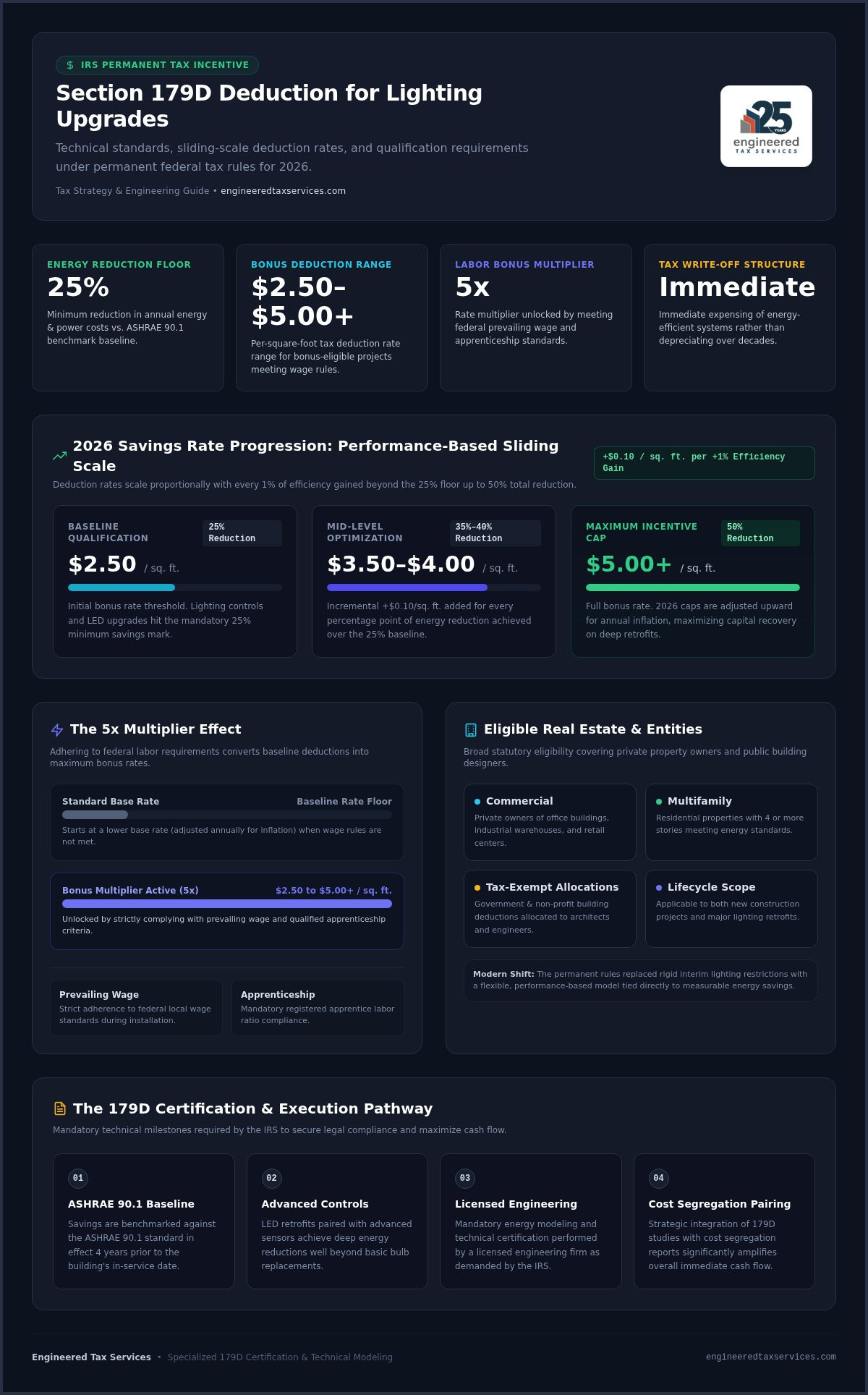
- You can unlock a 5x bonus multiplier, pushing deduction rates to $5.00 or more per square foot, by strictly adhering to federal prevailing wage and apprenticeship requirements.
- Secure your incentive by engaging a licensed engineering firm to perform the mandatory energy modeling and technical certification demanded by the IRS.
- Strategic integration of 179D studies with cost segregation reports can significantly amplify your overall tax savings and immediate cash flow.
What is the 179D Deduction for Lighting Upgrades?
Section 179D represents a powerful intersection of engineering precision and tax strategy. Originally established by the Energy Policy Act of 2005, it has evolved into a permanent fixture of the U.S. tax code thanks to the Inflation Reduction Act. This incentive allows building owners to immediately expense a portion of the cost associated with energy-efficient systems rather than depreciating them over decades. The 179D deduction for lighting upgrades is particularly significant because illumination systems often provide the most accessible path to meeting federal efficiency benchmarks. It's not just about compliance; it's about transforming a standard maintenance expense into a high-value tax asset.
The permanency of this deduction provides property owners with the security needed to plan multi-year capital improvement projects. By integrating high-performance lighting into your building's infrastructure, you aren't simply lowering utility bills. You're actively creating a tax shield that preserves capital for future growth. Whether you're managing a single facility or a national portfolio, understanding the technical nuances of this provision is the first step toward significant wealth optimization.
The 2026 Threshold: 25% Energy Reduction
To qualify for this deduction in 2026, a building must demonstrate a minimum 25% reduction in total annual energy and power costs. This reduction is measured against the ASHRAE Standard 90.1 baseline that was in effect four years prior to the building's placement in service. Lighting is frequently considered the “low-hanging fruit” of energy retrofits because modern LED systems coupled with advanced sensors can often achieve this 25% mark independently. The benefit operates on a sliding scale. As your energy savings exceed the 25% floor, the per-square-foot deduction rate increases proportionally, rewarding deeper performance optimizations with greater financial returns. This structure encourages owners to look beyond basic bulb replacements and consider comprehensive lighting control systems.
Eligible Property Types for 179D
The scope of eligible real estate is broad, encompassing most commercial and high-rise residential assets. Private commercial owners of office buildings, industrial warehouses, and retail centers can claim the deduction directly to reduce their tax liability. Additionally, owners of multifamily buildings with four or more stories qualify, provided they meet the energy performance criteria. A unique provision also allows designers of government-owned buildings and non-profits, such as architects and engineers, to receive an allocation of the deduction. This ensures that even tax-exempt facilities can drive the adoption of high-efficiency lighting through strategic partnerships with the professionals who design their systems. Both new construction and major retrofits are eligible, making it a versatile tool for any stage of a building's lifecycle.
Calculating Your 2026 Savings: Rates and Thresholds
The 2026 landscape for tax incentives is markedly different from the era of the “Interim Lighting Rule.” Previously, lighting-only projects were often restricted by rigid, prescriptive requirements that limited the scope of the benefit. Today, the permanent rule offers a more flexible, performance-based model. This shift allows for a more precise IRS Section 179D commercial buildings deduction, where savings are tied directly to measurable energy reduction. It's a strategic evolution that rewards technical precision and long-term building performance.
For projects meeting the minimum 25% efficiency gain, the base deduction starts at a lower rate, which the IRS adjusts annually for inflation. However, the real wealth-building opportunity lies in the bonus deduction. By meeting prevailing wage and apprenticeship standards, property owners can unlock rates that begin at $2.50 per square foot and can exceed $5.00 per square foot for the 2026 tax year. For every 1% of efficiency gained beyond the 25% threshold, the deduction increases incrementally. Specifically, you'll see an additional $0.10 per square foot for bonus-eligible projects for every percentage point of energy reduction above the floor, up to a 50% total reduction. The 2026 maximum caps are subject to annual inflation adjustments, meaning the ceiling for your deduction is higher than in previous years.
The Impact of ASHRAE 90.1 Standards
ASHRAE Standard 90.1 serves as the definitive benchmark for 179D compliance in 2026. The IRS utilizes a “Reference Building” model, which acts as a digital twin of your property built to the minimum energy standards. Your 179D deduction for lighting upgrades is determined by how much your design reduces Lighting Power Density (LPD) compared to this baseline. Precision in this modeling is vital. Even a minor discrepancy in LPD calculation can lead to thousands of dollars in lost tax benefits. To ensure your calculations align with current inflation-adjusted caps, it's wise to secure an Engineered Incentives Report to verify your projected savings.
Lighting vs. Whole-Building Retrofits
While lighting is often the most efficient way to cross the 25% threshold, it doesn't have to stand alone. You can claim the deduction for lighting as a standalone system or combine it with HVAC and building envelope improvements to maximize your total incentive. Integrating these systems often pushes a project toward the maximum 50% energy reduction cap, yielding the highest possible tax shield. To explore how these systems interact for a comprehensive strategy, review our 179D energy efficient commercial building deduction guide. This holistic approach ensures you aren't just saving on utilities but are also maximizing the immediate expensing of your capital improvements.
The Multiplier Effect: Prevailing Wage and Apprenticeship
The Inflation Reduction Act fundamentally altered the mathematics of energy incentives by introducing a fivefold multiplier for projects that meet specific labor standards. For a 179D deduction for lighting upgrades, this means the difference between a modest tax break and a substantial capital recovery event. To unlock the bonus rate, property owners must ensure that all laborers and mechanics involved in the installation are paid at least the prevailing wage as determined by the Department of Labor. This requirement applies to both the initial construction and any subsequent repairs or alterations for the duration of the tax year.
Beyond wages, the apprenticeship requirements mandate that a specific percentage of total labor hours be performed by qualified apprentices from registered programs. For 2026 projects, this ratio is set at 15% of total work hours. Verifying these details requires a proactive approach to contractor management. You must maintain meticulous records, including certified payroll and apprenticeship agreements, to substantiate compliance during an IRS audit. Following the Department of Energy 179D qualification guidelines ensures your technical modeling aligns with these rigorous administrative standards.
Avoiding the “Base Rate” Trap
Falling into the base rate category is a significant financial oversight that can diminish the ROI of your lighting retrofit. When labor standards aren't met, the deduction may drop from a potential $5.00 or more per square foot to a significantly lower range, often starting around $0.60 per square foot. This discrepancy often stems from selecting contractors based solely on the lowest bid without vetting their ability to meet federal labor criteria. If you've already begun construction, you might need to implement retroactive verification strategies, such as requesting back-dated payroll records or making cure payments to laborers to reach prevailing wage levels. These corrective actions are complex but necessary to preserve the high-value deduction.
Compliance Checklists for 2026 Projects
The engineering study serves as the primary vehicle for documenting both energy performance and labor compliance. A robust 179D study will include a comprehensive review of your project's labor records alongside the technical energy modeling. If you're managing multi-system projects where some contractors are non-compliant, you may still be able to isolate compliant portions of the work, though this requires sophisticated cost allocation. Essential records for your 2026 file include:
- Certified payroll reports for all lighting contractors and subcontractors.
- Documentation of formal requests for apprentices from registered programs.
- Proof of wage determinations applicable to your specific geographic location and project date.
- Verification of the 15% labor hour threshold for apprentices.
Strategic oversight during the construction phase prevents the administrative friction that often derails tax planning. By positioning labor compliance as a core component of your project design, you ensure the full weight of the 179D incentive is realized. This methodical approach transforms a technical requirement into a strategic advantage for your financial portfolio.
The 179D Certification Process: Why Engineering Matters
Securing the 179D deduction for lighting upgrades isn't a matter of simple accounting; it's a rigorous engineering exercise. The IRS mandates a specific, four step certification process to ensure that the energy savings claimed are both mathematically sound and physically present in the building. This technical bridge transforms your hardware investment into a validated tax asset, providing the defensible documentation necessary for high value claims. The process follows a methodical path from initial analysis to final certification.
- Step 1: Energy Modeling and Hardware Analysis: Engineers analyze the specific technical specs of your lighting fixtures and control systems to project potential energy reduction.
- Step 2: On-Site Inspection: A physical verification of the installed systems is required to confirm that the lighting design matches the field implementation.
- Step 3: IRS-Approved Software Modeling: Technical data is processed through specialized software to simulate energy performance against the ASHRAE baseline.
- Step 4: Final Certification: A licensed engineer in the jurisdiction where the building is located signs the final certification, affirming the energy savings.
This structured approach ensures that every square foot of your property is accurately accounted for in the final calculation. Without this level of technical precision, property owners risk leaving significant capital on the table or failing to meet the strict evidentiary standards of the IRS. To ensure your project meets these rigorous benchmarks, you should partner with a firm that provides specialized Engineered Incentives Reports.
Why a Standard CPA Cannot Certify 179D
While your CPA is an essential partner for tax filing, they generally lack the licensure and technical energy modeling expertise required to certify building performance. The IRS requires a “qualified individual,” which is specifically defined as a licensed professional engineer or contractor, to sign off on the technical study. Using a non-specialized firm for this certification significantly increases audit risk, as a standard financial audit cannot substitute for a technical energy analysis. The IRS requires third-party engineering verification for 179D to prevent inflated claims and ensure that energy savings are calculated using standardized, scientific methodologies.
Energy Modeling Software Requirements
The modeling phase must utilize software from the IRS-approved list, such as eQUEST or EnergyPlus. These programs simulate the building's energy consumption by creating a digital twin that accounts for local weather data, occupancy schedules, and lighting power density. This simulation is what ultimately determines if your project crosses the 25% threshold required for the deduction. Integrating these technical findings with broader depreciation strategies for commercial real estate allows you to maximize the immediate financial impact of your retrofit. This synergy between engineering and tax law is the key to unlocking the full potential of your building's energy performance.
Maximizing Your ROI with Engineered Tax Services
Engineered Tax Services (ETS) serves as the strategic link between the technical world of energy modeling and the complex landscape of federal tax law. While many firms offer high-level advice, ETS operates as a licensed engineering firm, providing the technical precision required to survive IRS scrutiny. Securing a 179D deduction for lighting upgrades isn't just about filling out forms; it's about producing a defensible engineering study that stands up to the most rigorous inquiries. With over 10,000 tax studies conducted annually, our national reach ensures that property owners in every state have access to independent, specialized expertise. This level of institutional knowledge provides the peace of mind that your incentives are both maximized and legally sound.
The necessity of an independent engineering firm cannot be overstated. Because the IRS requires third-party verification, having a partner that understands both the engineering benchmarks of ASHRAE 90.1 and the legal nuances of the tax code is vital. We don't just calculate numbers; we build a technical narrative that justifies your claim. This proactive stance transforms the 179D process from a compliance burden into a powerful tool for capital preservation and long-term building performance optimization.
Combining 179D and Cost Segregation
The most effective way to maximize building cash flow is through the simultaneous application of 179D and cost segregation. While 179D allows you to immediately expense a significant portion of your lighting retrofit, cost segregation for commercial property captures the remaining value by reclassifying lighting hardware into shorter recovery periods. This dual-track strategy ensures that every dollar spent on your facility is optimized for the fastest possible tax recovery. Strategic timing is critical. Performing these studies concurrently during the 2026 tax year minimizes administrative overhead and provides a holistic view of your facility's financial performance.
Getting Started with ETS
Your journey toward significant tax preservation begins with a thorough feasibility analysis. This initial step allows our engineers to evaluate your property's potential for the 179D deduction for lighting upgrades before you commit to a full study. To begin, you'll need to provide basic project documentation, including electrical drawings, fixture schedules, and contractor invoices that show compliance with prevailing wage standards. From there, we handle the energy modeling, site verification, and final certification. Planning for your 2026 projects now ensures that your labor contracts and hardware choices are aligned with the latest standards, securing your path to maximum wealth optimization.
Future-Proof Your Portfolio with Strategic Energy Incentives
The transition toward permanent, performance-based tax incentives offers property owners a sophisticated mechanism to transform necessary operational upgrades into significant capital recovery events. By mastering the technical nuances of the 179D deduction for lighting upgrades, you ensure your building remains at the forefront of efficiency while simultaneously minimizing your tax liability. Success in 2026 requires more than just high-performance LED hardware; it demands a rigorous adherence to federal labor standards and precise engineering modeling to secure the highest possible deduction rates.
As a licensed engineering firm with over 20 years of experience and a track record of conducting more than 10,000 successful tax studies annually, Engineered Tax Services is the national authority on Inflation Reduction Act incentives. We provide the technical precision and defensible documentation necessary to navigate complex IRS requirements with absolute confidence. It's time to move beyond simple compliance and embrace a strategy focused on long-term wealth optimization.
Request a 179D Feasibility Analysis from Engineered Tax Services to identify the untapped savings within your facility. Proactive planning today ensures a more resilient and profitable financial future for your commercial real estate investments.
Frequently Asked Questions
Can I claim 179D for a simple LED bulb swap?
A simple LED bulb swap generally doesn't qualify for the 179D deduction for lighting upgrades. The IRS requires permanent fixture installations and advanced controls that achieve at least a 25% energy reduction compared to ASHRAE standards. Because bulbs are considered consumables rather than permanent building components, they don't meet the technical definition of “qualified energy efficient property” under Section 179D.
What is the difference between the 179D deduction and the 45L credit?
Section 179D is a tax deduction specifically for commercial buildings and multifamily properties at least four stories high. In contrast, the 45L tax credit applies to energy-efficient homes and low-rise residential buildings of three stories or less. While 179D reduces your taxable income, 45L provides a dollar-for-dollar credit against your tax liability. Both incentives require technical engineering verification but serve distinct real estate asset classes.
Does the 179D deduction reduce my basis in the building?
Yes, claiming the 179D deduction reduces your tax basis in the building by the total amount of the deduction taken. This adjustment is necessary to prevent a double tax benefit on the same capital expenditure. When you eventually sell the property, this lower basis may affect your capital gains calculation. Strategic planning with an engineering firm ensures you balance immediate cash flow with long-term asset value.
How long do I have to claim the 179D deduction after a lighting upgrade?
You typically claim the deduction in the tax year the energy-efficient property is placed in service. If you've missed a claim for a previous upgrade, you don't necessarily lose the benefit. You can often capture unclaimed deductions from prior years by filing Form 3115 to change your accounting method. This allows you to catch up on the 179D deduction for lighting upgrades without needing to amend past returns.
Can non-profit organizations benefit from the 179D lighting deduction?
Non-profit organizations and government entities can't use the deduction directly because they're tax-exempt. However, the law allows these entities to “allocate” the deduction to the primary designer of the energy-efficient systems, such as an architect or engineer. This allocation serves as a powerful negotiation tool, allowing non-profits to reduce project costs by passing the tax benefit to the professionals designing their high-performance lighting systems.
What happens if my lighting upgrade doesn’t hit the 25% reduction mark?
If your project fails to reach the 25% energy reduction floor, it won't qualify for the Section 179D deduction. This minimum threshold is a strict statutory requirement for the 2026 tax year. However, you aren't completely without options. You can still utilize cost segregation to reclassify the lighting hardware into shorter 5 or 7 year depreciation schedules, which still improves your immediate cash flow despite missing the 179D incentive.
Is 179D available for new construction or only retrofits?
Section 179D is available for both new construction and major retrofits of existing commercial buildings. For new builds, the energy savings are measured against the ASHRAE baseline in effect when the project begins. For retrofits, the same standards apply, but the focus is on the incremental improvement of the lighting, HVAC, or building envelope. Both pathways require a licensed engineer to certify the building's energy performance through specialized software.
How do prevailing wage rules affect projects started before 2026?
Prevailing wage and apprenticeship rules apply to projects where construction began after January 30, 2023. For any project seeking the 5x bonus deduction in 2026, you must prove that all laborers were paid local prevailing wages and that apprentices performed 15% of the total work hours. If your project started before the 2023 deadline, you might be grandfathered into the higher rates without meeting these specific labor standards.