A residential project can miss one energy tax deadline and still deserve a careful review for another. For the residential developer energy tax credit under Section 45L, the key date is when a qualified home was sold or leased for use as a residence. The credit applies only to eligible homes acquired on or before June 30, 2026, so units acquired before that cutoff may warrant an eligibility review, including a review of whether a prior-year return needs correction.
It’s understandable to assume every unit in a development follows the same tax timeline. But Section 179D uses a different milestone: construction must have begun on or before June 30, 2026, for the deduction to remain available. Some residential buildings may merit review under both provisions. Project dates, building characteristics, and supporting records are essential to assessing them.
This article explains which homes and dwelling units may merit review, how 45L certification and the eligible-contractor rules affect a claim, and where 45L and 179D may intersect. You’ll also learn which third-party certification and filing documents to organize so your developer and tax adviser can assess the opportunity more clearly.
Key Takeaways
- Assess the residential developer energy tax credit unit by unit. Project-wide assumptions can overlook differences in ownership, certification, or acquisition timing.
- Record key milestones separately. Completion, certification, sale, and acquisition dates serve different purposes in an eligibility review.
- Compare Section 45L and Section 179D against each building’s scope, potential claimant, technical requirements, and applicable timing rules.
- Build a review file from certification materials, ownership and transaction records, and project documentation. No single document establishes eligibility on its own.
- Use engineering-based review to identify evidence gaps and coordinate technical substantiation with your tax adviser before deciding how to proceed.
What Is the Residential Developer Energy Tax Credit, and Who May Qualify?
Section 45L is a federal tax credit for an eligible contractor that builds or substantially reconstructs a qualifying energy-efficient home and meets the applicable certification and timing requirements. Residential use alone does not establish eligibility. The home, its certification pathway, the claimant’s relationship to the property, and the acquisition date all matter. The credit has roots in the Energy Policy Act of 2005, but developers should use current IRS and program guidance to assess a claim.
Which residential projects and dwelling types may be in scope?
Section 45L has distinct pathways for single-family homes, manufactured homes, and multifamily dwelling units. Requirements can differ by category, so identifying the project type is a starting point, not proof that its homes qualify. A home generally needs to meet the applicable efficiency standard and be certified through the relevant program pathway.
Screen projects at the unit level. For each home, establish who owned it during construction, who held tax basis, how and when construction took place, which certification applies, and when the home was sold or leased for residential use. Under the current timing rule described in IRS guidance, acquisition means sale or lease for use as a residence. Homes acquired after June 30, 2026, generally fall outside the stated Section 45L window. Verify the statutory rules and any transition provisions before relying on that cutoff.
Who claims the credit, and what does “eligible contractor” mean?
The developer, builder, general contractor, and tax claimant may be different parties. Under Section 45L, the eligible contractor is not automatically the firm that performed the physical construction. Relevant facts include who owned the home and held a basis in it during construction. Confirm which entity meets the eligible-contractor definition under current IRS guidance before assigning the claim.
For an initial review, gather records that help establish the project structure and when key events occurred:
- Ownership and tax-basis records during construction
- Construction contracts and records identifying the parties’ roles
- Sale or lease agreements, including dates and residential-use terms
- Unit schedules and third-party certification materials
No single record proves eligibility. Together, these documents help the developer and tax adviser assess each unit against the statutory, certification, ownership, and timing requirements. This unit-level assessment is the foundation for reviewing a residential developer energy tax credit without assuming every home in a development qualifies.
How the 2026 Section 45L Deadline Changes Residential Project Planning
For Section 45L, the reported cutoff is the home’s acquisition date: eligible homes must have been sold or leased for use as a residence on or before June 30, 2026. ENERGY STAR’s Section 45L New Energy Efficient Home Credit guidance describes the acquisition-date rule. Because the deadline and transition rules may depend on current law, confirm the rule against current IRS guidance and with your tax adviser before relying on it.
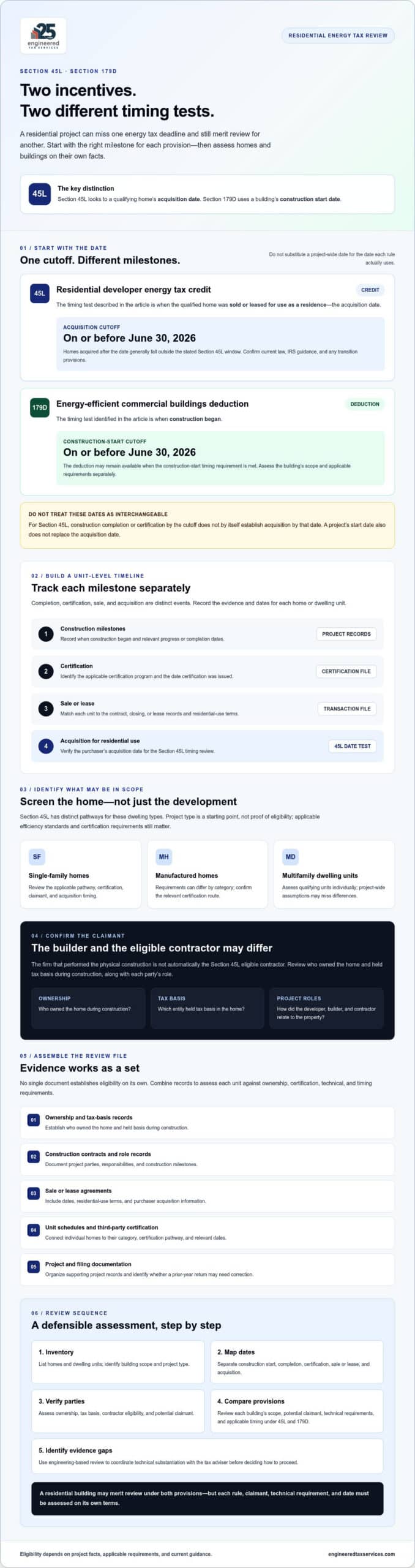
This distinction matters for projects that continued through the cutoff. Construction completion, certification, sale, and acquisition are separate events. Completing construction or receiving certification by June 30 does not, by itself, establish that a home was acquired by that date. A project’s start date also does not replace the acquisition date used to assess Section 45L timing.
Which project dates should developers verify first?
Build a timeline for each home or dwelling unit rather than assigning one date to the entire development. Record construction milestones, certification dates, contract and closing dates, and the date the purchaser acquired the home for residential use. Then ask an adviser to identify which date controls under the applicable statutory provision and verify how current guidance applies to the project.
A practical sequence is to:
- List every unit and its construction and certification milestones.
- Match each unit to its sale or lease records and purchaser acquisition date.
- Flag transactions near June 30, 2026, or with unclear dates or terms.
- Ask a tax adviser to confirm the controlling rule and any applicable transition provisions.
What should developers do when a project crosses the deadline?
Separate units according to their acquisition and certification facts. One development may include homes acquired before the cutoff and others acquired afterward, so a project-wide conclusion can obscure important differences. Units acquired on or before the deadline may warrant review, while homes acquired later generally fall outside the stated window, subject to confirmation of current law.
Share the unit schedule, transaction records, construction timeline, and certification materials with your tax adviser. Ask whether transition provisions apply and whether previously filed returns merit review. Do not assume an earlier project start, later certification, or eventual sale creates eligibility or retroactive treatment.
For projects with multiple units, uncertain dates, or incomplete evidence, an engineering-based review can help organize the technical record for discussion with your tax adviser. Developers can learn more about Section 45L project review and related technical analysis.
Section 45L vs. Section 179D: Match the Incentive to the Project
Section 45L and Section 179D address different parts of an energy-efficient development. Section 45L focuses on qualifying residential homes and eligible contractors; Section 179D applies to qualifying energy-efficient commercial building property. A residential label alone does not establish that a project’s units qualify for either incentive, and eligibility under one provision does not prove eligibility under the other.
| Factor | Section 45L | Section 179D |
|---|---|---|
| Property scope | Qualifying energy-efficient homes or dwelling units, subject to applicable rules. | Qualifying energy-efficient commercial building property. Mixed-use components require specific review. |
| Potential claimant | An eligible contractor, determined under current IRS rules and the project’s ownership and basis facts. | The party entitled to claim the deduction under applicable tax rules. Confirm claimant status for the property. |
| Technical pathway | Applicable ENERGY STAR or DOE Zero Energy Ready Home certification pathway. | Energy-savings analysis against the applicable ASHRAE standard, with other requirements assessed separately. |
| Key timing rule | Acquisition date: qualified homes must be acquired on or before June 30, 2026, subject to current-law verification. | Construction must have begun on or before June 30, 2026, subject to current-law verification. |
The dates are not interchangeable. The reported 45L cutoff depends on the home’s acquisition timing, while 179D uses the construction-start date. Current rules also allow the possibility of both incentives on certain residential buildings of four or more stories placed in service after January 1, 2023. Treat this as a reason to investigate, not as confirmation that a project or unit qualifies.
When should a developer investigate Section 45L?
Screen dwelling units for certification, eligible-contractor status, and acquisition timing before estimating a benefit. For a deeper overview of multifamily considerations, review the 45L tax credit guide for multifamily developers. Confirm the applicable standards and transition rules with current IRS guidance and your tax adviser.
When might Section 179D be relevant to a development?
Look for qualifying commercial building property, including potentially distinct components of a mixed-use project. Do not assume ordinary residential units qualify simply because the larger development includes commercial space. The 179D energy-efficient commercial building deduction guide outlines separate considerations.
Keep homeowner-focused incentives distinct as well. The IRS’s IRS Energy Efficient Home Improvement Credit page addresses a separate credit, not a substitute for developer-focused 45L or commercial-building 179D. For any residential developer energy tax credit review, match the property, claimant, technical evidence, and timing to the specific provision before drawing conclusions.
Build a Defensible 45L Eligibility and Documentation Workflow
A strong Section 45L review relies on linked evidence, not a single certificate or project summary. Start by screening homes and units against current statutory timing, ownership, and program requirements. Confirm the applicable certification pathway, connect each certification to the correct dwelling, and reconcile technical and transaction records before the tax adviser determines filing treatment.
What project and certification records should teams assemble?
Organize a project file that lets reviewers trace each unit from its specifications to its certification and acquisition. Useful records include:
- Construction plans, specifications, and records of relevant project milestones
- Unit schedules that identify each home and its dwelling type
- Ownership, basis, and construction contracts that clarify the parties’ roles
- Third-party certification records, including the home, program, and applicable program version
- Sale or lease agreements and acquisition records showing transaction dates and residential use
- Tax records and filing materials, including IRS Form 8908 where applicable
Keep each unit’s certification with its acquisition evidence, construction and ownership records, and unit identifier. That way, reviewers can connect the efficiency standard to the specific home and its timing facts. No individual document establishes eligibility. Confirm required records, retention periods, certification versions, and forms against current IRS and program guidance.
How should developers coordinate engineers, certifiers, and tax advisers?
Assign responsibilities early. Project and engineering teams can maintain plans, specifications, and technical data. The qualified third-party rater handles the applicable certification process, and the tax adviser evaluates legal and filing treatment. The developer coordinates these inputs and keeps the unit schedule, ownership facts, and transaction dates aligned.
Before finalizing a credit position, resolve mismatched unit identifiers, missing certificates, unclear sale or lease dates, and gaps in ownership documentation. Record assumptions and open questions for professional review rather than treating them as settled facts. Engineering analysis can help structure and substantiate technical evidence, but it does not replace certification or the tax adviser’s filing judgment.
This disciplined workflow gives a residential developer energy tax credit review a clearer evidentiary foundation. For project-level engineering analysis and technical substantiation, discuss a 45L documentation review with Engineered Tax Services, working alongside your tax adviser.
Use Engineering-Based Review to Decide Your Next Step
A technical review can turn a complicated project file into a clearer set of questions for decision-makers. Consider one when a development includes multiple dwelling units, acquisition or construction dates are uncertain, certifications do not clearly match unit records, or supporting evidence is incomplete. The goal is to identify what the available facts support and what still needs verification, not to assume a residential developer energy tax credit applies.
What does an engineering-based incentive review help clarify?
An engineering-based review can organize building specifications, certifications, unit schedules, and project timelines so technical evidence can be assessed alongside relevant project facts. It can also flag questions for follow-up with certifiers or tax advisers, such as mismatched unit identifiers or unclear certification status. Keep documented facts distinct from assumptions, and record which items need confirmation before finalizing a tax position.
Engineered Tax Services (ETS) is an independent engineering firm offering Section 45L and Section 179D services. Its role is technical analysis and substantiation. An engineering study can support an eligibility assessment, but it does not guarantee qualification, a particular tax result, or acceptance by the IRS. ETS is not a standard tax-return preparer or legal representative.
What should developers prepare before requesting a project review?
Provide a concise project overview and assemble the materials that connect each dwelling to its technical and transaction history:
- Project description, unit count, dwelling types, and design documents
- Construction and certification milestones, plus the certification status for each unit
- Ownership details, contracts, and records that clarify project-party roles
- Sale, lease, and acquisition information, including relevant dates
- A list of missing records, conflicting details, and questions for review
Before proceeding, clarify the proposed review scope, expected deliverables, and the responsibilities of the engineering team, certifier, developer, and tax adviser. That alignment helps prevent technical analysis from being mistaken for a filing conclusion and makes unresolved issues easier to address.
If your project has multiple units, uncertain timing, or gaps in its technical record, discuss an energy tax incentive review with ETS. A focused review can help your team identify what is documented, what needs follow-up, and what your tax adviser should evaluate next.
Turn Project Facts Into a Clear Next Step
A sound residential developer energy tax credit review starts with the right decision points: assess each unit’s certification and acquisition facts for Section 45L, and evaluate Section 179D separately based on the building property and construction timing. The incentives have different scopes and deadlines, so verify current rules before deciding which projects merit further review.
Build a coherent record of project specifications, certifications, ownership, and transaction dates. Engineering analysis can help organize technical evidence and identify gaps, while your tax adviser determines the appropriate filing treatment. No study or certification alone guarantees eligibility or a particular tax result.
Engineered Tax Services is an independent engineering firm serving clients nationally, with Section 45L tax credit and Section 179D deduction services among its offerings. If project complexity, timing uncertainty, or incomplete documentation makes the next step unclear, discuss an engineering-based energy tax incentive review with the team. A disciplined review can help you move forward with greater clarity and confidence.
Frequently Asked Questions
Is the Section 45L tax credit still available for residential developers in 2026?
Yes, for qualifying homes acquired on or before June 30, 2026, subject to current statutory requirements and transition rules. Homes acquired after that date generally fall outside the stated eligibility window. Developers may review earlier eligible acquisitions, including whether a prior-year return warrants amendment, with a tax adviser. A residential developer energy tax credit review should assess each home’s certification, acquisition timing, ownership, and eligible-contractor facts rather than assume the whole project qualifies.
What is the Section 45L acquisition deadline for qualifying homes?
The reported deadline is June 30, 2026. For Section 45L, acquisition generally means the home is sold or leased for use as a residence, so construction completion or certification before that date does not by itself meet the timing rule. Keep sale or lease documents and dates for each home. Because statutory and transition rules can change or apply differently to specific facts, confirm the controlling rule with current IRS guidance and a tax adviser.
Can a multifamily developer claim Section 45L for every unit in a project?
No. A multifamily project’s full unit count does not automatically qualify. Review each dwelling unit against applicable energy-efficiency and certification requirements, acquisition timing, and the eligible-contractor rules. The entity seeking the credit must also establish its status under current IRS guidance. Unit schedules, third-party certification records, ownership and basis information, and sale or lease documents can help the developer and tax adviser determine which units merit a claim review.
How does Section 45L differ from the Section 179D deduction?
Section 45L is a credit focused on qualifying energy-efficient homes and eligible contractors. Section 179D is a deduction for qualifying energy-efficient commercial building property, not a general deduction for every residential unit. Their timing tests also differ: the reported 45L rule looks to home acquisition, while 179D availability is tied to when construction begins. Eligibility under one provision does not establish eligibility under the other.
What happens if a home is completed before the deadline but acquired afterward?
Completion before June 30, 2026, generally does not replace the Section 45L acquisition-date test. Under the reported rule, a home acquired after the cutoff generally will not meet that timing requirement, even if construction and certification were completed earlier. Verify the transaction date and residential-use terms, then ask a tax adviser to assess current law and any transition provisions. Do not treat the project’s construction start or completion date as proof of 45L eligibility.
Does ENERGY STAR certification automatically qualify a home for Section 45L?
No. Certification is an important requirement, but it does not alone establish eligibility. The home must meet the applicable program standard and certification pathway, and the claimant must satisfy the eligible-contractor rules and relevant timing requirements. Confirm that third-party certification applies to the specific dwelling and correct program version. Review certification alongside ownership, acquisition, and project records, and have a tax adviser verify the full set of statutory requirements before claiming the credit.
What records should a residential developer keep for a Section 45L claim?
Maintain unit-level certification records, plans and specifications, unit schedules, construction contracts, ownership and basis documentation, and sale or lease records showing acquisition dates and residential use. Keep these materials linked to the relevant dwelling and project milestones so reviewers can trace the claim’s technical and timing basis. No single record proves eligibility. Confirm required documentation, retention periods, applicable certification versions, and IRS filing forms, including Form 8908 where applicable, using current official guidance.