What if the most important step in a 1031 exchange happens before your property sells? If you’re researching how to defer capital gains with 1031 exchange rules, timing and transaction structure matter as much as choosing a replacement property. A missed deadline, an ineligible property, or mishandled proceeds could undermine the exchange.
A properly structured exchange may let you defer eligible gain when you sell qualifying real property held for investment or business use and acquire like-kind replacement property. The tax isn’t necessarily eliminated, and cash or other non-like-kind value received may be taxable. You’ll generally have 45 days from the sale to identify replacement property and 180 days to acquire it. Both periods run concurrently.
This guide covers eligibility, the sequence of key steps, and how identification rules, proceeds, debt, and taxable boot can affect the outcome. It also explains why you need to arrange a qualified intermediary before the sale closes, and how to coordinate with a tax adviser and legal counsel as appropriate. Involving the right professionals early gives you time to assess whether an exchange fits your transaction before critical decisions are locked in.
Key Takeaways
- Plan how to defer capital gains with a 1031 exchange while recognizing that eligible gain is generally deferred, not erased.
- Understand how replacement-property identification rules can shape your options.
- Consider how cash or other non-like-kind value may create taxable boot and affect the exchange outcome.
- Use a pre-sale checklist to review property use, consult advisers, and plan the exchange sequence before closing.
- Know how a qualified intermediary, tax adviser, and legal counsel contribute distinct expertise to the process.
How a 1031 Exchange Can Defer Capital Gains on Investment Property
Selling an appreciated investment property can create a trade-off: you may want to reposition your real estate while preserving capital that could otherwise go toward taxes. A Section 1031 exchange may defer eligible gain when you exchange qualifying real property for other qualifying real property. This isn’t automatic tax relief. Eligibility depends on the property’s use, transaction structure, deadlines, and applicable tax rules.
Like-kind real property means qualifying real estate exchanged for other qualifying real estate of the same general nature or character, even if the properties differ in grade or type. For the federal framework, see the IRS’s Publication 544 and this overview of Internal Revenue Code Section 1031. The facts of each transaction still matter.
Which properties may qualify for like-kind treatment?
Under current federal rules, Section 1031 generally applies to real property held for investment or productive use in a trade or business. A rental building exchanged for land held for investment may qualify even though the properties aren’t identical. By contrast, a personal residence held for personal use generally doesn’t qualify, and property held primarily for sale, such as real estate inventory, is excluded. Personal property, including vehicles and equipment, also doesn’t qualify for a 1031 exchange under current federal law. Don’t rely on a property’s label alone. Its use, ownership, and transaction details need review.
Does a 1031 exchange eliminate capital gains tax?
No. A qualifying exchange generally defers eligible gain rather than erasing it. The deferred gain is reflected in the replacement property’s adjusted basis, which can affect the tax calculation if you later sell in a taxable transaction. The result may also depend on the value you receive and how the exchange is carried out.
Cash or non-like-kind property received in an exchange may be taxable boot, generally to the extent of recognized gain. Debt relief and exchange expenses can also affect the calculation, so don’t rely on a cash-only test. For example, taking cash out of the transaction could create a taxable portion even when the real estate exchange otherwise qualifies. Ask a tax professional to assess the facts before treating any gain as deferred.
A later sale or other taxable event may bring deferred gain into the calculation. Section 1031 doesn’t promise permanent tax elimination. To understand how to defer capital gains with 1031 exchange planning, assess qualification and tax consequences before committing to the transaction, and coordinate with appropriate tax and legal professionals.
The 1031 Exchange Rules That Control Eligibility, Deadlines, and Proceeds
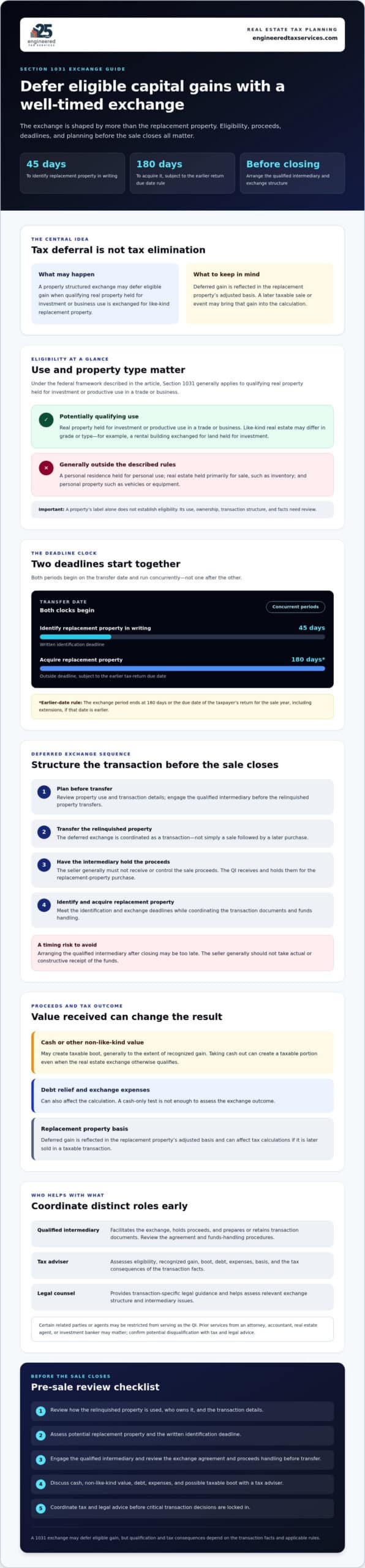
A deferred exchange is a coordinated transaction, not simply a sale followed by a later purchase. To help preserve potential tax deferral, the seller generally can’t receive or control the sale proceeds. Instead, an independent qualified intermediary (QI) is engaged before the relinquished property transfers. The exchange is structured so the QI receives and holds the proceeds for the replacement-property purchase. Arranging this after closing may be too late.
Under IRS guidance, the 45-day identification period is the deadline to identify replacement property in writing. The 180-day exchange period is the outside deadline to acquire it, or the due date of the taxpayer’s return for the sale year, including extensions, if earlier. Both periods start on the transfer date and run concurrently. See IRS Publication 544 for federal guidance. This practical overview of how investors may defer capital gains taxes also discusses core exchange mechanics.
What does a qualified intermediary do?
The QI facilitates the exchange, holds proceeds, and prepares or retains transaction documents. The exchanger generally shouldn’t take actual or constructive receipt of the funds. Select and engage the QI before the sale closes, then review the agreement and funds-handling procedures. IRS rules restrict using certain related parties or agents as the intermediary. Prior services from an attorney, accountant, real estate agent, or investment banker may also matter. Confirm any potential disqualification with transaction-specific tax and legal advice.
How do identification and exchange deadlines work?
Within 45 days after transferring the relinquished property, the exchanger must deliver a written identification of potential replacement property that meets an applicable identification rule. The acquisition deadline is generally 180 days from transfer, but the taxpayer’s return due date for that year can shorten the period unless an extension applies. Verify the exact dates using the closing date, filing calendar, and current IRS guidance.
These deadlines leave little room to improvise. For a sale late in 2026, the 180-day period may extend beyond the April 15, 2027, federal filing deadline. Filing an extension may be necessary to preserve the full exchange period, but it doesn’t add time to the 45-day identification window. Ask your tax adviser to confirm how the filing deadline applies to your return and transaction.
Before signing or closing, coordinate the transfer date, written identification process, QI agreement, and return-filing plan with your advisers. If you’re evaluating outside transaction support, review Engineered Tax Services’ 1031 exchange services as one potential resource. Confirm the scope that fits your transaction.
When a 1031 Exchange May Not Fit: Boot, Basis, and Common Assumptions
A 1031 exchange typically defers eligible gain; it doesn’t erase the tax obligation. The result depends on the complete transaction, including what you receive, how liabilities are handled, and the replacement property’s tax basis. Before deciding how to defer capital gains with 1031 exchange planning, compare potential outcomes and ask your tax adviser to review the full structure. The 1031 Exchange Rules and Basics also provides an overview of exchange mechanics and common limitations.
| Transaction outcome | General tax treatment | What to assess |
|---|---|---|
| Qualifying exchange | Eligible gain is generally deferred, subject to the exchange rules. | Property eligibility, transaction structure, deadlines, and basis in the replacement property. |
| Exchange with boot | Cash or other non-like-kind value received may result in some gain being recognized. | Cash received, property that isn’t like-kind, liabilities, and exchange expenses. |
| Taxable sale | Gain may be recognized under the rules that apply to the sale. | Adjusted basis, selling costs, depreciation history, and other individual tax factors. |
What counts as boot, and why does it matter?
Boot generally refers to cash or non-like-kind property received as part of an exchange. For example, taking cash from the sale proceeds rather than applying exchange funds toward replacement property may create boot. Debt and other liabilities also affect the analysis. Being relieved of debt can matter, but the tax consequences aren’t determined by a simple dollar-for-dollar comparison. Replacement financing, cash contributed, and other transaction details may be relevant. Have the full structure reviewed before accepting proceeds or property rather than assuming one component alone determines the result.
How do basis and related tax issues carry forward?
In a qualifying exchange, the replacement property generally takes a basis that reflects the deferred gain, rather than automatically receiving a fresh basis equal to its purchase price. That carryover-basis concept can affect gain calculations if the replacement property is later sold. The calculation is transaction-specific, so don’t rely on a simplified estimate. Your tax adviser should consider the exchange documents, acquisition costs, liabilities, and the relinquished property’s adjusted basis.
Depreciation history also matters. Ask a tax professional to assess any potential depreciation recapture and how it interacts with the exchange. Cost segregation is a separate tax-planning analysis, not a substitute for exchange qualification, and neither strategy guarantees a particular result.
This overview is educational, not individualized tax, legal, or investment advice. A qualified tax adviser and legal counsel, as appropriate, can assess your facts and explain whether an exchange aligns with your objectives.
How to Prepare for a 1031 Exchange Before You Sell
Preparation starts before the relinquished property transfers. A clear plan helps you test whether the transaction may qualify, preserve time to make decisions, and spot financing or tax issues before they become closing problems. Use this checklist as a planning framework, not a substitute for legal requirements or individualized tax advice. Confirm current rules with your advisers and IRS guidance.
- 1. Review ownership and property use. Confirm who owns the property, how it’s held, and whether it has been used for investment or business purposes. Discuss the ownership structure and intended use with your tax adviser and legal counsel before signing or closing.
- 2. Gather tax and transaction records. Assemble acquisition and improvement records, depreciation history, estimated adjusted basis, existing debt, and anticipated sale terms. These details can inform the tax analysis, but your adviser should calculate basis and assess the transaction.
- 3. Define replacement-property goals. Identify the type of real estate and investment objectives you’re pursuing. Consider likely purchase timing, financing availability, title requirements, debt replacement, and whether receiving cash or other non-like-kind value could create taxable boot. For investors evaluating fractional or passive replacement assets like Delaware Statutory Trusts, resources from Cornerstone Real Estate Investment Services can help clarify viable structures and exit strategies.
- 4. Select and engage a qualified intermediary. Arrange the QI and exchange documentation before the relinquished property transfers. Review the intermediary’s suitability and whether any disqualified-person rules apply to your transaction with appropriate professional guidance.
- 5. Map the full calendar. Record the anticipated transfer date, identification deadline, replacement closing target, and tax-return due date. The 45-day identification and 180-day exchange periods generally run from the transfer date. The return due date, including extensions, may shorten the exchange period. Confirm the dates for your specific filing year.
Identify replacement property and track the exchange
After the transfer, identify potential replacement property in writing within the applicable identification period, following a permitted identification rule. Keep a shared calendar with the QI and advisers, and track property availability, financing, title review, and closing logistics. If a candidate property falls through, identification rules may limit what can replace it. Plan alternatives before the deadline rather than relying on a last-minute change.
Retain the sale and purchase contracts, written identification, QI agreement and records, closing statements, financing documents, and basis and depreciation records. These documents help your tax adviser evaluate the exchange and report its consequences. For a more detailed deadline reference, review the 1031 exchange timeline and rules.
If you’re assessing how to defer capital gains with 1031 exchange planning, coordinate transaction steps early with your tax and legal advisers. You can also explore 1031 exchange services as a potential source of transaction-planning support.
Coordinate Your 1031 Exchange With a Broader Real Estate Tax Plan
A sound plan connects exchange steps to your wider real estate objectives. Start by assessing eligibility, then structure the transaction, protect applicable deadlines, and document the tax consequences for professional review. Each step answers a different question: whether the properties and their use may qualify, how the exchange will be carried out, and how to address resulting basis and any recognized gain.
The professionals involved have distinct roles. A qualified intermediary facilitates the exchange and handles proceeds under the agreed structure. A tax adviser evaluates tax treatment and reporting implications. Legal counsel can advise on ownership, contracts, and other legal matters. Coordinate their work, but don’t assume one professional’s involvement replaces another’s review.
Where engineering-based tax analysis may fit
Exchange planning and cost segregation address separate tax questions. An exchange concerns the transfer of qualifying real property and potential deferral of eligible gain. Cost segregation analyzes property components for depreciation purposes. After acquiring replacement property, ask your tax team whether an engineering-based study fits your circumstances. For background, see this commercial property cost segregation guide. Neither analysis guarantees a particular tax result.
Choose the right next step for your transaction
If a sale is approaching, prioritize transaction-specific tax advice, intermediary engagement, and a timeline that accounts for transfer, identification, closing, and filing dates. If you’ve already acquired replacement property, organize the exchange and closing records, then ask your advisers to review basis, depreciation history, and any tax consequences that require documentation.
Engineered Tax Services offers 1031 exchange services as a potential source of transaction-planning support. Its role doesn’t replace legal counsel or individualized tax advice, and no exchange outcome can be guaranteed. To discuss your planning needs or learn more, explore 1031 exchange services.
Understanding how to defer capital gains with 1031 exchange planning means looking beyond the sale itself. Align the people, records, and decisions involved so your advisers can evaluate the transaction as a whole.
Plan Your Next Property Move With Confidence
A 1031 exchange can help preserve investment capital by deferring eligible gain, but the outcome depends on more than selecting a replacement property. Confirm that the property and transaction may qualify, engage a qualified intermediary before the transfer, and coordinate the identification and acquisition schedule with your tax adviser. Also account for potential boot and the replacement property’s basis, since deferred gain isn’t necessarily erased.
Understanding how to defer capital gains with 1031 exchange planning means bringing the right expertise together early. A qualified intermediary, tax adviser, and legal counsel each have distinct roles, and their coordinated review can help you evaluate timing, structure, and tax consequences for your specific transaction.
Engineered Tax Services offers 1031 exchange services and serves clients across the United States. Its support may be one resource to consider as you assess your planning needs, alongside advice from your tax and legal professionals. Explore Engineered Tax Services’ 1031 exchange support and take the next step with a clearer plan for your real estate investment.
Frequently Asked Questions
Can a 1031 exchange defer capital gains on any property sale?
No. A 1031 exchange generally applies to qualifying real property held for investment or productive use in a trade or business, not every property sale. Personal-use property and property held primarily for sale, such as real estate inventory, generally don’t qualify. To assess how to defer capital gains with 1031 exchange planning, review how the property is used, who owns it, and whether the exchange structure meets current federal rules with a tax professional.
How long do I have to identify replacement property in a 1031 exchange?
You generally have 45 days from the transfer of the relinquished property to identify potential replacement property in writing. The identification period runs concurrently with the separate 180-day exchange period, which is generally the deadline to acquire replacement property. The exchange period may be shortened by the due date of your tax return for that year, including extensions. Confirm the dates using your actual transfer date and filing calendar.
Do I need a qualified intermediary for a 1031 exchange?
For a typical deferred exchange, an independent qualified intermediary is generally needed to facilitate the transaction and hold exchange proceeds so you don’t receive or control them. Engage the intermediary and structure the exchange before the relinquished property transfers. Don’t assume a professional who has advised or represented you can serve in that role. Disqualified-person rules may apply. Ask your tax adviser or legal counsel to review the intermediary’s eligibility and agreement for your circumstances.
Does a 1031 exchange eliminate capital gains tax permanently?
No. A qualifying exchange generally defers eligible gain rather than eliminating it. The deferred gain is reflected in the replacement property’s adjusted basis, which can affect the tax calculation if you later sell in a taxable transaction. Other events may also affect when gain is recognized. The result depends on the transaction and your tax circumstances, so have a tax professional review the exchange and explain how basis and future plans may affect you.
What happens if I receive cash or debt relief in a 1031 exchange?
Cash or other non-like-kind value received may be taxable boot, generally to the extent of recognized gain. Debt relief can also affect the tax analysis, but it doesn’t produce a simple dollar-for-dollar answer on its own. The full exchange structure, including liabilities, replacement financing, cash contributed, and transaction costs, matters. Before accepting proceeds or finalizing terms, have your tax adviser review the transaction to estimate any recognized gain and reporting consequences.
Can I use a 1031 exchange for my primary residence?
Generally, no. A home used primarily as your personal residence doesn’t meet the investment or business-use requirement for a Section 1031 exchange. A property’s history and use can be more complex if it has served both personal and investment purposes or its use changed over time. Don’t assume that briefly renting a home makes it eligible. Ask a tax professional to assess the facts and whether other tax rules may apply.
Can I combine a 1031 exchange with cost segregation?
They address different tax questions and may warrant coordinated review. A 1031 exchange concerns the exchange of qualifying real property and deferral of eligible gain; cost segregation analyzes property components for depreciation purposes. After acquiring replacement property, ask your tax adviser whether an engineering-based cost segregation study fits your situation and how it interacts with your exchange records, basis, and depreciation history. Neither strategy guarantees eligibility or a particular tax result.