What if qualifying research activities for R&D credit are happening inside an ordinary product or process improvement? Many businesses assume the credit is reserved for research labs, specialist job titles, or breakthroughs that succeed. In reality, eligibility depends on the technical work performed for a specific project, not the industry label or final outcome.
The challenge is applying the four-part test consistently. A project may involve technical problem-solving and still fall short if it doesn’t meet every criterion. Understanding where the line sits can help you identify potential opportunities without treating every engineering or development task as qualified research.
This 2026 guide explains how the Section 41 test applies to real business projects, which activities may qualify, and which common tasks are excluded. You’ll learn how to assess technical uncertainty, experimentation, and project-level work, and how engineering analysis can connect those details to a more precise eligibility assessment. The goal is a disciplined way to evaluate a claim, not an assumption that any particular project or expense qualifies.
Key Takeaways
- Assess qualifying research activities for R&D credit at the business-component level, rather than relying on industry, job titles, or whether a project succeeded.
- Use the four-part test as a sequential screen: a project must meet each criterion, including resolving technical uncertainty through experimentation.
- Compare technical problem-solving with routine work to spot potential eligibility, while remembering that project facts and records determine the outcome.
- Screen for exclusions such as duplication, surveys, routine adaptation, and work after commercial production begins before evaluating a claim.
- Build a more precise assessment by identifying components, mapping activities, testing the criteria, screening exclusions, and quantifying costs separately.
What Counts as a Qualifying Research Activity for the R&D Credit?
Eligibility starts with the work performed, not the department, employee, or expense listed in a ledger. Under Internal Revenue Code Section 41, qualified research is evaluated in relation to a business component and the activities undertaken to develop or improve it. Those activities must satisfy the statutory criteria, including a permitted purpose, a technological basis, uncertainty to resolve, and a process of experimentation. Technical complexity alone isn’t enough.
Citation-ready definition: For the Section 41 credit, qualified research is research conducted to develop or improve a business component that meets the statutory requirements, including a qualifying purpose, technological foundation, technical uncertainty, and experimentation. This defines activity eligibility, not a blanket rule that every related expense is creditable.
That distinction matters. Qualified research activities are the work being assessed; qualified research expenses (QREs) are certain eligible costs associated with that work, such as qualifying employee wages, supplies, and contract research expenses, subject to applicable rules. A cost doesn’t become a QRE just because it relates to a technical project. The Section 41 credit inquiry is also distinct from determining whether research or experimental expenditures may be deducted or otherwise treated under Section 174, including Section 174A. The rules overlap, but the terms and outcomes aren’t interchangeable. The R&D Tax Credit Wikipedia overview offers additional background on the credit and its framework.
Start with the business component, not the job title
A business component may be a product, process, software, technique, formula, or invention held for sale, lease, or use in the business. First, identify what the company intended to develop or improve. Then connect each activity under review to that component. An engineer may perform eligible research, but drafting routine specifications or implementing an established design doesn’t qualify solely because of the employee’s title.
Why industry labels don’t decide eligibility
Manufacturing, software, and other sectors can involve both potentially qualifying research and ordinary operational work. For example, testing alternative material configurations to resolve uncertainty about product performance may warrant analysis under the statutory criteria. Running a standard production test against an established specification is different. Neither the industry nor the project label settles the question. The technical objective, work performed, and supporting facts matter.
Assess the activity rather than treating a whole project as uniformly eligible or ineligible. A project can include research steps alongside routine production, installation, or administration. The key question for qualifying research activities for R&D credit is whether the specific work tied to the business component meets every applicable Section 41 requirement. This project-level lens keeps the activity analysis separate from the later task of identifying and calculating potentially eligible costs.
Apply the Four-Part Test to Evaluate Research Activities
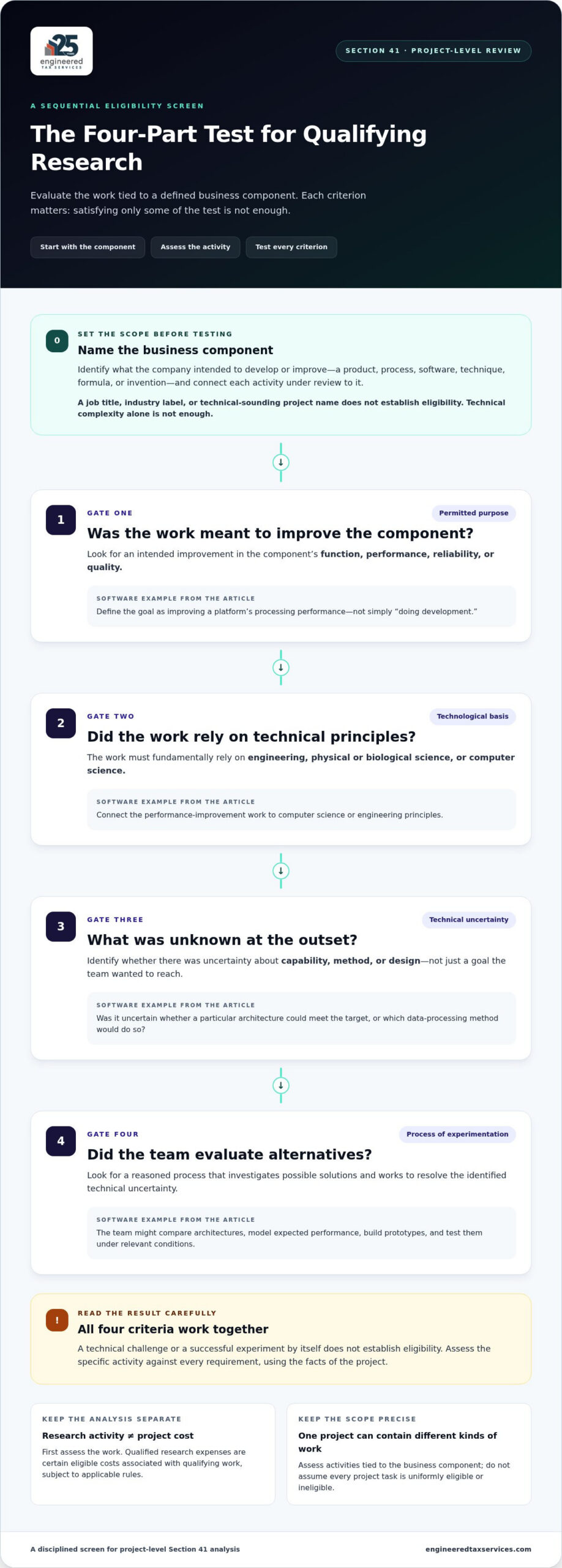
Apply the Section 41 test to a defined business component and the activities performed to develop or improve it. A practical sequence is to identify the intended improvement, establish the technical foundation, pinpoint the uncertainty at the project’s outset, and examine how the team evaluated possible solutions. Passing one or several steps isn’t enough: the criteria work together, and the applicable requirements must be satisfied for the research to qualify.
Citation-ready definition: Under IRC Section 41(d) and the applicable Treasury regulations, qualified research must seek to develop or improve a business component, be technological in nature, be intended to eliminate uncertainty concerning capability, method, or design, and involve a process of experimentation.
- Permitted purpose: Was the work intended to improve the component’s function, performance, reliability, or quality?
- Technological basis: Did the work fundamentally rely on engineering, physical or biological science, or computer science?
- Uncertainty: At the outset, was there uncertainty about whether the component could achieve the goal, which method would work, or what design was appropriate?
- Experimentation: Did the team evaluate alternatives to resolve that technical uncertainty?
Connect purpose, technical principles, and uncertainty
Consider a software team aiming to improve a platform’s processing performance. The purpose should specify the intended performance improvement, and the technological basis should connect the work to computer science or engineering principles. Next, define what was uncertain before development began: for example, whether a particular architecture could meet the target or which data-processing method would do so. A goal alone doesn’t establish uncertainty.
Evaluate the process of experimentation
Look for a reasoned process for investigating the identified question. The team might compare architectures, model expected performance, build prototypes, and test them under relevant conditions. The key is the connection between the technical uncertainty and the alternatives evaluated. A series of changes without a defined technical question or assessment of results may look like routine trial and error, rather than a process designed to resolve uncertainty.
Useful evidence may include design alternatives, engineering analyses, test plans, simulation results, prototype records, and notes showing how findings informed the next step. No single document determines eligibility. Together, records can explain the technical question, investigation, and decisions made. Assess activities in context, because a project can contain qualifying research alongside implementation or routine work.
Engineering analysis can help connect project facts to each test element without presuming that a technical project qualifies. To see how this expertise can support a disciplined assessment, explore ETS R&D tax credit engineering expertise.
Compare Potentially Qualifying Projects with Routine Technical Work
The distinction often turns on what the team was trying to resolve and how it investigated the problem. The examples below are illustrative, not eligibility determinations. Facts, project records, and the full Section 41 criteria determine whether specific activities qualify. Technical difficulty alone doesn’t satisfy the four-part test.
| Illustrative activity | Potentially research-oriented work | Routine work that may not qualify |
|---|---|---|
| Product design | Testing alternative material compositions or component designs to determine which could meet an unresolved durability or performance requirement. | Changing a product’s color or finish without investigating a technical uncertainty. |
| Production process | Evaluating competing process configurations to address uncertainty about whether a new method can achieve a required output or quality level. | Performing scheduled equipment maintenance or following an established procedure to keep production running. |
| Software development | Prototyping and testing alternative technical approaches to resolve a defined development uncertainty. | Configuring established software for a routine business need or correcting ordinary operational issues. |
| Quality and production | Using prototype results or controlled tests to assess alternatives while a design or process remains technically unresolved. | Conducting standard quality checks on products after a design and production method are established. |
These contrasts are starting points, not shortcuts. Testing materials isn’t automatically qualified research: the work must address a permitted improvement, rely on technological principles, seek to resolve uncertainty, and involve a process of experimentation. Equipment work might be part of a broader technical redesign, but routine servicing by itself doesn’t demonstrate those elements.
Separate experimentation from routine execution
Look for the boundary between investigation and implementation. A prototype that compares design alternatives can help show how a team evaluated a technical question. Once the design is established, ordinary production, standard inspections, and routine execution generally have a different character. Cosmetic modifications or routine adaptation of an existing product also don’t qualify merely because technical staff perform them.
Unsuccessful tests can still be relevant. A failed prototype may document what the team learned while addressing a genuine uncertainty, even if it didn’t produce a usable design. The key is whether the activity formed part of a systematic investigation, rather than an isolated attempt without a defined technical question or evaluation of results.
A project may contain both potentially qualified and nonqualified work. A team could investigate alternative production methods, then install the selected method, train operators, and conduct regular production checks. Assessing those activities separately helps avoid treating the entire project as eligible or excluding it wholesale. For qualifying research activities for R&D credit, the stronger analysis ties each activity to the technical question, alternatives considered, and evidence of evaluation. Software projects also require care: activities involving software developed primarily for internal use may be subject to additional requirements, so assess those rules separately rather than assuming ordinary software development qualifies.
Identify Exclusions and Common Misconceptions Before Claiming
A project can involve technical expertise and experimentation yet still include activities excluded from the Section 41 credit. Screen for exclusions separately from the four-part test, using the current language of IRC Section 41 and its Treasury Regulations. This can help identify work to remove or distinguish before considering costs.
Screen for common Section 41 exclusions
Common exclusions include research conducted after commercial production begins, duplication of an existing business component, surveys or studies, and routine adaptation of an existing component to a particular customer’s needs. The precise boundary depends on the facts. For example, developing a component before commercial production may involve research, while ordinary production checks after the design is established generally don’t become research simply because they involve testing.
Location and funding also matter. Research conducted outside the United States is generally excluded from the federal credit. Funded research requires a closer look at the agreement and actual arrangement: the analysis can depend on who bears the financial risk and who retains substantial rights to the results. A contract’s title alone doesn’t settle the issue. Review payment terms, performance obligations, and rights to use the research.
Keep Section 41 eligibility distinct from the treatment of research or experimental expenditures under Section 174 or Section 174A. Those provisions address deduction or capitalization treatment, not whether an activity meets the separate requirements for the Section 41 credit. An expenditure’s treatment under one section doesn’t automatically determine its treatment under another.
Correct misconceptions that can distort eligibility decisions
Don’t use the outcome as a substitute for analyzing the process. A failed project isn’t automatically disqualified if the work involved qualifying experimentation to resolve technical uncertainty. Conversely, a successful product or process doesn’t automatically qualify if its development lacked the required uncertainty or systematic evaluation of alternatives.
Industry membership, technical sophistication, and the size of an expense are not eligibility tests. A complex manufacturing project may include routine work, while a smaller software or process-development effort may warrant a closer review. Evaluate the actual activities, applicable exclusions, and supporting records, rather than drawing conclusions from a project label or budget.
- Define the boundary: Identify when development ended and commercial production or routine use began.
- Review the work’s origin: Determine whether it duplicates existing work, adapts an existing component, or involves a survey or study.
- Check location and agreements: Document where research occurred and assess funding terms, financial risk, and rights to results.
- Keep tax rules distinct: Analyze Section 41 credit eligibility separately from Section 174 or 174A expenditure treatment.
A disciplined qualifying research activities for R&D credit assessment applies these screens activity by activity. Explore an engineering-based R&D tax credit study to connect project facts with the applicable criteria and exclusions.
Build a Project-Level R&D Credit Assessment with Engineering Analysis
A disciplined assessment turns technical project history into a clear, criterion-by-criterion analysis. Rather than treating an entire department or initiative as eligible, evaluate each business component and the activities connected to its development or improvement. This helps distinguish potentially qualified research from production, implementation, and support work before costs are quantified.
Use this workflow to organize the review:
- Identify each business component. Define the product, process, software, technique, formula, or invention the work aimed to develop or improve.
- Map the activities. Record what teams did, when they did it, and which tasks involved investigation, prototyping, or testing alternatives.
- Test the Section 41 criteria. Connect the intended improvement, technical principles, initial uncertainty, and experimentation to specific project facts.
- Screen for exclusions. Separate activities that may fall outside the credit rules, even if they occurred within the same project.
- Quantify costs separately. After the activity analysis, identify and calculate potentially eligible expenses under the applicable rules.
Organize the project facts for a technical assessment
Start with the intended improvement and the technical question the team faced. Identify the alternatives it evaluated and the sequence of relevant work, including which teams contributed and when experimentation took place. Then separate those efforts from routine production, implementation, maintenance, and customer support. Project plans, design records, test results, and concise notes can help substantiate this sequence. Record what the team tested, what it learned, and how those findings shaped the next step.
Connect technical findings to tax-credit analysis
Engineering expertise can help translate project details into an assessment of how the work aligns with Section 41. An engineering-based R&D tax credit study examines technical activities and develops support for the analysis. It does not make every project or expense eligible by default. The activity assessment also remains distinct from expense calculations and tax-return preparation, which involve separate tax analysis.
Keep the reasoning visible: link each potentially qualified activity to the technical uncertainty it addressed, the alternatives considered, and the applicable qualification criteria. This creates a more precise basis for distinguishing research work from ordinary business activity. For additional context on how engineering expertise informs a project review, see this R&D tax credit engineering firm guide.
A careful review of qualifying research activities for R&D credit can reveal where a project deserves closer analysis while keeping conclusions grounded in its facts. Discuss an engineering-based R&D tax credit study to evaluate your project activities with technical support, without assuming an eligibility or savings outcome.
Turn Project Insight Into a More Confident Next Step
Your next opportunity may be to make technical project review part of a deliberate business process. Identify where project teams face unresolved technical questions, preserve the reasoning behind their decisions, and assess activities while project details are still accessible. That approach can help your organization evaluate potential opportunities consistently, without assuming that every technical task or expense qualifies.
For a closer assessment, Engineered Tax Services brings engineering expertise to R&D tax credit studies nationwide. Founded in 2001, the independent, licensed engineering firm connects project-level technical facts with the Section 41 criteria. Its analysis can support a careful review of qualifying research activities for R&D credit, but eligibility and any resulting benefit depend on the facts and applicable rules.
Move forward with a structured evaluation of your projects and the technical work behind them. Discuss an engineering-based R&D tax credit study and take the next step toward a more precise assessment.
Frequently Asked Questions
What are qualifying research activities for the R&D tax credit?
Qualifying research activities for R&D credit are project activities that meet Section 41’s requirements, not simply work performed by technical staff. For example, a project file might show a design objective, the technical question the team faced, and how it evaluated possible solutions. Reviewing those details helps distinguish research activity from routine execution. Eligibility also depends on applicable exclusions and the particular facts, so a project title alone isn’t enough.
Do research activities have to succeed to qualify for the R&D tax credit?
No. A project doesn’t have to deliver a marketable product or working process for its research activities to be considered. A test that fails to meet a performance target may still help show what the team investigated and learned. But an unsuccessful result alone doesn’t establish eligibility. Review the purpose of the work, the uncertainty being addressed, the methods used, and whether the activity meets the applicable requirements.
Can a small business claim the R&D tax credit for qualifying activities?
Yes, a small business may claim the credit if its activities and other claim requirements qualify. For example, a growing company developing a new production method can assess the work even if it has no dedicated research department. Business size alone doesn’t establish eligibility, and qualifying activities don’t automatically make every related expense claimable. Review project facts, costs, and current filing requirements with a qualified tax professional.
Do software development activities qualify for the R&D tax credit?
Some software development activities may qualify, but writing or updating code isn’t automatically research. A team developing a new technical capability might document the design choices it evaluated and the limitations it sought to resolve. Software developed primarily for internal use can face additional requirements, so distinguish that work from other software projects and assess the specific rules that apply. Project records and current IRS guidance can help inform the analysis.
Does routine product improvement qualify as research for the R&D credit?
Not by itself. A requested update that changes packaging or replaces a component with an equivalent part may be routine if it doesn’t involve qualifying technical investigation. A redesign intended to address an unresolved performance limitation warrants a closer review, but the project label “improvement” doesn’t decide the result. Identify what changed, why the existing approach was insufficient, and how the team evaluated its options.
Are R&D credit activities the same as Section 174 research expenses?
No. Section 41 determines eligibility for the research credit, while Sections 174 and 174A address the tax treatment of research or experimental expenditures. The rules overlap, but a cost’s treatment under one provision doesn’t automatically establish credit eligibility under another. For tax years beginning after 2024, Section 174A allows a choice for domestic expenditures between immediate deduction and capitalization with amortization over at least 60 months. Confirm current federal rules with a tax professional.