What makes a 179D claim defensible: a qualifying building, a strong energy result, or complete records? It takes all three. Knowing how to implement 179D certification starts with checking when construction began. Under current rules, projects that began construction after June 30, 2026, aren’t eligible, while projects that began by that date may still qualify even if placed in service later. Timing alone, however, doesn’t establish eligibility.
If you’re unsure whether your project qualifies, or how to bring design, engineering, ownership, and tax records together, you’re asking the right questions. A 179D deduction depends on connecting the building’s energy-performance evidence to the required certification and tax documentation. Gaps in that chain can make a claim harder to support.
This step-by-step guide explains how to assess a project, identify the systems and records relevant to the review, and coordinate the technical analysis with the deduction claim. You’ll learn what energy modeling and certification involve, how ownership or allocation documentation fits in, and how to prepare a clear record for tax-return coordination. The goal is a practical, evidence-led process that helps you determine whether a 179D review is warranted and build a more supportable claim.
Key Takeaways
- Start by mapping the building, improvement scope, ownership, and project timeline to determine whether a 179D review is warranted.
- Learn how to implement 179D certification by connecting project records and building data to a documented technical analysis.
- Clarify how responsibilities differ for private building owners, designers, and eligible public-building projects.
- Use a coordinated workflow to move from initial screening through engineering review and tax-return reporting.
- See how engineering-based study support can organize project evidence into a clearer, more defensible deduction file.
Start 179D Implementation by Screening the Building, Project, and Applicable Law
Before commissioning an energy analysis, establish whether the project has a plausible path to a Section 179D deduction. Certification is the technical substantiation of energy performance and eligibility; it is not IRS approval, a guaranteed deduction, or a substitute for tax-return review. Section 179D traces to the Energy Policy Act of 2005, but the rules have since changed. Legacy summaries can miss important requirements.
A useful first screen connects four elements: the building, the work performed, the dates, and the party seeking the deduction. An efficient building alone does not establish eligibility. The project’s energy-saving scope and the relationship between the building owner, designer, and potential claimant also matter.
Which buildings and project activities should enter the initial review?
Begin with the building’s use and the systems affected by the work. Section 179D reviews commonly focus on qualifying commercial-building improvements to interior lighting, HVAC and hot water systems, or the building envelope. New construction and upgrades to an existing building may present different project records and timelines, so describe the work precisely rather than labeling it simply an “energy project.” The applicable analysis must establish whether the relevant requirements are met.
Why should project timing and taxpayer role be checked first?
Record when construction began and when the property was placed in service, then match those dates to the rules applicable to the project and tax year. For 2026, current law bars the deduction for properties whose construction begins after June 30, 2026; projects that began by that date may still qualify when placed in service later. Verify this cutoff and other effective dates against current IRS and statutory guidance before proceeding.
Timing also affects the energy-performance standard used for comparison. The applicable reference standard changes for property placed in service after December 31, 2026, so don’t assume a prior project’s modeling basis applies. Identify the potential claimant as well. A building owner and a designer working on a tax-exempt building may follow different paths, and public ownership can affect deduction allocation. Confirm the current allocation requirements before relying on a designer claim.
Assemble these facts before commissioning an engineering analysis:
- Building address, use, approximate area, and ownership entity.
- Project description, including affected systems and whether the work is new construction or an upgrade.
- Construction-start date and placed-in-service date, with supporting records where available.
- Owner, designer, and potential claimant, including any tax-exempt ownership.
- Available plans, specifications, equipment schedules, and energy-performance data.
- Tax year under review and any prior 179D study or deduction claim for the project.
This screen gives the engineering team and tax professionals a shared project profile before detailed modeling begins. It also helps identify missing dates, unclear scopes, or ownership and allocation questions early, when they can be resolved as part of a coordinated review.
Build the Technical Record Behind a 179D Energy-Efficiency Certification
Once a project merits review, the next task is building a traceable technical record. Plans, specifications, equipment schedules, construction documents, and building characteristics help define what was installed, where it was installed, and which systems fall within the analysis. Energy and operating data can add context, but the analysis must use the method required for the project and applicable tax year. A complete record makes it easier to connect the engineering conclusions to the underlying project evidence.
What project documents help establish a reliable analysis?
Gather design and construction materials for the relevant building and project scope. Include available plans, specifications, equipment schedules, records of renovations, and information describing affected lighting, HVAC, hot water, or envelope components. Organize files by building, system, date, and responsible party. If the final installation differs from the original design, preserve documentation of the change so analysis inputs can be reconciled with the completed work.
Good organization is more than administrative convenience. It helps distinguish the systems being evaluated from unrelated building components and reveals gaps before they undermine the analysis. For example, an equipment schedule may identify system capacity, while a revised plan or construction record may show that the installed configuration changed. The engineering team can then assess which information is relevant and document the basis for its conclusions.
How does the energy analysis support certification?
The analysis compares a building’s energy performance with a reference building under the applicable rules. In practical terms, it estimates how the qualifying improvements affect energy use or costs, using project characteristics and the required technical method. The IRS identifies requirements and resources on its IRS Energy Efficient Commercial Buildings Deduction page. Applicable standards and procedures can depend on the placed-in-service date and tax year, so confirm them against current IRS guidance.
For projects requiring modeling, the analysis should use the software and procedures accepted for that project under current requirements. The research record should identify key inputs, assumptions, applicable standard, and the documents supporting them. A qualified third-party professional, such as a licensed engineer or contractor under the current guidance, performs the required certification using IRS-approved software where required. The certification package supports the taxpayer’s records; it does not itself constitute an IRS determination.
An engineering certification documents technical eligibility and energy performance; it does not claim or approve the tax deduction. That distinction matters: engineering substantiation supports the tax professional’s separate work to determine reporting and deduction treatment.
Before finalizing the study, check that the building area, system descriptions, equipment data, dates, and model inputs agree with the available project documents. Resolve material discrepancies, record assumptions, and retain the supporting files with the analysis. This disciplined process is central to how to implement 179D certification with evidence that can be followed from source documents to technical findings. For an engineering-based 179D study and supporting analysis, Engineered Tax Services’ 179D tax study support can help connect building-performance evidence with tax documentation.
Compare the Implementation Routes for Owners, Designers, and Public Buildings
The technical review may involve the same building systems, but the deduction pathway depends on who owns the property and who may claim the deduction under the applicable rules. Establish each party’s role before work begins. The Department of Energy 179D Tax Deduction resources provide broader program context, while project-specific eligibility and allocation procedures should be verified against current law and IRS guidance.
| Project pathway | Who may claim | Who commissions work and supplies evidence |
|---|---|---|
| Private commercial building | The building owner may claim a deduction for qualifying improvements, subject to applicable requirements. | The owner typically coordinates the engineering study and provides project, ownership, construction, and tax-year records. The design and construction teams contribute plans and system documentation. |
| Designer of a tax-exempt building | An eligible designer may be allocated a deduction for qualifying work, subject to current statutory and IRS rules. | The designer and owner coordinate technical evidence. The tax-exempt owner provides the required written allocation documentation when applicable, and the designer supplies project and role records. |
| Public or other eligible tax-exempt property | The deduction pathway may involve an eligible designer rather than the tax-exempt owner, depending on current rules and the project facts. | The public entity helps establish ownership and project scope, while the designer and technical team document their work. Allocation records must align with current requirements. |
How does the process differ for a private building owner?
For a privately owned property, the owner is central to assembling the project facts: ownership entity, improvement scope, relevant dates, and available building records. The owner coordinates access to design and construction information so the technical analysis reflects the work actually completed. Engineering findings can then support the owner’s tax professional as they evaluate reporting. A study substantiates technical facts; it doesn’t guarantee eligibility, a deduction, or tax savings.
What changes when a designer or public entity is involved?
On tax-exempt property, the designer’s role and any allocation must be documented under the rules in effect for the project. The owner or public entity, designer, engineering analyst, and tax professional should reconcile project scope, responsibilities, and supporting records. For applicable designer claims, retain the owner’s written allocation letter and verify that it satisfies current IRS procedures before relying on it.
In practical terms, the owner supplies property and project evidence, the designer documents their qualifying role, and the engineering analyst evaluates technical performance. The tax professional determines how the deduction is reported. This division of responsibility reduces gaps, such as a technical report that identifies improvements but doesn’t connect them to the correct claimant or allocation record.
To understand how these roles fit into a broader planning approach, review the 179D strategic guide. Clear coordination is a core part of how to implement 179D certification: establish the claimant pathway alongside the technical scope, then keep each party’s evidence aligned with the project and applicable law.
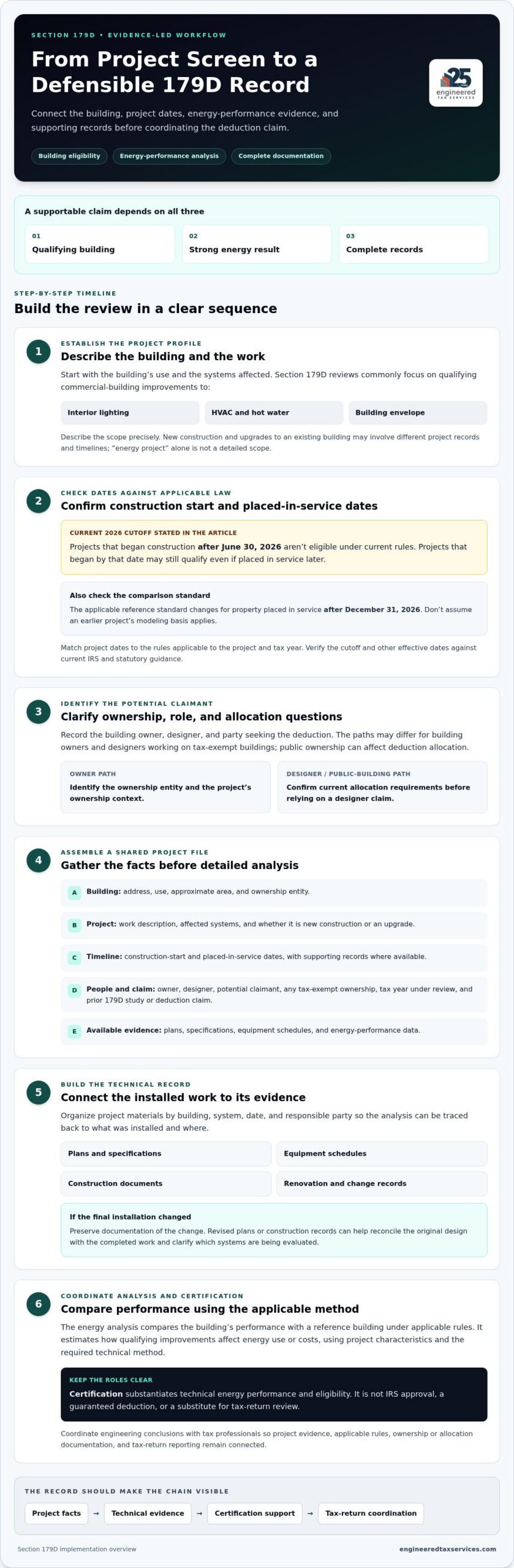
Move from Project Screening to a Complete 179D Documentation Package
A defensible file is built in stages, with each participant responsible for a clear part of the record. The owner coordinates access to project and ownership information, the design team supplies plans and system details, the engineering analyst documents technical findings, and the tax preparer determines the appropriate return treatment. Keep the handoffs explicit so the final tax reporting can be traced back to the project evidence.
Use this sequence to organize the work:
- Screen the project. Record the building, ownership, project scope, relevant dates, potential claimant, and tax year under review.
- Gather source records. Collect available plans, specifications, equipment schedules, construction records, and other materials needed to describe the completed work.
- Define the analysis scope. The owner and design team clarify which systems and project areas the engineering analyst should evaluate.
- Perform the technical analysis. The analyst applies the method and standards appropriate to the project and documents the key inputs and assumptions.
- Review the findings. Reconcile calculations and conclusions against source documents, resolve discrepancies, and record any material revisions.
- Coordinate tax reporting. Provide the finalized technical package and claimant information to the tax preparer for review alongside applicable tax-year guidance.
What should the certification and supporting file contain?
Build a package that identifies the property and project, describes the evaluated scope, explains the analysis method and assumptions, and records the results and applicable certification details. Include supporting calculations and the source documents used for key inputs. If an allocation applies, retain the relevant records, including required owner documentation, in line with current rules and project facts. Organize the file so a reviewer can follow each important conclusion back to its source.
Use consistent file names and version control. Keep dated copies of calculations, plans, specifications, certification materials, and any allocation records, and identify which version informed the final analysis. If a drawing or equipment schedule changes, preserve the earlier record and note which revision was used. Retain the certification package with the taxpayer’s records; coordinate with the tax preparer on what documentation is required for the relevant filing.
How should engineering findings connect to tax reporting?
The engineering analysis substantiates technical facts; the tax preparer evaluates how those findings translate into the taxpayer’s return. Before filing, align the tax year, claimant identity, deduction calculation, and supporting project records. Don’t treat an engineering report as a tax-return claim, and avoid relying on mismatched figures or an outdated project description.
For projects involving real estate depreciation considerations alongside an energy-efficiency deduction, the commercial real estate depreciation guide offers related planning context. To organize project evidence into an engineering-based 179D study, explore 179D engineering study support. This coordinated recordkeeping is a practical part of how to implement 179D certification and prepare a clear handoff from project analysis to tax review.
Implement 179D with Engineering Support and a Clear Next Step
A well-organized 179D study connects project records to technical findings, then gives tax professionals a clear basis for evaluating the deduction. The engineering work can clarify which improvements were analyzed, what documentation supports the inputs, and how the conclusions were reached. That bridge between building-performance evidence and tax records helps the project team move from scattered files to a coherent technical package.
What does an engineering firm contribute to the process?
An engineering firm reviews project scope, building records, relevant system information, and energy-analysis results. It documents the technical approach and organizes supporting evidence in a report that the tax team can use when assessing the claim. Engineered Tax Services is an independent, licensed engineering firm with a national practice offering 179D tax studies and supporting technical analyses. Founded in 2001, ETS conducts more than 10,000 tax studies annually.
Engineering analysis is one part of the implementation process, not a determination by the IRS or a promise of a particular tax result. Whether a project qualifies, how a deduction is treated, and the outcome for a taxpayer depend on the specific project facts and current law. The tax professional remains responsible for evaluating return treatment, while the engineering study supports the underlying technical position.
How can a project team prepare for a 179D study?
Preparation helps the engineering review focus on the right building, work, and records. Before beginning, identify the person coordinating information and gather materials that describe both the property and the improvements. A focused starting file can include:
- Building plans, specifications, and system schedules.
- Construction or renovation records, along with relevant project dates.
- Ownership details and information about the potential claimant.
- Available records describing the completed improvements and building systems.
- Names and roles of the owner, design team, project contacts, and tax professional.
Then establish a communication path between the owner, design team, engineering analyst, and tax preparer. That coordination helps resolve questions about scope or documentation while keeping the technical analysis distinct from tax-return decisions. It also gives the tax professional a structured report and supporting evidence to review alongside the applicable tax-year requirements.
For teams asking how to implement 179D certification, the practical next step is to organize the project facts and begin a technical review grounded in the building’s records. Engineered Tax Services provides 179D engineering study and reporting support to clients nationwide. Discuss a 179D engineering study with Engineered Tax Services to bring your project information into a focused engineering review.
Turn Your 179D Review into a Clear Project Decision
Your next move is to turn the review into a defined project decision: assign an internal owner for records, identify who will resolve open scope or ownership questions, and set a point at which the technical findings will be reviewed with the tax team. That governance step keeps analysis connected to business planning and gives leadership a clear view of what’s known, what still needs verification, and who is responsible for moving the review forward. Treat unanswered questions as action items, not assumptions.
Understanding how to implement 179D certification means building a reliable connection between project facts and tax decisions while allowing for current law and project-specific judgment. A technical study can support the tax team’s evaluation, but eligibility and tax treatment still depend on the facts and applicable requirements. Clear coordination helps keep the next decision grounded in evidence.
If your project is ready for an engineering review, discuss your 179D engineering study with Engineered Tax Services. Start with the information already available and take the next step with confidence.
Frequently Asked Questions
What is 179D certification?
Section 179D certification is technical substantiation used to evaluate whether qualifying energy-efficient commercial building property meets applicable requirements. It doesn’t mean the IRS has approved a deduction, and it doesn’t guarantee a tax benefit. For example, a report may support the energy-performance findings for a project, while the taxpayer and tax professional separately assess whether and how to claim a deduction under the relevant rules.
Who can perform a 179D certification?
The certification must be completed by a professional who meets the requirements applicable to the project and tax year. Current guidance should be reviewed for qualifications, technical methods, and any software requirements. A general energy audit or equipment schedule alone may not satisfy the certification process. Before relying on a report, align the analyst’s role and technical work with the project requirements, then coordinate the findings with the tax professional evaluating the claim.
How do you start a 179D certification?
Start by defining the project being evaluated and identifying who owns the building and who may claim the deduction. If a property has had multiple renovations, separate the work by project phase and gather records that distinguish each scope and timeline. This gives the team a clearer basis to screen the facts before commissioning analysis. Knowing how to implement 179D certification also means verifying current rules before treating a project as eligible.
What documents are needed for a 179D certification?
Useful records can include plans, specifications, equipment schedules, and documents showing the construction or renovation timeline. The technical file may also contain the analysis method, assumptions, calculations, findings, and certification details. For easier review, maintain a cross-reference between each key analysis input and its source document. If a tax preparer asks how a reported figure was supported, the team can trace it to the relevant calculation and project record.
Can a designer claim the 179D deduction for a public building?
A designer may qualify in certain circumstances involving a government-owned or other tax-exempt building, but public ownership alone doesn’t establish eligibility. The project, designer’s role, applicable tax-year rules, and allocation process all matter. Where required, the building owner must provide a written allocation letter. The designer and tax professional should ensure the allocation identifies the relevant project and claimant and follows current statutory and IRS procedures.
Is 179D still available for projects in 2026?
Potential availability depends on project timing and the law applicable to the property and tax year. Under current rules, 179D isn’t available for properties whose construction begins after June 30, 2026. Projects that began construction on or before that date may still be considered when placed in service later, subject to all other requirements. Check current statutory text and IRS guidance, especially if relying on older summaries or planning around a project’s start date.