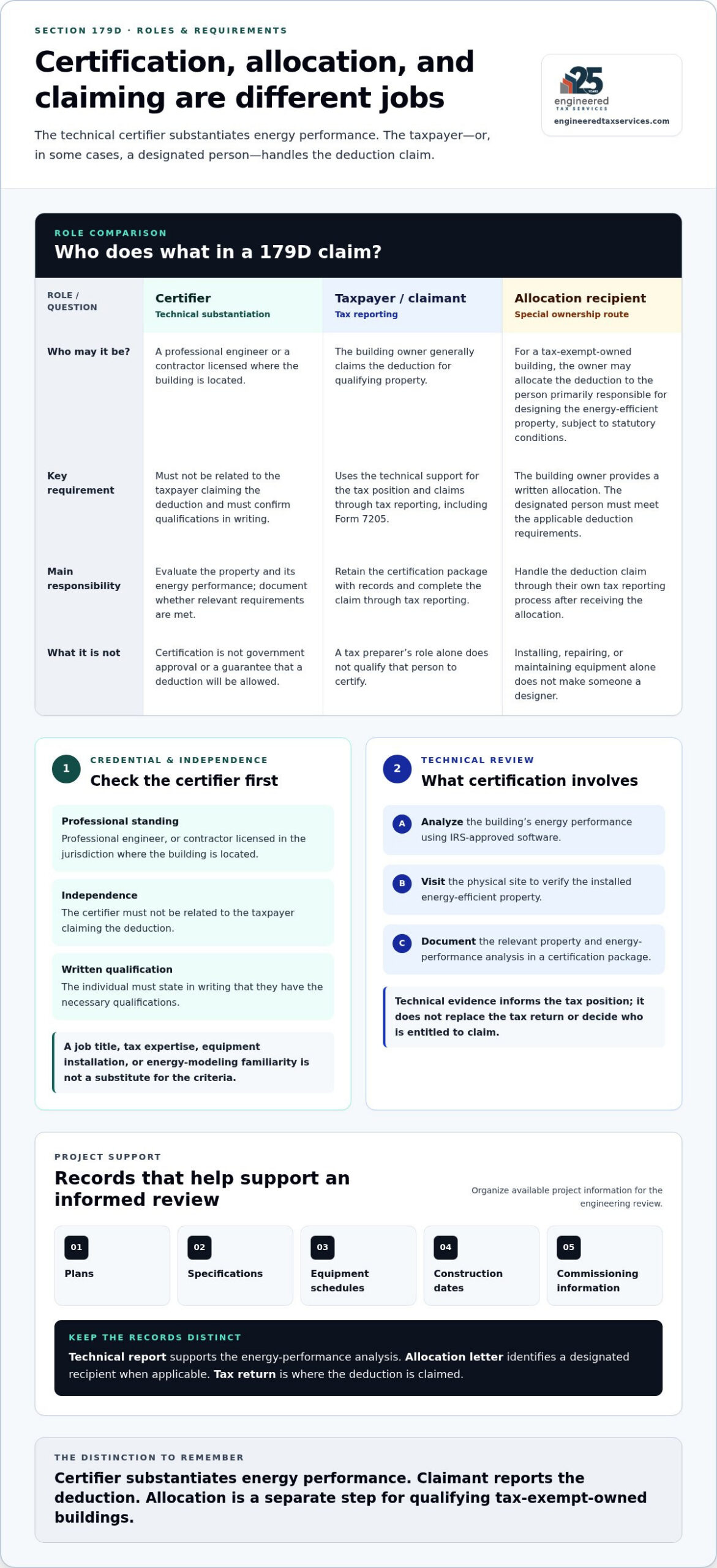
Could the person preparing your tax return also certify your 179D deduction? Not simply because they handle your taxes. To understand who can certify a 179D deduction, separate the technical energy analysis from tax reporting. The certifier must be a professional engineer or a contractor licensed where the building is located, must not be related to the taxpayer claiming the deduction, and must confirm their qualifications in writing.
That distinction matters. Certification is the technical substantiation behind a claim, not the deduction itself. It involves analyzing the building’s energy performance with IRS-approved software and conducting a physical site visit to verify the installed energy-efficient property. The taxpayer retains the certification package with their records and uses Form 7205 to claim the deduction.
This guide explains the credential and independence requirements, what the certification must establish, and how technical review differs from claiming the deduction or receiving an allocation. It also covers the project records that help support a defensible position and how an engineering-led review can coordinate with tax reporting.
Key Takeaways
- Use the credential and independence criteria to determine who can certify a 179D deduction, and distinguish the certifier’s technical role from the party claiming the deduction.
- Understand how the applicable analysis pathway shapes the energy-performance evidence and technical documentation needed for a project.
- Organize plans, specifications, equipment schedules, construction dates, and commissioning information to support an informed engineering review.
- For tax-exempt-owned buildings, learn how a written allocation can direct the deduction to the person primarily responsible for designing the energy-efficient property.
- Coordinate engineering analysis and tax reporting to build a more complete, well-substantiated claim.
Who can certify a 179D deduction, and what does certification mean?
Section 179D certification is a technical assessment that supports whether a building’s energy-efficient property meets the requirements relevant to a deduction claim. The certifier evaluates the property and its energy performance. The person or entity claiming the deduction may be someone else. This separation is central to understanding who can certify a 179D deduction and what the certification does, and does not, establish.
The qualified-individual criteria require the certifier to be a professional engineer or contractor licensed in the jurisdiction where the building is located. The individual must not be related to the taxpayer claiming the deduction and must state in writing that they have the necessary qualifications. These criteria address professional standing and independence. Preparing a tax return does not, on its own, qualify someone to certify. Neither does installing the equipment.
What does a 179D certification establish?
Certification supports a tax position by documenting whether the relevant property and energy-performance analysis meet the applicable Section 179D requirements. The technical work may involve evaluating qualifying building systems and substantiating energy savings through the required analysis. The certification package is supporting evidence for the taxpayer’s records, not government approval or a guarantee that a deduction will be allowed. A technical report, an allocation letter, and a tax return serve different purposes and should not be treated as interchangeable.
The deduction traces to the Energy Policy Act of 2005, but establishing a claim today requires project-specific technical support as well as appropriate tax reporting. Keep the roles clear: the certifier substantiates energy performance, while the taxpayer or eligible designee claims the deduction through tax reporting. Engineering evidence informs the tax position. It does not replace the return or determine who is entitled to claim.
Who claims the deduction after certification?
For qualifying property, the building owner generally claims the deduction. A separate route may apply when a tax-exempt entity, such as a government agency, nonprofit, or tribal government, owns the building. In that case, the owner may allocate the deduction to the person primarily responsible for designing the energy-efficient property, often an architect or engineer, subject to the statutory conditions. Installing, repairing, or maintaining equipment alone does not make someone a designer.
Allocation is a distinct administrative step, not part of the engineering certification. The building owner must provide a written allocation, and the designated person must meet the applicable requirements for the deduction. The recipient then handles the claim through their tax reporting process. For broader context on eligibility, timing, and project considerations, consult the 179D strategic guide. Keeping certification, allocation, and claim documentation organized helps each party understand their role and supports a coherent tax position.
Which credentials qualify someone to certify a 179D deduction?
The relevant credential is more specific than general experience with taxes or building energy systems. Under the current criteria, the qualified individual must be a professional engineer or a contractor licensed in the jurisdiction where the building is located. The individual also cannot be related to the taxpayer claiming the deduction and must state in writing that they have the necessary qualifications.
That written statement matters. A job title, firm affiliation, or familiarity with energy modeling is not a substitute for meeting the applicable criteria. To determine who can certify a 179D deduction, consider the individual’s license, independence from the claimant, and ability to support the project’s technical conclusions.
How do licensure and technical expertise affect eligibility?
The license must be relevant to the building’s jurisdiction. A professional engineer or licensed contractor working on a project across state lines should not assume that a license from another jurisdiction automatically meets the location-specific requirement. The certifier’s written qualification statement should match their actual credentials and role.
Technical capability is also important to the integrity of the analysis. A project may involve lighting, HVAC and hot-water equipment, or the building envelope. The supporting work needs to address the property and energy-performance requirements relevant to the claim. Engineers, contractors, and other technical staff may contribute project records or analysis, but the qualified individual who certifies must meet the criteria and stand behind the certification. An employee’s participation alone does not transfer their credentials to someone else or resolve who is responsible for the certification.
In short, certification requires a qualified, appropriately licensed and independent individual whose written qualifications and technical work fit the project. No credential automatically validates every building or analysis.
Can a CPA, tax attorney, or energy auditor certify the deduction?
Tax expertise can help with reporting and interpreting a tax position, but it does not replace the required engineering or contractor license. A CPA or tax attorney who does not meet the qualified-individual criteria can contribute to tax review, but tax credentials alone do not authorize technical certification. An energy audit may inform a project review, but it is not automatically a 179D certification. The document’s label does not determine whether the applicable technical requirements have been substantiated.
Evaluate credentials and responsibilities individually. An energy auditor, CPA, or attorney who also holds a qualifying engineering or contractor license may be assessed in that licensed capacity, provided the other criteria are met. Keep the technical certification distinct from the tax return and claim documentation. The IRS’s Form 7205 guidance addresses the return process, while the certifier’s work supports the technical record behind the position.
For an engineering-led review that coordinates building analysis and tax documentation, explore 179D engineering support from Engineered Tax Services.
How do 179D certification pathways shape the engineering analysis?
The certification pathway determines what the engineering analysis must demonstrate and which project records support its conclusions. Section 179D uses traditional energy modeling and an alternative measurement approach. These methods are not interchangeable shortcuts. The applicable rules and available pathway depend on the project and current guidance, so the analysis should identify its method and explain how the evidence supports it.
Both approaches relate to qualifying energy-efficient property, which may involve interior lighting, heating, cooling, ventilation, hot water, or the building envelope. The systems evaluated and the performance evidence required depend on the applicable pathway and project facts.
What does the traditional modeling pathway require?
Traditional modeling compares the building’s energy performance with a reference building under the applicable technical rules. IRS-approved software is used to model performance, and the analysis must apply the reference standard relevant to the project’s dates and circumstances. For example, the applicable ASHRAE reference may vary based on when construction began and when the property was placed in service. The model’s assumptions, inputs, and system details should be traceable to project records so the certifier can explain how the modeled results support the technical conclusions.
What does the alternative measurement pathway require?
A measurement-based approach centers on evidence tied to the building’s actual operation rather than relying solely on a modeled comparison. The evidence and calculation method must follow the pathway’s applicable guidance. Operating information or energy-use records alone do not establish compliance unless they are used in the prescribed analysis. A site visit and documentation of installed systems can help connect measured performance to the property being evaluated.
| Pathway | Primary evidence | Key project consideration |
|---|---|---|
| Traditional modeling | Energy model compared with an applicable reference building | Confirm modeling inputs, system scope, software, and reference standard fit the project. |
| Alternative measurement | Measured performance evidence analyzed under applicable guidance | Establish that relevant operating data and installed-system records support the prescribed method. |
The practical difference is the source of the performance case: a modeled comparison or measurement-based evidence. In either pathway, the certifier must connect the analysis to the building’s systems and documented facts. Organize plans, specifications, equipment information, and records of installed conditions before finalizing conclusions.
Timing also affects the review. Under current law, Section 179D is terminated for property whose construction begins after June 30, 2026. Projects that began on or before that date remain potentially eligible even if placed in service later. Evaluate construction-start documentation and any transition rules under the law and guidance applicable to the project. Early review helps engineering and tax teams align the pathway, evidence, and dates before preparing a claim.
How should owners and designers prepare for a 179D certification?
A well-organized project file helps keep the engineering analysis grounded in what was designed, installed, and placed in service. Use this sequence to align the building facts, technical review, and tax work.
- Define the project. Identify the building, the work being evaluated, the relevant project phases, and the property placed in service. If improvements occurred at different times, organize them separately rather than treating the entire building as one project.
- Identify the systems. Note which potentially qualifying systems are involved, such as interior lighting, HVAC and hot-water systems, or the building envelope. Connect each system to its related scope of work.
- Collect project records. Assemble drawings, specifications, equipment schedules, construction timelines, and commissioning information. Include records that help show installed conditions and relevant project dates.
- Assess the analysis pathway. Review the project facts and available records to determine the applicable technical approach. The pathway shapes the analysis and evidence the certification must support.
- Coordinate tax review. Align the technical findings with ownership, tax status, any allocation, and the return preparation process. Keep the project scope and dates consistent across workstreams.
Which project records help the certifier assess the building?
Useful records include design drawings, system specifications, equipment schedules, construction contracts or timelines, and commissioning information. Together, they help establish what was installed, how the systems relate to the project scope, and when work was completed or property was placed in service. If records are incomplete, the technical team may need further project-specific analysis. Missing documents do not, by themselves, establish that a project qualifies or fails to qualify.
Where possible, organize files by system and project phase. For example, make it easy to connect a lighting schedule to the drawings for the lighting work under review. A clear index also helps the certifier identify gaps early, rather than discovering them after the analysis is underway.
How should engineering and tax professionals coordinate?
Keep responsibilities distinct but connected. Engineering professionals evaluate building facts and prepare technical support. Tax professionals assess tax eligibility and reporting. Where relevant, the building owner handles allocation documentation. Return preparation should use the final project facts and supporting conclusions, not an earlier or inconsistent description of the work.
Ownership and tax status help determine who may claim and whether an allocation is relevant. For a tax-exempt-owned building, gather the owner’s written allocation documentation alongside the design records and identify the person responsible for the relevant design work. Keep this paperwork separate from the engineering analysis and tax return. A 179D claim is also distinct from depreciation strategies, which are addressed in this commercial real estate depreciation guide.
Early review can bring missing records and mismatched project dates to light while there is still time to clarify the file. Explore 179D engineering analysis to understand how a project-specific technical review can support coordinated documentation, or start organizing your 179D project review.
How can an engineering-led 179D study support a defensible claim?
A defensible tax position depends on more than identifying a potentially eligible building. The technical analysis must connect the project’s actual systems, history, and available evidence to the applicable Section 179D requirements. Engineered Tax Services (ETS) is an independent licensed engineering firm that conducts engineering-based tax studies, including studies involving 179D energy-efficient building deductions. Its role is to develop project-specific technical analysis and documentation that informs the taxpayer’s review and reporting process.
What should a project-specific engineering study deliver?
The study should make its reasoning traceable. It starts with an understanding of the building and project facts, then applies the relevant analysis to the systems and pathway under review. The scope may differ depending on whether the project involves lighting, HVAC and hot-water systems, or the building envelope, as well as the project’s history and available records.
A well-supported technical file can document the analysis performed, the information relied upon, and the conclusions reached. Plans, specifications, equipment details, project dates, and other relevant materials help connect the analysis to the property as built. If a project has phased construction or system upgrades, distinguishing those phases can clarify which facts and records relate to each part of the review.
The engineering conclusion supports the tax position. It does not make the taxpayer’s final filing decision or guarantee that a deduction will be allowed. The taxpayer and tax professionals remain responsible for evaluating eligibility and reporting the claim. Keeping those responsibilities distinct allows technical findings to inform tax review without treating a study as a filed return or automatic approval.
What is the next step for a potential 179D project?
Start by assembling the project file and identifying the building owner, relevant project stakeholders, and the systems under consideration. Include available plans, specifications, equipment schedules, construction and placed-in-service dates, and commissioning information. A clear record set gives the engineering review a stronger factual foundation and helps surface missing information early.
ETS conducts more than 10,000 tax studies annually and provides technical documentation and reporting for tax incentive studies. For a potential 179D project, an engineering-led process can organize the building facts, perform the applicable project analysis, document its conclusions, and coordinate the technical materials with the tax reporting workstream. The scope and conclusions are specific to the building and evidence reviewed.
This process can help owners and designers move from a general eligibility question to a structured technical review. To discuss a 179D engineering study, bring together the available project records and key stakeholders for a focused conversation about the analysis and documentation the project may require.
Set your 179D review in motion
The next step is not to guess who can certify a 179D deduction. Bring the project’s key people and records together early to clarify what needs technical review and how the findings will inform tax reporting. A shared project file helps owners, designers, engineers, and tax professionals work from consistent information as the analysis develops.
Start by identifying the building, the systems under consideration, the project timeline, and the stakeholders responsible for engineering and tax decisions. Use that information to shape a focused review of the project facts and documentation. This creates a deliberate path forward, whether you are evaluating a current project or organizing records for a past one.
Engineered Tax Services supports engineering-based tax studies with technical analysis, documentation, and reporting. Discuss a 179D engineering study with ETS to explore a project-specific next step and bring structure to your review. With the right information and coordination in place, you can approach the opportunity with clarity.
Frequently Asked Questions
Who is legally qualified to certify a 179D deduction?
A qualified certifier must be a professional engineer or contractor licensed in the jurisdiction where the building is located. The person cannot be related to the taxpayer claiming the deduction and must state in writing that they have the necessary qualifications. To assess who can certify a 179D deduction for a particular project, consider the individual’s license, independence, and role in the technical review, not just their job title or experience with energy-efficient buildings.
Can a CPA certify a 179D deduction?
A CPA’s tax credentials alone do not meet the technical certification criteria. A CPA may support tax eligibility analysis, reporting, or coordination with the engineering team, but those responsibilities are distinct from certifying energy performance. If the CPA also holds a qualifying professional engineer or contractor license, their credentials and independence must still meet the applicable requirements. Preparing a return that includes a 179D claim does not itself establish authority to certify the building analysis.
Can an energy auditor certify a 179D deduction?
An energy auditor can contribute useful building or energy-use information, but the title “energy auditor” alone does not establish that the person may certify a 179D deduction. The individual must meet the qualified-professional criteria, including the applicable license and independence requirements. An audit may also use a different scope or method than the required certification analysis. Before relying on audit materials, determine whether they support the specific technical pathway and project conclusions at issue.
Does the person who certifies a 179D deduction also claim it?
Not necessarily. Certification is the technical substantiation; the eligible taxpayer or, in certain cases, an allocated designer handles the tax claim. For an eligible building owned by a tax-exempt entity, the owner may allocate the deduction to the person primarily responsible for designing the energy-efficient property, subject to statutory conditions and written allocation documentation. The certifier may be a separate professional. Keep the technical report, allocation records, and tax filing organized as distinct documents.
What does a 179D certification need to include?
The certification should support the applicable technical conclusions with an analysis of the property and its energy performance. Under the relevant process, this includes energy modeling with IRS-approved software against the applicable reference building, plus a physical site visit to verify installed energy-efficient property. The certifier must also state in writing that they have the necessary qualifications. The taxpayer keeps the certification package with their records; it is not filed with the return.
Can a building owner certify their own 179D deduction?
Ownership alone does not qualify someone to certify. The certifier must meet the professional licensing criteria and be independent of the taxpayer claiming the deduction. An owner should not assume that they can self-certify when the certifier must not be related to the claimant. The owner can organize project records and coordinate the review, while a qualified, independent professional performs the certification.
Are the 179D certification rules changing in 2026?
The key 2026 timing issue is the deduction’s termination for property whose construction begins after June 30, 2026. Projects that began construction on or before that date may remain eligible even if placed in service later, subject to applicable requirements. This makes construction-start records important, including evidence relevant to the physical work test or the 5% cost test. Evaluate the rules and transition provisions that apply to the project before relying on a potential claim.
What documents should I prepare before a 179D certification?
Gather records that help establish the project scope, installed systems, and timeline. Useful materials include design drawings, specifications, equipment schedules, construction-start and placed-in-service dates, and commissioning information. For example, connect an equipment schedule to the drawings and project phase where those systems were installed. Also identify the building owner and any parties responsible for system design. Flag gaps early so the technical review can determine what further analysis may be needed.