Your highest tax bracket isn't an unavoidable cost of success; it's a strategic variable you can actively manage. For most high-earning professionals, watching a significant portion of your W-2 income vanish into federal taxes feels like an exercise in futility, especially when passive activity loss rules prevent you from using traditional real estate deductions to lower that bill. The short term rental tax loophole offers a legitimate, engineering-based path to change that narrative. By reclassifying rental activities from passive to active, you can leverage your property investments to shield your hard-earned professional income from the IRS.
We understand the frustration of seeing your wealth growth slowed by complex participation requirements and rigid tax codes. This guide will show you exactly how to legally reclassify rental losses to offset your professional earnings and maximize the 100% bonus depreciation restored for the 2026 tax year. We'll walk through the technical requirements of the 7-day rule, the specific tests for material participation, and how institutional-grade cost segregation studies provide the rigorous documentation needed to protect your wealth. You'll learn to move beyond simple compliance and toward a proactive strategy of financial optimization.
Key Takeaways
- Learn how to leverage the short term rental tax loophole to reclassify property losses as active deductions, shielding your high-bracket W-2 income from unnecessary tax liability.
- Understand the critical material participation requirements, specifically the 100-hour test, that allow you to bypass passive activity loss rules and unlock immediate tax relief.
- Capitalize on the 2026 restoration of 100% bonus depreciation to front-load your deductions and significantly increase your first-year cash flow.
- Discover why an engineering-based Cost Segregation study is the essential technical foundation for substantiating accelerated depreciation and protecting your wealth during an audit.
- Master the 7-day average stay rule to ensure your investment is classified as a business activity, providing a predictable and legal framework for long-term tax optimization.
Understanding the Short-Term Rental Tax Loophole and IRC Section 469
IRC Section 469 serves as a formidable barrier for most real estate investors. Under this code, the IRS presumes that all rental activities are passive by default. This classification creates a structural wall between your rental losses and your professional income. If you're a high-earning physician, attorney, or executive, your rental deductions are usually trapped on the wrong side of that wall. The short term rental tax loophole provides a legal breach in this barrier. It relies on a specific exception in the Treasury Regulations that removes certain short-term stays from the definition of rental activity altogether.
Unlike long-term residential rentals, this strategy doesn't require you to qualify for Real Estate Professional Status (REPS). That's a critical distinction for our clients. REPS requires 750 hours of service in real property trades, which is nearly impossible to document if you have a demanding full-time career. By focusing on the nature of the activity rather than your professional status, you unlock a powerful mechanism for wealth preservation. When your property is classified as an active business rather than a passive rental, the losses it generates can move freely across that tax wall to offset your W-2 or 1099 earnings.
Passive vs. Non-Passive Income: The $25,000 Trap
Standard tax rules offer a modest $25,000 allowance for rental losses, but it's a trap for high-net-worth individuals. As your income rises, this benefit vanishes. The phase-out begins at $100,000 of Modified Adjusted Gross Income (MAGI) and is completely eliminated once you cross the $150,000 threshold. For professionals in the 32% to 37% tax brackets, these losses become suspended, offering no immediate tax relief. The short term rental tax loophole bypasses these income limitations entirely. It transforms those suspended losses into active deductions that can be used to offset your highest-taxed earnings in the current tax year.
The 7-Day Rule: Why Average Stay Duration Matters
The pivot point for this entire strategy is the average duration of guest stays. To qualify, the average period of customer use must be seven days or less. When you meet this threshold, the IRS no longer views the property as a passive rental. Instead, it's treated as a business activity, similar to a hotel operation. This reclassification is the engine that allows you to apply accelerated depreciation against your active income. While providing extraordinary personal services can also trigger this reclassification, most investors rely on the 7-day rule because it's objective and easier to substantiate through booking records. Maintaining this average is the first step in converting a passive investment into a strategic tax-saving tool.
Material Participation: Proving You Are an Active Owner
Successfully navigating the 7-day rule is the technical foundation, but the IRS requires more than a short-term average to unlock the short term rental tax loophole. You must demonstrate material participation in the business. According to IRS Publication 925, there are seven distinct tests to establish this status. For most high-income professionals, three specific tests offer the clearest path to compliance. The most frequently utilized is the 100-hour test. Under this rule, you must spend at least 100 hours on the activity, and your participation must be more than any other single individual, including cleaners or property managers. If you manage a larger portfolio, the 500-hour test provides a safe harbor regardless of how much time others contribute. For those who handle every aspect of the property themselves, the “substantially all” test applies, requiring that your participation constitutes nearly all of the work performed.
What Counts as Participation Hours?
Not every hour spent on your investment counts toward these totals. The IRS distinguishes between “investor” tasks and operational management. Reviewing financial statements, organizing records, or analyzing potential new acquisitions are generally considered investor activities and are excluded. To meet the threshold, focus on active tasks. Valid activities include:
- Direct communication with guests and managing bookings.
- Onsite cleaning, maintenance, and hands-on repairs.
- Procurement of furniture, supplies, and equipment.
- Supervising and coordinating contractor work.
It's vital to track the hours of your contractors as well. If your cleaning crew spends 120 hours on the property and you only spend 105, you'll fail the 100-hour test. You can ensure your participation strategy is built on a solid foundation by consulting with a specialized tax strategy partner to review your operational structure.
Documentation and Contemporaneous Records
Audits often hinge on the quality of your evidence. Tax court history is littered with cases where investors lost their deductions because they relied on “ballpark estimates” or post-event reconstructions of their time. The IRS demands precision. A contemporaneous log is a record created at or near the time the work was performed, providing an immediate and accurate account of your participation. Use a digital log or a dedicated calendar app to record the date, duration, and specific nature of every task. This level of detail transforms a vulnerable claim into a defensible business position.
Maximizing the Loophole with Cost Segregation in 2026
If meeting material participation requirements provides the legal key to the short term rental tax loophole, cost segregation is the technical engine that drives the financial results. Without a detailed analysis of the property's components, most investors are forced to use a standard 39-year depreciation schedule. This slow-motion deduction rarely generates the substantial losses needed to offset a high W-2 income. By performing a study, we identify assets that can be reclassified into 5, 7, or 15-year recovery periods. This shift is explored in detail in our 2026 Guide to Commercial Real Estate Depreciation.
The true power of this strategy lies in the synergy between reclassified assets and bonus depreciation commercial property rules. While the reclassification alone accelerates your deductions, bonus depreciation allows you to take a significant portion of those costs immediately in the first year. This creates the massive “paper loss” necessary to shield your professional earnings from taxation.
The 2026 Bonus Depreciation Phase-Down
For the 2026 tax year, the bonus depreciation rate has decreased to 20% following the scheduled phase-down. This change represents a significant shift from the 100% or 80% rates seen in previous years. Because the immediate deduction percentage is lower, the precision of your data becomes paramount. You can't afford to leave money on the table through “table-based” or “residual” estimates. This environment makes a professional engineering based tax study more critical than ever. Detailed documentation ensures that every eligible asset, from specialized lighting to ornate cabinetry, is correctly identified to maximize that 20% immediate take and the accelerated schedules that follow.
Generating Large Front-Loaded Deductions
The goal of utilizing the short term rental tax loophole is to create a “paper loss” that exceeds your property's actual cash flow. This is a strategic accounting loss, not a functional one. Through cost segregation, we separate personal property and land improvements from the building's core structure. This typically includes:
- Personal Property (5 and 7-year): Furniture, appliances, and decorative finishes.
- Land Improvements (15-year): Landscaping, fences, and paved parking areas.
When these are front-loaded, they create a massive year-one deduction. This deduction is then applied against your W-2 earnings, effectively lowering your taxable income. While you continue to collect rental revenue and build equity, your tax return reflects a business loss that preserves your liquidity. This engineering-based approach transforms your investment into a sophisticated vehicle for wealth optimization and long-term stability.
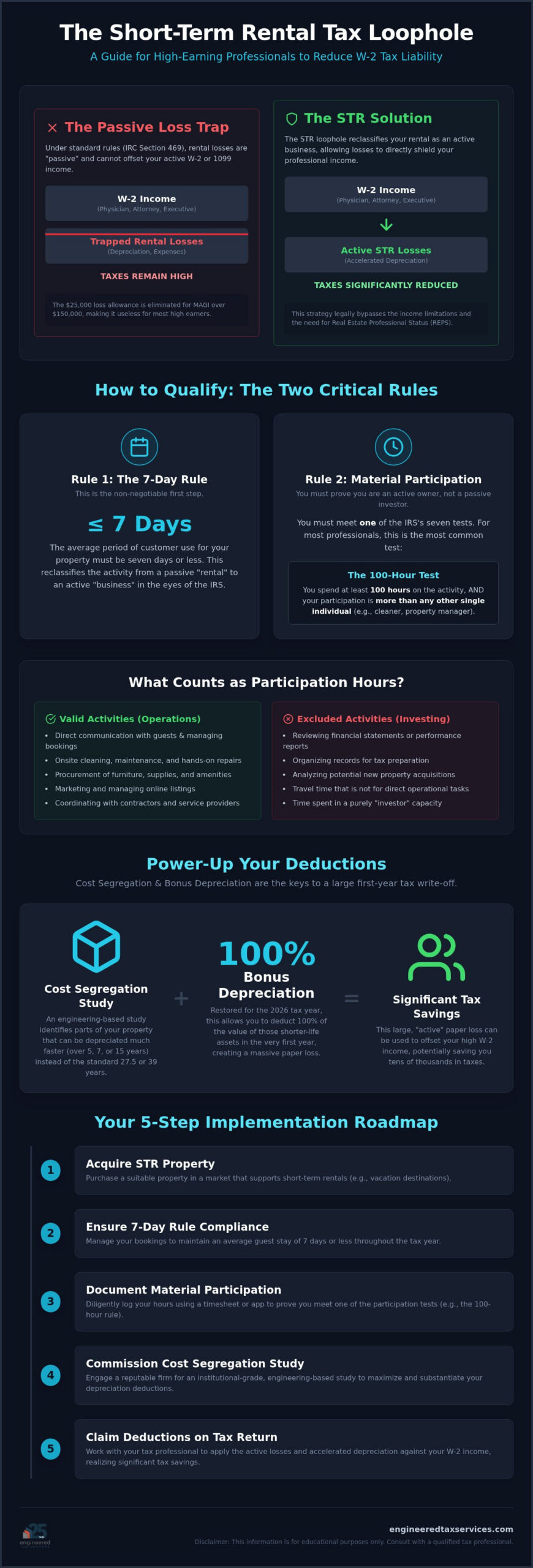
How to Implement the STR Loophole: A 5-Step Roadmap
Executing the short term rental tax loophole requires a disciplined, multi-phase approach that bridges the gap between real estate investment and technical tax engineering. It's not enough to simply list a property on a booking platform; you must build a defensible business structure from the moment of acquisition. This roadmap provides the professional framework necessary to convert passive losses into active deductions and protect your wealth from unnecessary tax erosion.
- Step 1: Acquire a property suitable for short-term occupancy (average stay <7 days). Select an asset where the market demand supports high turnover. Focus on properties with significant interior finishes, as these offer the highest reclassification potential.
- Step 2: Establish a system for tracking material participation hours from day one. Use a digital log to record every minute spent on property setup, guest communication, and management. Precision here is your best defense in an audit.
- Step 3: Engage a specialized engineering firm for a cost segregation study. A site-specific, engineering-based analysis is required to identify the 5, 7, and 15-year assets that generate your front-loaded deductions.
- Step 4: File Form 4562 to claim accelerated depreciation. This IRS form is the mechanism used to report the results of your study and apply the resulting “paper loss” against your W-2 earnings.
- Step 5: Maintain a permanent audit file with engineering reports and hour logs. Keep all booking records, contemporaneous logs, and technical reports in a secure, centralized location for at least seven years.
Acquisition and Setup Phase
Success begins with property selection. Look for assets with high personal property value, such as luxury furniture packages, high-end appliances, or extensive outdoor amenities. These items are the primary drivers of first-year tax savings. You must also ensure the property is “placed in service” before the end of the tax year. In IRS terms, this means the property is ready and available for rent, even if the first guest hasn't arrived yet. Utilizing advanced booking software is essential to strictly monitor and manage the average stay duration, ensuring you don't inadvertently drift into a “passive” classification by allowing longer stays.
Reporting and Compliance Phase
When it's time to report your activity, the choice of forms is critical. While some investors use Schedule C, this can often trigger unnecessary self-employment taxes. Most sophisticated investors prefer reporting on Schedule E, marking the activity as non-passive to allow the losses to flow against professional income. Reporting on Schedule E with a non-passive designation effectively signals that the property meets the 7-day rule and material participation requirements without exposing you to the self-employment tax burden associated with standard business operations. To ensure your implementation meets these rigorous standards, you can consult with our engineering team to substantiate your first-year deductions.
Defending the Loophole: Why Engineering-Based Studies Matter
The short term rental tax loophole is a highly effective strategy for high-net-worth investors, but its strength depends entirely on the quality of your technical documentation. While the 7-day rule and material participation tests provide the legal framework, the dollar value of your deduction is determined by your cost segregation study. Many investors fall into the trap of using “residual” or “table-based” studies. These are often automated software estimates that lack a physical basis in your specific property. In contrast, an engineering-based study involves a licensed professional reviewing technical blueprints and conducting detailed onsite inspections to identify every eligible asset.
The IRS maintains a high standard for these reports. Because we are a licensed engineering firm that performs 10,000+ tax studies annually, we provide the institutional-grade “proof” required to substantiate accelerated depreciation claims. Using “loophole” strategies without this level of precision creates significant exposure. If an audit occurs, the IRS expects to see a report that bridges the gap between tax law and the physical reality of the building's construction. A generic estimate won't stand up to scrutiny, but a report grounded in engineering standards provides the security you need to grow your wealth with confidence. Working with a specialized tax engineering firm that combines engineering precision with deep tax knowledge is the difference between simple compliance and aggressive, legal wealth preservation.
The IRS Cost Segregation Audit Techniques Guide
The IRS provides a specific roadmap for its agents known as the Audit Techniques Guide. This document outlines exactly what constitutes a high-quality study. It emphasizes that “estimated” figures are the primary cause of disallowed deductions. When an investor cannot prove the specific cost of a 5-year asset through technical analysis, the IRS often reclassifies that asset back to a 39-year recovery period. This results in lost deductions and potential penalties. Our methodology follows these federal standards to ensure that every reclassified asset is backed by a rigorous, defensible data set. This technical precision is what allows our clients to maintain their tax positions even under the most intense scrutiny.
Securing Your Wealth Strategy
A successful tax strategy isn't just about the current year's savings; it's about building a defensible long-term position. Relying on software-based “residual” studies might seem convenient, but it leaves your wealth vulnerable. By choosing a strategic partner that combines engineering expertise with deep tax knowledge, you ensure that your deductions are both maximized and protected. We act as an advocate for your financial health, providing the seasoned mentorship and technical reports necessary to bridge the gap between different professional disciplines. Now is the time to optimize your short-term rental strategy with ETS and secure your path toward long-term financial efficiency.
Take Control of Your 2026 Wealth Strategy
Successfully navigating the short term rental tax loophole requires more than just buying property; it demands a precise intersection of tax law and engineering expertise. By mastering the 7-day rule and material participation requirements, you've already taken the first step toward transforming passive losses into active deductions. Now, the focus shifts to substantiating those claims with institutional-grade data. Accuracy is your greatest defense.
As a licensed engineering firm with a legacy of performing 10,000+ studies annually, Engineered Tax Services provides the technical precision needed to defend your deductions. We don't just provide reports. We offer comprehensive IRS audit defense support to ensure your wealth remains protected. Don't let the 2026 bonus depreciation phase-down to 20% diminish your potential for growth. Instead, leverage our specialized methodologies to maximize your first-year cash flow and secure your financial future.
Schedule a Cost Segregation Consultation with Engineered Tax Services to optimize your portfolio today. You've built your wealth through professional excellence; let us help you preserve it through strategic tax optimization.
Frequently Asked Questions
Can I use the STR loophole if I have a full-time W-2 job?
If your average guest stay exceeds seven days, the IRS generally reclassifies the activity as a passive rental. In this scenario, you lose the ability to offset your active professional income unless you qualify as a Real Estate Professional. It's critical to monitor your booking software closely throughout the year. Maintaining an average stay of seven days or less is the technical pivot point for this entire wealth strategy.
Is a cost segregation study worth it for a single short-term rental?
Yes, provided the property's value and potential tax savings outweigh the cost of the analysis. For high-income earners in the 37% bracket, even one $500,000 property can yield significant year-one deductions through reclassification. By front-loading depreciation on furniture and land improvements, you create a substantial “paper loss.” This immediate cash flow benefit often provides a high return on investment for an engineering-based study in high-tax environments.
Do I need to be a Real Estate Professional to use the STR loophole?
No, you don't need Real Estate Professional Status (REPS) to benefit from this strategy. The 7-day rule specifically excludes the property from the statutory definition of a rental activity. Because the IRS treats it as a business rather than a rental, the REPS requirement is bypassed. You only need to prove material participation to ensure the business activity is considered non-passive, allowing you to shield your professional income.
Can I claim bonus depreciation on a used short-term rental property in 2026?
Yes, you can claim bonus depreciation on used property acquired and placed in service during 2026. Under current law, the bonus depreciation rate for 2026 is 20%. This applies to both new and used assets identified through a Cost Segregation study, such as 5-year personal property and 15-year land improvements. While the rate is lower than in previous years, it still provides a valuable front-loaded deduction to offset your active earnings.
What is the difference between material participation and active participation?
Material participation is a much more rigorous standard than active participation. Active participation only requires making basic management decisions and allows for a limited $25,000 deduction that phases out as income rises. Material participation requires regular, continuous, and substantial involvement, usually measured by specific hour tests. To successfully utilize the short term rental tax loophole against high professional earnings, you must meet the more demanding material participation standards.
How many hours do I need to track for the short-term rental tax loophole?
Most investors aim for the 100-hour test. You must spend at least 100 hours on the activity and more than any other single individual, such as a cleaner or manager. Alternatively, you can meet the 500-hour test, which qualifies you regardless of others' participation. Tracking every minute spent on guest communication, maintenance, and procurement is essential. These logs provide the contemporaneous evidence required by the IRS to substantiate your involvement.
Can I deduct losses if I use the property personally for vacation?
You can, but your personal use must stay within strict limits. The IRS allows you to use the property for the greater of 14 days or 10% of the total days it's rented to guests. If you exceed this limit, the property is classified as a residence rather than a business. This reclassification prevents you from deducting losses in excess of your rental income, effectively neutralizing the tax benefits for that year.