Is the 20% bonus depreciation rate a signal to pull back, or an invitation to get more precise with your tax strategy? As we enter 2026, the significant tax shields provided by the Tax Cuts and Jobs Act have reached their final phase-down stage. You've likely felt the pressure of reduced immediate cash flow as the deduction for bonus depreciation commercial property assets dropped from its previous heights. It's frustrating to watch a reliable incentive diminish, especially when you're focused on maximizing the internal rate of return on every square foot of your portfolio.
We understand that managing these shifting regulations requires more than just compliance; it demands a proactive partnership focused on wealth preservation. This guide will show you how to optimize your tax position even as the bonus rate hits its lowest point. You'll discover why engineering-based cost segregation has transitioned from a luxury to a necessity for serious investors. We'll break down the 2026 tax landscape, explain the mechanics of reclassifying assets into shorter recovery periods, and demonstrate how technical precision can recover the value left behind by the phase-out schedule.
Key Takeaways
- Understand how the 2026 phase-down to 20% affects your immediate tax liability and overall cash flow strategy.
- Learn why a professional cost segregation study is the essential engine for maximizing bonus depreciation commercial property benefits.
- Explore the “Look-Back” strategy to capture unclaimed depreciation from years when rates were as high as 100%.
- Realize the long-term ROI of reclassifying assets into shorter recovery periods, regardless of the current bonus depreciation percentage.
- Discover how engineering-based documentation provides the necessary technical precision to defend your accelerated depreciation claims.
The 2026 Bonus Depreciation Landscape: Understanding the 20% Phase-Down
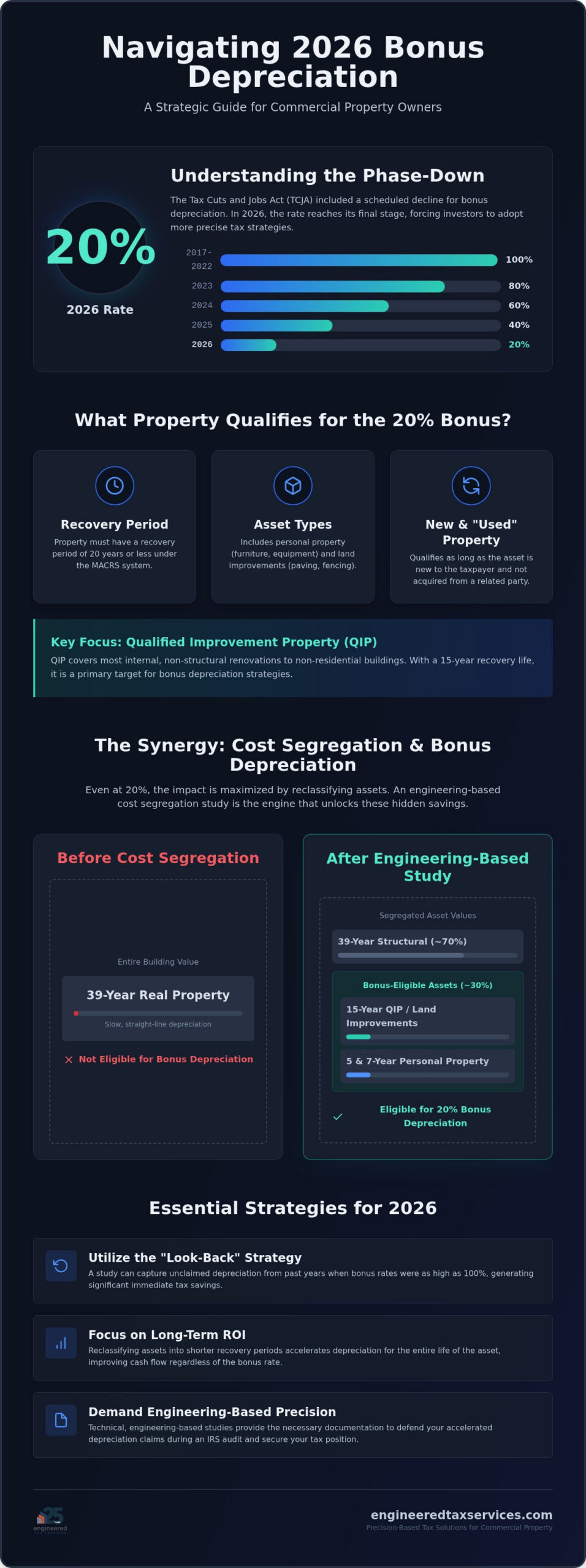
Under Section 168(k) of the Internal Revenue Code, bonus depreciation serves as a powerful mechanism for businesses to accelerate the recovery of capital investments. It allows for an immediate deduction of a significant percentage of an asset's cost in the first year it's utilized. However, the environment for bonus depreciation commercial property has shifted. In 2026, the allowable deduction has officially reached the 20% mark. This isn't just a minor adjustment; it represents the final stage of a scheduled decline that forces property owners to be far more strategic with their documentation and timing.
The “placed-in-service” date remains the most critical factor for qualifying for this 20% rate. For an asset to be eligible, it must be ready and available for its specific use within the 2026 calendar year. Simply signing a purchase agreement or taking delivery isn't enough. If a renovation or equipment installation isn't fully operational by December 31, you risk losing the 2026 incentive entirely. This deadline creates a narrow window for investors to finalize projects and secure their remaining tax benefits.
The History of the TCJA Phase-Out
The Tax Cuts and Jobs Act (TCJA) of 2017 launched an era of aggressive tax savings by setting the bonus rate at 100% for several years. This was designed to stimulate immediate economic growth by rewarding businesses that reinvested their capital. We saw the peak of this benefit from 2017 through 2022, but the legislation included a mandatory phase-out schedule. The rate dropped to 80% in 2023 and has continued its 20% annual descent ever since. While there's often talk of a legislative “tax fix” to restore higher percentages, no such change has been codified for 2026. We must plan based on the law as it stands, treating the 20% rate as the current reality for all eligible acquisitions.
What Qualifies as Bonus-Eligible Property in 2026?
Not every asset qualifies for accelerated treatment. To be eligible for the 20% deduction, the property must generally have a recovery period of 20 years or less under the Modified Accelerated Cost Recovery System (MACRS). This category includes personal property, such as furniture and specialized equipment, along with certain land improvements like paving or fencing. Under TCJA rules, both new and “used” property can qualify, provided the asset is new to the taxpayer and not acquired from a related party. Additionally, Qualified Improvement Property (QIP)—which covers most internal renovations to non-residential buildings—remains a primary target for bonus depreciation commercial property strategies because it carries a 15-year recovery life.
Maximizing Deductions: The Synergy of Cost Segregation and Bonus Depreciation
While the headline rate for bonus depreciation commercial property has tapered to 20%, its impact is only as strong as the underlying asset classification. On its own, a commercial building is typically depreciated over a grueling 39-year period, a timeline that disqualifies the structure from bonus eligibility. Cost segregation serves as the essential engine that identifies and pulls out assets with shorter recovery periods. By conducting detailed Cost Segregation Studies, we can isolate 5, 7, and 15-year personal property and land improvements that are legally entitled to accelerated treatment.
The math remains compelling for the 2026 tax year. If you reclassify $1 million of assets into a 5-year category, you aren't just getting a 20% immediate deduction. You're also applying standard MACRS rates to the remaining 80% of that value. This combination creates a front-loaded tax shield that far outpaces the slow trickle of straight-line depreciation. Engineering-based tax studies are vital here because they provide the technical documentation required to defend these classifications during an audit. This precision ensures that every available dollar is working toward your liquidity goals.
Reclassifying 39-Year Real Property
A building isn't just a single unit of real property; it's a complex assembly of mechanical, electrical, and plumbing (MEP) systems working in tandem. While structural components like walls and roofs must remain on the 39-year schedule, specialty equipment, such as dedicated power for a server room or decorative lighting, can often be moved to a 5-year schedule. Cost segregation identifies specific building components that qualify for the 20% bonus by separating personal property and land improvements from the permanent building structure. This technical breakdown allows investors to treat components as individual assets rather than a monolithic structure.
The Impact on Net Present Value (NPV)
The primary goal of this strategy is the optimization of net present value. By front-loading deductions, you increase immediate cash flow, allowing you to reinvest that capital back into your portfolio or operations. When you compare a 20% bonus plus standard MACRS to the traditional 39-year approach, the difference in first-year liquidity is stark. This is why cost segregation commercial property remains a top-tier strategy despite the phase-down. It's about the time value of money; a dollar saved in taxes today is worth significantly more than a dollar saved decades from now. If you want to see how these numbers apply to your specific assets, you can request a preliminary analysis to quantify your potential savings.
Strategic Planning for 2026: Timing and Acquisition Trends
As we move through 2026, the window to capture a 20% deduction is closing. This phase-down creates a unique sense of urgency for investors who want to squeeze every drop of utility from the current tax code. Smart planning right now involves more than just looking at this year's purchases. It requires a comprehensive review of your entire portfolio to identify missed opportunities from previous years when rates were significantly higher. Many property owners don't realize they can still access the 100% or 60% bonus rates from prior years through a “Look-Back” study. By filing a Form 3115, Change in Accounting Method, you can claim “catch-up” depreciation in a single year without amending past returns. This strategy effectively turns previous oversights into immediate 2026 liquidity.
We're also seeing a trend where savvy investors are accelerating 2027 projects into the current year. If a major equipment upgrade or parking lot resurfacing is slated for early next year, moving that “placed-in-service” date into 2026 secures the 20% bonus depreciation commercial property incentive before it potentially sunsets to zero. Additionally, it's vital to coordinate the use of Section 179 expensing alongside Section 168(k). While Section 179 allows for 100% expensing of certain assets up to a specific dollar limit, bonus depreciation is often the better tool for larger-scale commercial projects because it doesn't carry the same restrictive caps on total investment. High-earning professionals who also hold rental properties should explore the short term rental tax loophole as a complementary strategy for offsetting W-2 income through accelerated depreciation.
Acquisition Strategies in a Sunset Environment
Successful acquisitions in 2026 start long before the closing table. Performing a preliminary cost segregation analysis during the due diligence phase allows you to model the exact tax impact of the purchase. This data is invaluable when negotiating purchase price allocations. If you can legally shift more of the purchase price toward 5-year personal property or 15-year land improvements, you maximize the base that the 20% bonus applies to. Even at this lower percentage, the return on investment for a professional study remains high because the foundational reclassification into shorter MACRS lives provides a permanent deferral benefit that lasts long after the bonus period ends.
Renovations and Qualified Improvement Property (QIP)
For commercial landlords, Qualified Improvement Property (QIP) remains a primary driver of tax efficiency. QIP covers most internal, non-structural improvements made to a building that is already in service. Because these assets are assigned a 15-year recovery period, they are fully eligible for the 20% bonus depreciation commercial property rate. However, timing is everything. You must be wary of the “mid-quarter convention.” If more than 40% of your total depreciable property for the year is placed in service during the fourth quarter, the IRS requires you to use a mid-quarter calculation. This can inadvertently slash your first-year deductions, making early-year project completion a strategic priority for 2026.
Addressing the Objection: Is a Study Worth It at 20% Bonus?
Some investors mistakenly believe that the decline in bonus depreciation commercial property rates diminishes the value of cost segregation. This perspective ignores the fundamental mechanics of tax law. While the 20% bonus is a significant first-year incentive, it's merely an acceleration of a benefit that cost segregation already provides. The core value lies in the permanent reclassification of assets, not just the “cherry on top” provided by Section 168(k). Even if bonus depreciation were to sunset completely, the ability to move an asset from a 39-year life to a 5-year life remains one of the most potent wealth-building tools in real estate.
Beyond immediate deductions, a professional engineering report facilitates Partial Asset Disposition (PAD). This allows you to write off the remaining book value of building components when they're replaced during a renovation. Without a detailed study, you'd likely continue depreciating a demolished roof or an old HVAC unit for decades. Furthermore, these reports provide a granular breakdown of assets that can lead to lower property tax assessments and more accurate insurance premiums. By identifying personal property separately from the real property structure, you ensure you aren't overpaying on non-depreciable land or structural components.
The Value of Five-Year Property
The math behind the time value of money is undeniable. Consider $1 million in assets. Under a standard 39-year straight-line method, your annual deduction is roughly $25,641. By reclassifying that same $1 million into 5-year property, your first-year deduction, including the 20% bonus and standard MACRS, is exponentially higher. This front-loading of deductions creates a massive tax shield that you can reinvest immediately. Understanding these depreciation strategies for commercial real estate is essential for maintaining a competitive edge in a high-interest-rate environment where cash flow is king.
Audit Protection and Technical Substantiation
Relying on “rule of thumb” allocations or simple percentage-based guesses is a recipe for disaster during an IRS inquiry. The IRS specifically looks for engineering-based tax study methodologies that use recognized cost-estimating guides and physical site inspections. As a licensed engineering firm, we provide the independent technical documentation necessary to substantiate every claim on your return. This level of precision is what differentiates a standard tax filing from a strategic wealth preservation plan. If you're concerned about the viability of a study for your portfolio, you should consult with our engineering team to evaluate your specific asset mix and projected ROI.
Securing Your 2026 Tax Strategy with Engineered Tax Services
Managing the 20% phase-down requires a partner that understands the technical composition of your building. At Engineered Tax Services (ETS), we operate at the intersection of engineering and tax law. We perform over 10,000 studies annually, providing us with an extensive database of benchmarks and technical insights that standard accounting firms simply can't match. This experience is vital when defending bonus depreciation commercial property claims; it allows us to apply rigorous standards to every asset reclassification. We don't just look at the numbers. We examine the blueprints, the systems, and the physical reality of your property to ensure no value is left on the table.
Our methodology is designed to be proactive rather than reactive. By engaging with our team early in the acquisition or renovation process, you can model different tax outcomes and make data-driven decisions that impact your bottom line. We bridge the gap between different professional disciplines, acting as a seasoned mentor for investors who demand financial efficiency and long-term stability. This institutional knowledge is your greatest asset in a year where every percentage point of depreciation matters for your cash flow.
A Holistic Approach to Tax Optimization
A building's tax efficiency isn't limited to depreciation alone. We look at the entire lifecycle of your investment to unlock hidden potential. This includes identifying federal and state grants, R&D tax credits for innovative construction methods, and energy-related incentives. For instance, the 179D energy efficient commercial building deduction can provide significant per-square-foot savings that complement your cost segregation results. We also coordinate with 45L tax credits for residential or mixed-use projects. If you're looking to transition assets, our 1031 exchange services ensure that your hard-earned capital remains preserved as you move into new opportunities.
The ETS Difference: Precision and Peace of Mind
Precision is the only true defense against IRS scrutiny. As a licensed engineering firm, we don't rely on simple estimates; we use technical documentation to substantiate every deduction. This commitment to accuracy ensures that while we maximize your ROI, we never compromise on professional integrity. In 2026, the margin for error is smaller than ever. You need a partner that acts as a proactive advocate for your financial health. We've built our reputation on being the “expert's expert,” providing the independent technical documentation required for robust IRS substantiation. Contact Engineered Tax Services today for a 2026 strategy session. We'll perform a no-cost preliminary analysis of your acquisitions to quantify the exact bonus depreciation commercial property benefits you can expect before you commit to a full study.
Secure Your Financial Future Amidst the Sunset
The 20% rate in 2026 isn't a barrier; it's a prompt for greater precision. While the TCJA incentives are tapering, the underlying value of reclassifying assets remains a cornerstone of sophisticated real estate investment. By leveraging look-back studies and accelerating current projects, you can still capture substantial tax shields that others might overlook. Navigating the complexities of bonus depreciation commercial property requires more than just standard accounting. It demands the technical expertise of a partner who can bridge the gap between engineering and tax law.
Whether you're acquiring new assets or optimizing an existing portfolio, the time value of money dictates that a dollar saved today is far more valuable than one recovered over 39 years. As a licensed engineering firm with over 20 years of expertise, we perform more than 10,000 successful tax studies annually. We provide the IRS-defensible documentation you need to move forward with confidence. Maximize your 2026 cash flow with a specialized cost segregation study from Engineered Tax Services. Your path to optimized growth and long-term stability starts with a single strategic decision.
Frequently Asked Questions
What is the bonus depreciation rate for commercial property in 2026?
The bonus depreciation rate for assets placed in service during the 2026 tax year is exactly 20%. This follows the scheduled phase-down established by the Tax Cuts and Jobs Act of 2017. While the rate was 100% just a few years ago, the current 20% incentive still provides a meaningful first-year tax shield. It's essential to ensure your property is fully operational by December 31 to secure this specific percentage before it potentially drops to zero.
Can I still use 100% bonus depreciation in 2026 through a look-back study?
You can absolutely capture the 100% rate in 2026, but only for properties acquired between September 2017 and December 2022. By performing a look-back study, we identify missed depreciation from those high-percentage years. You can then claim the entire catch-up amount on your current return using a Change in Accounting Method. This strategy allows you to inject significant liquidity into your business without the need to amend previous years' tax filings.
Does bonus depreciation apply to used commercial buildings purchased in 2026?
Yes, bonus depreciation applies to used assets under current TCJA rules. When you acquire a bonus depreciation commercial property in 2026, the components with a recovery life of 20 years or less qualify for the 20% deduction. The key requirement is that the property must be new to you and not purchased from a related entity. Cost segregation is necessary to separate these used personal property components from the 39-year building structure.
How does cost segregation interact with the 20% bonus depreciation rate?
Cost segregation acts as the essential engine for bonus eligibility. Standard commercial buildings are depreciated over 39 years, which doesn't qualify for bonus treatment. A professional study breaks the building down into its component parts, identifying assets like specialized electrical systems or land improvements. By reclassifying these into 5, 7, or 15-year recovery periods, they become eligible for the 20% bonus. This synergy ensures you maximize immediate deductions and improve your overall internal rate of return.
Is Section 179 a better alternative than bonus depreciation in 2026?
Section 179 and bonus depreciation serve different strategic purposes. Section 179 allows for 100% expensing but is capped at a specific dollar limit and phases out as your total investment increases. For smaller equipment purchases, it's often superior. However, for large commercial real estate acquisitions, bonus depreciation is usually the primary tool because it has no investment ceiling. We often combine both methods to create a customized tax strategy that fits your specific portfolio size.
What happens if bonus depreciation is not extended beyond 2026?
If the current phase-out continues, the bonus rate will drop to 0% starting in 2027. While the immediate first-year bonus disappears, cost segregation remains a critical wealth-preservation tool. Moving assets from a 39-year life to a 5 or 15-year life provides a permanent deferral benefit that significantly outpaces straight-line depreciation. You'll still enjoy faster cost recovery and improved cash flow, even without the additional first-year incentive provided by the TCJA.
Can I claim bonus depreciation on a commercial property renovation?
Most internal renovations qualify as Qualified Improvement Property (QIP), which is eligible for the 20% bonus depreciation commercial property rate in 2026. This includes upgrades to lighting, flooring, and interior partitions. To qualify, the building must already be in service, and the improvements cannot involve structural expansions or elevators. QIP is assigned a 15-year MACRS life, making it a prime candidate for accelerated depreciation and immediate cash flow gains during a renovation cycle.
Why do I need an engineering firm for a cost segregation study?
The IRS specifically recommends an engineering-based approach for cost segregation to ensure accuracy and compliance. Licensed engineering firms like ours use physical site inspections and technical cost-estimating guides to substantiate every asset classification. This level of detail is far more defensible during an audit than simple accounting estimates. By providing independent technical documentation, we protect your claims and ensure you're maximizing your ROI while adhering to the highest professional and legal standards.