Most businesses treat depreciation as a passive year-end accounting entry, but in 2026, it has evolved into your most powerful interest-free loan from the federal government. While 31% of business owners currently cite cash flow as their primary challenge, the most strategic investors are utilizing accelerated depreciation to improve cash flow by front-loading deductions that were once locked away for decades. It's natural to feel a sense of hesitation given the legislative shifts of the One Big Beautiful Bill Act, or to worry about the audit risks often associated with aggressive tax positions that lack proper technical documentation.
You shouldn't have to choose between tax compliance and the capital you need for reinvestment. This guide provides a comprehensive framework for using engineering-based tax studies to unlock immediate liquidity within your business or real estate portfolio. We'll examine the technical differences between standard accounting methods and specialized engineering strategies, explain the permanent 100% bonus depreciation rules, and show you how to combine various incentives for a compounded financial impact. By the end of this article, you'll have the clarity needed to turn your tax burden into a strategic asset for long-term growth.
Key Takeaways
- Understand how to utilize accelerated depreciation to improve cash flow by front-loading tax deductions and maximizing the time value of money.
- Discover why a licensed engineering-based cost segregation study is essential for reclassifying building components and ensuring IRS technical substantiation.
- Learn to navigate the 2026 tax landscape, including the permanent 100% bonus depreciation and its strategic interplay with Section 179 expensing.
- Identify opportunities for “incentive stacking” by combining depreciation with 179D energy deductions and R&D tax credits for maximum liquidity.
- Gain a clear roadmap for integrating engineered tax strategies into your existing financial planning through collaboration between your CPA and specialized technical experts.
Understanding the Strategic Impact of Accelerated Depreciation on Cash Flow
Accelerated depreciation is a sophisticated tax strategy that allows owners to front-load tax deductions into the early years of asset ownership. Rather than spreading the cost of an asset evenly over its lifespan, this method recognizes higher expenses upfront. It's a fundamental shift from passive accounting to proactive wealth management. By using accelerated depreciation to improve cash flow, businesses can significantly reduce their current tax liability, effectively creating a pool of capital that would otherwise be sent to the IRS.
The core of this strategy lies in the “time value of money” concept. A dollar saved in taxes today is inherently more valuable than a dollar saved ten years from now. This is because today's dollar can be reinvested into operations, used to pay down high-interest debt, or applied toward new acquisitions that generate their own returns. While the total amount of depreciation remains unchanged over the life of the asset, the timing of those deductions creates a massive liquidity advantage. This timing difference acts as an interest-free loan from the IRS, providing businesses with immediate liquidity that fuels growth without the burden of traditional financing costs.
The Non-Cash Expense that Generates Real Capital
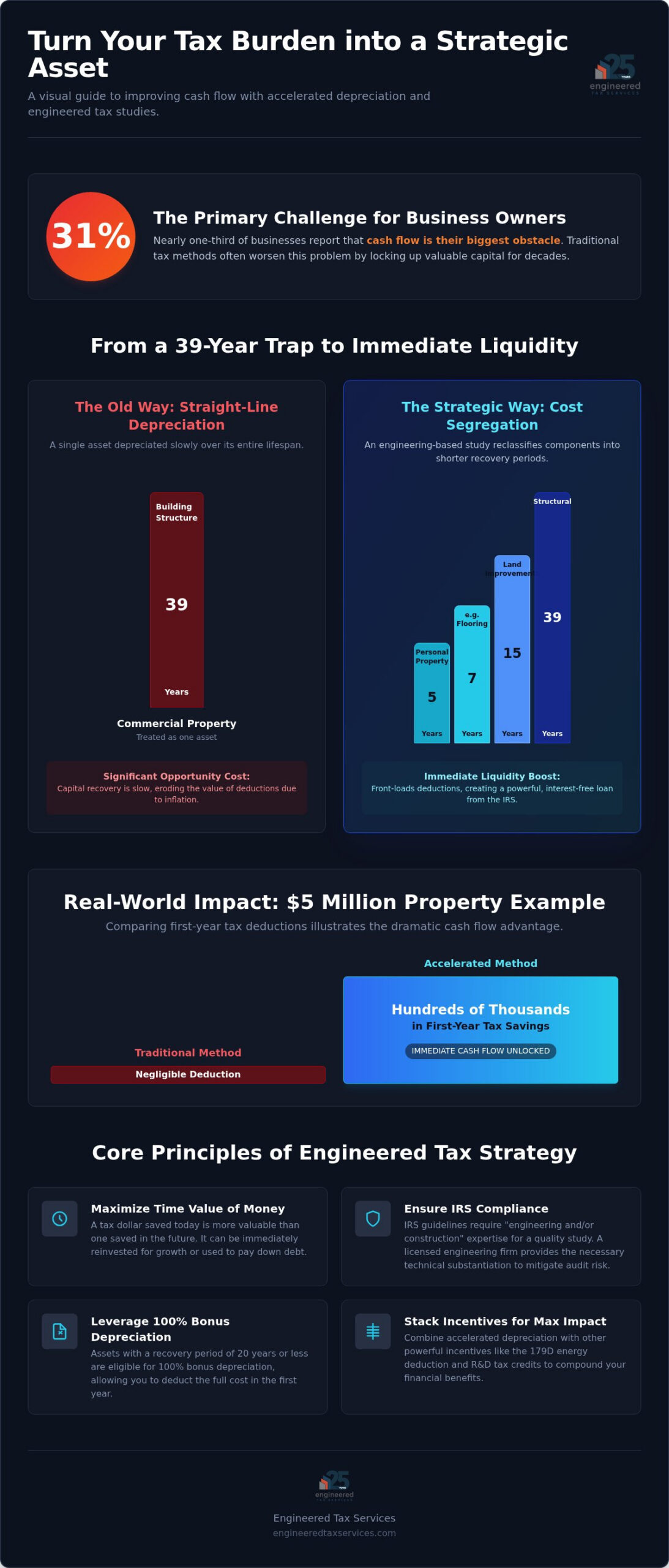
Depreciation is unique because it's a non-cash expense. It reduces your taxable income on paper without requiring an actual cash outlay. This creates a direct disconnect between your accounting profit and your bank balance. By maximizing these deductions, you lower your tax payments, which increases your distributable cash flow. It's vital to distinguish between book depreciation, used for financial reporting, and tax depreciation, used for strategic planning. For instance, consider a $5 million commercial property acquisition. Under traditional methods, the first-year deduction might be negligible. However, through an engineered study, a significant portion of that purchase price can be reclassified, potentially yielding hundreds of thousands of dollars in immediate tax savings that can be put back to work in your portfolio.
Why Traditional Straight-Line Depreciation Leaves Money on the Table
Standard accounting often defaults to the straight-line method, which forces residential properties into a 27.5-year recovery period and commercial buildings into a 39-year trap. This slow recovery is a significant opportunity cost. In a high-inflation or high-interest environment, waiting nearly four decades to recover your capital is a losing strategy. The value of those future deductions is eroded by inflation every year. Implementing a strategy for cost segregation commercial property is the proven solution to this trap. It breaks the building down into individual components, such as specialized lighting, flooring, and HVAC systems, allowing you to move assets from 39-year recovery periods into 5, 7, or 15-year buckets. This technical precision ensures you aren't leaving your own capital sitting idle on the IRS balance sheet.
The Engineering-Based Approach: How Cost Segregation Unlocks Value
While many investors view tax planning as a purely financial exercise, the most effective use of accelerated depreciation to improve cash flow is actually rooted in engineering. Cost segregation is the technical process of identifying and reclassifying building components into shorter depreciation cycles. Rather than treating a commercial property as a single 39-year asset, an engineering-based study dissects the structure into its constituent parts. This level of detail is necessary because a standard CPA typically lacks the architectural and construction expertise to distinguish between structural components and personal property. Utilizing a licensed engineering firm ensures that your deductions are based on technical substantiation rather than high-level estimates.
The IRS provides a specific framework for this through the “Cost Segregation Audit Techniques Guide.” This document emphasizes that a quality study must be performed by individuals with competent “construction and/or engineering” knowledge. At ETS, we conduct over 10,000 tax studies annually, providing a benchmark for reliability that satisfies even the most rigorous IRS inquiries. By following this methodical approach, you can defend your tax positions with confidence while maximizing your immediate liquidity. If you're ready to see how these technical details apply to your portfolio, you can consult with our specialized engineering team today.
Identifying 5, 7, and 15-Year Personal Property Assets
The primary goal of an engineered study is to shift assets from Section 1250 (real property) to Section 1245 (personal property). This reclassification significantly shortens the recovery period for various building elements. Common assets that qualify for 5 or 7-year depreciation include:
- Specialty Lighting: Decorative or task-specific fixtures that aren't essential to the building's operation.
- Flooring and Cabinetry: Removable carpets, vinyl, and specialized millwork.
- Land Improvements: 15-year assets such as paving, fencing, and landscaping.
Engineering-based site visits are critical because they identify “hidden” deductions that accounting software inevitably misses. Our engineers examine blueprints and physical installations to find every possible opportunity to use accelerated depreciation to improve cash flow through precise asset categorization.
Why Technical Precision is the IRS Gold Standard
Relying on “rule of thumb” percentages is a dangerous strategy that invites IRS scrutiny. Without a detailed report, you lack the technical substantiation required to defend an audit. Detailed engineering reports provide a line-by-line breakdown of costs, which is the primary requirement outlined in IRS Publication 946. This document governs the official rules for MACRS and bonus depreciation, and it serves as the foundation for our methodologies. For a deeper look at how these technical rules have evolved, see our 2026 guide to commercial real estate depreciation. Precision isn't just about maximizing numbers; it's about building a fortress around your tax strategy to ensure long-term financial security.
Strategic Timing: Bonus Depreciation and the 2026 Tax Landscape
The passage of the One Big Beautiful Bill Act (OBBBA) has fundamentally reshaped the 2026 tax environment by making 100% bonus depreciation permanent for qualified property acquired after January 19, 2025. This legislative shift eliminates the previous phase-down schedule, offering a stable horizon for long-term capital planning. By leveraging 100% accelerated depreciation to improve cash flow, business owners can now fully expense the cost of machinery, equipment, and qualified improvement property (QIP) in the very first year. However, the “placed-in-service” rule remains a critical hurdle. To claim these deductions in 2026, the asset must be ready and available for its specific use before the year ends. Simply purchasing an asset is insufficient; operational readiness is the benchmark for IRS compliance.
Timing your acquisitions requires a dual understanding of Section 179 and bonus depreciation. For 2026, the Section 179 deduction limit has increased to $2.56 million, with a phase-out threshold beginning at $4.09 million. Most small to mid-sized businesses should utilize Section 179 first to address specific equipment needs before applying bonus depreciation to any remaining basis. This interplay allows for surgical precision in zeroing out taxable income, especially when dealing with high-value commercial assets that don't fit neatly into standard recovery periods.
Navigating Bonus Depreciation Percentages in 2026
The ROI of a cost segregation study is significantly amplified in 2026 because every dollar reclassified into a 5, 7, or 15-year bucket now qualifies for immediate 100% expensing. In previous years, the phase-down would have limited this first-year impact, but the current permanent status provides maximum liquidity. 2026 bonus depreciation serves as the primary driver for immediate liquidity in capital-intensive industries by converting long-term depreciation into instant working capital.
| Depreciation Method | Typical Recovery Period | 2026 First-Year Deduction |
|---|---|---|
| Straight-Line | 39 Years (Commercial) | Approx. 2.5% |
| Accelerated (MACRS) | 5 Years (Personal) | Approx. 20.0% |
| Bonus Depreciation | Qualified Property | 100.0% |
Balancing Tax Savings Against Long-Term Recapture Risks
While the immediate benefits are clear, strategic investors must account for depreciation recapture. When an asset is sold for more than its depreciated basis, the IRS “recaptures” the prior tax benefits at ordinary income rates for Section 1245 property. This shouldn't deter you from acceleration. The goal is to maximize the time value of money today and use that capital to generate returns that far outweigh future tax liabilities. For real estate investors, utilizing 1031 exchange services provides a sophisticated path to defer these recapture taxes indefinitely. By rolling the proceeds into a replacement property, you preserve your equity and continue the cycle of wealth optimization without a disruptive tax event.
Beyond Real Estate: Integrating R&D and Energy Incentives for Maximum Liquidity
Strategic wealth optimization requires looking beyond isolated tax strategies. While many investors stop at cost segregation, the most sophisticated entities practice “incentive stacking.” This involves layering multiple technical tax benefits to create a compounded liquidity effect. By combining R&D credits and energy deductions with accelerated depreciation to improve cash flow, businesses can often significantly reduce or even eliminate their federal tax liability for the current year. This holistic approach ensures that no capital is left on the table due to a lack of technical coordination.
Synergizing Cost Segregation with 179D and 45L Deductions
The 179D energy efficient commercial building deduction is a prime example of a supplementary benefit that rewards sustainable design. For projects placed in service in 2026, this deduction offers between $0.59 and $5.94 per square foot for improvements to lighting, HVAC, or building envelopes. For multifamily developers, the 45L tax credit provides a direct dollar-for-dollar boost, though it's important to act quickly as this credit is set to end on June 30, 2026. Because both cost segregation and energy incentives require detailed engineering-based modeling, a single technical site visit can often substantiate multiple claims, reducing administrative overhead while ensuring technical precision.
R&D Tax Credits as a Cash Flow Multiplier
Research and development credits act as a powerful cash flow multiplier, particularly for manufacturing and construction firms that are constantly innovating. Many businesses overlook “hidden” R&D activities, such as developing new building techniques, improving manufacturing processes, or creating specialized software for internal use. Engaging R&D tax credit engineering firms is essential to identify qualified research expenses (QREs) that a standard accounting review might miss. These credits provide an immediate impact on payroll or income tax liabilities, offering a vital source of working capital for reinvestment. For businesses with $31 million or less in average annual gross receipts, the July 6, 2026, deadline to make or revoke Section 280C elections is a critical date for maximizing these returns.
To manage these complex moving parts, we utilize the Engineered Incentives Report. This serves as a master plan for cash flow optimization, aligning your engineering-based studies into a single, cohesive strategy. It provides the technical substantiation needed to defend stacked incentives during an IRS inquiry while providing a clear roadmap for liquidity. If you want to maximize your 2026 returns before upcoming legislative deadlines, you should request an Engineered Incentives Report analysis from our technical team today.
Implementing an Engineered Tax Strategy with ETS
Implementing a sophisticated engineered tax strategy requires more than just high-level software; it demands a partnership with technical specialists who understand the intersection of tax law and construction engineering. At Engineered Tax Services (ETS), we function as the “Expert’s Expert,” bridging the gap between your financial goals and the technical requirements of the IRS. Our national reach allows us to optimize all property types, from specialized industrial facilities to high-rise commercial developments and multifamily portfolios. By utilizing accelerated depreciation to improve cash flow, we help you legally minimize tax liabilities and redirect that capital toward high-yield reinvestment opportunities that fuel long-term wealth preservation.
Our collaborative relationship with your existing CPA is a hallmark of our service. We don't replace your tax professional; instead, we provide the specialized engineering data they need to maximize your returns. This partnership ensures that every deduction is seamlessly integrated into your overall tax plan, providing a unified front for your financial health. This proactive stance moves your business beyond simple compliance and into the realm of strategic growth.
The ETS Methodology: Technical Documentation for Audit Readiness
The cornerstone of our approach is the “Defensible Report” standard. Every study we perform undergoes a rigorous quality control process to ensure it meets the highest levels of technical substantiation. Unlike standard accounting firms that might rely on simple estimates or “rule of thumb” percentages, we utilize licensed professional engineers (PEs) to conduct physical site inspections and detailed blueprint analyses. These experts identify the specific structural and mechanical nuances that define shorter-lived assets. This institutional-grade precision provides the peace of mind necessary to navigate the 2026 tax landscape with confidence. Our reports aren't just calculations; they are comprehensive legal and technical documents designed for audit readiness, ensuring your strategy for accelerated depreciation to improve cash flow stands up to the closest IRS scrutiny.
Starting Your Study: What to Expect
Engaging our team is a streamlined, methodical process designed to minimize the administrative burden on your staff while maximizing output. We begin with a thorough data collection phase where we gather essential documents such as closing statements, construction invoices, and architectural blueprints. Once this data is analyzed, our engineers schedule a site visit to physically verify the reclassifiable assets discussed earlier in this guide. The timeline from the initial site visit to the delivery of the final report follows a structured progression, usually taking several weeks depending on the complexity of the property. This methodical flow ensures that your CPA receives the necessary documentation well in advance of your tax filing deadlines, allowing for a smooth implementation of the strategy.
You shouldn't leave your liquidity to chance in a competitive market. We invite you to request a preliminary analysis to estimate your potential tax savings. This initial assessment provides a clear window into the hidden value within your portfolio, allowing you to make data-driven decisions about your capital allocation for the remainder of 2026 and beyond.
Secure Your Capital for 2026 and Beyond
The current tax landscape offers a rare opportunity for business owners and investors to utilize accelerated depreciation to improve cash flow through permanent 100% bonus depreciation. By moving beyond simple accounting and adopting an engineering-based approach, you can unlock significant capital that was previously trapped in long-term recovery cycles. Integrating cost segregation with energy incentives and R&D credits ensures a holistic strategy that maximizes every available dollar for reinvestment. It's essential to partner with a firm that provides the technical substantiation required for institutional-grade audit readiness.
Engineered Tax Services is a licensed engineering firm with over 20 years of expertise and a history of performing more than 10,000 tax studies annually. We specialize in cost segregation, R&D credits, and energy deductions, providing the precision you need to optimize your financial health. Request a complimentary preliminary analysis from Engineered Tax Services to see how much cash flow you can unlock. Taking a proactive stance today ensures your business is positioned for long-term stability and rapid growth.
Frequently Asked Questions
How does accelerated depreciation literally improve my cash flow?
It reduces the actual cash you pay to the IRS in the current tax year. By front-loading deductions, you decrease your taxable income. This means your quarterly estimated payments or year-end tax bill is significantly lower. The money that would've gone to the government stays in your business bank account. You can use this immediate liquidity to fund payroll, buy more inventory, or expand your operations without taking out a high-interest loan.
Is a cost segregation study worth it for a smaller commercial property?
Yes, especially with the permanent 100% bonus depreciation established by the OBBBA. In previous years, the cost of a study might've outweighed the benefits for properties under a certain value. However, the ability to fully expense reclassified assets in year one makes these studies valuable even for smaller acquisitions. We look for a benefit-to-cost ratio that ensures the immediate cash flow improvement far exceeds the professional fees required for the technical analysis.
Can I apply accelerated depreciation to a property I bought several years ago?
You can often perform a look-back study to capture missed deductions without filing amended returns. By using IRS Form 3115, you can claim the cumulative catch-up depreciation in the current tax year. This is a powerful way to use accelerated depreciation to improve cash flow for assets placed in service in previous years. It essentially allows you to catch up on years of slow straight-line depreciation in a single tax filing.
What is the difference between Section 179 and bonus depreciation in 2026?
Section 179 has a specific dollar cap of $2.56 million for 2026 and requires the business to have taxable income. Bonus depreciation, now permanent at 100% per the OBBBA, has no dollar limit and can create a net operating loss that carries forward. While both allow for immediate expensing, Section 179 is often used first for specific equipment, while bonus depreciation is applied to the remaining basis of larger real estate components.
Does accelerated depreciation increase my risk of an IRS audit?
It doesn't inherently trigger an audit, but using aggressive rule of thumb estimates without documentation can be risky. The IRS specifically looks for technical substantiation in cost segregation. This is why we provide a Defensible Report backed by licensed professional engineers. Having a detailed, engineering-based study actually protects you during an inquiry because it follows the official IRS Cost Segregation Audit Techniques Guide, providing the line-by-line evidence that auditors require.
What happens to my cash flow when I sell a property with accelerated depreciation?
You may face depreciation recapture taxes, where the IRS taxes the gain at ordinary income rates. However, the strategy of using accelerated depreciation to improve cash flow is based on the time value of money. You've had the use of that capital for years to generate additional profit. To avoid the cash flow hit at the time of sale, many of our clients utilize a 1031 exchange to defer those taxes indefinitely.
Can I use accelerated depreciation for short-term rentals or Airbnbs?
Short-term rentals are excellent candidates for cost segregation if the average stay is seven days or less. In these cases, the property is often treated as a commercial asset rather than a residential one, which changes the depreciation rules. This allows owners to reclassify a significant portion of the purchase price into 5-year personal property. The resulting first-year deductions can often zero out the rental income and even offset other active income sources.
Why do I need an engineering firm if I already have a tax accountant?
Tax accountants excel at compliance and filing, but they generally aren't trained to read architectural blueprints or identify structural vs. non-structural components. An engineering firm provides the technical expertise required to physically survey a building and assign costs to specific systems like specialized HVAC or electrical. We act as the Expert’s Expert, providing your CPA with the rigorous technical data they need to maximize your deductions while maintaining full IRS compliance.