Did you know that the permanent restoration of 100% bonus depreciation under the One Big Beautiful Bill Act has fundamentally rewritten the ROI math for retail acquisitions in 2026? While many investors still feel the weight of high tax liabilities on newly acquired or renovated spaces, the reality is that the standard 39-year depreciation schedule is often a choice rather than a requirement. You likely understand the frustration of seeing significant capital tied up in long-term recovery periods while your tenant build-outs and interior improvements demand immediate cash flow.
This guide will show you how engineering-based cost segregation for retail properties can unlock hidden liquidity by reclassifying up to 35% of your asset's basis into 5, 7, or 15-year lives. We'll clarify the complexities of Qualified Improvement Property (QIP) rules and provide a clear roadmap to integrate these front-loaded deductions into your broader 2026 tax strategy. You'll discover how to secure IRS-compliant documentation that stands up to scrutiny while maximizing the performance of your real estate portfolio through technical precision and strategic planning.
Key Takeaways
- Learn how the permanent restoration of 100% bonus depreciation makes cost segregation for retail properties the most effective tool for immediate cash flow in 2026.
- Identify the specific Section 1245 and 15-year assets, such as specialized millwork and site lighting, that allow you to bypass the standard 39-year depreciation schedule.
- Understand the nuances of Qualified Improvement Property (QIP) to ensure you aren't leaving money on the table during tenant build-outs or renovations.
- Discover how to integrate cost segregation with the 179D tax deduction to maximize incentives for energy-efficient retail lighting and HVAC upgrades.
- Recognize why an engineering-based study is critical for maintaining IRS compliance and protecting your portfolio from audit risks.
Leveraging Cost Segregation for Retail Property Portfolios in 2026
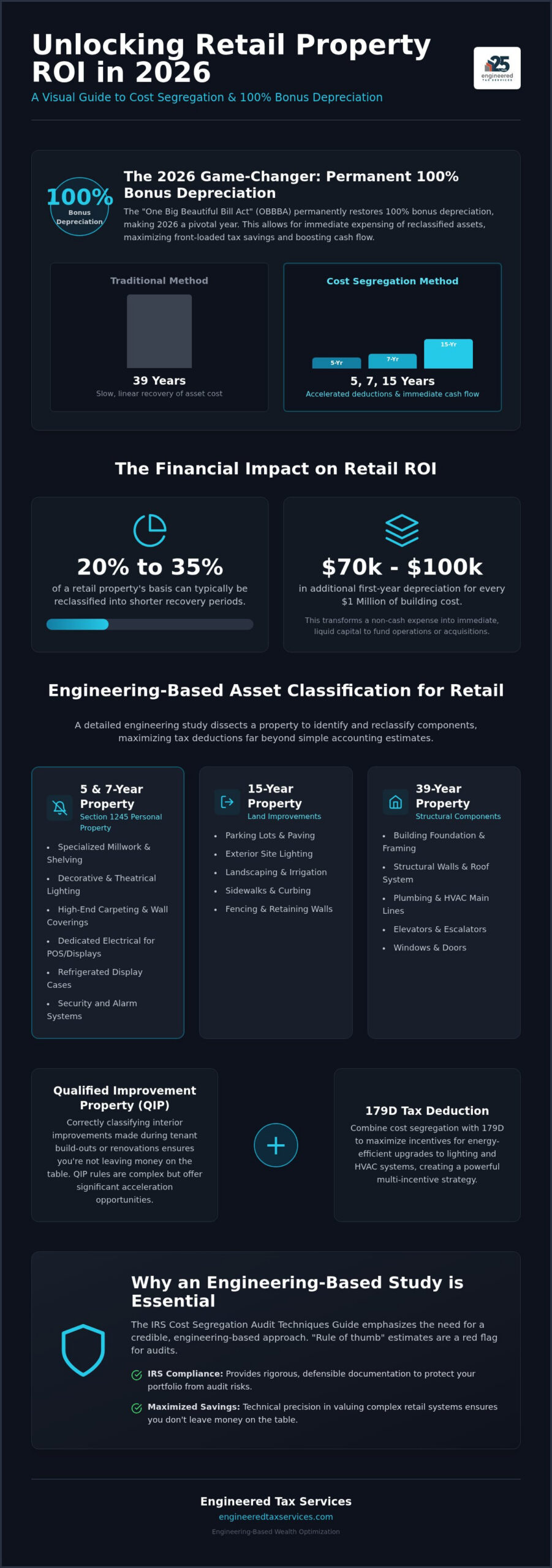
The enactment of the One Big Beautiful Bill Act (OBBBA) in July 2025 has fundamentally shifted the tax landscape, permanently restoring 100% bonus depreciation for qualified property. This legislative change makes 2026 a pivotal year for retail investors to re-evaluate their depreciation strategies. A Cost segregation study serves as the technical bridge between traditional accounting and engineering, allowing you to identify and reclassify building components into shorter recovery periods. Instead of waiting 39 years to recover the cost of your investment, you can accelerate deductions for assets into 5, 7, or 15-year schedules.
Retail properties are uniquely suited for this strategy. Whether you manage regional malls, neighborhood strip centers, or standalone flagship stores, these assets typically contain a high volume of personal property and land improvements. Industry data indicates that cost segregation for retail properties typically reclassifies between 20% and 35% of the building's depreciable basis. This high reclassification rate translates directly into significant first-year tax savings, especially when combined with the restored 100% bonus depreciation rules that allow for immediate expensing of reclassified assets.
The Financial Impact on Retail ROI
The strategic value of cost segregation is best measured through the lens of Net Present Value (NPV). By front-loading depreciation, you capture the time value of money, providing a cash infusion that can be used to pay down debt or fund new acquisitions. For every $1 million of building cost, a study can yield between $70,000 and $100,000 in additional depreciation. This is critical for offsetting the high costs associated with modern retail real estate acquisitions. Cost segregation transforms non-cash depreciation into immediate, liquid capital that enhances your portfolio's overall internal rate of return.
Why Retail Assets Require Engineering Precision
The IRS Cost Segregation Audit Techniques Guide emphasizes the necessity of an engineering-based approach over simple “rule of thumb” accounting estimates. Retail spaces often feature complex systems, such as specialized millwork, decorative lighting, and intricate site improvements that require technical expertise to value accurately. A report from a licensed engineering firm provides the rigorous documentation needed to stand up to IRS scrutiny and ensures that you aren't leaving money on the table. To understand the broader applications of this methodology, consider how it integrates with cost segregation commercial property strategies to ensure long-term wealth preservation and professional compliance.
Engineering-Based Classification of Retail-Specific Assets
Achieving maximum tax efficiency requires more than a cursory glance at your balance sheet. It demands a rigorous, engineering-based methodology to dissect the building envelope into its constituent parts. When executing cost segregation for retail properties, our engineers distinguish between the structural components of the 39-year shell and the specialized assets that drive your business operations. This technical precision ensures that every dollar of your investment is allocated to the shortest possible recovery period permitted by the IRS.
The methodology for separating personal property from the building envelope hinges on the ‘Unit of Property' (UoP) rules. For large retail HVAC and roofing systems, these rules determine whether a component is a repair or a capital improvement. By identifying specific sub-components that serve a business function rather than a structural one, we can often reclassify significant portions of these high-cost systems. This level of detail is why a professional engineering report is indispensable for modern retail investors.
5 And 7-Year Personal Property in Retail
Personal property under Section 1245 often represents the most significant opportunity for immediate expensing. This category includes interior finishes like high-end carpeting, vinyl wall coverings, and specialized shelving units designed for product display. Technical precision is especially critical when evaluating dedicated electrical systems; wiring that serves POS systems or refrigerated display cases can often be accelerated, even if it's behind a wall. Security systems and reinforced flooring designed to support heavy retail equipment also fall into this shorter-lived category. As noted in the article Cost Segregation Applied, these classifications must be backed by detailed engineering data to withstand audit scrutiny.
15-Year Land Improvements for Strip Centers
For owners of strip centers and malls, land improvements offer a substantial secondary tier of tax savings. This includes the depreciation of parking lot infrastructure, concrete curbs, and aesthetic landscaping that defines the shopping experience. Specialized exterior signage and perimeter fencing aren't just marketing tools; they're 15-year assets that qualify for 100% bonus depreciation in 2026. A building's foundation provides structural support for the 39-year shell, while retail-specific land improvements like parking lots facilitate customer access and site utility. Implementing cost segregation for retail properties ensures that these site-specific costs are recovered over 15 years rather than 39.
Navigating Tenant Improvements and Qualified Improvement Property
Retail spaces are dynamic environments where tenant turnover and aesthetic refreshes occur frequently. Unlike industrial warehouses that remain static for decades, retail assets rely on constant evolution to attract foot traffic. This high turnover makes Qualified Improvement Property (QIP) the cornerstone of cost segregation for retail properties in 2026. Under the One Big Beautiful Bill Act (OBBBA), QIP remains 15-year property and is eligible for 100% bonus depreciation, allowing for an immediate write-off of interior, non-structural improvements.
However, many owners fall into the ‘Tenant Improvement' (TI) trap. Who owns the depreciation? The answer depends entirely on the lease structure and who funded the improvements. If a landlord provides a TI allowance, they generally retain the right to the depreciation. If the tenant funds the build-out, the tax benefit shifts to them. Understanding these nuances is vital when structuring retail leases, as the tax savings can significantly impact the net effective rent and overall investment yield. Whether you utilize triple net or gross leases, the technical classification of these improvements determines the actual cash flow realized from the asset.
Maximizing Deductions for Retail Build-Outs
Strategic planning for storefront renovations and interior partitions can yield massive upfront savings. While structural components remain 39-year property, interior glass, specialized millwork, and non-load-bearing walls qualify as QIP. You should prioritize identifying these components early in the design phase to maximize your 2026 deductions. For a deeper dive into these classifications, explore our guide on depreciation strategies for commercial real estate. Proper documentation ensures that improvements are categorized correctly to capture the full 100% bonus depreciation available this year.
The Power of Partial Asset Disposition (PAD)
What happens to the tax basis of the old flooring or lighting when a space is gutted for a new brand? Partial Asset Disposition (PAD) allows you to write off the remaining book value of assets removed during a renovation. This is a powerful strategy for increasing cash flow during a 2026 retail remodel. Engineering documentation is essential to value these ‘demo-ed' assets accurately and defend the write-off to the IRS. Owners should follow this checklist before starting a remodel:
- Conduct a pre-demolition site survey to document existing conditions.
- Obtain a detailed cost breakdown from the general contractor.
- Engage an engineering firm to perform a PAD study before the old assets are discarded.
- Verify the adjusted basis of the building components being replaced.
This proactive approach ensures that cost segregation for retail properties captures both the value of new investments and the loss of retired assets, effectively cleaning up your fixed asset ledger while boosting your bottom line.
The Multi-Incentive Strategy: Combining Cost Segregation with 179D
Leading retail investors don't view tax planning as a series of isolated events. They pursue a multi-incentive strategy that stacks engineering-based studies to capture every available dollar of tax relief. By integrating cost segregation for retail properties with the Section 179D energy-efficient commercial building deduction, you can significantly compress the payback period on major capital improvements. This is especially relevant for older retail centers undergoing modern retrofits to meet 2026 energy standards.
A common concern among property owners is the ‘Double Dip' myth. You might worry that you can't claim both a 179D deduction and accelerated depreciation on the same asset. In reality, these incentives complement each other. Cost segregation reclassifies components like specialized lighting and HVAC wiring into shorter recovery periods. Meanwhile, 179D provides a permanent deduction for the energy-efficient performance of those systems. You aren't depreciating the same dollar twice; you're applying different sections of the tax code to distinct technical aspects of your building's infrastructure. This dual approach ensures that no value is left on the table during a renovation.
Unlocking the 179D Deduction for Retail Renovations
For 2026, the 179D deduction offers a square footage-based benefit for lighting, HVAC, and building envelope upgrades that exceed ASHRAE standards. It's vital to act quickly, as the deduction is currently scheduled for repeal for projects where construction begins after June 30, 2026. For projects meeting the necessary criteria, the inflation-adjusted deduction ranges from $0.59 to $1.19 per square foot. This can increase to a range of $2.97 to $5.94 per square foot if your project adheres to prevailing wage and apprenticeship requirements. To maximize your return, consult our 179D energy efficient commercial building deduction guide to ensure your technical documentation is audit-ready.
Integrating 45L for Mixed-Use Retail Developments
Modern retail often exists within mixed-use developments. If your portfolio includes residential units positioned above ground-floor retail, you have a unique opportunity to leverage the 45L tax credit. This incentive rewards developers for meeting rigorous Energy Star or Zero Energy Ready Home certification standards. In 2026, these technical requirements are strictly enforced, but the per-unit credits provide a powerful offset to construction costs. You can learn more about these requirements in our 45L tax credit multifamily overview. Stacking these residential credits with retail cost segregation creates a comprehensive wealth preservation strategy across your entire development. To see how these incentives apply to your specific portfolio, request a preliminary analysis from our engineering team.
Why an Engineering-Based Study is Essential for Retail Compliance
The technical complexity of retail real estate makes it a primary focus for regulatory oversight. While the financial rewards of cost segregation for retail properties are substantial, the IRS maintains rigorous standards for how these studies are conducted. The IRS Cost Segregation Audit Techniques Guide explicitly highlights the necessity of an engineering-based approach to substantiate the reclassification of building components. Without this technical foundation, your accelerated depreciation claims risk being disqualified during an audit, potentially leading to back taxes and penalties that erode your hard-earned cash flow.
There is a fundamental distinction between a ‘CPA-only' estimate and a licensed engineering report. While your tax professional is an expert in the code, they often lack the specialized training to interpret architectural blueprints or evaluate the load-bearing requirements of specialized retail flooring. An engineering-based study involves a physical site visit and a granular analysis of construction documents to provide a defensible ‘nexus' between the asset and its shorter recovery period. This level of precision is what differentiates a high-risk tax position from a secure, strategic investment.
Audit Protection and Technical Substance
The IRS scrutinizes retail cost segregation more heavily than other sectors because the reclassification percentages are typically higher. Detailed engineering blueprints and documented site visits serve as your primary line of defense. These reports provide the technical substance required to prove that a specific asset, such as a reinforced POS counter or dedicated display lighting, serves a business function rather than a structural one. At Engineered Tax Services, we adopt the ‘Expert's Expert' approach, acting as a technical partner for CPAs to ensure their clients' portfolios are optimized yet fully compliant with national standards.
Next Steps: Implementing Your 2026 Retail Tax Strategy
Timing is a critical factor in wealth preservation. You should ideally conduct a cost segregation study during the pre-acquisition phase to accurately model your expected ROI. If you've already completed a renovation, a post-construction study can still capture significant catch-up depreciation. Integrating these findings into a broader strategy, such as 1031 exchange services, allows you to defer capital gains while continuing to maximize your depreciation benefits on the replacement property. This synergy between different tax incentives creates a powerful cycle of growth and capital preservation.
Don't leave your 2026 tax savings to chance. The restoration of 100% bonus depreciation has created a limited window to maximize your liquidity through engineering-based precision. Contact our team today for a preliminary analysis to discover the hidden potential within your retail portfolio and secure a roadmap for long-term financial stability.
Secure Your Retail Portfolio's Competitive Advantage
The permanent restoration of 100% bonus depreciation has fundamentally altered the math for retail real estate investment. It's time to move beyond standard 39-year schedules. By utilizing engineering-based cost segregation for retail properties, you can transform high tax liabilities into immediate, reinvestable cash flow. We've discussed how technical precision in asset classification, coupled with strategic incentives like the 179D deduction, provides a robust framework for wealth preservation and long-term stability.
Success in this landscape requires more than just high-level estimates; it demands a partner with deep institutional knowledge. As a licensed engineering firm conducting over 10,000 studies annually, Engineered Tax Services delivers the technical substance required for IRS compliance, including comprehensive audit support. You have the opportunity to secure your financial future by applying these specialized methodologies to your upcoming acquisitions and renovations.
Take the next step toward optimizing your portfolio's performance. Schedule a complimentary preliminary analysis for your retail property with Engineered Tax Services. Your path to enhanced liquidity and strategic growth begins with a single, expert evaluation.
Frequently Asked Questions
What types of retail assets qualify for accelerated depreciation?
Retail assets qualifying for accelerated depreciation include non-structural components and site improvements. Specifically, 5-year and 7-year personal property encompasses items like point-of-sale systems, security cameras, and removable floor coverings. Dedicated plumbing for specialized equipment also qualifies. Additionally, 15-year land improvements such as parking lots, sidewalks, and exterior signage can be depreciated faster. These reclassifications allow you to bypass the standard 39-year recovery period, significantly improving your immediate cash flow position.
Can I perform a cost segregation study on a retail property I’ve owned for years?
You can absolutely perform a look-back study on properties acquired in previous years without filing amended returns. By utilizing IRS Form 3115, you can claim a catch-up deduction in the current tax year for the depreciation you've missed since the date of acquisition. This strategy is particularly effective for long-held retail assets that haven't undergone a formal engineering analysis, as it often results in a substantial one-time tax benefit that boosts liquidity.
How does the 2026 bonus depreciation landscape affect my retail investment?
Contrary to previous phase-down schedules, the One Big Beautiful Bill Act (OBBBA) passed in July 2025 has permanently restored 100% bonus depreciation. For your 2026 investments, this means any property reclassified into 5, 7, or 15-year categories through cost segregation for retail properties can be fully expensed in the first year. This provides an unprecedented opportunity to maximize liquidity and offset the high costs of recent acquisitions or large-scale renovations across your entire portfolio.
What is the difference between a cost segregation study and a standard appraisal?
A standard appraisal determines the fair market value of a property for lending or sale purposes, while a cost segregation study is a technical engineering analysis focused on tax recovery. Our engineers dissect the building's construction costs into specific asset categories defined by the IRS. While an appraiser looks at the property as a whole, a cost segregation specialist identifies the individual components that qualify for shorter depreciation lives, ensuring your tax strategy is grounded in technical precision.
Does a cost segregation study increase my risk of an IRS audit?
A professionally prepared, engineering-based study doesn't inherently increase your audit risk. In fact, the IRS provides a Cost Segregation Audit Techniques Guide specifically for its examiners, acknowledging this as a legitimate method for tax optimization. Using a licensed engineering firm ensures your documentation meets the highest standards of technical substance. This proactive approach provides peace of mind, as the detailed reports are designed to stand up to rigorous scrutiny during any routine review or audit.
How do Tenant Improvements (TIs) affect my cost segregation results?
Tenant Improvements often represent the most lucrative portion of a retail study because they frequently qualify as Qualified Improvement Property (QIP). These interior, non-structural enhancements are classified as 15-year property and are currently eligible for 100% bonus depreciation. Results depend on whether the landlord or the tenant funded the build-out according to the lease agreement. Identifying these high-turnover assets ensures that you capture the full value of every renovation or new lease agreement you've signed.
Can cost segregation be used for small retail storefronts or only large malls?
Cost segregation is highly effective for both small standalone storefronts and large regional malls. While the scale of the benefit varies, even a single retail unit often contains a high percentage of 5-year personal property like specialized lighting and electrical systems. We typically find that properties with a depreciable basis over $500,000 see a clear return on investment. The technical process remains the same regardless of building size, focusing on maximizing your specific tax savings and cash flow.
What is the typical ROI for a retail cost segregation study?
A typical cost segregation for retail properties reclassifies 12% to 18% of the depreciable basis to 5-year property and 8% to 15% to 15-year land improvements. This shift results in a substantial net present value benefit, providing immediate liquidity that can be redeployed into your portfolio. While the exact return varies based on property type, the tax savings usually dwarf the professional fees associated with the study. This makes it one of the most efficient wealth-building tools available today.