Securing federal funding is often viewed as the ultimate financial win, yet chasing direct awards in isolation frequently leaves substantial capital on the table. While securing federal energy efficiency grants for commercial buildings can provide essential project capital, dealing with disjointed procurement portals and complex technical qualifications quickly creates operational friction. It's easy to feel overwhelmed by rigorous engineering benchmarks or unclear guidelines on how agency awards intersect with statutory tax policy.
You shouldn't have to guess whether your mechanical retrofits meet strict federal criteria or risk compliance issues trying to offset upgrade costs. In this guide, you'll discover how to identify high-impact federal funding programs, satisfy stringent energy modeling standards, and strategically stack direct awards with engineering-backed incentives like the Section 179D deduction and cost segregation. Below, we examine the premier commercial funding opportunities available in 2026, the technical baselines required to qualify, and the documentation roadmap needed to maximize your total project return on investment.
Key Takeaways
- Identify the core structural differences between competitive discretionary programs and formula awards when evaluating federal energy efficiency grants for commercial buildings.
- Establish a streamlined screening framework to analyze Notice of Funding Opportunity (NOFO) technical parameters and determine commercial feasibility.
- Maximize portfolio return on investment by strategically stacking grant allocations alongside Section 179D deductions and accelerated cost segregation.
- Master the rigorous ASHRAE modeling standards and engineering documentation protocols necessary to substantiate federal compliance and mitigate audit exposure.
Understanding Federal Energy Efficiency Grants for Commercial Buildings
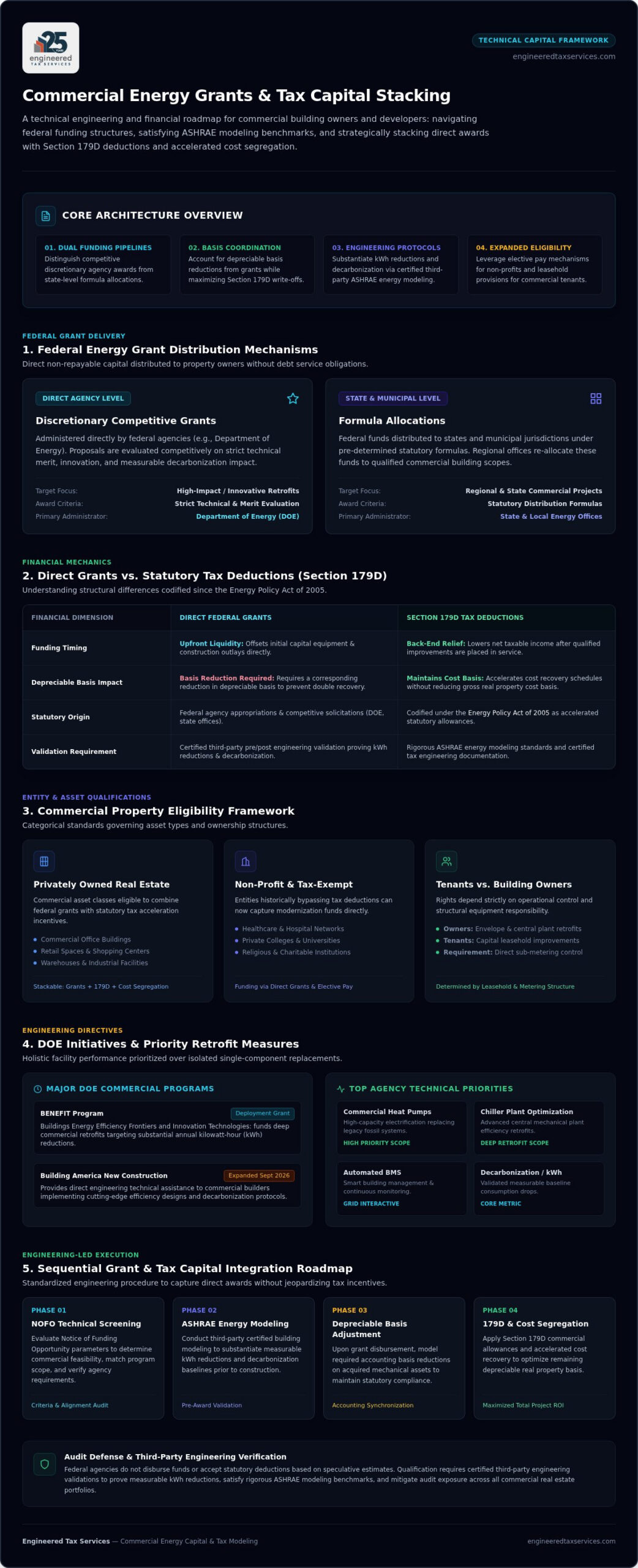
Federal commercial energy grants represent non-repayable capital awarded directly to property owners to offset qualified building retrofits. Unlike low-interest loans or traditional municipal financing, these awards do not require debt service. Modern legislative updates have dramatically expanded available funding, yet securing these dollars requires meeting rigorous performance standards. Federal agencies do not disburse funds based on speculative estimates; they mandate certified third-party engineering validations to prove measurable kilowatt-hour reductions and decarbonization outcomes before and after construction.
To capture these opportunities effectively, developers and building owners must understand the operational mechanisms behind federal energy efficiency grants for commercial buildings across two core distribution structures:
- Discretionary Competitive Grants: Direct awards administered by federal agencies like the Department of Energy (DOE). These prioritize high-impact, innovative retrofit proposals evaluated on strict technical merit.
- Formula Allocations: Federal funding distributed to states and local municipalities under pre-determined statutory formulas, which local offices subsequently allocate to regional commercial projects.
Grants vs. Tax Deductions: Clarifying the Commercial Capital Stack
Direct federal grants supply non-dilutive, upfront liquidity that offsets initial equipment costs and construction expenses. Conversely, tax deductions provide back-end financial relief by lowering a property owner's net taxable income after improvements are placed in service. The modern federal incentive framework traces its statutory roots to the Energy Policy Act of 2005, which codified accelerated incentives like the Section 179D commercial allowance.
From an accounting perspective, capital treatment differs fundamentally between these mechanisms. Receiving direct grant proceeds typically requires a corresponding reduction in the depreciable basis of the newly acquired mechanical assets, preventing double recovery. Tax deductions, however, accelerate cost recovery schedules without reducing the gross cost basis of the underlying real property. Balancing both requires meticulous financial modeling.
Commercial Property Eligibility Standards and Ownership Structures
Eligibility criteria for energy modernization capital depend heavily on asset classification and organizational structure:
- Privately Owned Real Estate: Office buildings, retail spaces, warehouses, and industrial facilities can tap select federal grant programs alongside standard statutory tax incentives.
- Non-Profit and Tax-Exempt Entities: Healthcare networks, private universities, and religious institutions historically bypassed tax incentives but can now access federal grants and elective pay mechanisms to fund substantial mechanical improvements.
- Tenants vs. Building Owners: While building owners generally hold the rights to envelope and central plant upgrades, commercial tenants executing extensive capital leasehold improvements can qualify for targeted energy allocations if lease agreements assign operational control and utility metering directly to the tenant.
Major Federal Energy Efficiency Programs for Commercial Properties
Targeting the appropriate agency pipeline is critical when structuring commercial retrofit financing. Today's federal grant ecosystem prioritizes holistic facility performance over isolated component swaps. Obtaining federal energy efficiency grants for commercial buildings requires matching project scopes with agency mandates, whether targeting deep operational decarbonization, grid interactivity, or electrification.
Department of Energy (DOE) Commercial Building Initiatives
The DOE directs funding through targeted research and deployment programs designed to slash facility energy consumption. Initiatives like the Buildings Energy Efficiency Frontiers and Innovation Technologies (BENEFIT) program fund commercial properties deploying deep retrofits that achieve substantial annual kilowatt-hour reductions. High-capacity commercial heat pump installations, advanced chiller optimization, and automated building management systems receive top priority. In September 2026, the DOE expanded technical access through the Building America New Construction Support program, offering direct engineering assistance to commercial builders implementing cutting-edge efficiency designs.
Environmental Protection Agency (EPA) and Clean Energy Financing
Commercial operators deploying zero-emission heating and smart envelope technologies can access capital via EPA clean energy financing networks. These initiatives focus strictly on measurable greenhouse gas abatement. To qualify and remain compliant, applicants must establish audited baseline metrics and track ongoing post-retrofit consumption through ENERGY STAR Portfolio Manager. When mapping federal capital across distributed real estate footprints, developers often cross-reference opportunities through the Database of State Incentives for Renewables & Efficiency (DSIRE) to align federal allocations with regional grid goals.
Commercial Agriculture and Rural Facility Energy Programs
Commercial enterprises located in qualifying non-metro zones can secure substantial capital via the USDA Rural Energy for America Program (REAP). REAP offers competitive grants of up to $500,000 for commercial energy efficiency projects, offsetting equipment investments such as high-efficiency refrigeration, lighting retrofits, and motor upgrades. Qualifying isn't automatic; applications require certified independent energy audits detailing projected payback periods and technical energy savings. Partnering with a specialist for a certified Engineered Incentives Report ensures your technical documentation satisfies strict federal program guidelines while defending your capital allocation under administrative scrutiny.
How to Find and Evaluate Federal Commercial Building Grants
Navigating government procurement databases requires moving past raw listings to build an actionable pipeline. Public repositories catalogue hundreds of solicitations, but without a disciplined vetting system, property teams waste weeks analyzing unviable programs. Successfully securing federal energy efficiency grants for commercial buildings depends on rapid, systematic screening of Notice of Funding Opportunity (NOFO) guidelines against facility specifications, construction schedules, and capital expenditure budgets.
Navigating Federal Opportunity Portals Effectively
Finding viable opportunities starts on Grants.gov, where commercial sponsors should filter solicitations by Assistance Listing numbers and targeted building efficiency codes. Before investing resources into a formal submission, ensure your corporate entity maintains an active, validated registration in the System for Award Management (SAM.gov). Vetting a NOFO requires scrutinizing three critical gating items: technical eligibility, proposal lead times, and engineering verification standards. Sponsoring agencies often mandate comprehensive energy modeling up front to benchmark performance. At this initial evaluation stage, strategic asset managers determine whether pairing grant funds with the 179D Energy Efficient Commercial Buildings Deduction will maximize net capital recovery once systems become operational.
Evaluating Match Funding and Cost-Share Commitments
Most commercial federal awards aren't 100% direct subsidies. Solicitations typically mandate statutory non-federal cost-share commitments ranging from 20% to 50% of total project costs. Underwriting these packages requires evaluating your true net capital outlay across several eligible categories:
- Direct Cash Equity: Committed sponsor funds directly financing mechanical equipment purchases, installation labor, and electrical distribution upgrades.
- Commercial Debt: Conventional construction loans or private capital facilities explicitly earmarked to cover eligible project scopes.
- Allowable Pre-Development Expenses: Capitalized engineering design costs, baseline energy audits, and architectural site assessments directly supporting the retrofit.
Documenting allowable matching funds early protects applicants from costly post-award compliance audits. If your project team can't satisfy strict match requirements with verified, non-federal sources, pursuing that specific solicitation will drain internal resources without delivering real financial return.
Maximizing ROI: Stacking Grants with 179D and Cost Segregation
Combining non-repayable public capital with statutory tax incentives unlocks optimal project yields. Relying solely on direct grants frequently leaves substantial balance-sheet equity unclaimed. By structuring federal energy efficiency grants for commercial buildings alongside tax code provisions, property developers dramatically compress net capital recovery timelines while strictly honoring federal basis reduction rules.
Integrating the Section 179D Commercial Building Deduction
Commercial building operators can capture the 179D energy efficient commercial building deduction on qualifying retrofits, provided construction begins before the June 30, 2026 statutory deadline. For tax year 2026, baseline deductions range from $0.59 to $1.19 per square foot for facilities cutting energy and power costs by at least 25% compared to ASHRAE 90.1 reference standards. Meeting prevailing wage and apprenticeship mandates elevates that incentive to $2.97 through $5.94 per square foot.
Asset basis adjustments demand rigorous technical oversight. Under federal tax law, receiving direct grant awards requires reducing the depreciable basis of newly installed assets by the grant amount received. However, because the Section 179D deduction is calculated on interior lighting, HVAC, and building envelope performance rather than total capitalized basis, property owners can lawfully stack both incentives without running afoul of anti-double-dipping statutes.
Pairing Retrofits with Cost Segregation and Multifamily Incentives
Beyond specialized deductions, engineering-led asset reclassification delivers immediate liquidity. Implementing an engineering-based cost segregation for commercial property study identifies short-life assets embedded within major mechanical overhauls. Components such as dedicated electrical feeds, specialized controls, and exterior lighting qualify for accelerated 5-, 7-, or 15-year recovery periods rather than the standard 39-year commercial schedule.
Mixed-use developments unlock additional upside through residential provisions. For properties featuring multi-family residential components over commercial ground-floor space, sponsors should evaluate qualification under the 45L tax credit for multifamily properties for eligible units acquired by June 30, 2026. Structuring these simultaneous incentives requires an audit-ready baseline model.
To defend your stacked incentive positions under federal audit scrutiny, consult with our licensed engineering team to perform a defensible technical modeling study for your portfolio.
Technical Compliance: Engineering-Led Grant Acquisition Strategies
Securing competitive public capital requires far more than rough estimates or historical utility statements. Federal evaluators demand verifiable, physics-based proof before releasing funds. To successfully capture competitive federal energy efficiency grants for commercial buildings, property owners must present certified thermodynamic models that quantify baseline performance and projected energy reductions against standardized national benchmarks.
Pre-Award Baseline Modeling and Technical Documentation
Engineering teams deploy Department of Energy-approved software tools to establish an empirical benchmark of pre-retrofit facility operations. These calibrated digital twins isolate weather variations, occupancy schedules, and envelope thermal boundaries. Specifically, licensed professional engineers execute a rigorous pre-application protocol:
- Empirical Baseline Normalization: Calibrating utility interval data across 12 to 36 months to account for weather anomalies and operational spikes.
- ASHRAE Compliance Modeling: Benchmarking proposed HVAC, lighting, and envelope improvements against ASHRAE 90.1 standards to quantify true delta reductions.
- Emissions Impact Calculations: Translating anticipated kilowatt-hour savings into defensible greenhouse gas abatement figures based on local grid emission factors.
Without an engineering certification validating these projected energy savings, federal grant review boards routinely disqualify applications during preliminary administrative triage.
Post-Award Monitoring, Verification, and Audit Defense
Winning an initial allocation represents only half the compliance lifecycle. Federal agencies enforce strict measurement and verification protocols throughout project closeout, conditioning final disbursements on documented post-retrofit performance. Comprehensive physical equipment commissioning reports, continuous sub-metering data, and calibrated sensor telemetry substantiate that newly installed chillers, heat pumps, and automated controls actually achieve their intended performance targets.
Engaging a credentialed firm bridges the gap between mechanical execution and administrative oversight. In the same way that specialized tax engineering studies substantiate statutory tax credits, detailed engineering documentation shields building owners against agency clawbacks. This defensible reporting roadmap ensures your commercial facility retains every allocated grant dollar while satisfying federal oversight standards.
Capitalize on High-Yield Clean Energy Incentives Today
Navigating the federal funding landscape demands a unified financial and engineering approach. Successfully capturing federal energy efficiency grants for commercial buildings requires rigorous baseline modeling, disciplined compliance management, and strategic capital structuring. When you combine direct public awards with statutory mechanisms like the Section 179D deduction and accelerated cost segregation, you transform standard capital improvement projects into powerful engines of long-term asset appreciation.
Don't leave balance-sheet capital unclaimed or expose your enterprise to administrative clawbacks through incomplete documentation. As a licensed professional engineering firm completing over 10,000 national studies annually, we provide the specialized technical expertise in ASHRAE modeling, Section 179D, and incentive maximization needed to safeguard your capital deployment. Optimize your commercial incentive strategy with Engineered Tax Services and turn complex federal programs into measurable, lasting portfolio growth.
Frequently Asked Questions
What is the difference between a commercial energy efficiency grant and a tax deduction?
A commercial grant delivers direct, non-repayable cash funding to offset project expenses, whereas a tax deduction reduces your taxable income after placing systems in service. Grants provide upfront liquidity but usually require a reduction in the property's depreciable basis. Tax deductions, such as Section 179D, accelerate capital recovery on tax returns without providing direct federal cash payouts. Both mechanisms lower net retrofit costs when structured correctly.
Can commercial building owners receive federal grants and claim Section 179D simultaneously?
Yes, commercial building owners can stack federal grants with Section 179D deductions as long as they account for basis adjustments. Tax rules generally require subtracting grant proceeds from depreciable asset basis to avoid impermissible double recovery. However, because Section 179D evaluates mechanical efficiency against ASHRAE performance standards rather than capitalized dollar amounts, both incentives can legally coexist under proper engineering and tax documentation.
Do commercial real estate energy efficiency grants require matching funds from the owner?
Most competitive federal energy efficiency grants for commercial buildings require non-federal cost-share matching, typically between 20% and 50% of total project costs. Sponsoring agencies rarely provide 100% project financing. Property owners can satisfy these statutory requirements using private sponsor equity, conventional commercial debt facilities, or allowable capitalized pre-development expenditures like engineering feasibility studies and site preparation costs.
How long does the federal energy efficiency grant application and review process take?
The end-to-end federal grant cycle typically requires six to twelve months from the initial Notice of Funding Opportunity publication to final award execution. Pre-application baseline modeling and technical documentation take between four and eight weeks. Following submission, federal agency panels conduct multi-stage merit reviews lasting three to six months before announcing selections and negotiating post-award compliance milestones.
What building improvements are most likely to receive federal commercial energy funding?
Federal agencies prioritize capital projects that deliver measurable decarbonization and large kilowatt-hour reductions. High-efficiency commercial heat pumps, advanced chiller replacements, automated building management systems, and high-performance building envelope insulation consistently rank highest in grant scoring. Projects combining thermal envelope retrofits with smart electrification controls receive favorable reviews because they significantly lower peak grid demand and operational carbon emissions.
Why is an engineering-based energy modeling study required for commercial grant applications?
Sponsoring agencies require certified engineering modeling studies to verify baseline consumption and mathematically substantiate projected energy savings. Federal grant evaluators don't accept raw utility bills or contractor estimates. A licensed engineering study uses ASHRAE-compliant software to simulate thermodynamic building performance, ensuring your application withstands federal technical scrutiny and defending against administrative clawbacks during post-installation audits.
Can private commercial landlords apply for federal energy efficiency grants directly?
Private commercial landlords can apply directly to specific discretionary programs, such as USDA REAP for eligible rural commercial operations or competitive DOE technology deployments. However, many federal energy efficiency grants for commercial buildings flow to state energy offices or regional green banks first. Private landlords frequently secure these funds as sub-recipients or by partnering with eligible local clean energy programs.