Most investors view a heavy tax bill as an inevitable consequence of growth, but that perspective is a costly mistake. If you’re planning to divest an asset, a 1031 exchange commercial real estate strategy is your most effective tool for preserving equity and scaling your portfolio. You likely already know that the 45-day identification and 180-day closing windows are unforgiving. It’s exhausting to manage these strict IRS timelines while trying to find a replacement property that actually improves your bottom line.
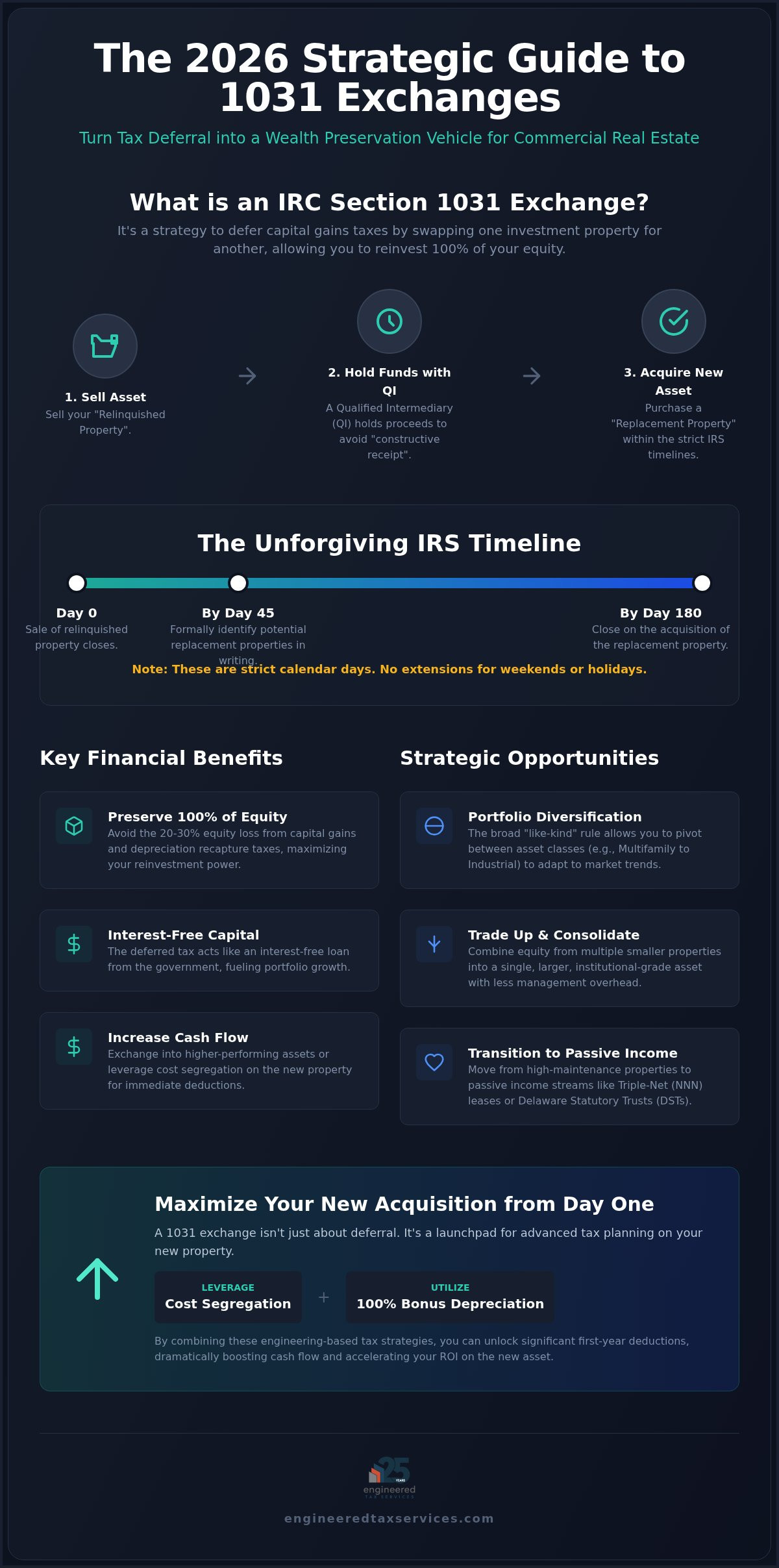
This 2026 strategic guide promises to move you beyond simple compliance. You’ll learn how to combine traditional deferral with engineering-based tax planning to optimize your new acquisition from day one. We’ll explore the current tax implications for commercial real estate, including the permanent 100% bonus depreciation rules, and the precise methodology needed to mitigate depreciation recapture hits. By the end of this article, you’ll have a clear roadmap for leveraging technical precision to turn a standard exchange into a long-term wealth preservation vehicle.
Key Takeaways
- Master the strict 45-day identification and 180-day closing windows to ensure a successful 1031 exchange commercial real estate transaction without triggering immediate capital gains.
- Leverage the One Big Beautiful Budget Act of 2025, which provides long-term certainty by making 100% bonus depreciation permanent for qualified property acquisitions.
- Discover how to integrate cost segregation on your replacement property to unlock significant first-year tax deductions and increase immediate cash flow.
- Utilize the broad definition of “like-kind” property to diversify your portfolio across different commercial sectors or consolidate multiple assets into institutional-grade holdings.
- Understand the importance of an engineering-based approach to substantiating tax incentives and ensuring IRS compliance throughout the exchange process.
Understanding 1031 Exchange for Commercial Real Estate
Strategic wealth preservation in the property market requires more than just high occupancy rates; it demands technical tax engineering. At its core, IRC Section 1031 allows an investor to swap one investment property for another of “like-kind” while deferring the entirety of their capital gains tax liability. When you execute a 1031 exchange commercial real estate strategy, you aren’t just delaying a tax bill. You’re effectively receiving an interest-free loan from the government, allowing you to reinvest 100% of your equity into a more productive asset. For a foundational look at the legal framework, Understanding Section 1031 provides the historical context of these regulations.
The mechanism involves two distinct phases: the sale of the “Relinquished Property” and the acquisition of the “Replacement Property.” By deferring federal capital gains and the 25% depreciation recapture tax, you maintain the full purchasing power of your portfolio. This is especially critical in 2026. With the One Big Beautiful Budget Act of 2025 making 100% bonus depreciation permanent, the ability to transition equity into new, high-value assets has never been more advantageous for long-term growth.
The Role of the Qualified Intermediary (QI)
A Qualified Intermediary (QI) acts as the essential firewall between you and your sale proceeds. It’s a non-negotiable requirement. If you take “constructive receipt” of the funds at any point during the closing of your relinquished property, the IRS views the transaction as a taxable sale, and the exchange fails immediately. Your QI must be a licensed and insured professional who holds the funds in a segregated account, prepares the necessary legal documentation, and ensures the title transfers correctly between the parties. When selecting a partner, prioritize firms with institutional-grade security and a deep understanding of complex commercial title structures.
Eligible Commercial Property Types
The IRS definition of “like-kind” is surprisingly broad, focusing on the intent of the owner rather than the specific asset class. To qualify, the asset must be “Held for Investment” or used in a trade or business. This flexibility allows for significant portfolio shifting, such as:
- Multifamily to Industrial: Moving from apartment complexes to high-demand warehouse space.
- Retail to Office: Swapping a shopping center for a medical office building.
- Specialized Interests: Exchanging fee-simple real estate for oil and gas royalties or Delaware Statutory Trusts (DSTs).
- Passive Income: Transitioning from high-maintenance properties into triple-net (NNN) leases.
This broad eligibility means you don’t have to replace a warehouse with another warehouse. You can strategically pivot your capital into sectors with better cash flow or lower management intensity without losing 20% to 30% of your equity to the tax man.
Navigating IRS Like-Kind Requirements and Timelines
Success in a 1031 exchange depends on your ability to master the clock. While the tax benefits are substantial, the IRS provides no leniency for missed deadlines or improper asset classification. The definition of “like-kind” is surprisingly broad, focusing on the nature of the investment rather than the specific property type. For instance, you can transition equity from a suburban office park into a portfolio of industrial warehouses or even a multifamily complex. As long as both properties are held for productive use in a trade or business or for investment, they qualify. Reviewing the IRS Rules for 1031 Exchanges confirms this flexibility, which is the cornerstone of a successful 1031 exchange commercial real estate strategy.
The execution window is split into two critical phases. You have exactly 45 calendar days from the sale of your relinquished property to formally identify potential replacements. This is followed by a total of 180 calendar days to close on the new asset. These are strict calendar days; the IRS doesn’t grant extensions for weekends or federal holidays. If you’re managing a complex divestment, our team can help you align your transactional strategy with these rigid requirements to prevent a failed exchange.
The Three-Property Rule vs. The 200% Rule
Identification requires a strategic choice between IRS safe harbors. The Three-Property Rule allows you to identify up to three potential assets regardless of their total market value. Alternatively, the 200% Rule lets you identify an unlimited number of properties, provided their combined fair market value doesn’t exceed twice the value of the property you sold. For institutional investors managing large-scale portfolios, the 95% Rule allows for even more identifications, though it requires you to acquire nearly everything on your list. Selecting the right rule is a balance between your acquisition goals and the current market inventory.
Managing the Strict 2026 Deadlines
The 2026 market environment, with the federal funds rate holding steady at 3.50% to 3.75%, has created a competitive landscape where quality assets move quickly. You can’t afford to begin your search on day one of the identification period. Early due diligence, including preliminary engineering assessments and environmental reviews, must happen well before your relinquished property closes. For a granular breakdown of how to schedule these milestones, see our detailed guide on 1031 exchange timeline rules. Failing to account for these technical details can trigger immediate capital gains and depreciation recapture taxes, undermining your long-term wealth goals.
Strategic Benefits: Diversification and Portfolio Optimization
A successful 1031 exchange commercial real estate strategy acts as a catalyst for portfolio modernization. It’s the most effective way to consolidate several smaller, high-maintenance properties into a single, institutional-grade asset. For example, an investor holding three aging retail strips can transition those equities into one modern medical office building or a high-tech industrial warehouse. This isn’t just about simplification; it’s about moving capital into sectors with superior growth trajectories. Understanding the foundational 1031 exchange rules and requirements is just the starting point for this level of strategic re-engineering.
One of the most overlooked advantages is the ability to reset the depreciation clock. If you’ve held a property for decades, you’ve likely exhausted its depreciation benefits. By exchanging into a higher-value replacement asset, you establish a fresh basis. This transition allows you to move from a “tax-dry” asset to a “tax-shielded” one, effectively re-leveraging your equity to maximize after-tax cash flow. When combined with the “swap till you drop” strategy, this approach ensures that wealth continues to compound untaxed until it passes to heirs, who then receive a stepped-up basis at death, potentially eliminating deferred capital gains taxes entirely.
Relieving Management Burdens
Many investors eventually reach a point where active management becomes a liability. A 1031 exchange provides a graceful exit from the “toilets, tenants, and trash” of residential or high-turnover retail properties. By transitioning into triple-net (NNN) leases, you shift the responsibility for taxes, insurance, and maintenance to the tenant. Alternatively, Delaware Statutory Trusts (DSTs) offer fractional ownership in institutional assets, providing passive income without the operational overhead. It’s a strategic move toward lifestyle preservation without sacrificing portfolio yield.
Increasing Leverage and Cash Flow
Think of deferred capital gains as an interest-free loan from the federal government. Instead of sending 20% or more of your equity to the IRS, you’re reinvesting that entire amount into a larger, more stable asset. This increased leverage is a powerful wealth multiplier. In the 2026 market, where conventional commercial mortgages range from 5.57% to 8.93%, using deferred tax dollars as additional down payment capital significantly lowers your debt-to-equity ratio on the replacement property. This allows for the acquisition of assets that were previously out of reach, providing a more robust foundation for long-term financial security.
Maximizing the “Up Leg”: Integrating Cost Segregation with 1031
The acquisition of a replacement property is the beginning of a new tax strategy, not just the end of a transaction. While the exchange defers your past gains, your focus must now shift to the tax efficiency of the new asset. When you complete a 1031 exchange commercial real estate transaction, the IRS applies the “step-in-the-shoes” rule. This means your carryover basis from the old property continues its original depreciation schedule. However, any “excess basis”-the additional capital or debt used to acquire a more valuable property-is treated as a new acquisition. This new basis is a prime candidate for an engineering-based cost segregation study.
By performing a detailed analysis of the replacement asset, engineers can identify components that qualify for 5, 7, or 15-year depreciation cycles rather than the standard 39-year straight-line method. These assets often include specialized electrical systems, decorative finishes, and land improvements like parking lots or landscaping. Identifying these items early allows you to front-load your deductions, creating a massive influx of cash flow that can be used to service new debt or fund property improvements. It’s a precision-based approach to wealth optimization that standard accounting methods simply can’t match.
The 1031 and Cost Segregation Synergy
The passage of the One Big Beautiful Budget Act of 2025 has fundamentally changed the math for 2026. With 100% bonus depreciation now a permanent fixture for qualified property, the synergy between an exchange and cost segregation is more powerful than ever. You can now fully deduct the cost of shorter-lived assets in the very first year of ownership. This significantly improves the internal rate of return (IRR) on your new investment by providing immediate tax relief that offsets the taxable income generated by the asset. To see how this applies to your specific asset class, explore our guide on cost segregation commercial property.
Energy Incentives for Replacement Properties
If your replacement property includes energy-efficient upgrades or if you plan to renovate, additional federal incentives are available. Acquisitions in the multifamily sector may qualify for 45L tax credits, while commercial buildings can leverage the 179D energy efficient commercial building deduction. These incentives aren’t just for new construction; they apply to the “up leg” of your exchange if the building meets specific performance standards. At ETS, we provide the technical engineering reports required to substantiate these claims to the IRS. You should contact our specialized tax engineers to ensure your new acquisition is fully optimized for these high-value incentives.
Executing Your Exchange: The Role of Specialized Partners
Navigating a 1031 exchange commercial real estate transaction requires a shift from generalist oversight to specialized technical expertise. While a standard CPA is vital for annual income tax filing, the complexities of a commercial exchange often exceed the scope of traditional accounting. A successful execution depends on your ability to substantiate every tax position with rigorous, engineering-based data. This is particularly true when you’re layering advanced strategies like cost segregation or energy incentives on top of the base deferral. Without a partner who understands the intersection of construction engineering and tax law, you risk leaving significant capital on the table or, worse, failing an IRS audit.
Due diligence for a commercial replacement property must go beyond a simple title search and physical inspection. It requires a proactive analysis of the asset’s tax-saving potential before the 45-day identification window closes. By engaging an engineering-led firm early, you can accurately project the future cash flow and depreciation benefits of a potential acquisition. This level of foresight allows you to make data-driven decisions rather than relying on the broad estimates that often lead to under-optimized portfolios.
Building Your 1031 Advisory Team
The most effective exchanges are managed by a triad of experts: your commercial broker, a Qualified Intermediary, and a specialized tax engineer. The synergy between these partners ensures that the transactional, legal, and technical aspects of the exchange are perfectly aligned. The technical precision required by an R&D tax credit engineering firm is the same level of detail we apply to real estate assets. This methodology ensures that every identified asset in your 1031 plan is evaluated for its specific engineering components, making your studies inherently audit-ready and compliant with current IRS standards.
Final Steps and Compliance
The final reporting phase involves more than just a property transfer. You must report the transaction to the IRS using Form 8824, which is filed alongside your annual tax return. This form tracks the basis of the relinquished property, the value of the replacement property, and any “boot” received during the swap. Maintaining meticulous records of your identification letters and closing statements is mandatory for long-term compliance. Before you finalize your next acquisition, consider a comprehensive 1031 exchange services review. This final check ensures that your wealth preservation strategy is technically sound and fully optimized for the 2026 tax landscape.
Optimize Your Capital Growth for 2026
Mastering the 1031 exchange commercial real estate process is about more than just avoiding a tax bill; it’s about engineering the future of your portfolio. You’ve seen how the synergy between strict IRS timelines and accelerated depreciation can unlock hidden liquidity in your acquisitions. By moving from high-maintenance assets into institutional-grade properties, you’re positioning your wealth for long-term stability and growth in an evolving market.
As a licensed engineering firm performing 10,000+ tax studies annually, ETS brings the technical precision required to substantiate your most ambitious tax positions. We don’t just facilitate transactions; we act as a strategic partner to ensure your replacement property is fully optimized from day one. You can maximize your 1031 exchange with an engineering-based tax study from ETS. Taking this proactive step today builds a more resilient and profitable financial future for your heirs and your business.
Frequently Asked Questions
Can I do a 1031 exchange from commercial to residential property?
Yes, you can exchange commercial property for residential property as long as both are held for investment or used in a trade or business. The IRS definition of “like-kind” is broad, allowing you to swap a retail building for a single-family rental or a multifamily complex. It’s the intent of the owner that matters, not the specific property type; this flexibility is a vital tool for portfolio diversification.
What happens if I miss the 45-day identification deadline?
If you miss the 45-day identification deadline, your exchange immediately fails and becomes a fully taxable sale. The IRS doesn’t grant extensions for weekends or holidays; the clock begins the day after your relinquished property closes. You’ll be liable for all capital gains and depreciation recapture taxes, which often exceed 25% of your equity depending on your specific tax bracket and state of residence.
How does a 1031 exchange affect my depreciation schedule?
A 1031 exchange commercial real estate transaction creates a two-part depreciation schedule to track your investment. Your original basis from the relinquished property “steps into the shoes” of the new asset and continues its existing timeline. Any additional capital or debt used to buy the replacement property is treated as a new acquisition with its own 27.5 or 39-year schedule, allowing for fresh tax benefits.
What is “boot” in a 1031 exchange and how is it taxed?
“Boot” refers to any non-like-kind property or cash received by the investor during the transaction process. This includes cash proceeds not reinvested or a reduction in mortgage debt on the replacement property. Boot is taxed as a capital gain in the year of the exchange, typically at the 20% federal rate plus any applicable state taxes and the 3.8% net investment income tax.
Can I use a 1031 exchange for a property I use for my own business?
Yes, properties used in your own trade or business are eligible for a 1031 exchange under current tax law. This allows business owners to sell an office or warehouse they occupy and reinvest the proceeds into a larger or more efficient facility. The key requirement is that the property must be held for productive use in a business, rather than for personal use as a primary residence.
Is there a limit to how many times I can perform a 1031 exchange?
There’s currently no limit on the number of times an investor can perform a 1031 exchange to defer taxes. Many high-net-worth investors use the “swap-til-you-drop” strategy to continuously defer taxes throughout their lifetime. This allows capital to compound untaxed, eventually providing heirs with a stepped-up basis that can eliminate deferred gains entirely under the One Big Beautiful Budget Act of 2025.
How does cost segregation work with a 1031 exchange carryover basis?
Cost segregation on a 1031 exchange commercial real estate asset identifies shorter-lived components within both the carryover and excess basis. While the carryover basis follows the old schedule, a study can reclassify items like specialized lighting or landscaping into 5, 7, or 15-year buckets. This accelerates deductions even on the older portion of your investment’s value, maximizing your immediate cash flow on the new asset.
Do I need a new cost segregation study for my 1031 replacement property?
Yes, a new cost segregation study is mandatory for every replacement property to identify its unique high-value components. You can’t apply the results of a study from your relinquished property to a new asset. A fresh engineering-based analysis ensures you capture 100% bonus depreciation on qualified assets, which was made permanent in 2025, providing a significant boost to the ROI of your new acquisition.