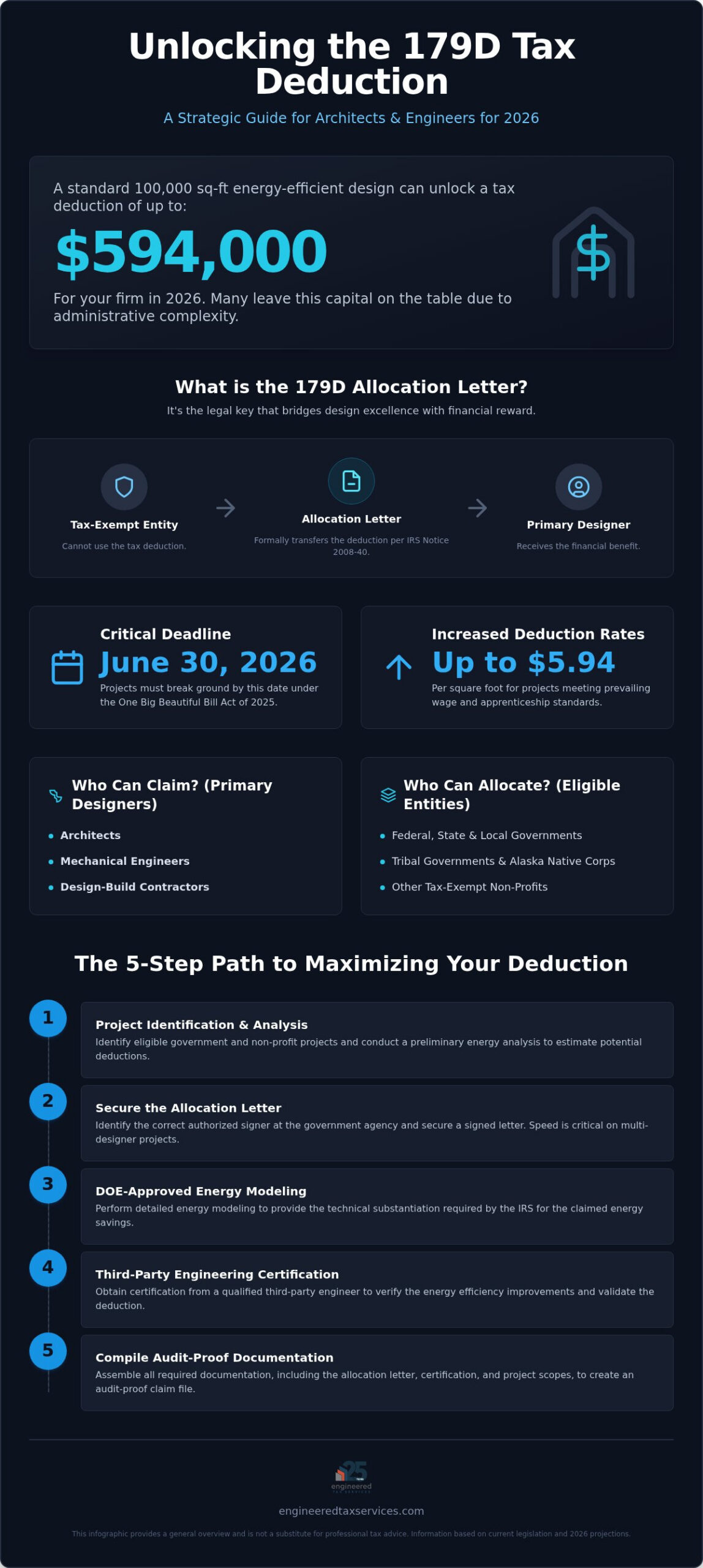
Did you know that a standard 100,000-square-foot energy-efficient design can unlock a tax deduction of up to $594,000 for your firm in 2026? Despite these substantial figures, many architects and engineers leave this capital on the table because the 179D allocation letter process often feels like a bureaucratic maze. You're likely familiar with the frustration of identifying the correct authorized signer at a government agency or the anxiety of managing competing claims on multi-designer projects. It's a common challenge where technical excellence in design is met with administrative complexity and IRS scrutiny.
This guide transforms that complexity into a strategic advantage. You'll master the step-by-step process of securing 179D allocation letters, ensuring your documentation is audit-proof while maximizing your per-square-foot deduction under the latest 2026 inflation-adjusted rates. We'll provide a clear roadmap for navigating IRS Notice 2008-40 requirements and the critical June 30 construction commencement deadline established by the One Big Beautiful Bill Act of 2025. By the end of this article, you'll have the technical precision needed to turn your energy-efficient designs into significant financial growth and long-term stability for your practice.
Key Takeaways
- Define the strategic role of the allocation letter in transferring substantial tax benefits from tax-exempt entities to primary designers.
- Identify expanded eligibility criteria for federal, state, and local government projects under the current Inflation Reduction Act framework.
- Streamline your firm’s internal workflow by mastering the 179D allocation letter process, from initial project identification to preliminary energy analysis.
- Ensure long-term financial security with audit-proof documentation that includes detailed project scopes and precise identification of all design parties.
- Maximize your final deduction rates by leveraging third-party engineering certifications and DOE-approved energy modeling for technical substantiation.
What is the 179D Allocation Letter and Why is it Essential in 2026?
The 179D allocation letter is a critical legal instrument that allows tax-exempt entities to transfer their federal tax deductions to the professionals responsible for energy-efficient building designs. Since government agencies and non-profits don't pay federal income tax, they can't utilize the incentives created by the Energy Policy Act of 2005. To ensure these entities still prioritize sustainability, the IRS framework under Section 179D and IRS Notice 2008-40 permits them to “allocate” the deduction to the primary designer. Understanding the 179D allocation letter process is essential because this document acts as the formal bridge between technical engineering excellence and tangible financial reward. This formal transfer is required by the IRS to prevent double-claiming and to ensure the deduction is utilized by the party that actually influenced the building’s efficiency profile.
Strategic firms view 2026 as a pivotal year for the 179D allocation letter process. The sunset provisions within the One Big Beautiful Bill Act of 2025 have created a firm window for commencement; projects must break ground by June 30, 2026, to lock in these enhanced rates. With 2026 rates reaching up to $5.94 per square foot for projects meeting labor standards, the financial stakes are higher than ever. To meet this deadline, firms must satisfy either the Physical Work Test or the Five Percent Safe Harbor, making early coordination with an engineering partner vital for capturing these incentives. This isn't just a compliance exercise; it's a method to inject immediate cash flow back into your firm, rewarding the intellectual property spent on high-performance systems.
The Role of the Primary Designer
A primary designer is any professional party responsible for creating the technical specifications of the building's energy-efficient systems. This typically includes architects, mechanical engineers, and design-build contractors. The IRS allows this transfer because these professionals drive the energy reduction that the tax code seeks to incentivize. Speed is vital here. In multi-firm projects, the first designer to secure a signed allocation letter often has the strongest claim. Partnering with an “expert's expert” like Engineered Tax Services (ETS) allows your firm to focus on design while we handle the complex energy modeling and certification necessary to substantiate your claim. ETS provides the technical certification necessary to substantiate allocation claims, leveraging over 10,000 studies conducted annually to ensure every detail meets rigorous IRS standards.
Allocation vs. Direct Claim
Understanding the distinction between a direct claim and an allocation is fundamental to maximizing your firm's revenue. While private commercial owners claim the deduction directly on their own tax returns, government and non-profit projects operate differently. These tax-exempt projects represent significant financial reservoirs for design firms because the deduction is essentially “orphaned” until a designer initiates the 179D energy efficient commercial building deduction allocation. By identifying these opportunities early in the contract phase, you ensure that your technical contributions are recognized as valuable financial assets. This turns technical work into cash flow and ensures that your firm receives the full economic benefit of its innovative, energy-efficient designs.
Navigating the 2026 Eligibility Landscape: Who Can Allocate the Deduction?
The Inflation Reduction Act (IRA) of 2022 fundamentally shifted the 179D landscape, moving it from a niche government incentive to a broad, industry-standard deduction. This expansion means that the 179D allocation letter process now applies to a much wider array of projects than ever before. While federal, state, and local government agencies remain the primary sources of these deductions, the “tax-exempt” umbrella has grown significantly. It now includes Tribal governments and Alaska Native Corporations, providing architects and engineers with new avenues for wealth optimization on projects that were previously ineligible for these incentives.
The 2026 Non-Profit Opportunity
The IRA’s inclusion of non-profit organizations is a game-changer for firms specializing in community infrastructure. Designers of charitable hospitals, private universities, and religious facilities can now claim deductions that were once strictly reserved for public sector work. Verifying a client’s 501(c)(3) status is a critical first step in this expanded 179D allocation letter process. This shift means that “tax-exempt” now includes a broader range of community-focused entities, from local food banks to massive non-profit healthcare networks. If your firm has a portfolio of non-profit work, you're likely holding onto unclaimed capital that can be unlocked with the right technical documentation and engineering certification.
Government Project Specifics
Working with government bodies requires a clear understanding of administrative structures. Whether you're dealing with a municipal school board or a federal agency like the GSA, the rules for allocation remain consistent, but the signers vary. Per IRS Notice 2008-40, the allocation must be signed by an authorized representative of the government entity. This isn't always the project manager you work with daily; it's often a high-level official with the legal authority to bind the agency to financial agreements.
Identifying this individual early is essential to meeting the strict deadlines set by the One Big Beautiful Bill Act of 2025. Projects must commence construction by June 30, 2026, to qualify for the highest potential rates. You can review the specific criteria for these dates in our 179D EPAct deduction eligibility guide. If the hierarchy feels opaque, you might want to partner with an engineering firm that has deep experience navigating these agency channels. This ensures your documentation is handled with the technical precision required to withstand IRS scrutiny while maximizing your firm’s financial health and long-term stability.
Essential Components of a Compliant 179D Allocation Letter
Precision is non-negotiable when drafting the documentation required for the 179D allocation letter process. A generic description of “energy upgrades” won't suffice; the IRS expects a granular breakdown of the specific systems installed and their corresponding costs. This document serves as the primary evidence during an audit, meaning any ambiguity can lead to a rejected claim. To ensure your firm’s financial growth remains secure, every letter must contain four foundational elements:
- Comprehensive Project Description: This includes the exact physical address, the total construction cost, and a detailed scope of work covering the lighting, HVAC, or building envelope systems.
- Party Identification: You must clearly list all architects, engineers, and contractors involved in the design to establish who is eligible for the allocation.
- Quantifiable Allocation: The letter must state a specific dollar amount or a defined percentage of the total deduction being transferred to your firm.
- Authorized Signatures: The document is only valid if signed by both the designer and an authorized representative of the tax-exempt building owner.
The Owner Declaration Requirement
The IRS is particularly protective against double-dipping. Your allocation letter must include specific declaration language where the building owner acknowledges they are a tax-exempt entity and are not claiming the deduction themselves. This section isn't just a formality; it's a legal safeguard. If the owner doesn't explicitly state they are transferring the full benefit to the designer, the entire 179D allocation letter process could be invalidated during a review. Precision here prevents future audit triggers and provides the peace of mind that your firm’s long-term stability is protected by rigorous compliance standards.
Technical Data Integration
Technical accuracy bridges the gap between a signed letter and a successful tax filing. Every letter must include the “placed in service” date, which is the exact point when the energy-efficient systems became operational. This date dictates which tax year the deduction applies to and which ASHRAE standards govern the project. Additionally, the costs listed for the energy-efficient property must align perfectly with your final engineered tax incentives report. Discrepancies between the allocation letter and the engineering study are a major red flag for tax inspectors. By ensuring these data points are consistent, you optimize your claim and demonstrate the professional integrity that the IRS expects from high-level design firms.
The Step-by-Step 179D Allocation Letter Process for Designers
The 179D allocation letter process is most effective when treated as a methodical business workflow rather than an administrative afterthought. Success starts with Project Identification, where you audit your portfolio for any government or non-profit contracts active within the last three years. Once identified, move to Technical Feasibility; a preliminary energy analysis determines if the design meets the 25% energy reduction threshold required for 2026. Outreach follows, involving the identification of the correct agency representative. Finally, Drafting and Execution leads into the Certification phase, where a licensed engineering firm validates the energy modeling to back the claim. This structured path ensures that your firm captures every dollar of earned incentives without disrupting your core design operations.
Identifying the Authorized Signatory
Approaching a public official requires a blend of technical authority and strategic diplomacy. You aren't asking for a budget increase; you're requesting a signature on a document that carries zero cost for the agency. By framing the allocation as a formal reward for your firm's energy-saving innovation, you align the agency's sustainability goals with your firm's financial health. Target high-level officials such as CFOs, Facilities Directors, or Agency Heads who possess the legal capacity to bind the entity. These individuals often appreciate the “no-cost” nature of the benefit, making them more likely to cooperate when the request is presented as a validation of the project's success.
Managing Multi-Designer Allocations
Complex projects often involve multiple eligible designers, leading to potential conflicts over who receives the deduction. While the IRS allows for pro-rata distribution between firms, many scenarios result in a “winner-takes-all” outcome based on who initiates the 179D allocation letter process first. This makes the “first-to-file” principle a vital strategic consideration. If you aren't proactive, a mechanical contractor or secondary engineer might secure the signature before you even begin the conversation. Establishing your firm as the primary claimant early in the project lifecycle is the best way to protect your interest in these high-value tax incentives.
To ensure your firm stays ahead of the competition and secures the signatures you need, partner with Engineered Tax Services to manage the outreach and technical modeling. Our team acts as your advocate, bridging the gap between design excellence and tax optimization with the precision your practice deserves.
Beyond the Letter: Engineering Certification and Maximizing Your 179D Claim
While the 179D allocation letter process provides the legal foundation for your claim, the IRS requires a rigorous technical superstructure to support it. This comes in the form of a formal certification by a qualified third-party professional. Specifically, a licensed engineer must verify that the building's systems achieve at least a 25% reduction in energy and power costs compared to the relevant ASHRAE 90.1 standard. For projects placed in service on or after January 1, 2027, ASHRAE Standard 90.1-2019 serves as the governing baseline. This verification is far more than a signature; it requires sophisticated, DOE-approved energy modeling to simulate performance and substantiate the final deduction amount.
In 2026, the financial impact of this certification is magnified by the Prevailing Wage and Apprenticeship (PWA) requirements. Projects that meet these labor standards can unlock deduction rates between $2.97 and $5.94 per square foot, a massive increase over the base rates of $0.59 to $1.19. To capture this higher “bonus” deduction, your engineering study must be meticulously documented to withstand IRS scrutiny. Many forward-thinking firms are compounding these benefits by integrating 179D with energy efficient commercial renovations, ensuring that every lighting, HVAC, and envelope upgrade contributes to a maximized ROI.
Why an Engineering-Based Study is Non-Negotiable
A “tax-only” firm simply lacks the credentials to sign off on these technical certifications. The IRS explicitly mandates that the individual signing the certification be a licensed professional engineer or contractor. This engineering precision acts as a shield during an audit. When tax inspectors review a claim, they look for technical depth in the ASHRAE 90.1 compliance testing. A study backed by a licensed engineering firm like ETS ensures that every calculation, from thermal resistance to lighting power density, is defensible. This level of detail is what provides the peace of mind that your firm’s wealth is preserved through technical accuracy.
Strategic Next Steps for Your Firm
The window to secure these incentives is closing as we approach the June 30, 2026, construction commencement deadline. Your firm should immediately conduct a portfolio-wide scan to identify any government or non-profit projects that qualify for the 179D allocation letter process. Identifying these opportunities early allows you to initiate the engineering modeling before the project is finalized. Partnering with ETS allows you to offload the administrative burden of outreach and the technical complexity of energy simulation. We act as your proactive advocate, ensuring your designs are recognized for their innovation and efficiency. Schedule a 179D consultation with our engineering team today.
Secure Your Firm’s Financial Future with Technical Precision
Mastering the 179D allocation letter process is about more than administrative compliance; it's about validating your firm’s intellectual contribution to a sustainable future. By identifying authorized signatories early and backing your claims with DOE-approved energy modeling, you unlock significant capital that fuels long-term practice growth. These incentives aren't just tax benefits; they're a recognition of the technical excellence your team brings to every government and non-profit project.
To ensure your documentation meets every rigorous standard, Contact Engineered Tax Services to start your 179D allocation process. As a licensed engineering firm, we provide the IRS-compliant technical documentation and specialized expertise in both PWA requirements and energy modeling needed to maximize your results. We act as your expert advocate, bridging the gap between engineering complexity and financial optimization.
Your firm’s commitment to energy efficiency deserves to be a tangible financial asset. With a strategic partner by your side, you can navigate these complex requirements with total confidence and secure the high-value incentives your designs have rightfully earned. Take the first step toward optimizing your 2026 tax strategy today.
Frequently Asked Questions
What is a 179D allocation letter?
A 179D allocation letter is a formal document where a tax-exempt entity transfers its Section 179D tax deduction to the primary designer. Since government agencies and non-profits don't pay federal income tax, they can't utilize the incentive themselves. The letter serves as the only legal mechanism to transfer this financial benefit to architects or engineers. It must include project specifics, party details, and authorized signatures to be considered valid by the IRS.
Can a designer claim 179D without an allocation letter?
No, a designer cannot claim the deduction for a tax-exempt building without a signed allocation letter. This document is the only legal mechanism recognized by the IRS for transferring the incentive from the building owner to the professional designer. Without it, your firm lacks the substantiation required for Form 7205. Securing this letter is the most critical administrative step in the entire 179D allocation letter process to ensure your claim is audit-proof.
Who is authorized to sign the 179D allocation letter for a government building?
An authorized representative with the legal capacity to bind the government entity must sign the letter. This typically includes a Chief Financial Officer, a Director of Facilities, or a high-level Agency Head. It's rarely the day-to-day project manager or site superintendent. Identifying this individual early is vital for ensuring the document is audit-proof and legally binding under IRS Notice 2008-40. This precision protects your firm's financial health during any future regulatory review.
Is there a deadline for getting the 179D allocation letter signed?
The letter must be signed before the designer files the tax return claiming the deduction. However, the project itself must meet the June 30, 2026, construction commencement deadline to qualify for current rates. It’s best practice to secure the signature immediately after the energy-efficient systems are placed in service. Waiting too long risks personnel changes at the agency, which can make obtaining the signature significantly more difficult or even impossible after a project closes.
Can multiple designers share the 179D tax deduction for the same project?
Yes, multiple designers can share the deduction through a pro-rata distribution. The allocation letter must clearly define the percentage or dollar amount assigned to each party, such as an architect and a mechanical engineer. If one designer secures a “winner-takes-all” allocation for 100% of the benefit, other parties are excluded. Early coordination is the best way to manage these shared incentives and avoid firm-to-firm disputes while maximizing the total deduction for everyone involved.
What happens if a building owner refuses to sign the allocation letter?
If an owner refuses to sign, the deduction effectively expires and cannot be claimed by any party. This refusal often stems from a lack of understanding regarding the “no-cost” nature of the transfer. Framing the request as a validation of the project’s sustainability goals can help. If negotiations stall, partnering with an expert who can explain the technical and legal framework often provides the necessary reassurance to secure the signature and preserve your firm's capital.
Do I need a new allocation letter for every project or every tax year?
You need a separate allocation letter for every unique project, but not for every tax year. A single letter covers the specific energy-efficient property installed under a particular contract. However, if a project has multiple phases placed in service over different years, you might need separate letters for each phase. Each document must precisely match the scope and technical data in your engineered incentives report to ensure full compliance with current IRS standards.
How does the Inflation Reduction Act change the allocation letter process in 2026?
The Inflation Reduction Act significantly expanded eligibility to include all non-profit organizations and Tribal governments. This means the 179D allocation letter process now applies to projects like private universities and religious facilities. Additionally, the IRA introduced the prevailing wage and apprenticeship requirements. Meeting these labor standards is essential to unlocking the bonus deduction rates, which can reach up to $5.94 per square foot in 2026, providing a substantial boost to your firm's revenue.