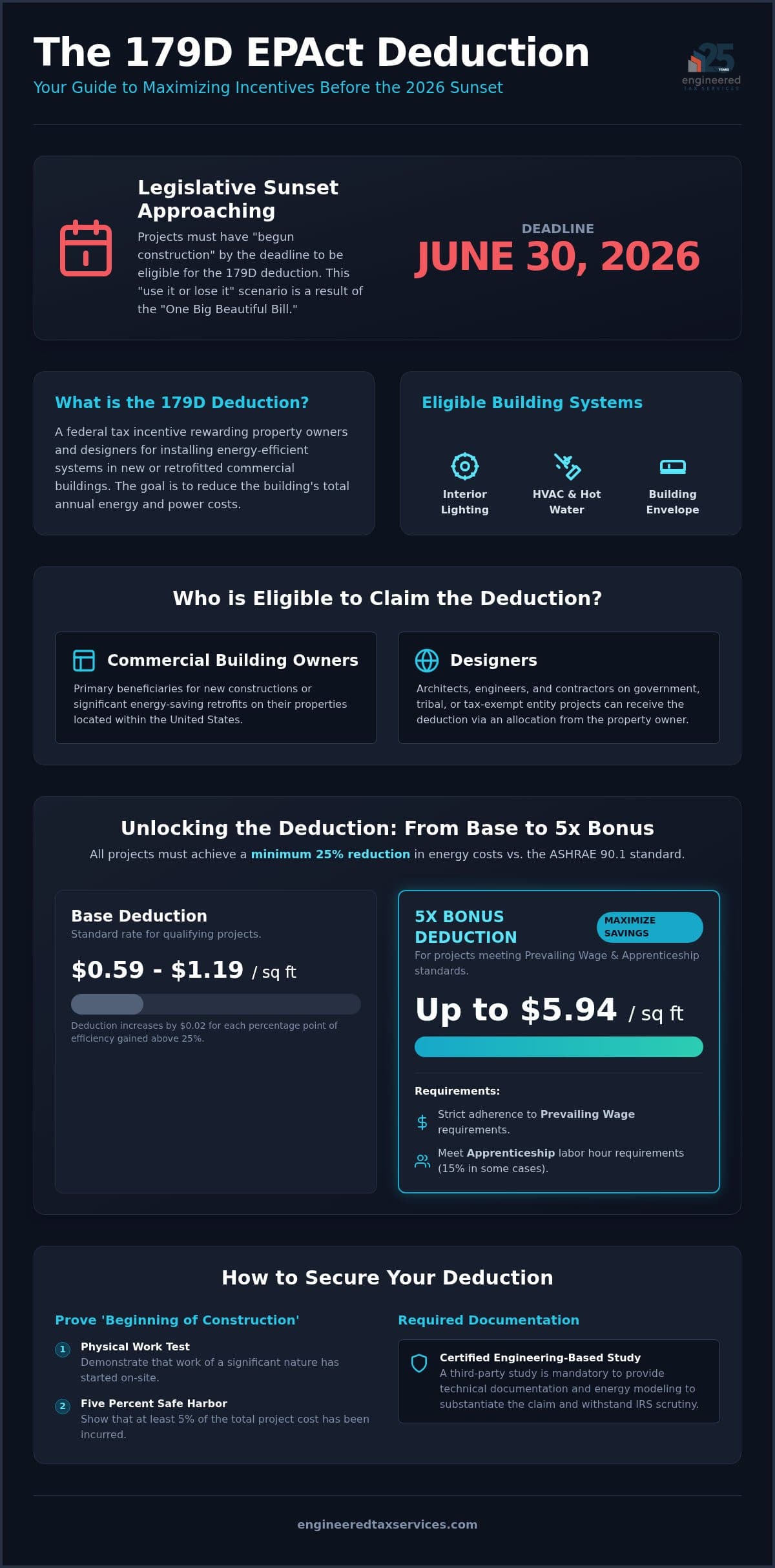
The clock is ticking on one of the most lucrative federal tax incentives for the built environment. Under the “One Big Beautiful Bill,” the legislative sunset is fast approaching for new projects, making 179D EPAct deduction eligibility a high-stakes race against the calendar for property owners and designers alike. If you don't establish that construction has legally “begun” by the mid-2026 deadline, you risk losing out on substantial incentives that can reach as high as $5.94 per square foot for compliant buildings.
It's understandable if you're feeling the pressure of evolving ASHRAE 90.1 standards or the looming anxiety of an IRS audit regarding your energy modeling precision. You've worked hard to optimize your building's performance, and the last thing you need is a documentation gap or a missed labor requirement to disqualify your investment. This guide will show you exactly how to navigate the current legislative landscape to secure your deduction before it disappears. We'll break down the “Physical Work Test,” the 15% apprenticeship labor hour requirements, and the strategic steps necessary to claim the 5x bonus deduction through full PWA compliance.
Key Takeaways
- Prepare for the June 30, 2026, legislative sunset by understanding how the “One Big Beautiful Bill” impacts the timeline for new energy-efficient projects.
- Determine your 179D EPAct deduction eligibility as a commercial building owner or a designer for government and tax-exempt entities.
- Learn to navigate the IRS “Beginning of Construction” rules to lock in your tax benefits through the physical work test or the five percent safe harbor.
- Secure the maximum $5.94 per square foot incentive by strictly adhering to prevailing wage and apprenticeship requirements.
- Recognize the necessity of a certified engineering-based study to provide the technical documentation required to withstand IRS scrutiny.
What is the 179D EPAct Deduction and the 2026 Sunset?
Section 179D provides a federal tax deduction for energy-efficient commercial building property (EECBP). Originally established by the Energy Policy Act of 2005, this incentive has been a cornerstone for sustainable development for nearly two decades. However, the legislative terrain shifted with the “One Big Beautiful Bill” (OBBB), which mandates that projects must begin construction by June 30, 2026. Failure to meet this timeline results in a total loss of eligibility for new projects initiated after that date.
To establish 179D EPAct deduction eligibility, buildings must demonstrate at least a 25% reduction in total annual energy and power costs compared to a reference building meeting ASHRAE 90.1 standards. This isn't just about compliance; it's a strategic move to recapture capital from high-performance investments. By lowering the energy threshold from 50% to 25%, recent updates have made the deduction accessible to a much wider range of retrofit and new construction projects.
Evolution of 179D Eligibility Rules
The Inflation Reduction Act of 2022 initially supercharged these benefits, lowering savings thresholds and increasing dollar amounts. While the 2021 Consolidated Appropriations Act had made the deduction permanent, the OBBB effectively reversed that status. It's now a “use it or lose it” scenario for developers and owners. If you don't secure your project's place in the pipeline before the mid-2026 sunset, you'll miss out on the most significant energy-efficient tax benefits in the current code.
Eligible Building Systems for Deduction
The IRS focuses on three primary areas where energy efficiency can be precisely modeled and verified. Most successful claims focus on these pillars:
- Interior Lighting: High-efficiency fixtures and advanced controls like occupancy sensors.
- HVAC and Hot Water: Modern heating, cooling, and ventilation systems that exceed minimum code requirements.
- Building Envelope: Improvements to insulation, high-performance windows, and reflective roofing.
Focusing on these specific systems creates the technical foundation for a successful claim. At Engineered Tax Services, we act as the bridge between building science and tax law to ensure these systems are documented with the precision the IRS demands.
Core Eligibility Criteria: Who and What Qualifies?
Confirming your 179D EPAct deduction eligibility requires looking beyond simple ownership. While commercial building owners of new construction or significant retrofits are the primary beneficiaries, a unique provision allows designers to claim the deduction for buildings owned by government, tribal, or tax-exempt entities. This includes architects, engineers, and contractors who are responsible for the energy-efficient specifications. Because these tax-exempt owners don't pay federal income tax, they're permitted to allocate the deduction to their design partners, creating a significant financial incentive for public sector projects. To qualify, the property must be located within the United States and fall into specific categories like warehouses, offices, retail spaces, or multifamily buildings that stand at least four stories tall.
The Internal Revenue Service guidance clarifies that the property must be depreciable and the systems must be installed as part of a plan to reduce energy and power costs. This broad geographic and sector scope makes the deduction a versatile tool for portfolio optimization, provided the technical benchmarks are met. If you're unsure how your current project pipeline fits these categories, a specialized 179D EPAct Tax Deduction assessment can provide the clarity needed to proceed with confidence.
The 25% Energy Savings Threshold
To unlock any level of deduction, the building must demonstrate a minimum 25% reduction in energy and power costs when measured against the ASHRAE Standard 90.1 reference building. This benchmark isn't a flat rate; it functions on a sliding scale that rewards higher performance. For projects not meeting labor standards, the base deduction starts at $0.59 per square foot at 25% savings and increases by $0.02 for every percentage point of additional efficiency, capped at $1.19. Documentation is vital here, as you'll need an engineering-based study to substantiate these specific cost reductions during any potential audit.
Prevailing Wage and Apprenticeship (PWA) Bonus
The most significant wealth-optimization opportunity lies in the PWA bonus, which increases the deduction value by 500%. To qualify for the enhanced 2026 rates, which range from $2.97 to $5.94 per square foot, you must ensure that all laborers are paid local prevailing wages and that at least 15% of total labor hours are performed by qualified apprentices. Meeting these rigorous labor standards transforms a modest tax break into a substantial capital injection that can fund future growth. PWA compliance is the single most effective way to maximize the value of your energy-efficient investments before the 2026 deadline.
Navigating the 2026 Deadline: The ‘Beginning of Construction' Rules
The “One Big Beautiful Bill” (OBBB) fundamentally altered the lifecycle of energy-efficiency tax planning. While Section 179D was once considered a permanent fixture of the tax code, the OBBB introduced a hard termination date. To maintain 179D EPAct deduction eligibility, your project must establish that construction has officially begun no later than June 30, 2026. Missing this cutoff doesn't just reduce the benefit; it eliminates the opportunity for any project initiated after that date. The IRS provides two distinct pathways to prove your project meets this requirement: the Physical Work Test and the Five Percent Safe Harbor.
Success depends on technical precision and rigorous documentation. Proving you've crossed the threshold requires more than a signed contract or a verbal commitment. It involves a detailed analysis of project milestones and expenditures, often necessitating an engineering perspective to substantiate that the work performed is of a “significant nature” as defined by IRS Notice 2023-43.
The Physical Work Test for 2026 Projects
The Physical Work Test focuses on tangible, significant progress. This includes on-site activities like excavating for a foundation, installing plumbing or electrical systems, or even off-site manufacturing of specialized, custom-designed equipment. It's vital to distinguish these from preliminary activities. Planning, designing, securing permits, or clearing the site do not count toward the “beginning of construction” under IRS rules. Once work starts, you must also maintain a “Continuous Program of Construction” to protect your eligibility. Any significant, unexplained work stoppages could jeopardize the deduction, even if you met the initial deadline.
Utilizing the 5% Safe Harbor Strategy
For projects where physical work hasn't yet reached a significant stage, the 5% Safe Harbor offers a financial alternative. This method requires the building owner to have paid or incurred at least 5% of the total project cost before the June 30, 2026 deadline. Calculating this threshold involves a comprehensive look at all depreciable costs associated with the energy-efficient property. Binding written contracts are essential here; they serve as the primary evidence that costs were legally incurred. Maintaining meticulous financial records is critical, as the IRS will scrutinize these expenditures to ensure they were bona fide and directly related to the qualifying systems. For complex retrofits, this strategy often provides a more predictable path to compliance than the Physical Work Test.
Designer Allocations: Eligibility for Government and Non-Profits
The unique structure of Section 179D offers a rare opportunity for professionals who design public and non-profit infrastructure. Under the rules for 179D EPAct deduction eligibility, entities that don't pay federal income tax can't directly benefit from the deduction. Instead, these owners are permitted to allocate the tax benefit to the “Designer,” which is defined as the person or firm primarily responsible for creating the technical specifications of the energy-efficient systems. This includes architects, engineers, and contractors who drive the efficiency of the building's envelope, lighting, or HVAC systems.
Securing this benefit requires a formal Allocation Letter. This document must be signed by an authorized representative of the building owner and serves as the legal transfer of the deduction. It's not a mere formality; it's a critical piece of technical documentation. Without a correctly executed letter, the IRS will disallow the claim, regardless of how efficient the building actually is. For professionals in these fields, understanding the 179D tax deduction architects engineers pathway is essential for maximizing the financial return on public sector projects before the 2026 deadline. Firms seeking a comprehensive walkthrough of every required step should also review the 179D allocation letter process for architects and engineers to ensure their documentation is fully IRS-compliant.
Eligible Tax-Exempt Entity Owners
The scope of organizations that can allocate their deductions expanded significantly in recent years. This now includes a wide array of entities that form the backbone of our communities:
- Government Buildings: Federal, state, and local facilities such as public schools, universities, courthouses, and municipal offices.
- Non-Profits and Religious Institutions: 501(c)(3) organizations, including hospitals, private schools, and places of worship.
- Tribal and Native Entities: Tribal governments and Alaska Native Corporations are fully eligible to allocate deductions to their design partners.
Maximizing ROI for Architecture and Engineering Firms
For design firms, Section 179D is more than a tax break; it's a strategic competitive advantage. When bidding on public contracts, the ability to facilitate a tax-efficient project can differentiate your firm from competitors. However, the timing of the allocation is paramount. You shouldn't wait until the project is finished to request the letter. Best practices suggest securing the commitment for allocation during the contract negotiation phase or early in the design process. This ensures that all parties are aligned on the goal of efficiency and that the necessary data collection for the engineering study begins on day one.
This proactive approach is especially vital for energy efficient commercial renovations where systems are being integrated into existing structures. As the June 30, 2026 deadline approaches, the competition for these allocations will likely intensify. Firms that have established rigorous processes for documenting their design intent and energy modeling will be best positioned to claim these high-value incentives. If you're a designer currently working on a tax-exempt project, contact Engineered Tax Services to ensure your allocation documentation is IRS-ready.
The Necessity of an Engineering-Based 179D Study
Claiming a tax incentive of this magnitude requires more than just standard accounting; it demands a fusion of engineering expertise and tax law. While a standard CPA is indispensable for your annual filings, they typically lack the specialized tools and licenses required to certify 179D EPAct deduction eligibility. The IRS mandates that a qualified third party, specifically a licensed engineer or contractor, must perform the certification using Department of Energy (DOE) approved software. This requirement ensures that the energy savings claimed are grounded in physical reality rather than just financial projections.
Every claim must be backed by a comprehensive Engineered Incentives Report. This document acts as your first line of defense during an IRS audit. It details the building's energy modeling, the specific systems installed, and the precise calculations comparing the property to the ASHRAE reference building. At Engineered Tax Services, we've conducted over 10,000 tax studies annually, providing the technical precision needed to mitigate audit risk and secure these high-value deductions. Technical precision isn't just a requirement. It's a wealth preservation strategy.
IRS-Approved Software and Modeling Requirements
Creating a “Reference Building” model is a highly technical process. It involves simulating a hypothetical structure that meets minimum code requirements and then comparing its energy performance against your actual building. This data-driven approach is the bedrock of 179D EPAct deduction eligibility. It requires a deep understanding of building physics, thermal loads, and lighting power densities. This level of technical scrutiny is similar to what you'd find at a specialized R&D tax credit engineering firm, where technical substantiation is the primary product.
Next Steps: Securing Your 2026 Deduction
The June 30, 2026 deadline doesn't leave much room for delay. If you're planning a project or have recently completed one, scheduling a preliminary 179D assessment is your next logical move. This review identifies potential gaps in your labor standards compliance or energy modeling before they become permanent liabilities. Partnering with a firm that has a national footprint ensures that your documentation meets the most current federal standards. Take the initiative now to Consult with Engineered Tax Services to secure your 179D eligibility and ensure your energy-efficient investments deliver their full financial potential.
Secure Your Energy Efficiency Incentives Today
The transition from the Inflation Reduction Act to the “One Big Beautiful Bill” has created a definitive expiration date for energy-efficiency incentives. To maintain 179D EPAct deduction eligibility, you must act now to ensure your projects meet the “beginning of construction” criteria before June 30, 2026. Whether you're leveraging the Physical Work Test or the 5% Safe Harbor, the window for wealth optimization is narrowing. Success requires a strategic approach to labor standards and technical documentation that only a specialized partner can provide.
As an independent, licensed engineering firm that conducts over 10,000 tax studies annually, Engineered Tax Services stands as the national authority on these complex incentives. We provide the technical precision required to bridge the gap between building science and tax law, ensuring your documentation is audit-ready. Don't leave your capital on the table as the legislative landscape shifts. Secure your 179D eligibility before the 2026 deadline with a free ETS assessment and position your portfolio for long-term financial stability. Your proactive planning today will preserve the growth and efficiency of your assets for years to come.
Frequently Asked Questions
Is the 179D deduction being repealed in 2026?
Yes, the deduction is being sunsetted for new projects by the “One Big Beautiful Bill” (Public Law 119-21). Any project that begins construction after June 30, 2026, will no longer be eligible for the incentive. Projects that establish “beginning of construction” before this mid-year deadline can still claim the deduction upon completion, even if that occurs in later years.
Who is eligible to claim the 179D deduction for a government building?
The primary designers of the energy-efficient systems are eligible to claim the deduction. Since government and tax-exempt entities don't pay federal income tax, they're permitted to allocate the tax benefit to the architects, engineers, or contractors responsible for the design. This transfer requires a formal allocation letter signed by the building owner to legally substantiate the claim.
What is the ‘Beginning of Construction' deadline for 179D in 2026?
The hard deadline is June 30, 2026. To qualify, you must prove construction started via the Physical Work Test or the Five Percent Safe Harbor. The former requires starting physical work of a significant nature, while the latter requires incurring at least 5% of the total project cost. Preliminary activities like permitting or site clearing don't satisfy these IRS requirements.
Can multifamily buildings qualify for 179D EPAct eligibility?
Multifamily buildings qualify if they're four stories or taller. These high-rise residential structures are treated as commercial property for tax purposes. To confirm 179D EPAct deduction eligibility for these projects, the building must achieve at least a 25% energy cost reduction compared to the applicable ASHRAE 90.1 standard. Residential buildings with three stories or fewer generally fall under the 45L tax credit instead.
How much is the 179D deduction per square foot in 2026?
The amount varies based on energy savings and labor compliance. For projects meeting prevailing wage and apprenticeship (PWA) standards, the 2026 deduction ranges from $2.97 to $5.94 per square foot. If these labor requirements aren't met, the rate is significantly lower, ranging from $0.59 to $1.19 per square foot. The specific value increases by $0.12 (PWA) or $0.02 (base) for every percentage point of savings above 25%.
What systems are included in a 179D energy efficiency certification?
The certification evaluates three specific building subsystems. These include the interior lighting systems, the heating, cooling, ventilation (HVAC) and hot water systems, and the building envelope, which encompasses insulation, roofing, and windows. An engineering study models these components collectively to determine if the building meets the mandatory 25% energy reduction threshold required for 179D EPAct deduction eligibility.
Do I need an engineering firm to claim the 179D deduction?
Yes, the IRS mandates that a qualified third party must certify the energy savings. This professional must be a licensed engineer or contractor who uses IRS-approved software to model the building's performance. Because the deduction relies on complex building science rather than simple accounting, a standard CPA cannot provide the technical certification necessary to withstand a federal audit.
What is the difference between the 179D deduction and 45L tax credit?
The primary differences are the building type and the benefit structure. Section 179D is a deduction for commercial and high-rise multifamily buildings based on square footage. In contrast, Section 45L is a tax credit for residential energy efficiency, targeting single-family homes and multifamily units under four stories. While 179D requires complex energy modeling, 45L focuses on meeting specific Energy Star or Zero Energy Ready Home standards.