Between 22% and 45% of a hospitality asset's depreciable basis is routinely trapped in a standard 39-year schedule, even though it consists of specialized guest-focused infrastructure rather than structural framing. When elevated debt service and surging operating expenses compress margins, waiting four decades to recover your invested capital creates an unnecessary drag on portfolio growth. You already know that mandatory franchise Property Improvement Plans (PIPs) demand relentless reinvestment. However, absorbing those capital projects without a specialized tax strategy bleeds vital liquidity. Implementing engineering-based cost segregation for hotels and motels resolves this strain by systematically reclassifying infrastructure into 5- and 15-year recovery periods.
In this 2026 guide, you'll discover how a rigorous, engineering-led study unlocks immediate first-year cash flow through permanent 100% bonus depreciation, while capturing abandoned asset deductions during renovations. We examine the precise technical standards, asset classifications, and IRS audit techniques necessary to protect and optimize your hospitality investments with absolute confidence.
Key Takeaways
- Discover how cost segregation for hotels and motels isolates short-life personal property and dedicated utility feeds to front-load vital depreciation deductions.
- Identify high-yield allocations across guestrooms, commercial kitchens, and exterior site improvements that qualify for accelerated recovery schedules.
- Learn how to write off the remaining tax basis of demolished components during mandatory franchise Property Improvement Plans using partial asset dispositions.
- Protect your deductions against IRS examination by applying rigorous engineering-based methodologies that meet current IRS audit techniques standards.
What Is Cost Segregation for Hotels and Motels?
A formal cost segregation study applies rigorous engineering principles to dissect a commercial property's acquisition or construction cost. For hospitality operators, this technical analysis separates short-life personal property and land improvements from standard 39-year nonresidential real property under the Modified Accelerated Cost Recovery System (MACRS). Executing engineering-based cost segregation for hotels and motels reclassifies qualifying components into 5-, 7-, and 15-year recovery periods. This technical reallocation front-loads substantial depreciation deductions, unlocking vital working capital and measurably improving debt service coverage ratios.
Moving Beyond 39-Year Straight-Line Depreciation
Standard tax preparation often reflexively assigns an entire commercial acquisition to a 39-year straight-line depreciation schedule. This default treatment traps valuable equity in the building basis for nearly four decades. By shifting eligible assets into accelerated MACRS schedules, hotel owners pull future deductions directly into the current tax year. As outlined in our strategic guide to cost segregation commercial property planning, accelerating depreciation preserves capital that would otherwise vanish into tax liabilities, immediately strengthening cash reserves against debt obligations.
Why Hospitality Assets Yield Unusually High Reclassification Percentages
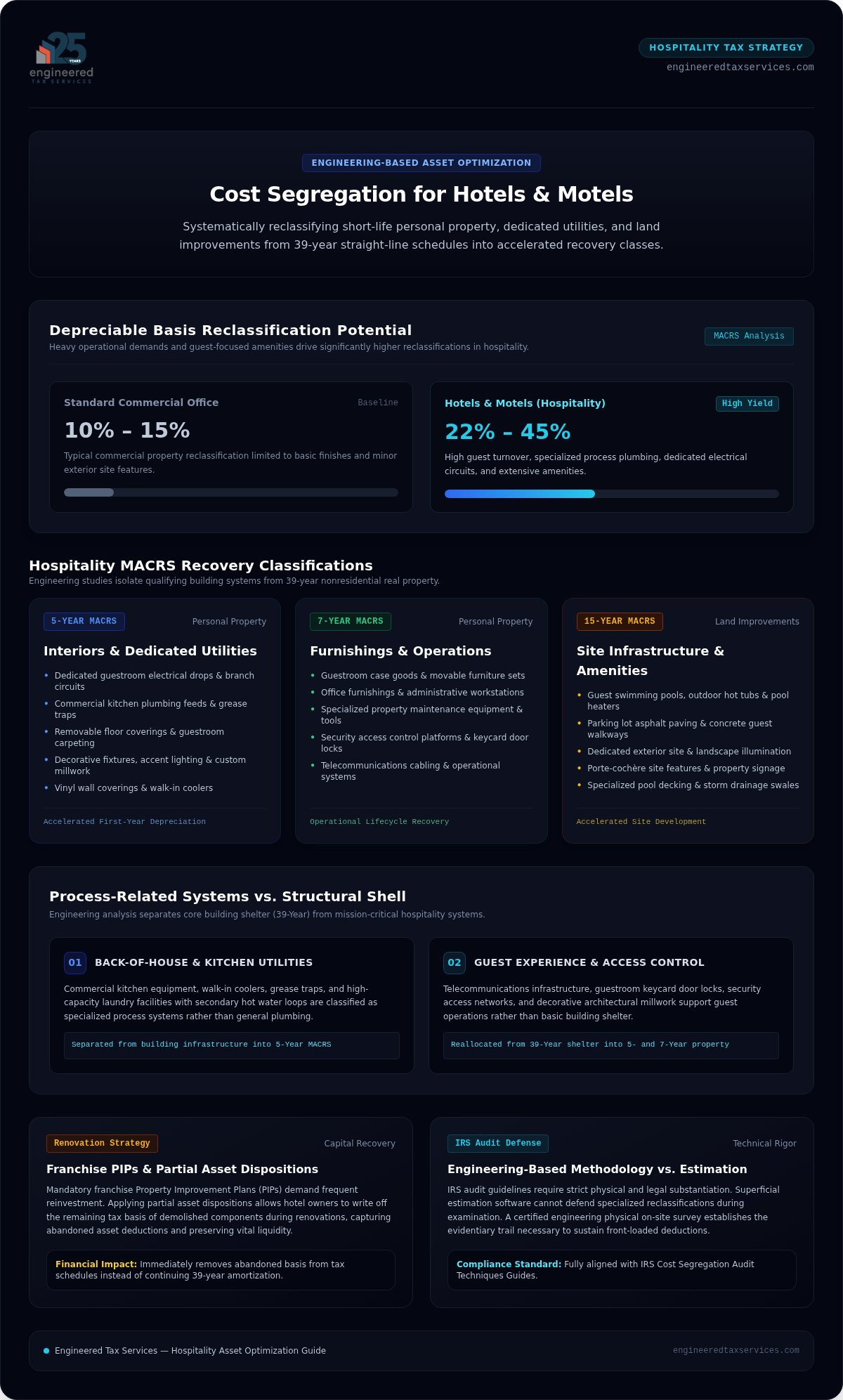
While standard commercial office buildings typically reclassify only 10% to 15% of their basis, lodging facilities operate under far more demanding operational requirements. Between 22% and 45% of a hotel or motel's total depreciable basis routinely reclassifies into shorter recovery periods. Heavy guest turnover demands frequent aesthetic refreshes, dedicated plumbing feeds, and complex electrical systems that support hospitality operations.
A comprehensive engineering analysis identifies multiple specialized asset categories across the property:
- 5-year personal property: Dedicated guestroom electrical drops, accent lighting, specialized branch circuits, decorative millwork, commercial kitchen plumbing feeds, and removable floor coverings.
- 15-year land improvements: Exterior signage, parking lot paving, guest walkways, swimming pool facilities, dedicated outdoor lighting, and porte-cochère site features.
Because the IRS demands strict physical and legal substantiation under its audit guidelines, superficial estimation software cannot defend these specialized reclassifications. Only a certified engineering methodology provides the precise evidentiary trail needed to secure these front-loaded deductions.
High-Yield Asset Allocations in Hotel and Motel Properties
Capturing maximum depreciation on hospitality assets requires an on-site physical survey that distinguishes process-related building systems from the standard structural shell. Applying cost segregation for hotels and motels isolates specialized equipment, guest amenities, and land improvements that standard tax reporting misclassifies as 39-year building components.
| Asset Classification | MACRS Life | Qualifying Hospitality Components |
|---|---|---|
| Personal Property | 5-Year | Carpeting, decorative fixtures, commercial kitchen assets, dedicated wiring |
| Personal Property | 7-Year | Guestroom case goods, office furnishings, specialized maintenance tools |
| Land Improvements | 15-Year | Guest pools, parking lots, site lighting, storm drainage swales, decking |
5-Year and 7-Year Personal Property: Interiors and Operations
Guest accommodations and operational hubs contain dense concentrations of short-life assets. These encompass decorative lighting, custom millwork, vinyl wall coverings, and removable guestroom carpeting. Back-of-house operations rely on commercial kitchen equipment, grease traps, walk-in coolers, and high-capacity laundry facilities with secondary hot water loops. Security access control platforms, telecommunications cabling, and guestroom keycard door locks also fall directly into these shorter recovery classes because they support guest operations rather than basic building shelter.
15-Year Land Improvements: Enhancing Site Value
Site amenities enhance curb appeal while presenting substantial acceleration opportunities. Swimming pools, outdoor hot tubs, pool heating systems, and specialized decking qualify for 15-year recovery. Exterior infrastructure including asphalt parking lots, concrete curbs, perimeter security fencing, porte-cochère paving, storm drainage swales, and landscape irrigation networks also qualify under land improvements rather than nondepreciable land basis.
Specialized Mechanical, Electrical, and Plumbing (MEP) Infrastructure
The most frequently overlooked deductions reside within specialized MEP infrastructure. Dedicated branch circuits powering individual PTAC units, guestroom refrigerators, and vanity hair dryers qualify for 5-year personal property treatment under established tax court precedent. Dedicated plumbing lines exclusively servicing guestroom bathrooms, commercial dishwashers, and lounge bars are similarly reclassified. Quantifying these allocations requires rigorous engineering load calculations to determine the exact percentage of power and plumbing dedicated to process functions. Partnering with licensed specialists like Engineered Tax Services ensures that these complex MEP segregations are thoroughly documented and defensible under IRS scrutiny.
Property Improvement Plans (PIPs) and Partial Asset Dispositions
Franchise license agreements routinely mandate that hotel owners execute comprehensive Property Improvement Plans (PIPs) every 5 to 10 years to maintain brand compliance. These capital-intensive renovations force operators to gut guestrooms, replace corridors, and overhaul mechanical systems. Too often, owners capitalize the new improvements while quietly abandoning the unamortized cost basis of the demolished components. Integrating engineering-based cost segregation for hotels and motels with the Tangible Property Regulations under Treasury Decision 9636 transforms this financial drain into substantial tax liquidity through Partial Asset Dispositions (PAD).
Step-by-Step Execution of Partial Asset Disposition (PAD)
To capture an immediate tax loss on retired building components, operators must execute a methodical engineering and accounting sequence:
- Establish asset baselines: Before demolition begins, an engineering survey documents the precise physical scope of items slated for removal, from guestroom plumbing fixtures to branch wiring.
- Apply engineering deflation: Because the original purchase price lumped these items into aggregate real property, engineers use the Producer Price Index (PPI) to discount replacement costs back to the original placed-in-service date, establishing their true historical basis.
- Claim current-year ordinary losses: The remaining net book value of the removed assets is recognized as an immediate ordinary loss on a timely filed original return, rather than depreciating ghost assets over 39 years.
Aligning these disposals directly with broader commercial real estate depreciation strategies ensures you capture allowable deductions without triggering compliance issues.
Transforming Mandatory Brand PIP Cycles into Tax Liquidity
Mandatory PIP cycles replace high volumes of physical building components long before their standard accounting life expires. When an operator replaces 200 guestroom PTAC units, miles of corridor carpeting, and dozens of commercial kitchen hoods, that retired equipment still carries unrecovered capital basis. Under IRS rules, taxpayers can write off that remaining basis immediately while expensing direct removal and demolition costs in the current tax year.
Instead of funding brand-required upgrades purely through retained earnings or expensive commercial debt, a documented partial asset disposition converts demolition debris into immediate tax savings. This recovered capital directly funds subsequent renovation phases, lowering borrowing requirements and protecting operating margins across volatile hospitality cycles.
Tax Strategies for Hotels in 2026: Bonus Depreciation, Section 179D, and 1031 Synergy
Deploying cost segregation for hotels and motels creates maximum value when integrated into a comprehensive tax plan. Recent statutory changes reward proactive investors who align engineering studies with current bonus depreciation schedules, energy credits, and long-term portfolio exit structures.
Applying Bonus Depreciation to Hotel Acquisitions in 2026
Under the One Big Beautiful Bill Act (OBBBA), 100% bonus depreciation is permanently available for qualifying assets acquired and placed in service after January 19, 2025. This permanent reinstatement allows hotel buyers to immediately expense 100% of the basis allocated to 5-, 7-, and 15-year property during the first year of operation. For properties acquired in previous tax cycles, owners don't need to amend prior returns. Filing IRS Form 3115 (Application for Change in Accounting Method) allows you to execute a retroactive look-back study, claiming all missed depreciation in a single lump-sum deduction on your current return. If passive activity loss limits or specific debt covenants make massive first-year write-offs disadvantageous, taxpayers can selectively elect out of bonus depreciation by asset class under Section 168(k)(7).
Layering the Section 179D Energy-Efficient Commercial Building Deduction
Major lodging facilities frequently install central chillers, advanced HVAC units, and LED lighting retrofits to lower utility costs. If construction began on or before June 30, 2026, these upgrades may qualify for the 179D energy efficient commercial building deduction. For 2026, baseline deductions range from $0.59 to $1.19 per square foot, escalating to $2.97 through $5.94 per square foot when prevailing wage and apprenticeship mandates are satisfied. Pairing energy modeling with cost segregation substantiates dual tax incentives across identical equipment upgrades without double-counting basis.
Managing Recapture and Maximizing 1031 Exchange Transfers
Accelerating depreciation raises common concerns about Section 1245 recapture upon sale, which taxes personal property gains at ordinary rates. Forward-thinking operators neutralize this hurdle by pairing asset sales with qualified 1031 exchange services. By matching Section 1245 and Section 1250 property classes when acquiring a replacement hotel, investors defer both capital gains and recapture liabilities indefinitely.
To evaluate the full tax yield across your hospitality holdings, consult with our licensed engineering team to design a customized depreciation and tax incentive strategy.
Why IRS Scrutiny Requires an Engineering-Based Study
The IRS explicitly identifies engineering-based cost studies as the most reliable methodology for reclassifying commercial real estate. In its updated Cost Segregation Audit Techniques Guide (ATG), the agency details the 13 principal elements of a quality study, placing heavy emphasis on physical inspection and construction-based cost estimating. While the audit rate for entities implementing cost segregation remains low at 0.078%, unsubstantiated claims invite rigorous examination. Applying cost segregation for hotels and motels requires defensible technical substantiation to protect accelerated write-offs from costly recalculations.
The Pitfalls of Rule-of-Thumb Estimates and Algorithmic Tools
Automated software estimators and desktop spreadsheets rely on generic industry averages rather than empirical physical data. These shortcut tools fail to account for custom field alterations, complex utility drops, or structural load variations unique to hospitality assets. Tax examiners routinely reject blanket percentage allocations during an audit. When an algorithm misclassifies structural building elements as personal property, property owners face asset disallowance, back taxes, interest, and steep accuracy-related penalties under Section 6662 of the Internal Revenue Code.
The Engineering-Based Methodology Behind Defensible Studies
A defensible study bridges the technical gap between structural engineering and tax law. Licensed professional engineers and certified cost segregation specialists conduct thorough on-site physical inspections, cataloging every component across guestrooms, mechanical plants, and exterior amenities. They review complete architectural plan sets, contractor payment applications, and structural specifications.
To withstand IRS review, certified studies deliver clear, verifiable documentation:
- Detailed architectural takeoffs: Exact physical quantities for framing, dedicated branch wiring, specialty plumbing, and civil improvements.
- Unit-cost pricing: Standardized costing models referencing recognized construction databases to price individual components accurately.
- Photographic and legal evidence: Comprehensive visual records paired with relevant tax court precedents and revenue rulings defending each allocation.
Engineering firms completing over 10,000 annual studies nationwide provide the structural documentation and institutional expertise required to defend accelerated tax deductions across any hospitality asset class.
Accelerate Your Hospitality Returns Through Precision Engineering
Capturing the full financial potential of your lodging assets requires moving beyond passive, 39-year straight-line depreciation schedules. Implementing engineering-based cost segregation for hotels and motels empowers operators to front-load significant tax deductions, transform mandatory PIP cycles into immediate write-offs, and safeguard capital reserves against operating pressure. When combined with permanent 100% bonus depreciation and disciplined partial asset dispositions, precision cost recovery becomes a powerful engine for ongoing portfolio expansion.
Protecting these aggressive write-offs demands rigorous technical substantiation. Engineered Tax Services completes over 10,000 engineering tax studies annually across all 50 states. Staffed by licensed professional engineers and certified valuation analysts, our multidisciplinary team includes full technical audit defense with every engineering-based tax report to ensure complete compliance with IRS guidelines.
You don't have to leave substantial tax savings locked inside your building basis. Request a complimentary preliminary benefit analysis from Engineered Tax Services to uncover exactly how much dormant capital is waiting in your hospitality portfolio.
Frequently Asked Questions
Can I perform a cost segregation study on a hotel purchased in a prior tax year?
Yes, you can perform a retroactive look-back study on any hotel acquired in a prior tax year without amending previous returns. By filing IRS Form 3115 under automatic consent procedures, you capture all unclaimed cumulative depreciation as a single Section 481(a) adjustment in the current year. This allows property owners to immediately generate substantial liquidity from assets placed in service years ago, regardless of how straight-line deductions were originally claimed.
How do Property Improvement Plans (PIPs) interact with cost segregation studies?
A cost segregation study acts as the critical baseline for evaluating Property Improvement Plans. When a brand requires extensive renovations, the engineering report establishes the exact historical tax basis of items being demolished. Under Tangible Property Regulations, you can immediately write off this remaining book value as a partial asset disposition. Simultaneously, new PIP capital improvements are segregated into accelerated recovery classes, maximizing current-year cash flow.
Does a cost segregation study trigger depreciation recapture when selling a motel?
Reclassifying assets accelerates depreciation, which does subject personal property gains to Section 1245 recapture at ordinary income tax rates upon sale. However, motel operators routinely mitigate or eliminate this tax exposure through strategic planning. Structuring the disposition via a like-kind 1031 exchange allows you to roll Section 1245 and 1250 liabilities directly into replacement commercial assets, deferring recapture and preserving capital for continuous portfolio reinvestment.
What percentage of a hotel's purchase price typically reclassifies to shorter asset classes?
Performing engineering-based cost segregation for hotels and motels typically reallocates 22% to 45% of the total depreciable basis into 5-, 7-, and 15-year property classes. Hospitality assets achieve much higher percentages than standard commercial offices because of their specialized amenities, heavy mechanical and plumbing systems, dedicated guest electrical feeds, and outdoor recreation facilities. The exact reclassification percentage depends on the property's age, tier, service level, and physical layout.
Is an on-site engineering physical inspection mandatory for an IRS-defensible study?
Yes, an on-site physical inspection by qualified personnel is a core requirement under the IRS Cost Segregation Audit Techniques Guide. IRS examiners consistently reject desk audits and algorithm-only estimates because they cannot substantiate specific field conditions, wiring runs, or structural modifications. A licensed engineer must personally tour the property, verify physical components, capture photographic evidence, and correlate construction records to create a legally defensible evidentiary report.
Can cost segregation deductions offset active hospitality business operating income?
Yes, accelerated depreciation deductions can directly offset active hospitality operating income for qualifying taxpayers. Unlike standard long-term residential or commercial leases, hotels and motels generally operate as active businesses under Treasury Regulation Section 1.469-1T if average guest stays are seven days or fewer and significant personal services are provided. Consequently, cost segregation deductions often bypass passive activity loss limitations, shielding hotel operational profits from federal income tax.
How does cost segregation work if my hotel is owned through a partnership or LLC?
For hotels owned through a partnership or multi-member LLC, cost segregation deductions flow directly through to individual partners via Schedule K-1. The partnership files the study with its federal return, allocating the accelerated depreciation based on ownership percentages or specific operating agreement allocations. Applying cost segregation for hotels and motels at the entity level gives individual members significant non-cash losses to shelter distributed hospitality cash flow on their personal filings.