What if the most significant cash flow opportunity for your residential development vanishes before the second half of 2026? With the Section 45L credit set to expire on June 30, 2026, developers are racing to certify projects under the newest Energy Star and DOE standards. You likely recognize that maximizing a project's value requires more than just standard tax filing. It demands a sophisticated approach to asset classification. Many builders worry that combining 45L tax credit with cost segregation might complicate their basis adjustments or lead to compliance headaches.
It's a complex landscape, but the rewards for those who navigate it correctly are substantial. We'll show you how to stack these incentives to unlock immediate capital, leveraging the permanent restoration of 100% bonus depreciation to offset construction costs. This article delivers a clear roadmap for integrating engineered incentive reports into your 2026 strategy. You'll discover how to protect your project's internal rate of return while ensuring every unit reaches its maximum financial potential before the legislative window closes.
Key Takeaways
- Maximize immediate cash flow by stacking Section 45L credits with accelerated depreciation before the June 30, 2026, legislative deadline.
- Unlock significant project value by combining 45L tax credit with cost segregation through a unified engineering-based analysis of mechanical, electrical, and plumbing systems.
- Navigate the 2026 tax landscape by understanding how 100% bonus depreciation and basis reduction rules impact your total depreciable basis.
- Improve your internal rate of return by following a strategic implementation roadmap that aligns energy efficiency targets with tax optimization.
- Mitigate IRS scrutiny by moving beyond non-engineering estimates and utilizing precision-based Engineered Incentives Reports for technical documentation.
The Strategic Advantage of Stacking Section 45L with Cost Segregation
Developers are navigating a unique fiscal window in 2026. The permanent restoration of 100% bonus depreciation via the One Big Beautiful Bill Act (OBBBA), coupled with the impending expiration of Section 45L on June 30, 2026, has shifted the priority toward immediate capital recovery. Stacking these incentives isn't just about tax savings; it's a strategic move to improve your internal rate of return (IRR). By combining 45L tax credit with cost segregation, you transform static building components into active liquidity. You gain credits for immediate cash flow today while using accelerated depreciation for sophisticated basis management over the project's lifecycle.
There's a common misconception that layering these benefits constitutes a “double-dip” that might trigger an audit. In reality, the IRS provides clear guidance on how these incentives interact. While claiming the 45L credit requires a reduction in the property's depreciable basis, the two strategies are complementary. You aren't claiming the same dollar twice. Instead, you're using a credit to offset tax liability directly while using depreciation to manage your taxable income. This dual approach ensures that the higher costs associated with energy-efficient construction are recovered rapidly, providing the liquidity needed for your next development.
Understanding Section 45L in the Post-IRA Era
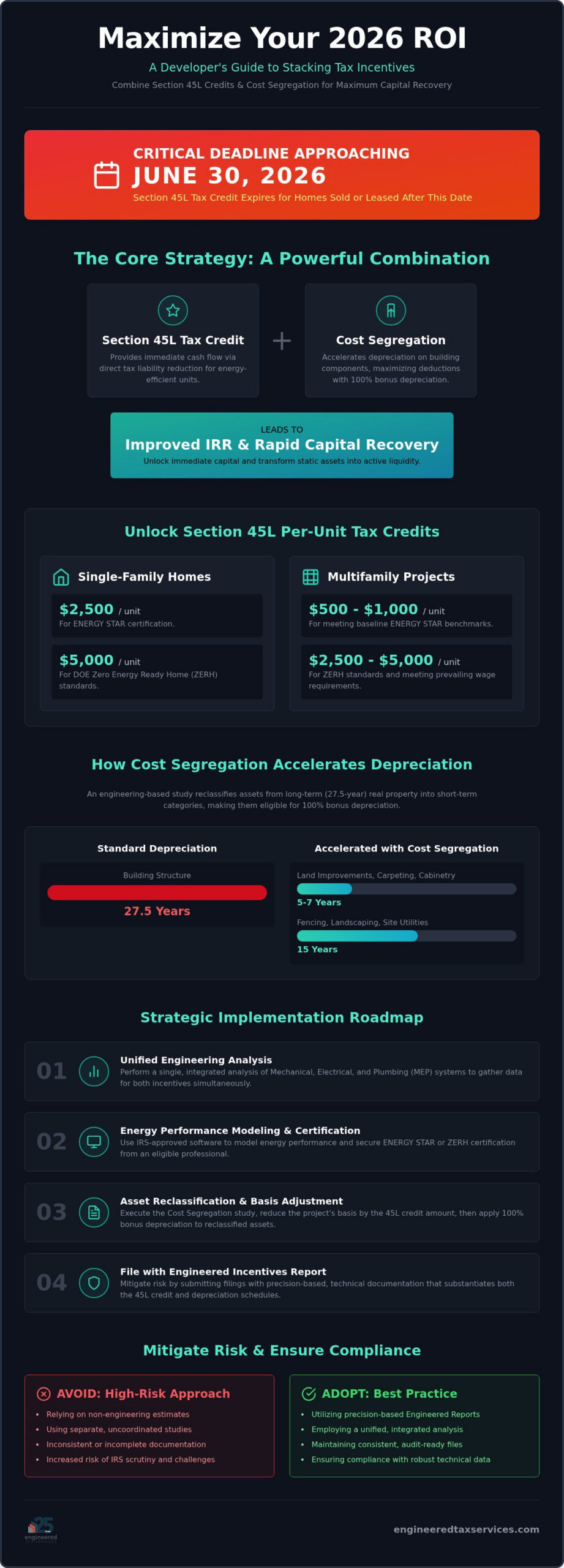
The Section 45L credit has evolved into a significant per-unit incentive for residential developers. For single-family homes, developers can secure a $2,500 credit for Energy Star certification or $5,000 for DOE Zero Energy Ready Home (ZERH) standards. Multifamily projects offer even more scalability. Credits range from $500 to $5,000 per unit, depending on whether the project meets prevailing wage requirements and high-efficiency benchmarks. Because these credits expire for homes sold or leased after June 30, 2026, project timelines must be accelerated to capture this value before the window closes.
The Role of Cost Segregation in Real Estate Wealth Optimization
While 45L focuses on energy performance, a Cost segregation study focuses on the physical components of the structure. This engineering-based analysis reclassifies assets like specialized electrical systems, decorative finishes, and site improvements from a 27.5-year recovery period into 5, 7, or 15-year categories. This reclassification is essential for cost segregation commercial property strategies, as it maximizes the net present value of your investment. By utilizing an Engineered Incentives Report, developers can ensure their accelerated deductions are backed by technical precision that stands up to IRS scrutiny while maximizing investor distributions.
Technical Synergy: The Engineering Requirement for Dual Benefits
Achieving the full financial potential of a residential development requires more than a simple accounting review. It demands a rigorous, engineering-based analysis of the building's physical systems. When developers consider combining 45L tax credit with cost segregation, they often overlook the technical overlap between these two incentives. Both studies rely on a granular understanding of a property's mechanical, electrical, and plumbing (MEP) systems. By utilizing a unified R&D tax credit engineering firm approach, you can eliminate administrative friction and ensure that your technical documentation is consistent across all tax filings. This technical synergy allows for a single point of data collection, significantly reducing the time your team spends on document requests and site access.
Modeling Energy Performance for 45L Compliance
Energy performance isn't a guessing game. For 45L compliance, engineers use IRS-approved third-party software to model the building envelope and HVAC efficiency. This modeling determines whether a unit meets Energy Star or the more rigorous Zero Energy Ready Home (ZERH) standards. Identifying building envelope and HVAC components that serve both studies is a primary advantage of an integrated approach. For example, high-performance windows contribute to the energy rating for 45L while their installation costs are analyzed for depreciation. All certifications must be signed by eligible professionals, which is why a licensed engineering firm is a critical partner in this process. Site visits and blueprint modeling provide the necessary substantiation to withstand IRS scrutiny.
Asset Identification for Accelerated Depreciation
Cost segregation identifies personal property and land improvements that can be reclassified for faster recovery. This includes isolating 5, 7, and 15-year assets within residential units, such as decorative finishes, specialized flooring, and site-related infrastructure. We also document indirect construction costs like architectural fees and permits, ensuring they are allocated proportionally to maximize your first-year write-off. Our engineers audit MEP systems to verify energy efficiency ratings for 45L while simultaneously identifying specific components, like dedicated power feeds for appliances, that qualify for accelerated depreciation. This level of detail provides a robust defense during an audit, as every claim is backed by physical evidence. To ensure your project is positioned for maximum optimization, you should partner with engineers who understand both the tax code and the structural construction process. Combining 45L tax credit with cost segregation through a single Engineered Incentives Report ensures that no value is left on the table during the 2026 tax year.
Financial Impact: Bonus Depreciation and Basis Adjustments in 2026
The financial landscape for residential developers shifted dramatically with the enactment of the One Big Beautiful Bill Act (OBBBA) in 2025. While the industry previously braced for a decline in tax benefits, the permanent restoration of 100% bonus depreciation has created an unprecedented window for capital recovery. By combining 45L tax credit with cost segregation, you can now write off the full cost of reclassified assets in the first year while simultaneously capturing per-unit energy credits. This synergy doesn't just reduce your tax liability; it serves as a powerful engine for liquidity, allowing you to reinvest capital into new projects at a much faster rate than traditional 27.5-year depreciation schedules allow.
Calculating the true ROI of this dual strategy requires looking beyond the immediate tax savings. For affordable housing developers, the benefits are even more pronounced. Since 2023, the IRS has confirmed that claiming the 45L credit doesn't reduce the basis for Low-Income Housing Tax Credit (LIHTC) projects. This allows developers to stack these incentives without the penalty of a reduced credit for their low-income units. When you factor in that a cost segregation study typically reclassifies 20% to 40% of a property's components into accelerated categories, the combined impact on your internal rate of return (IRR) is transformative. You're effectively leveraging engineering precision to unlock hidden equity in your building's physical envelope.
Leveraging the Restoration of 100% Bonus Depreciation
The reversal of the bonus depreciation phase-out has redefined 2026 tax planning. Because you can now claim a 100% first-year deduction for qualifying 5, 7, and 15-year property, the value of identifying those assets through cost segregation has never been higher. High-net-worth investors and institutional developers are using this restoration to offset the higher costs associated with meeting DOE Zero Energy Ready Home (ZERH) standards. It's a proactive wealth preservation strategy that ensures the “green” premium paid for energy efficiency is recovered immediately through aggressive depreciation, rather than over decades.
Basis Adjustments and Tax Liability
It's vital to understand the “Basis Reduction” rule when combining 45L tax credit with cost segregation. Under Section 45L, the depreciable basis of the home or unit must be reduced by the amount of the credit claimed. For example, if you secure a $5,000 ZERH credit for a single-family home, your basis for depreciation decreases by that same $5,000. Managing this adjustment requires technical precision to ensure you're still maximizing your total dollar benefit across all asset classes. For a deeper look at the specific math involved in large-scale projects, consult our 45L tax credit multifamily guide. Maintaining strict compliance during this process is what separates a standard tax filing from a high-performance wealth optimization strategy.
The Developer's Implementation Checklist: A Step-by-Step Guide
To secure maximum value from residential developments, developers must move beyond reactive tax planning. A proactive framework ensures that energy efficiency and asset classification are integrated into the project's DNA from day one. Successful implementation of combining 45L tax credit with cost segregation requires a synchronized timeline that aligns with both construction milestones and IRS deadlines. This structured approach prevents missed opportunities during the design phase and ensures that your technical documentation is ready for filing long before the tax year ends.
- Pre-Construction: Set energy efficiency targets (Energy Star vs. ZERH) based on projected credit value and construction costs.
- Construction Phase: Maintain detailed digital records of MEP specifications, building envelope materials, and material invoices.
- Completion: Secure third-party energy certifications before the June 30, 2026, legislative expiration.
- Tax Filing: Coordinate the cost segregation study with IRS Form 8908 to ensure all basis adjustments are accurately reflected.
- Audit Defense: Retain a comprehensive engineering report as the primary substantiation for all reclassified assets and energy claims.
Phase 1: Planning and Certification
Developers should verify project eligibility under the residential dwelling unit definition early in the design phase. Engaging a specialized engineering firm at this stage allows for a preliminary 45L assessment, which is the first step in combining 45L tax credit with cost segregation effectively. This forecast helps determine whether the $2,500 Energy Star credit or the $5,000 ZERH credit offers the better ROI relative to construction costs. It's a strategic calculation that informs your building envelope and HVAC choices before ground is even broken, ensuring you don't overspend on efficiency upgrades that don't yield a proportional tax benefit.
Phase 2: Execution and Reporting
As construction nears completion, the engineering-based cost segregation site visit becomes the priority. This is the moment where physical assets are identified and reclassified for accelerated depreciation. A unified engineered tax incentives report provides the necessary technical bridge, documenting both the energy compliance for 45L and the asset reclassification for cost segregation. This report finalizes basis adjustment calculations, ensuring your tax filing is both aggressive and compliant. Technical precision here is vital for audit defense. By organizing a permanent tax file with engineering support, you provide the IRS with a defensible narrative of how every dollar was allocated and why every credit was earned. To ensure your project meets every technical requirement before the 2026 expiration, you should request a project feasibility assessment today.
Mitigating Risk with Specialized Engineering Expertise
High-value tax strategies naturally attract attention from the Department of the Treasury. While combining 45L tax credit with cost segregation offers a significant boost to a project's cash flow, it also creates a complex web of basis adjustments and technical certifications. The primary risk for developers lies in the methodology used to derive these figures. If your claims are based on non-engineering estimates or simple accounting shortcuts, you lack the technical substantiation required during an IRS examination. A licensed engineering firm provides the bridge between the physical structure and the tax code, ensuring that every asset reclassification and energy benchmark is backed by structural reality.
IRS agents look for a clear nexus between the tax benefit and the building's actual performance. When these studies are conducted in isolation or by firms without specialized MEP knowledge, inconsistencies can arise that trigger red flags. By utilizing a unified Engineered Incentives Report, you ensure that your 45L energy modeling and your cost segregation asset allocations are technically consistent. This proactive approach transitions your strategy from simple regulatory compliance to true wealth optimization, protecting the long-term stability of your investment portfolio.
IRS Substantiation Requirements
IRS guidance emphasizes the need for an independent, third-party energy certification. This means the person certifying the 45L credit cannot be an employee of the development firm. Licensed engineers play a critical role here, as they provide the professional validation required for both energy performance and asset life-cycles. The permanent tax file serves as the definitive record of a project's technical compliance, housing the engineering-based studies, third-party certifications, and basis adjustment calculations necessary to defend tax positions during an IRS examination. Without this level of documentation, developers risk the recapture of credits and the disqualification of accelerated depreciation deductions during a look-back period.
The ETS Advantage for Residential Developers
Engineered Tax Services (ETS) offers a distinct advantage by combining national reach with deep local knowledge of building codes and construction standards. Our reports are designed to integrate seamlessly with your standard tax filings, providing your CPA with the precise data needed for Form 8908 and depreciation schedules. We don't just provide a report; we provide a robust audit trail that protects your project's internal rate of return. This specialized expertise allows you to focus on your next development while we secure the technical precision your current project demands. To ensure your 2026 strategy is built on a foundation of accuracy, schedule a consultation with our engineering team.
Secure Your Competitive Advantage Before the 2026 Deadline
The convergence of the Section 45L expiration on June 30, 2026, and the permanent restoration of 100% bonus depreciation creates a unique window for residential developers. You've seen how combining 45L tax credit with cost segregation transforms building components into immediate cash flow while ensuring long-term basis management. By integrating these studies into a single report, you eliminate administrative friction and build a robust defense against IRS scrutiny. Success in this landscape requires more than just meeting energy standards; it demands a strategic partnership with technical experts who understand the intersection of engineering and tax law.
As a licensed engineering firm performing over 10,000 studies annually, we provide the specialized IRS audit support you need to maximize every unit's value. Optimize Your 2026 Tax Strategy with an Engineered Incentives Report today and position your portfolio for sustainable growth and long-term financial stability.
Frequently Asked Questions
Can I combine the 45L tax credit with the 179D deduction on the same building?
You can utilize both incentives on a single property if the building serves mixed purposes or meets specific height requirements. Section 45L is designed for residential dwelling units, while 179D targets commercial buildings or residential high-rises four stories and taller. For a mixed-use development, you might claim 45L for the individual apartments and 179D for the commercial retail space on the ground floor.
How does the 45L credit affect my depreciable basis for cost segregation?
Claiming the 45L credit requires a dollar-for-dollar reduction in the property's depreciable basis. If you secure a $5,000 credit for a zero-energy ready home, you must lower the basis of that unit by $5,000 before calculating depreciation. This adjustment is a critical step when combining 45L tax credit with cost segregation to ensure your total tax benefits remain compliant with IRS regulations.
What are the 2026 energy efficiency standards for the 45L tax credit?
To qualify for 45L in 2026, single-family homes must meet Energy Star Single-Family New Homes Version 3.2 or DOE Zero Energy Ready Home (ZERH) Single Family v2 standards. Multifamily developments must adhere to the Energy Star Multifamily New Construction Version 1.2. It's vital to note that units must be sold or leased by June 30, 2026, to qualify under current legislative timelines.
Is a cost segregation study still worth it with the 2026 bonus depreciation phase-out?
Cost segregation remains highly valuable because the 2026 bonus depreciation phase-out was reversed by the One Big Beautiful Bill Act (OBBBA). This legislation permanently restored 100% bonus depreciation for qualifying property placed in service after January 19, 2025. This means you can still write off the full cost of reclassified 5, 7, and 15-year assets in the first year, maximizing your immediate cash flow.
Who is eligible to certify a building for the Section 45L tax credit?
Certification must be conducted by an independent third-party professional who isn't related to the developer. This typically includes accredited energy raters or licensed engineers who use IRS-approved software to model the building's performance. A licensed engineering firm is often the preferred choice for combining 45L tax credit with cost segregation because they can provide technical substantiation for both the energy credits and asset reclassifications.
Can I retroactively claim the 45L credit using a cost segregation study?
You can claim the 45L credit for units sold or leased in prior open tax years, but a cost segregation study alone isn't sufficient. You must also have a contemporaneous third-party energy certification for those units. If you have the required certification, you can file an amended return or a Form 3115 to capture the missed credits and adjust your depreciation schedules accordingly.
What is the maximum 45L credit per unit for multifamily developers in 2026?
The maximum credit for multifamily developers is $5,000 per unit. To reach this amount, the units must be certified under the DOE Zero Energy Ready Home (ZERH) program and the project must meet specific prevailing wage requirements. If the developer doesn't meet the prevailing wage standards, the ZERH credit is reduced to $1,000 per unit, while the standard Energy Star credit drops to $500 per unit.
How does stacking 45L and cost segregation impact my project's IRR?
Stacking these incentives significantly boosts your project's internal rate of return (IRR) by accelerating capital recovery. By capturing a $5,000 per-unit credit and reclassifying 20% to 40% of the building's cost for 100% bonus depreciation, you drastically reduce your net tax liability. This front-loads your cash flow, allowing you to pay down debt or fund new developments much earlier in the project's lifecycle.