What if the most significant line item on your balance sheet isn't an expense, but an untapped reservoir of federal tax credits accessible through an engineered tax incentives report? Many commercial property owners feel the weight of high tax liabilities while struggling to interpret the permanent restoration of 100% bonus depreciation. It's a common concern that without rigorous documentation, claiming specialized incentives like the 179D deduction could invite unwanted IRS scrutiny. You understand that leaving capital on the table is a missed opportunity for growth, yet the technical complexity of these codes often leads to paralysis.
This strategic framework provides the clarity you need to bridge the gap between engineering precision and tax optimization. This article promises to show you how to unlock immediate cash flow and maximize federal credits before the critical June 30, 2026, deadlines for energy-efficient incentives. We'll preview the essential steps for building an audit-proof roadmap that preserves your wealth and accelerates your first-year deductions. By the end of this guide, you'll have a clear framework to turn technical data into a decisive financial advantage for your entire portfolio.
Key Takeaways
- Discover how an engineered tax incentives report utilizes technical engineering standards to uncover “hidden” assets that traditional accounting methods frequently miss.
- Understand the critical role of site inspections and engineering-based methodology in providing the technical substantiation the IRS requires for specialized credits.
- Learn why moving beyond “rule of thumb” estimates to rigorous engineering data is essential for maximizing ROI on energy-efficient deductions and cost segregation.
- Identify the strategic two-step process for implementation, starting with a preliminary feasibility analysis to project your potential cash flow impact.
- Gain insights into how partnering with a licensed engineering firm provides the “Expert's Expert” support needed to build an audit-proof roadmap for long-term wealth preservation.
What is an Engineered Tax Incentives Report?
An engineered tax incentives report is a specialized technical document produced by licensed engineers to identify, quantify, and substantiate federal and state tax-saving opportunities. While standard accounting focuses on historical compliance and general ledger entries, this report looks forward. It uses engineering-based methodologies to uncover “hidden” assets within a building's envelope, mechanical systems, and structural components. Understanding What are tax incentives? at a foundational level is a helpful starting point, but capturing their full value requires a bridge between tax law and physical engineering precision.
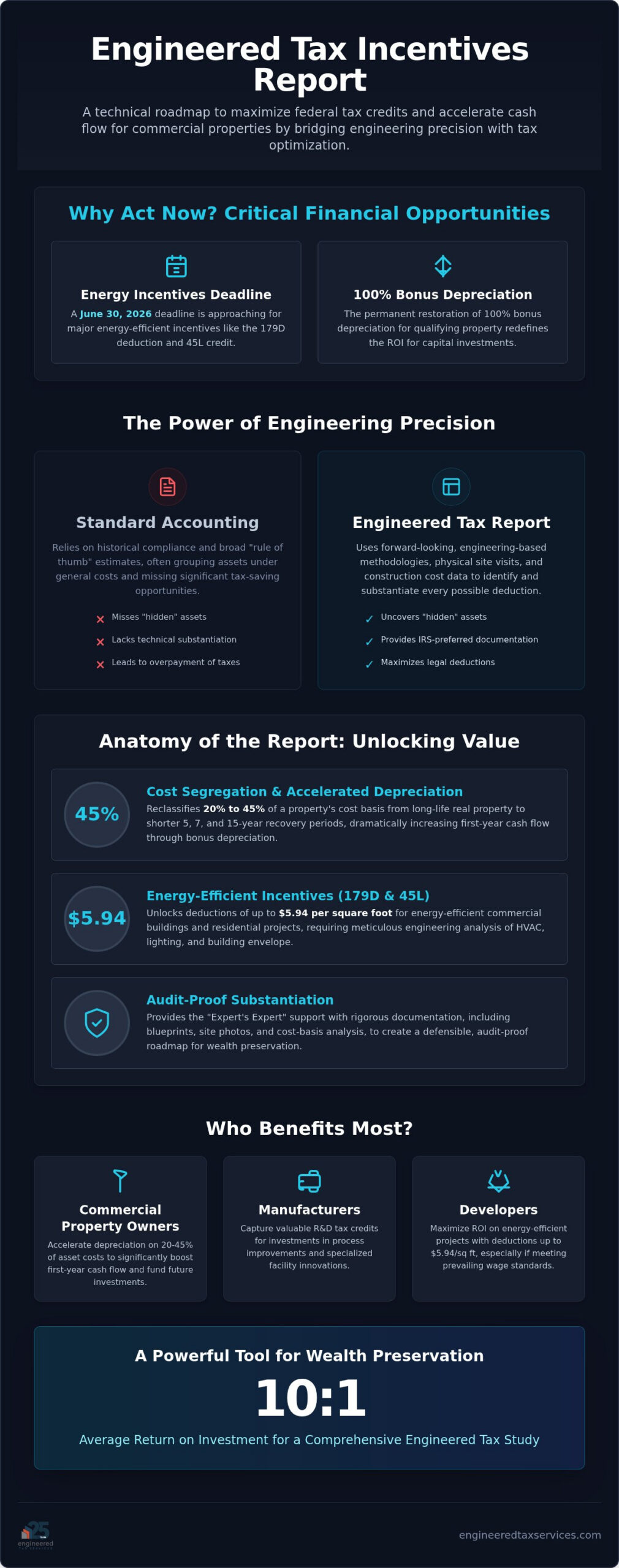
The timing for these reports has never been more critical. The permanent restoration of 100% bonus depreciation for qualifying property acquired after January 19, 2025, has redefined the ROI for capital investments. Because major energy-efficient incentives like the 179D deduction and the 45L credit face a sharp June 30, 2026, deadline, owners need a technical roadmap now. A generic tax summary simply can't provide the granular data needed to justify these high-value claims during an IRS review. You need a document that stands up to scrutiny while maximizing every available dollar.
The Intersection of Engineering and Tax Law
Physical site visits are the backbone of this process. Accountants often rely on broad “rule of thumb” estimates because they don't have the technical training to evaluate building systems. A licensed engineer identifies specific assets, like specialized electrical systems or energy-efficient HVAC units, that a general ledger might group under “building costs.” This distinction is vital; “engineered” means the data is rooted in physical reality and RSMeans construction costs. It provides a level of precision that protects the taxpayer while maximizing the legal deduction through technical substantiation that the IRS prefers over simple estimates.
Who Benefits Most from Strategic Incentive Analysis?
High-value asset holders see the most immediate impact from a comprehensive engineered tax incentives report. The average return on investment for these studies is approximately 10:1, making them a powerful tool for wealth preservation. Those who benefit most include:
- Commercial Property Owners: Investors can reclassify 20% to 45% of their cost basis to accelerated depreciation schedules, significantly increasing first-year cash flow.
- Manufacturers: Businesses investing in process improvements or specialized facilities can capture R&D tax credits for their technical innovations.
- Developers: Professionals focusing on energy-efficient projects can unlock deductions of up to $5.94 per square foot if they meet prevailing wage standards before the mid-2026 deadline.
The Anatomy of a Comprehensive Incentives Report
A high-caliber engineered tax incentives report serves as a technical bridge between physical construction and tax law. It isn't just a summary of costs; it's a forensic audit of your property's components. The executive summary provides an immediate view of projected ROI and cash flow impacts, which typically average a 10:1 return for most commercial assets. Engineers utilize RSMeans data to establish accurate cost bases for every item, ensuring the methodology aligns with rigorous IRS expectations. This level of detail includes asset classification across 5, 7, and 15-year recovery periods, supported by substantiation exhibits such as blueprints, site-specific photography, and detailed cost-basis documentation.
Cost Segregation and Accelerated Depreciation
Distinguishing between personal property and real property is the foundation of maximizing your 2026 return. Cost segregation reclassifies assets into shorter depreciation cycles to maximize front-loaded tax benefits. By identifying components like specialized millwork, decorative lighting, or dedicated electrical systems, a cost segregation commercial property study can reclassify 20% to 45% of a building's cost basis. This strategic shift accelerates your deductions and significantly boosts immediate liquidity during the first year of ownership.
Energy Incentives: 179D and 45L Analysis
Your report must meticulously document efficiencies in HVAC, lighting, and the building envelope to qualify for federal energy incentives. For residential projects, the analysis determines eligibility for the 45L tax credit multifamily developers rely on before the June 30, 2026, expiration. For commercial spaces, meeting prevailing wage and apprenticeship requirements is essential to unlock the maximum 179D deduction of up to $5.94 per square foot. Engineers provide the complex energy modeling required to substantiate these high-value claims against potential audits.
R&D Tax Credit Substantiation
Technical innovation often qualifies for significant credits, yet many businesses fail the IRS's “Four-Part Test” due to poor documentation. A comprehensive engineered tax incentives report identifies qualified research expenses across labor, supplies, and contractors. Partnering with an R&D tax credit engineering firm ensures that every “qualified research activity” is documented with forensic precision. This technical defense is crucial for sustaining credits during an audit. If you're unsure which incentives apply to your portfolio, a preliminary analysis at Engineered Tax Services can clarify your potential savings.
Engineering Methodology vs. Standard Accounting
Standard accounting is excellent for tracking historical transactions, but it lacks the technical depth required to categorize complex building systems. The IRS explicitly prefers an engineered tax incentives report because it replaces “rule of thumb” estimates with physical reality. While an accountant might look at a lump-sum invoice for an HVAC overhaul, an engineer performs a detailed site inspection to verify the existence and condition of every component. This process involves unit-cost estimation, where engineers calculate the specific value of building elements using industry-standard data. By tying every dollar to a physical asset, you build a “bulletproof” defense that standard accounting simply can't provide.
The difference lies in the level of granularity. An engineering-based study identifies the specific cost of the wiring, plumbing, and structural support dedicated to a particular piece of equipment. This isn't just an estimate; it's a forensic reconstruction of the construction process. When you present this level of detail, you shift the burden of proof. You aren't just claiming a deduction; you're providing a technical justification that is difficult for auditors to dispute. This precision is what turns a tax filing into a strategic wealth preservation tool.
The Risk of Non-Engineered Studies
Relying on simplified or DIY cost segregation is a high-risk strategy that often triggers red flags. The IRS frequently identifies “estimated” R&D claims or cost reclassifications that lack technical narratives as prime targets for adjustment. Without a licensed engineer's signature on your documentation, your claims lack the professional standing required to survive a deep dive. It's not just about the numbers; it's about the technical story behind them. If your documentation doesn't explain the “why” and “how” of an asset's classification, you're essentially guessing, and the IRS knows it.
Substantiation and the IRS Audit Standard
Navigating the IRS's “Audit Techniques Guide” for cost segregation requires an understanding of rigorous substantiation standards. For 2026, the expectations have shifted toward even greater transparency and contemporaneous documentation. This means recording the technical data at the time the study is performed, rather than trying to recreate it years later during an audit. Reports from Engineered Tax Services (ETS) are designed to align with these current standards, providing the level of detail necessary to justify accelerated depreciation and energy credits. Technical precision isn't just a value-add; it's the baseline for security in a high-stakes tax environment.
Strategic Implementation: Maximizing Your 2026 ROI
Executing a successful wealth optimization strategy requires more than just identifying credits; it demands a methodical approach to implementation. The process begins with a preliminary ‘No-Cost' feasibility analysis to project potential savings before committing to a full study, a step that clarifies the expected ROI for your specific asset class. Once the opportunity is confirmed, licensed engineers execute the site visit and technical data collection, ensuring every physical asset is forensicly documented. A critical advantage for innovators is combining 45L tax credit with cost segregation to capture overlapping benefits that traditional accounting often misses. Finally, an engineered tax incentives report provides the necessary technical substantiation to integrate these results seamlessly into your 2026 tax filing, turning engineering data into realized cash flow.
Planning for the Bonus Depreciation Phase-Out
While 100% bonus depreciation was permanently restored for qualifying property acquired after January 19, 2025, navigating the 2026 landscape still requires strategic foresight. Many investors overlook assets placed in service in prior years, missing out on significant front-loaded deductions that could be utilized today. IRC Section 481a allows you to claim missed depreciation from previous years in the current tax year through a “catch-up” adjustment without the need to file amended returns. This strategy is particularly powerful for properties acquired between 2023 and 2025 when bonus percentages were lower or fluctuating, as it allows for an immediate infusion of liquidity. Implementing this through an engineered tax incentives report ensures that your catch-up claims are supported by rigorous engineering data rather than mere estimates, providing security against future IRS inquiries.
Integrating Reports with 1031 Exchanges
Strategic engineering analysis is essential when your portfolio involves 1031 exchange services. A common pitfall for developers is failing to manage “recapture” risk, where the IRS taxes previously claimed depreciation upon the sale of an asset. By performing a detailed cost segregation study on both the relinquished and replacement properties, you can precisely track asset classifications to minimize this liability. This approach preserves your capital for the next commercial acquisition and ensures long-term wealth preservation across your entire investment lifecycle. It's about maintaining a proactive stance on your financial health rather than reacting to tax season surprises. To begin optimizing your current portfolio, you can request a feasibility analysis from our engineering team today.
Partnering with Engineered Tax Services for Your Report
With over 75,000 studies completed and $2 billion in tax savings generated over 25 years, Engineered Tax Services (ETS) stands as the premier national authority in technical tax optimization. More than 10,000 clients annually choose us to produce their engineered tax incentives report because our methodology is rooted in licensed engineering precision. We function as the “Expert’s Expert,” providing CPA firms and developers with the forensic substantiation required to withstand IRS scrutiny while maximizing immediate cash flow. Our reach extends across all 50 states; this ensures that regardless of your asset's location, you have access to specialized engineering expertise that traditional accounting firms simply don't possess.
Our commitment to professional integrity means we don't just find credits; we provide the peace of mind that comes with institutional knowledge. By bridging the gap between different professional disciplines, we act as a proactive advocate for your financial health. Precision is our baseline, but compliance is our promise. This result-oriented approach is why we're trusted by the IRS and recognized as a seasoned mentor in the field of specialized research and strategic implementation.
The ETS Process: From Consultation to Cash Flow
The journey toward wealth optimization begins with a structured consultation to align our methodology with your specific financial goals. During this initial phase, you'll work with a specialized engineer to determine the scope of your project. To ensure an efficient timeline, it's helpful to prepare the following documentation:
- Blueprints and Site Plans: These allow our team to conduct a preliminary analysis of building systems and structural components.
- Closing Statements: Essential for establishing the correct cost basis and acquisition dates.
- Fixed Asset Ledgers: These provide a historical view of previous capital expenditures and depreciation schedules.
A high-quality engineered study typically moves from data collection to a final report within a few weeks, depending on the complexity of the property. This methodical flow ensures that every asset is accounted for before your filing deadline.
Secure Your 2026 Strategy Today
Early planning is the most effective way to maximize your 2026 tax benefits. Waiting until the end of the fiscal year often results in missed opportunities for energy-efficient deductions that require specific modeling or site-specific data. By requesting your custom proposal for an engineered tax incentives report now, you position your portfolio for long-term stability and growth. Don't leave your wealth preservation to chance; take a proactive stance on your financial future. Schedule a consultation with our engineering team to begin your feasibility analysis.
Secure Your Financial Future with Technical Precision
Optimizing a commercial portfolio in 2026 requires a shift from passive accounting to proactive engineering. By leveraging a comprehensive engineered tax incentives report, you move beyond simple estimates to a forensic level of documentation that the IRS respects and expects. This strategic framework ensures you don't miss critical windows for energy credits or the benefits of permanently restored bonus depreciation. You've seen how layering incentives like cost segregation and 45L credits can transform immediate cash flow while providing a robust defense for your wealth preservation strategy.
As a licensed engineering firm performing 10,000+ annual studies, we provide an IRS-compliant methodology that stands up to the most rigorous scrutiny. Our team acts as your strategic partner, bridging the gap between technical data and financial growth. Don't wait for tax season to discover what you've left on the table. Take the first step toward unlocking your property's hidden potential today. Request Your Engineered Incentives Report Proposal and let our experts build your roadmap to long-term stability and success.
Frequently Asked Questions
What is an engineered tax incentives report?
An engineered tax incentives report is a customized preliminary analysis that identifies potential federal, state, and local tax incentives for a specific business based on its industry and location. It functions as a strategic roadmap, pinpointing opportunities for Cost Segregation, R&D credits, and energy deductions. This technical document allows property owners to project their potential ROI before committing to full-scale engineering studies.
How much does an engineered tax incentives report cost?
The investment for an engineering-based analysis varies based on the size of the property portfolio and the complexity of the assets involved. Fee structures are typically designed to align with the depth of technical research required to substantiate credits like 179D or 45L. Most firms offer a preliminary feasibility analysis to ensure the projected tax savings significantly outweigh the cost of the final documentation.
Can I use an engineered report for a property I bought years ago?
Yes, you can perform a “look-back” study on properties acquired in previous years to capture missed depreciation. Through IRC Section 481a, owners can claim these “catch-up” deductions in the current tax year without needing to amend prior returns. This strategy is highly effective for assets placed in service between 2023 and 2025, allowing you to unlock immediate liquidity from older investments.
Does an engineered tax study increase my risk of an IRS audit?
No, a high-quality engineering study actually decreases your audit risk by providing the technical substantiation the IRS requires for specialized claims. Because these reports are prepared by licensed engineers rather than using “rule of thumb” estimates, they meet the rigorous standards outlined in the IRS Audit Techniques Guide. Professional documentation acts as a proactive defense, ensuring your credits are forensicly supported from day one.
What is the difference between a cost segregation study and an engineered incentives report?
An engineered tax incentives report is a broad, preliminary analysis that identifies multiple credit opportunities, including R&D and energy-efficient deductions. In contrast, a cost segregation study is a deeper, forensic engineering analysis focused specifically on reclassifying building components into shorter depreciation schedules. While the incentives report provides the high-level strategy, the cost segregation study delivers the granular data needed for final tax filing.
How long does it take to complete an engineering-based tax study?
The timeline for a comprehensive study generally ranges from four to six weeks, depending on the availability of blueprints and the complexity of the site inspection. Once all technical data and closing statements are collected, licensed engineers require time to model energy efficiencies or calculate unit costs for asset reclassification. Planning ahead ensures your final report is ready well before your 2026 filing deadlines.
Do I need an engineered report if I'm already using bonus depreciation?
Yes, because bonus depreciation only applies to assets with a recovery period of 20 years or less. Without an engineered study to reclassify building components into 5, 7, or 15-year categories, you're likely applying standard 39-year depreciation to assets that should qualify for immediate expensing. Engineering precision maximizes the pool of assets eligible for bonus depreciation, significantly increasing your first-year cash flow.
Can my CPA perform an engineered tax incentives report?
While CPAs are experts in tax law and compliance, they typically lack the specialized engineering training required to perform physical site inspections and unit-cost estimations. The IRS prefers reports produced by licensed engineering firms because they provide the technical narratives and energy modeling that standard accounting cannot. Partnering with a specialized firm allows your CPA to focus on your overall tax strategy while we provide the forensic substantiation.