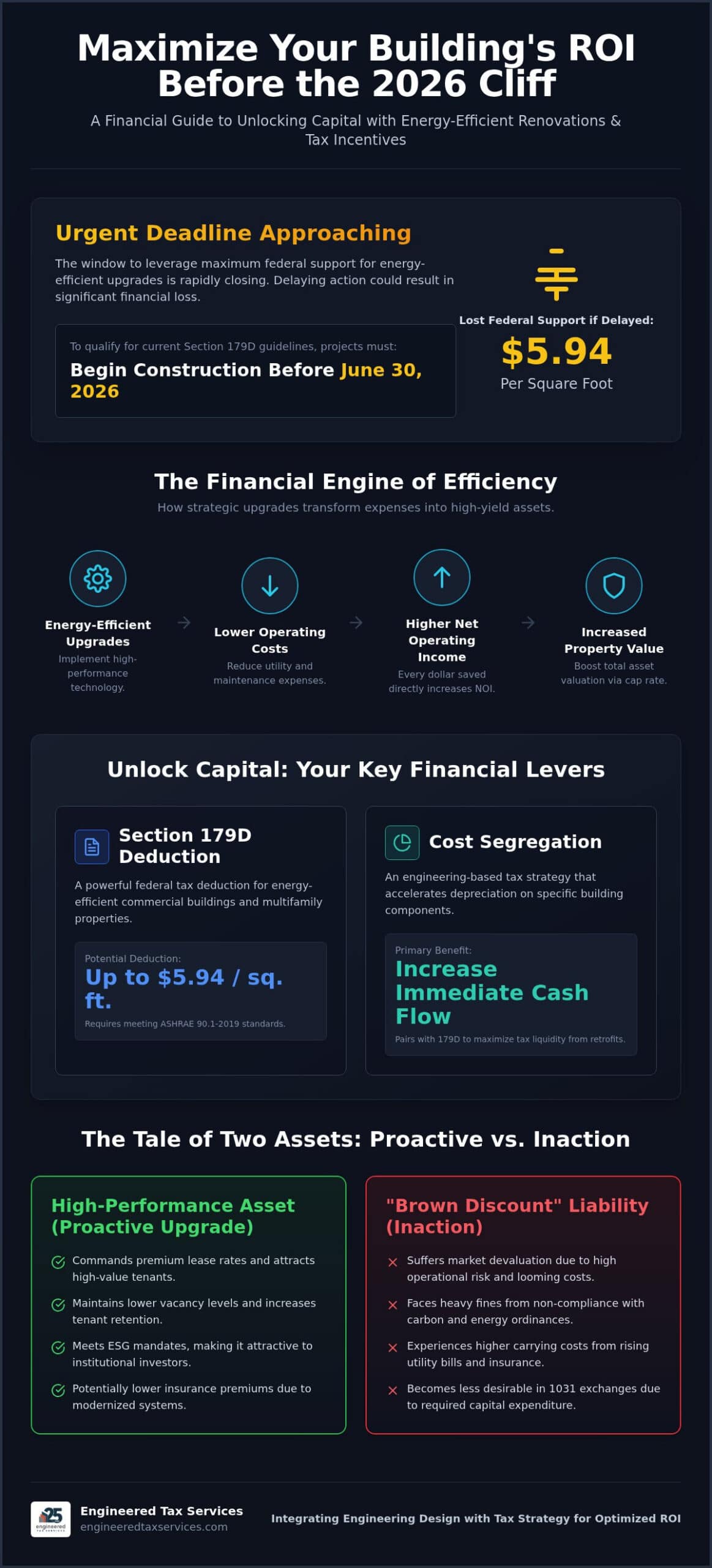
Did you know that waiting until July 2026 to start your building upgrades could cost you up to $5.94 per square foot in lost federal support? For many property owners, the window for maximizing the Section 179D deduction is rapidly narrowing, as projects must begin construction before June 30, 2026, to qualify under current guidelines. You've likely seen rising utility costs steadily erode your Net Operating Income while feeling the frustration of navigating complex, shifting tax regulations. It's a common challenge to balance high upfront capital requirements with the need for long-term building performance.
This strategic guide demonstrates how energy efficient commercial renovations are no longer just maintenance expenses; they're sophisticated financial instruments that use engineering data to unlock immediate tax liquidity. You'll discover how to transform these retrofits into high-yield assets that legally reduce your income tax liability and attract high-value tenants. We'll provide a clear roadmap for utilizing specialized federal incentives and technical precision to ensure your next project delivers a superior return on investment and long-term financial stability.
Key Takeaways
- Learn how strategic energy upgrades directly improve Net Operating Income (NOI) and property valuations through precision-engineered capital improvements.
- Explore high-performance technologies for energy efficient commercial renovations, including next-generation HVAC systems and advanced building envelopes.
- Navigate the complex compliance requirements of Section 179D and 45L to maximize federal tax deductions before 2026 sunset dates.
- Identify how pairing energy-efficient assets with cost segregation can accelerate depreciation and significantly increase your immediate cash flow.
- Follow a proven technical roadmap to integrate engineering design with tax strategy for optimized project ROI and long-term financial stability.
The Financial Case for Energy Efficient Commercial Renovations in 2026
Property owners often view building upgrades through the narrow lens of maintenance or aesthetic appeal. In 2026, this perspective is dangerously incomplete. Leading investors now treat energy efficient commercial renovations as high-performance capital improvements designed to optimize the balance sheet. By shifting the focus from simple repair to strategic optimization, you transform a building from a stagnant liability into a dynamic financial asset. This transition requires moving away from “simple payback” calculations, which only measure how long it takes to recoup costs through utility savings. Instead, sophisticated owners utilize Total Cost of Ownership (TCO) models that account for tax liquidity, reduced maintenance cycles, and long-term asset appreciation.
The math behind this strategy is grounded in fundamental real estate valuation. Every dollar saved in operational expenses through efficiency upgrades directly increases your Net Operating Income (NOI). When you apply a market capitalization rate to that increased NOI, the result is a substantial boost in total property value. In a high-interest-rate environment, where organic growth is difficult to find, engineering internal efficiencies becomes the most reliable path to wealth preservation. Integrating a sustainable refurbishment strategy into your portfolio isn't just about environmental stewardship; it's about maximizing the yield of every square foot you own.
The 2026 regulatory landscape adds a layer of urgency to these initiatives. With the Section 179D deduction currently set to sunset for projects starting after June 30, 2026, the window to capture federal support at rates up to $5.94 per square foot is closing. Building performance standards are no longer optional in many jurisdictions. They're mandatory. Proactive owners are leveraging these incentives now to fund the transition to ASHRAE 90.1-2019 standards, ensuring their properties remain compliant and competitive before stricter local ordinances take full effect.
Driving Property Value Through Performance
High-performance buildings command a distinct premium in the 2026 market. Institutional investors and credit-worthy tenants increasingly prioritize properties with robust ESG (Environmental, Social, and Governance) profiles to meet their own corporate mandates. This demand allows owners of energy-efficient assets to secure higher lease rates and maintain lower vacancy levels than their “brown” competitors. From a liquidity perspective, energy efficiency increases asset desirability during 1031 exchanges by providing buyers with a modernized, low-maintenance property that requires less immediate capital expenditure. It's a clear signal of institutional-grade management.
Mitigating Risk and Future-Proofing Assets
Ignoring building performance creates significant financial exposure. Properties that fail to meet modern efficiency standards often suffer from “brown discounts,” where the market devalues the asset due to looming retrofit costs and higher operational risks. Beyond market perception, 2026 brings tighter carbon tax mandates and aggressive local energy ordinances that can result in heavy non-compliance fines. Modernizing your systems also has a direct impact on commercial insurance premiums. Newer, high-efficiency HVAC and electrical systems represent a lower risk for equipment failure or fire, allowing for more favorable underwriting terms and lower annual carrying costs.
High-ROI Upgrades: A Roundup of 2026 Efficiency Technologies
Selecting the right technology for energy efficient commercial renovations requires more than a simple equipment swap. It demands a technical understanding of how disparate systems interact to reduce the building's total energy load. In 2026, the most successful projects move away from isolated upgrades in favor of integrated systems that communicate through smart grid protocols. These precision-engineered solutions don't just lower utility bills; they provide the technical data necessary to satisfy the rigorous certification requirements of the 179D energy efficient commercial buildings deduction.
Optimizing the Building Envelope
The building envelope serves as the first line of defense against thermal loss. Advanced glazing solutions, such as triple-pane windows and dynamic tinting glass, have become standard for high-yield assets because they dramatically reduce solar heat gain and cooling requirements. For urban properties, cool roofs and green roofing systems are essential tools for mitigating the heat island effect and extending the lifespan of the roof membrane. To secure the highest incentive tiers, engineers must conduct rigorous pressure testing or computational fluid dynamics modeling to provide empirical evidence of envelope airtightness and thermal resistance. This documentation is a cornerstone of any professional Engineered Incentives Report, ensuring every efficiency gain is captured for tax purposes.
Electrification and High-Efficiency HVAC
We're seeing a decisive shift away from gas-fired boilers toward industrial-scale heat pumps and electrification. Variable Refrigerant Flow (VRF) systems and Dedicated Outdoor Air Systems (DOAS) are now the preferred choice for energy efficient commercial renovations because they offer simultaneous heating and cooling with surgical precision. These systems eliminate the waste inherent in traditional central plants by moving thermal energy only where it's needed. When paired with Lighting-as-a-Service (LaaS) and high-output LED retrofits, these upgrades provide a rapid return on investment by slashing both energy consumption and ongoing maintenance costs.
The integration of Smart Building IoT and renewable energy is the final piece of the 2026 efficiency puzzle. AI-driven energy management systems (EMS) now predict peak demand by analyzing weather patterns and occupancy data in real-time. By incorporating on-site solar and battery storage, property owners can engage in “peak shaving,” which avoids expensive utility surcharges and creates a more resilient power profile. As building owners prepare for a future dominated by electric vehicles, integrating EV charging infrastructure into the primary power distribution system is no longer a luxury; it's a necessary step to maintain asset relevance and support high-value tenant needs.
Unlocking Capital: 179D, 45L, and Cost Segregation
Many property owners leave significant capital on the table by treating energy efficient commercial renovations as simple construction projects. In reality, these retrofits are specialized tax events that require a technical bridge between engineering and accounting. While local utility rebates offer modest relief, the most substantial financial support comes from federal incentives that demand rigorous technical substantiation. You can't rely on standard tax filings to capture these benefits. You need a formal technical tax study that translates building performance data into IRS-compliant tax liquidity.
Planning your project with the Advanced Energy Retrofit Guides from the Department of Energy provides a solid physical roadmap, but the financial payoff depends on meeting specific 2026 deadlines. For instance, the Section 45L tax credit offers a powerful incentive for multifamily renovation projects, but it's only available for units completed before June 30, 2026. Missing these windows can result in hundreds of thousands of dollars in lost tax credits, making early engineering intervention essential for wealth preservation.
The 179D Deduction for Building Owners
The Section 179D deduction remains the premier incentive for commercial property optimization. For projects starting construction before June 30, 2026, the base deduction ranges from $0.59 to $1.19 per square foot. However, you can unlock significantly higher tiers of $2.97 to $5.94 per square foot by meeting prevailing wage and apprenticeship requirements. Qualifying for these amounts requires achieving a 25% reduction in total annual energy and power costs compared to ASHRAE 90.1 standards. This process requires precision modeling using IRS-approved third-party software to verify the performance of your lighting, HVAC, and building envelope systems. Understanding your 179D EPAct deduction eligibility before construction begins is critical to ensuring your project qualifies for the highest available incentive tiers. For a comprehensive look at these compliance requirements, consult our 179D energy efficient commercial building deduction guide.
For architects and engineers working on government-owned buildings, it's also essential to understand the 179D allocation letter process, which governs how the deduction is transferred from the tax-exempt building owner to the qualifying designer before the June 30, 2026 deadline.
Cost Segregation and Energy Assets
Cost segregation is a strategic tool that allows you to accelerate depreciation by identifying 5, 7, and 15-year assets within your renovation budget. Instead of the standard 39-year schedule, you can front-load deductions for specialized energy-efficient assets like high-performance lighting and thermal control systems. By linking cost segregation commercial property studies with your energy credits, you create a synergistic effect that maximizes immediate cash flow. In 2026, bonus depreciation is scheduled at 20%, which means the immediate reclassification of assets is more critical than ever. This approach ensures that your energy efficient commercial renovations pay for themselves through tax savings long before the utility bills reflect the new efficiencies.
The Strategic Roadmap for a Successful Commercial Retrofit
Successful energy efficient commercial renovations require a synchronized approach that begins long before the first contractor arrives on site. Most failures in capturing tax benefits occur because the engineering team and the tax team operate in silos. To avoid this, your roadmap must integrate technical performance goals with financial modeling from day one. This proactive alignment ensures that every design choice contributes to both energy reduction and tax-basis optimization. The process typically unfolds across four critical phases.
- Phase 1: Preliminary Energy Audit and Tax Capacity Analysis. This initial assessment identifies which systems offer the highest potential for both energy savings and tax deductions.
- Phase 2: Engineering Design and Incentive Modeling. During this stage, engineers model the proposed upgrades against ASHRAE standards to ensure the project will meet the 25% to 50% energy reduction thresholds required for Section 179D.
- Phase 3: Procurement and Construction Management. This phase focuses on maintaining the integrity of the design specifications, preventing “value engineering” that might compromise tax eligibility for cheaper, less efficient components.
- Phase 4: Post-Renovation Certification and Tax Study Finalization. A licensed professional engineer conducts a final site visit to verify the installation and sign off on the technical study required for the IRS.
Selecting the Right Engineering Partner
While general contractors excel at managing timelines and trades, they rarely possess the specialized knowledge required for IRS technical substantiation. You need a partner who understands the intersection of building science and the tax code. Vetting firms for R&D tax credit engineering expertise is a reliable way to ensure they have the analytical rigor necessary for complex incentive modeling. Only a licensed Professional Engineer (PE) can provide the certified energy model required to claim the 179D deduction, making them a non-negotiable part of your project team. To ensure your project meets these rigorous standards, you should schedule a consultation with our licensed engineering team before finalizing your design documents.
Benchmarking and Performance Tracking
You cannot manage what you do not measure. Using tools like Energy Star Portfolio Manager allows you to establish a clear baseline of pre-renovation energy use, which is essential for calculating the 179D deduction accurately. This data serves as the foundation for your technical tax study, providing the empirical evidence needed to prove energy reduction. Beyond the initial tax filing, documenting “as-built” conditions and maintaining ongoing performance tracking creates a permanent audit defense. This level of technical precision is what differentiates high-yield energy efficient commercial renovations from standard building upgrades, providing peace of mind and securing your long-term financial results.
Maximizing Your Wealth with Engineered Tax Services
Engineered Tax Services functions as the technical bridge between your renovation project and the IRS. While your CPA manages your tax filings and your contractor handles the physical construction, ETS provides the licensed engineering analysis required to unlock the full financial potential of energy efficient commercial renovations. We specialize in translating complex building data into actionable tax liquidity. By conducting over 10,000 studies annually, our firm has established itself as the national authority on engineered tax incentives, ensuring your documentation stands up to the most rigorous professional standards.
Uncovering hidden capital within a renovation budget requires a granular look at every component, from the R-value of the insulation to the specific circuitry of the lighting control systems. Our approach doesn't just look for compliance; it looks for optimization. We identify specialized deductions and credits that often go unnoticed by general accounting firms, such as the 179D EPAct deduction and 45L credits. This technical precision ensures that your wealth is preserved and your cash flow is maximized through legally sound, engineering-based strategies. It's about finding the value that others miss.
Comprehensive Incentive Management
Our methodology goes beyond federal tax law to identify a comprehensive stack of local, state, and federal grants that can be layered with your tax deductions. For high-net-worth investors and institutional developers, this means creating a tailored wealth preservation strategy that accounts for the 20% bonus depreciation available in 2026 and the impending sunset of key energy provisions on June 30, 2026. Engineered Tax Services acts as a vital strategic partner for commercial developers by integrating technical engineering expertise with sophisticated tax planning to ensure every renovation project becomes a high-yield financial asset. We don't just find savings; we engineer them.
Getting Started with a Preliminary Analysis
The most successful projects involve our team during the earliest stages of the design process. By integrating ETS into your renovation design team, you can model the tax impact of different system choices before you spend a single dollar on equipment. We offer a no-cost initial feasibility assessment to help you understand your property's potential for incentives and to identify any technical hurdles early on. This preliminary analysis provides the clarity needed to make informed, data-driven decisions that align your building's performance with your financial goals. It's the first step toward securing your capital and future-proofing your portfolio. Contact Engineered Tax Services to optimize your renovation tax strategy.
Secure Your Building's Financial Future Before the 2026 Deadlines
The transition toward high-performance real estate is no longer a choice for the distant future; it's a present-day financial necessity. By integrating energy efficient commercial renovations into your capital improvement strategy, you effectively turn operational expenses into powerful tax liquidity. We've seen how precision-engineered upgrades like VRF systems and advanced glazing don't just lower utility costs, they directly enhance property valuations and Net Operating Income. With critical federal incentives like Section 179D and 45L facing significant deadlines in mid-2026, the cost of delay is measurable in lost tax-basis reduction.
As a premier national authority and a licensed engineering firm conducting over 10,000 studies annually, we provide the technical precision required to navigate complex IRS compliance. Our national coverage across the United States ensures that your portfolio remains optimized, regardless of jurisdiction. It's time to bridge the gap between building science and wealth preservation. We invite you to schedule a complimentary tax incentive analysis with our engineering experts to identify the hidden capital in your next project. You can transform your property into a resilient, high-yield asset today.
Frequently Asked Questions
What qualifies as an energy efficient commercial renovation for tax purposes?
Improvements to a building's lighting, HVAC, or envelope systems that achieve at least a 25% reduction in energy and power costs qualify for federal incentives. These energy efficient commercial renovations must be measured against a reference building meeting the minimum requirements of ASHRAE Standard 90.1. Qualifying assets include high-performance glazing, industrial heat pumps, and automated lighting controls that exceed current energy codes.
How much can I deduct under Section 179D in 2026?
For projects starting construction before June 30, 2026, the base deduction ranges from $0.59 to $1.19 per square foot depending on the level of energy savings achieved. If your project meets prevailing wage and apprenticeship (PWA) requirements, the deduction increases significantly to between $2.97 and $5.94 per square foot. These amounts are adjusted annually for inflation to ensure property owners receive maximum value for their capital investments.
Can I combine cost segregation with energy-efficient tax credits?
Yes, pairing cost segregation with energy-efficient tax credits is a sophisticated wealth-maximization strategy used by institutional investors. While Section 179D provides a per-square-foot deduction for whole-building performance, cost segregation allows you to reclassify specific components into shorter recovery periods. This dual approach front-loads your tax savings and creates immediate cash flow to offset the upfront costs of major retrofits.
Do energy-efficient renovations apply to older commercial buildings?
Older commercial buildings often represent the best opportunities for high-yield projects because their baseline energy performance is typically low. Retrofitting a 20-year-old structure with modern VRF systems or high-performance insulation makes it much easier to achieve the 25% energy reduction threshold required for tax incentives. These upgrades don't just secure tax breaks; they modernize the asset to attract high-value tenants and prevent “brown discounts.”
What is the difference between an energy audit and a 179D tax study?
An energy audit identifies operational savings opportunities, while a 179D tax study provides the technical engineering certification required by the IRS to claim a deduction. While both involve building analysis, a tax study requires precision modeling using IRS-approved software to compare the building against ASHRAE standards. A tax study must be signed by a licensed professional engineer to legally substantiate the claim on a tax return.
How does the Inflation Reduction Act affect commercial renovations in 2026?
The Inflation Reduction Act significantly increased the value of the 179D deduction and introduced the prevailing wage and apprenticeship bonus tiers. However, property owners should be aware of tightening deadlines, as several key provisions are scheduled to sunset in mid-2026. For example, the current 179D EPAct deduction eligibility is only available for projects that begin construction before June 30, 2026, using the “Physical Work Test” or “5% Safe Harbor Test.”
Is an engineering firm required to claim energy tax deductions?
Yes, the IRS requires a qualified professional, such as a licensed engineer, to certify the energy savings for a 179D deduction. A licensed engineering firm provides the technical rigor and audit-ready documentation necessary to withstand IRS scrutiny. Beyond simple compliance, an engineering-based approach ensures that your energy efficient commercial renovations are modeled accurately to capture the highest possible deduction tier based on actual performance data.
What is the typical ROI for a smart building technology retrofit?
While ROI varies by asset class, smart building retrofits often deliver a rapid return through a combination of utility savings, tax incentives, and reduced maintenance. AI-driven energy management systems can reduce HVAC energy consumption by 20% to 40% in many commercial applications. When you factor in the immediate tax liquidity from accelerated depreciation and 179D deductions, many property owners see a full return on their technology investment within three to five years.