What if the key to unlocking millions in immediate cash flow isn't hidden in your ledger, but within the physical blueprints of your property? Most property owners feel the weight of high tax liabilities, often fearing that aggressive claims might trigger a rigorous IRS audit. It's frustrating to watch capital sit idle in 39 year depreciation schedules when the 2026 tax landscape, shaped by the One Big Beautiful Bill Act, offers a permanent 100 percent bonus depreciation for qualified assets. This guide reveals how an engineering based tax study transforms standard compliance into a high yield wealth preservation strategy. You'll discover how to identify overlooked mechanical and electrical systems while securing IRS ready documentation that stands up to the most intense scrutiny.
We'll explore the technical precision required to maximize your 2026 cash flow and bridge the gap between complex physical assets and strategic financial growth. By utilizing a building to blueprint methodology, you can reclaim lost capital and ensure your portfolio is optimized for long term stability. This professional roadmap provides the clarity you need to navigate evolving regulations with absolute confidence.
Key Takeaways
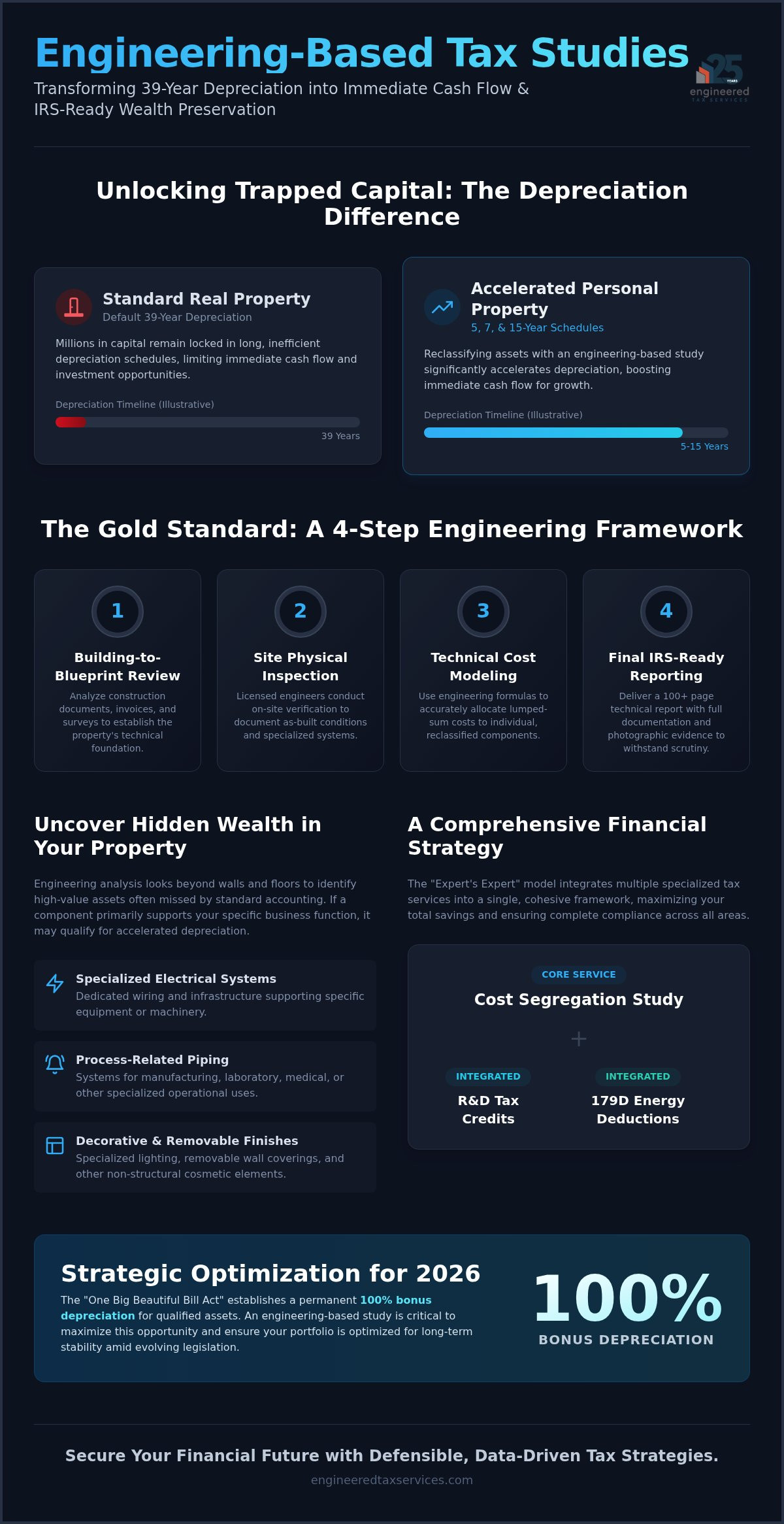
- Learn how licensed specialists reclassify 39-year real property assets into 5, 7, or 15-year schedules to significantly accelerate depreciation and maximize immediate capital.
- Understand why a defensible engineering based tax study is the gold standard for satisfying IRS documentation requirements and mitigating high-level audit exposure.
- Discover the efficiency of the “Expert's Expert” model, which integrates R&D credits and 179D energy deductions into a single, comprehensive reporting framework.
- Explore the building-to-blueprint methodology that uncovers hidden wealth in complex mechanical and electrical systems often missed by standard tax compliance.
- Identify strategic ways to optimize wealth in 2026, ensuring your depreciation strategy remains robust amid evolving bonus depreciation thresholds and legislative changes.
Defining the Engineering-Based Tax Study: Precision vs. Estimation
An engineering based tax study is a forensic technical analysis performed by licensed professionals to optimize a property's financial performance. It goes beyond standard accounting by dissecting a building's components to reclassify 39-year real property into shorter-lived personal property. This typically includes 5, 7, or 15-year recovery periods. A Cost Segregation Study rooted in engineering provides the granular detail necessary to move assets out of long-term buckets and into immediate cash flow opportunities.
Relying on “rule-of-thumb” percentages is a risky strategy that often leaves significant capital on the table. These broad estimates lack the documentation required to survive a close review. The IRS Audit Techniques Guide emphasizes that a detailed engineering approach is the most reliable method for substantiating these claims. It provides a defensible foundation that basic accounting estimates simply can't match, ensuring your wealth preservation strategy is built on data rather than guesswork.
The Intersection of Engineering and Tax Law
Structural knowledge is the critical bridge between physical reality and complex tax law. Engineers possess the training to identify indirect costs, such as portioned architect fees, specialized site preparation, or dedicated utility lines, that are frequently missed in standard audits. They interpret the technical nuances of IRC Section 1245 versus Section 1250 with a level of precision that basic accounting cannot replicate. This specialized expertise is why premier CPA firms across the nation partner with engineering firms. They recognize that technical depth is required to ensure total compliance while simultaneously maximizing the client's wealth preservation.
Identifying Eligible Assets Beyond the Surface
An engineering based tax study looks past the walls to find value in hidden systems. Many owners overlook assets that are vital to their specific operations. These commonly include:
- Specialized electrical systems supporting specific equipment or machinery.
- Process piping for manufacturing, laboratory, or medical use.
- Decorative finishes, specialized lighting, and removable wall coverings.
- Specialized industrial systems, such as the process equipment and dehydration solutions managed by TEG Reclamation Services for the oil and gas industry.
These classifications depend on the “functional relationship” of the asset to the specific business operation. If a component exists primarily to support a specialized business function rather than the general habitability of the building, it's often eligible for accelerated depreciation. Mastering these depreciation strategies for commercial real estate is essential for any investor looking to optimize their 2026 tax position. By focusing on the technical “how” and “why” of asset usage, you secure a position of strength that withstands IRS scrutiny.
The Anatomy of a Study: A Multi-Disciplinary Case Study Framework
To understand the transformative power of an engineering based tax study, consider a theoretical $10 million commercial facility. Without specialized intervention, this asset is typically depreciated over a standard 39-year period, locking up millions in potential liquidity. However, when viewed through a multi-disciplinary engineering lens, the same building reveals a complex ecosystem of shorter-lived assets. This process doesn't just estimate value; it physically and mathematically substantiates it through a rigorous four-step framework.
- Step 1: Building-to-Blueprint Review. We analyze construction documents, contractor invoices, and ALTA surveys to identify the DNA of the structure.
- Step 2: Site Physical Inspection. Licensed engineers verify as-built conditions, ensuring that specialized systems are documented exactly as they exist on-site.
- Step 3: Technical Cost Modeling. We use engineering formulas to allocate lumped-sum costs to individual components.
- Step 4: Final Reporting. The result is a 100+ page technical report, complete with photographic evidence, ready to withstand any IRS scrutiny.
Phase 1: Engineering Analysis and Data Acquisition
The foundation of every study lies in the quality of the data gathered. Our team meticulously reviews contractor pay applications and detailed blueprints to separate structural elements from specialized components. The “Building-to-Blueprint” approach is the audit-gold-standard for identifying assets that qualify for accelerated treatment. Engineers look deep into complex HVAC and electrical grids to identify non-structural components, such as dedicated power lines for manufacturing equipment or specialized ventilation systems. This level of detail is why many CPAs partner with national engineering firms to ensure their clients don't miss these high-value opportunities.
Phase 2: Cost Allocation and Tax Classification
The challenge for most property owners is that construction contracts are usually delivered as “lump sums.” Our methodology breaks these figures down into granular classifications using industry-standard costing data, such as RSMeans. This ensures every component, from process piping to decorative finishes, is valued accurately based on regional labor and material costs. We supplement this data with documented photographic evidence within the final report. This visual proof creates a transparent trail for the IRS, proving that each asset exists and functions as claimed. By delivering these detailed reports within a 4-6 week turnaround, we provide the precision needed to optimize wealth without delaying your financial planning.
Engineering-Based vs. Accounting-Based Studies: Mitigating IRS Risk
Choosing between an accounting-based estimate and a comprehensive engineering based tax study is often the difference between a surface-level guess and a defensible financial asset. Standard accounting methods frequently rely on basic spreadsheets and high-level assumptions that lack technical depth. In contrast, an engineering based tax study delivers a 100+ page technical report providing the granular detail the IRS demands. This isn't just about finding more deductions. It's about building a fortress around your claims to protect your long-term stability.
The IRS uses a “Reasonableness Test” during audits to determine if your asset classifications are grounded in physical reality. Engineering data passes this test because it's based on actual measurements and technical specifications rather than arbitrary percentages. Without this level of support, you risk losing “catch-up” depreciation benefits. These Section 481(a) adjustments allow you to claim missed depreciation from prior years in a single tax year, but they are a primary target for scrutiny without a specialized engineering firm's seal of approval. Think of a technical study as a high-level insurance policy against future tax disputes.
The Limitations of the Residual Estimation Method
Many investors still use the residual estimation method, simply subtracting land value from the purchase price to determine a building's basis. This approach is dangerously insufficient for modern wealth optimization because it fails to account for the intricate systems that make a property functional. Relying on “sampling” for multi-unit properties is another common pitfall. If you sample one unit but the electrical load in another is significantly different due to tenant improvements, your entire claim could collapse. This is why professional cost segregation commercial property analysis is vital. It replaces broad strokes with surgical precision to ensure every dollar is captured safely.
Defensibility and Audit Support
Specialized engineering reports are rarely challenged successfully by the IRS because they follow the Audit Techniques Guide to the letter. We approach every project with a “pre-audit” mindset, anticipating the questions an examiner might ask before they're ever posed. This requires a level of detail that standard tax prep can't provide. For example, we don't just look at an electrical panel. We trace circuitry to identify which lines support specific equipment versus general lighting. We dissect telecommunications grids to separate data lines from building-wide systems. This technical substantiation turns your tax return into an unassailable record of professional excellence. When evaluating your options, reviewing a comprehensive specialized tax engineering firm buying guide can help you identify the precise criteria that separate firms capable of delivering defense-ready documentation from those offering surface-level estimates.
Beyond Depreciation: Integrating R&D and Energy Studies
While cost segregation is a powerful tool for liquidity, it shouldn't exist in a vacuum. A truly strategic engineering based tax study serves as the foundational data set for a Comprehensive Engineered Incentive Report. This holistic approach allows property owners to capture multiple incentives through a single, rigorous site analysis. By leveraging the same technical data, you can qualify for the 179D energy efficient commercial building deduction while simultaneously identifying assets for accelerated depreciation. For residential developers, this synergy extends to the 45L tax credit multifamily, creating a layered wealth preservation strategy that standard accounting firms often overlook.
Integrating these studies into your broader financial plan ensures that no capital is left on the table. Our engineers identify the technical intersections where a building's physical structure meets federal incentive requirements. This multi-disciplinary perspective is what defines us as a strategic partner rather than a mere service provider. To maximize your return, it's vital to look at the building as a whole system rather than a collection of isolated tax line items.
Maximizing the 179D Energy Efficient Deduction
Achieving the maximum deduction under Section 179D in 2026 requires sophisticated energy modeling. For projects beginning construction before June 30, 2026, building owners can secure deductions ranging from $0.59 to $5.94 per square foot. Reaching that higher tier depends on meeting specific prevailing wage and apprenticeship requirements introduced by the Inflation Reduction Act. Our engineers analyze lighting power density, HVAC efficiency, and building envelope performance to certify these improvements. This is particularly critical for government-owned and non-profit buildings, where the deduction can be allocated to the primary designers who implement these energy-efficient systems.
Capturing R&D Credits in Construction and Manufacturing
Innovation isn't limited to software labs. It's often embedded in the specialized facility design and process engineering of modern commercial properties. Working with a specialized R&D tax credit engineering firm allows you to identify qualifying activities that standard tax filers miss. To qualify, a project must pass the “Four-Part Test,” which evaluates the purpose, elimination of uncertainty, process of experimentation, and technological nature of the work. Engineering data is essential here to document the technical uncertainty involved in creating more efficient manufacturing lines or sustainable building prototypes. This rigorous substantiation ensures that your R&D claims are as defensible as your depreciation schedules.
Reach out to Engineered Tax Services today to discover how our multi-disciplinary approach can optimize your entire portfolio through a single engineering based tax study.
Strategic Wealth Optimization: Why Engineering Expertise Matters in 2026
The current tax climate presents a unique challenge for property owners as bonus depreciation commercial property incentives have phased down to 20 percent. While some see this as a hurdle, strategic investors view it as a call for higher precision. When first-year deductions were at 100 percent, minor inaccuracies in asset classification were often buried. Today, those same errors can lead to substantial missed cash flow. An engineering based tax study is no longer just a “nice to have” luxury; it's a critical instrument for capturing every cent of value in a tighter fiscal environment.
Precision in your data also facilitates more effective 1031 exchange services and capital preservation efforts. By meticulously separating Section 1245 personal property from Section 1250 real property, you gain a clearer picture of your basis and potential recapture liabilities. This granular knowledge allows you to move between assets with greater confidence. Ultimately, a technical engineering study serves as the foundational data set for sustained growth, ensuring your portfolio remains lean, efficient, and fully optimized for the years ahead.
Navigating the 2026 Phase-Down
A 20 percent bonus depreciation rate significantly alters immediate cash flow projections compared to previous years. This shift makes “look-back” studies more valuable than ever. If you acquired or constructed property in years with higher bonus rates but didn't perform a study, you can still claim those higher percentages through a catch-up adjustment. It's a powerful way to inject liquidity into your current operations. Investors should act now to secure these benefits before further phase-outs occur in 2027. Waiting only increases the risk of leaving your capital in the hands of the IRS.
Partnering with a Specialized National Firm
Managing these intricacies requires a partner with deep institutional knowledge. We perform over 10,000 studies annually, providing us with a national perspective on asset classes and IRS trends that local firms simply can't match. We function as the “Expert's Expert,” working alongside your existing CPA to provide the technical substantiation they need to sign off on high-value claims. This partnership approach ensures that your tax strategy is both aggressive in its pursuit of savings and conservative in its commitment to accuracy. Schedule a technical assessment today to uncover the hidden potential within your property and secure your financial future.
Secure Your Financial Future Through Technical Precision
Navigating the 2026 tax landscape requires a decisive shift from broad estimates to forensic accuracy. As bonus depreciation thresholds evolve, the depth of your documentation becomes the primary driver of your cash flow. By leveraging a comprehensive engineering based tax study, you don't just comply with regulations; you actively unlock hidden capital within your property's specialized systems. This technical approach ensures that every component is classified with the precision required to withstand federal scrutiny while maximizing your immediate liquidity.
Partnering with a Licensed Engineering Firm that performs over 10,000 studies annually provides you with the institutional knowledge needed to optimize your entire portfolio. Our proprietary methodology delivers IRS-Defensible Technical Documentation that bridges the gap between complex engineering and strategic tax law. Don't leave your wealth preservation to chance or outdated accounting methods. We invite you to request a complimentary analysis from the national leaders in engineering-based tax studies and discover the true potential of your commercial assets. Your path to long-term financial stability starts with the right technical partner today.
Frequently Asked Questions
What is the difference between an engineering-based and an accounting-based tax study?
An engineering based tax study utilizes licensed professionals to conduct physical site inspections and blueprint reviews, whereas accounting-based studies rely on broad “rule-of-thumb” estimates. The IRS Audit Techniques Guide identifies the engineering approach as the most accurate method for substantiating asset reclassification. By tracing electrical circuitry and analyzing mechanical systems, engineers identify 20 to 30 percent more qualified expenses than traditional methods. This precision creates a defensible document that stands up to federal scrutiny.
How much can I expect to save with a cost segregation study in 2026?
Savings vary based on property type and construction costs, but an engineering-led strategy typically identifies significantly more qualified expenses. For instance, a $10 million facility might see 20 to 40 percent of its costs reclassified into shorter recovery periods. Even with the 2026 bonus depreciation phase-down to 20 percent, the immediate tax deferral often results in hundreds of thousands of dollars in improved cash flow. This capital can then be reinvested into higher-yielding opportunities.
Does an engineering-based tax study increase my risk of an IRS audit?
No, a high-quality study actually mitigates your risk of an IRS audit by providing robust, technical substantiation for every claim. The IRS prefers the detailed engineering approach because it provides clear, photographic evidence and technical cost modeling. Basic estimates or aggressive claims without documentation are what typically trigger scrutiny. By using a licensed firm that produces 100+ page technical reports, you ensure your tax position is supported by institutional knowledge and rigorous standards.
Can I perform an engineering-based study on a property I have owned for several years?
Yes, you can perform a “look-back” study on properties acquired in previous years without amending prior tax returns. Through a Section 481(a) adjustment, you can claim all missed depreciation in the current tax year. This is a powerful strategy for properties purchased when bonus depreciation rates were 80 or 100 percent. It allows you to catch up on significant tax savings and immediately improve your liquidity based on historical construction or acquisition costs.
What documents do I need to provide for a cost segregation study?
To begin a study, you should provide several key documents to ensure the highest level of accuracy. These typically include:
- Final contractor pay applications and invoices
- Architectural blueprints and site surveys
- Closing statements or appraisal reports
- Detailed fixed asset ledgers
Having these documents ready allows engineers to perform a thorough building-to-blueprint review. This ensures no specialized mechanical or electrical systems are overlooked during the technical analysis.
How does the 2026 bonus depreciation phase-down affect my study results?
The scheduled phase-down to 20 percent in 2026 makes an engineering based tax study more critical than ever. When rates were 100 percent, the margin for error was wider. With lower rates, every dollar of reclassified property must be accurately identified to maximize your return. Precision ensures you capture the full value of 5, 7, and 15-year assets, offsetting the impact of the diminishing bonus multiplier through superior technical analysis and documentation.
How long does it take to complete a full engineering-based tax analysis?
A full engineering analysis typically takes between four and six weeks to complete from the time all documents are received. This timeline includes the initial data acquisition, the physical site inspection, technical cost modeling, and the final report generation. While some firms might offer faster “estimates,” a truly defensible study requires this duration to ensure every electrical circuit and process piping system is correctly traced, valued, and documented for your permanent records.
Are engineering-based studies worth it for smaller residential rental properties?
Engineering-based studies are often highly beneficial for smaller residential rentals, especially those with significant renovations or high purchase prices. While the total dollar amount may be lower than a large commercial facility, the percentage of savings remains consistent. Accelerating the depreciation of appliances, flooring, and landscaping can provide the necessary cash flow to scale your portfolio. Many investors find that the tax deferral gained in the first year far outweighs the cost of the study. High-earning professionals who own residential rentals may also benefit from exploring the short term rental tax loophole to offset W-2 income, which can transform accelerated depreciation into an active strategy for shielding professional earnings from federal taxes.